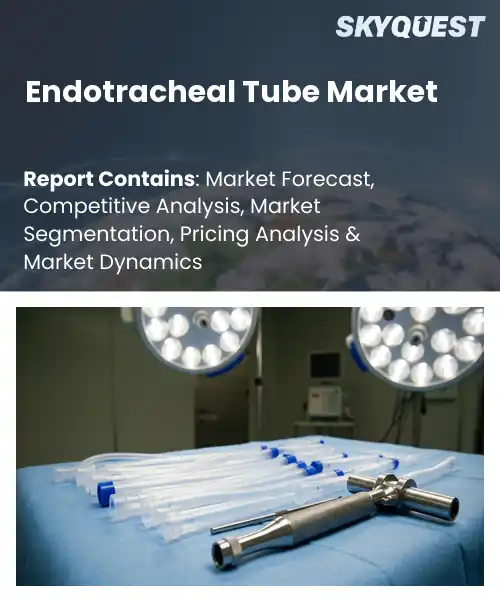
Endotracheal Tube Market
Report ID: SQMIG35A3530
Report ID: SQMIG35A3530
[email protected]
USA +1 351-333-4748
Report ID:
SQMIG35A3530 |
Region:
Global |
Published Date: May, 2026
Pages:
157
|Tables:
177
|Figures:
79


Global Endotracheal Tube Market size was valued at USD 2.6 Billion in 2024 and is poised to grow from USD 2.76 Billion in 2025 to USD 4.51 Billion by 2033, growing at a CAGR of 6.3% during the forecast period (2026-2033).
An increase in older patients, more surgeries being performed and a higher rate of respiratory disease are driving the growth of the endotracheal tube industry from the need for improved airway management in acute and perioperative care. Endotracheal tubes play an important role in ensuring the availability of the airway during anesthesia, in intensive care units and when performing emergency procedures; therefore, the impact endotracheal tubes have on reducing morbidity and mortality with better intubation techniques is critical to perform more complex surgical interventions. The endotracheal tube industry has evolved greatly over the years with an original endotracheal tube made of rubber to current versions made from innovative new materials and processes which incorporate cuffed (inflated to hold the tube in place), reinforced (to prevent straining) and subglottic suctioning designs.
The companies that manufacture these products are some of the largest medical device manufacturers in the world and are subject to international regulatory requirements and the procurement standards within the hospitals they sell to; both of these have led to increased world-wide acceptance and purchase of endotracheal tubes. A major driver of endotracheal tube market growth is the increasing awareness of infection control as hospitals place an emphasis on preventing ventilator associated pneumonia (VAP). Many hospitals have begun ordering endotracheal tubes that provide single use and/or have improved cuffs to prevent VAP; the result of these efforts results in lowering complication rates and shorter lengths of stay in ICUs, thus lowering costs through justifying higher prices per unit on these types of tubes.
How is AI Improving Quality Control In The Endotracheal Tube Market?
The AI industry is utilizing machine vision and data analytics to enhance quality assurance in the endotracheal tube field by integrating them into both manufacturing and clinical workflows. Specifically, use has been made of automated vision inspection systems for surface imperfections and errors in the manufacturing process; sensors and process analytics are utilized to identify an out-of-specification condition; and imaging algorithms are employed to help confirm proper tube placement after intubation. There seems to be an increasing trend in this area toward using AI for more accurate decisions because it will reduce human variability and allow for greater speed when making decisions, while also improving traceability and regulatory documentation.
Some examples of current AI technologies utilized include camera inspection systems for quality assurance on production lines, and AI application models that can analyze CXR images to determine if a tube is in the proper position in the trachea. With the introduction of a new AI CXR device from Carebot in February 2026, that detects endotracheal tubes on CXR images, the clinical efficiency of correctly positioning a tube will improve as well as increase confidence in the ability of these technologies which will lead to further acceptance of these technologies throughout the marketplace.
Market snapshot - (2026-2033)
Global Market Size
USD 2.6 Billion
Largest Segment
Cuffed Endotracheal Tubes
Fastest Growth
Reinforced Endotracheal Tubes
Growth Rate
6.3% CAGR
To get more insights on this market click here to Request a Free Sample Report
Global endotracheal tube market is segmented by product type, material, application, route type, end user, patient type and region. Based on product type, the market is segmented into Cuffed Endotracheal Tubes, Uncuffed Endotracheal Tubes, Reinforced Endotracheal Tubes, Preformed Endotracheal Tubes, Double Lumen Endotracheal Tubes and Others. Based on material, the market is segmented into Polyvinyl Chloride (PVC), Silicone, Polyurethane and Others. Based on application, the market is segmented into Emergency Treatment, Surgical Procedures, Intensive Care, Neonatal Care and Others. Based on route type, the market is segmented into Oral Endotracheal Tubes and Nasal Endotracheal Tubes. Based on end user, the market is segmented into Hospitals, Ambulatory Surgical Centers, Emergency Care Centers and Specialty Clinics. Based on patient type, the market is segmented into Adult, Pediatric and Neonatal. Based on region, the market is segmented into North America, Europe, Asia Pacific, Latin America and Middle East & Africa.
As per endotracheal tube market analysis, Cuffed Endotracheal tubes (ETT) comprise the largest segment of the ETT market due to their ability to provide an effective controlled airway seal for successful positive pressure ventilation while minimizing the risk of aspiration. In addition to being central tools for adult ICU management and for many general surgical procedures, their predictable ability to create a seal provides for reliable management of ventilation, compatibility with suction and monitoring accessories, and their usage as outlined in standardized clinical training and procurement processes, supporting their widespread use across different care settings.
As per endotracheal tube market outlook, Reinforced Endotracheal Tubes (RETT) are experiencing the greatest growth rate within the overall ETT market due to their kink resistance and flexibility in meeting growing demands of both complex surgical positioning and challenging airways. Materials and designs for RETT are advancing; the increased use of RETT in specialized anesthesia procedures is driving innovative applications, increased supplier investment, and accelerating future device diversity and clinical adoption.
Polyurethane, which provides a thinner sidewall construction than other materials and elastic characteristics, dominates in the marketplace because it provides for larger internal lumens relative to smaller external profiles allowing for improved airflow, patient comfort and reduced tissue abrasion. Additionally, since polyurethane has superior biocompatible characteristics and microperforation resistance, it increases the reliability of devices using polyurethane, which has resulted in increased utilization by manufacturers of polyurethane in advanced tube designs and increased use by clinicians who place a premium on sealing performance and reduced leakage.
As per endotracheal tube market forecast, Silicone is being recognized as one of the fastest growing categories of materials used because of its soft, thermally stable, and gentle interactions with tissues (i.e., prolonged intubation) as well as neonatal applications. Innovations in surface treatments and sterilization compatibility, as well as demand from clinicians for less traumatic airway interfaces, are being driven by advancements in these areas resulting in new innovative products as well as opportunities that create new categories of products and associated market opportunities.
To get detailed segments analysis, Request a Free Sample Report
As per endotracheal tube market regional analysis, due to its highly developed clinical system, large hospital networks and strong commitment to surgical/critical care, North America is clearly the leader in securing airway management services. Research and development are concentrated in this region and the presence of the large manufacturers is bolstered by a regulatory environment that supports innovation while maintaining safety. The combination of established distribution channels, professional training programs, and the familiarity of clinicians with new devices leads to fast adoption rates for improved endotracheal solutions. The hospital procurement practices and payer structures of this area of the world favour using technologies that have an evidence base, promoting validation by clinicians and encouraging their adoption. Strong partnerships between industry and academia and strong after-care/services support create confidence among clinicians and lead to continuing iterative design improvements, thereby reinforcing North America's leadership in device innovation/use in acute patient care settings.
Demand for innovative tube designs and adjuncts in the United States is driven by established connection between manufacturers and academic hospitals, as well as the focus by clinicians on airways that improve patient safety. The use of an endotracheal tube (ETT) is dependent on how well they are available and how well they are evaluated by clinicians; strong connections ensure good access to both the product itself and its efficacy through further evaluation. Well established procurement processes and infrastructure in place in the U.S. provide additional support for product availability and improvement. In addition to existing connections between suppliers and clinicians, there has been a focus on using ETT's at various levels, that provide clinicians with better options for improving the safety of their patients.
In Canada, significant attention is placed on obtaining equitable access to ETT's in urban centres that focus primarily on improving patient safety and clinician training in using ETT's. To achieve these goals, hospital systems and procurement processes have a focus on validated endotracheal devices to support the adoption of improved devices that provide increased efficiency in performing procedures. In addition, collaboration between manufacturers and regional health authorities enhances ETT distribution as well as providing good support after product sales. Another area of impact on ETT utilization in Canada has been related to the growth of anesthesiology and critical care educational programs, which has resulted in the increased use of advanced ETT's.
As per endotracheal tube market regional outlook, integrated healthcare systems that place an emphasis on procedural efficiency, patient safety, and clinical protocols that are standardized throughout health systems are driving much of Europe’s rapid growth. The existence of clinical networks that are strong aids in the implementation of best practices and innovation in design via regional manufacturers and an exciting and growing medtech ecosystem aid in localizing the supply chain for products. Harmonization of regulations throughout Europe allows for approval of products on a cross-border basis, which increases access to devices that have been validated; additionally, consortia that support collaborative procurement of products developed by manufacturers tend to seek out products with strong clinical benefit/delivery evidence. Factors such as increased training for clinicians, advanced airway teams and national initiatives aimed at reducing airway complications help support the growth of product usage in the marketplace. Collaborative projects between industry and academia, which are focused on developing clinical evidence and enhancing the use of devices to meet the needs of various patient populations, also assist in ensuring that more advanced (and the most effective) devices will be successfully adopted by both specialized and general hospitals. Additional factors that will contribute to the overall success of the marketplace are positive reimbursement structures and hospitals making investments in critical care infrastructure as a means to increase penetration in a variety of healthcare environments.
Germany's Endotracheal Tube Market is strengthened by its robust medtech manufacturing base, university hospital networks, and clinical trials to support its evaluation of devices. The hospitals are focused on developing standardised procedures and protocols to help with patient safety, which influences their adoption of new advanced technologies for the provision of airway access. Manufacturers also work closely with clinical centres to assist with ongoing development and validation of products. Hospitals are using centralised purchasing practices and have access to established post-market support networks to ensure devices are available on an ongoing basis and that clinicians are confident in their use across all acute-care settings.
The dynamic adoption of innovative airway devices throughout all UK healthcare systems is indicative of the country’s Endotracheal Tube Market. Extensive clinical guidelines, training opportunities, and professional societies enhance the uptake of validated devices into practice. Innovative procurement methods prioritise devices with sustainability through deliverable benefits of safety and effectiveness, while collaboration among industry, academic medical centres, and regulatory agencies supports an organisation’s ability to evaluate and integrate these devices into clinical practice. The enhanced confidence and long-term use of innovative airway devices in all care delivery settings has resulted from both post-market surveillance and clinician networks.
Endotracheal Tube Market in France is emerging due to modernization of hospital infrastructure, emphasis on patient safety, and growing clinical research. A focus on device compatibility with regional ventilation practices and adherence to national standards drives interest in validated tube designs. Partnerships between hospitals and suppliers enable implementations, and clinician training programs support diffusion of best practices. Strengthened distribution networks and aftersales support underpin increasing acceptance across varied care settings.
Asia Pacific is strengthening its position through a combination of expanding manufacturing capacity, growing clinical expertise, and targeted investments in healthcare infrastructure. Local medtech firms increasingly focus on quality enhancement and product differentiation to meet regional clinical preferences, while international companies deepen partnerships to localize production and distribution. Regulatory refinement and harmonization in several markets are facilitating broader market access for validated devices. Emphasis on training programs, multidisciplinary airway management, and adoption of standardized protocols is improving clinician comfort with advanced endotracheal solutions. Additionally, customization for diverse patient populations and cost-efficient product strategies broaden appeal across both tertiary centers and expanding secondary care facilities, enabling the region to play a more influential role in global device development and adoption pathways.
Endotracheal Tube Market in Japan is driven by high clinical standards, strong hospital infrastructure, and local manufacturing competence that emphasize precision and quality. Clinician preference for ergonomically refined devices and rigorous clinical evaluation fosters demand for advanced airway solutions. Collaboration between domestic manufacturers and research hospitals supports iterative product improvements and validation. Well-developed distribution networks and aftersales service ensure device availability and clinician confidence across surgical and critical care environments.
Endotracheal Tube Market in South Korea reflects a strong orientation toward medical innovation, hospital systems, and domestic production capacity. Clinical adoption is supported by professional training, national quality initiatives, and partnerships between technology firms and tertiary care centers that validate device performance. Procurement practices and logistics networks facilitate access to advanced airway devices. Focus on cost-effective design and local validation helps extend use beyond large hospitals into regional care settings.
To know more about the market opportunities by region and country, click here to
Buy The Complete Report
Increasing Incidence Of Respiratory Illnesses
As the prevalence of respiratory diseases and acute airway emergencies continues to rise, there is an increasing demand for more effective airway management solutions through the use of endotracheal tubes (ETT) in both hospital and emergency medical settings. Clinicians utilize ETTs to ensure adequate ventilation and prevent any obstruction of the airway during surgery and critical care, which allows for a greater use of them across all specialty types and settings. Additionally, as more health care providers begin focusing on the safety of patients and creating standardized airway protocols, there is a growing need for reliable and diverse options for procuring ETTs. As a result of this need, manufacturers have begun to ramp up production and to develop innovative solutions that meet the clinical requirements of many different types of facilities.
Advancements In Tube Materials And Design
Regulatory Approval Complexity And Variability
Manufacturers are facing substantial obstacles in getting their new designs and/or materials for endotrachael tubes approved because they have to comply with various different regulatory requirements in each country that they deal with. There is much difference between countries with regard to testing standards as well as documentation requirements and approval timing; therefore, manufacturers have to devote a lot of resources to meet those requirements and develop products that will comply with rules for different jurisdictions. These differing regulatory requirements may discourage smaller innovative companies, slow the commercialization of advanced technology, and limit the speed at which improved devices are made generally available; thus, the result may be that there is less diversity in the market and a decrease in overall market growth.
High Costs Of Advanced Tube Technologies
Request Free Customization of this report to help us to meet your business objectives.
Competitive dynamics in the global endotracheal tube market are shaped by consolidation, targeted distribution partnerships, and rapid product innovation; acquisitions such as ICU Medical’s purchase of Smiths Medical and Teleflex’s bolt-on deals have increased supplier scale and portfolio breadth. Established vendors pursue exclusive distribution agreements and AI-enabled imaging collaborations, exemplified by Teleflex’s Insighters arrangement and GE Healthcare’s AI for tube placement, to defend share and reduce clinical variability.
SkyQuest’s ABIRAW (Advanced Business Intelligence, Research & Analysis Wing) is our Business Information Services team that Collects, Collates, Correlates, and Analyses the Data collected by means of Primary Exploratory Research backed by robust Secondary Desk research.
As per SkyQuest analysis, a key driver is rising demand for advanced airway management in acute and perioperative care and a second driver is growing infection control awareness that favors single use and advanced cuff technologies. A restraint is regulatory approval complexity and variability across regions which can slow product launches and deter smaller innovators. North America is the dominating region thanks to advanced clinical infrastructure and strong manufacturer presence. The cuffed endotracheal tubes segment is the dominating segment due to reliable airway sealing and widespread use in adult, surgical and intensive care settings. Continued growth will depend on aligning innovation with compliance and cost considerations.
| Report Metric | Details |
|---|---|
| Market size value in 2024 | USD 2.6 Billion |
| Market size value in 2033 | USD 4.51 Billion |
| Growth Rate | 6.3% |
| Base year | 2024 |
| Forecast period | (2026-2033) |
| Forecast Unit (Value) | USD Billion |
| Segments covered |
|
| Regions covered | North America (US, Canada), Europe (Germany, France, United Kingdom, Italy, Spain, Rest of Europe), Asia Pacific (China, India, Japan, Rest of Asia-Pacific), Latin America (Brazil, Rest of Latin America), Middle East & Africa (South Africa, GCC Countries, Rest of MEA) |
| Companies covered |
|
| Customization scope | Free report customization with purchase. Customization includes:-
|
To get a free trial access to our platform which is a one stop solution for all your data requirements for quicker decision making. This platform allows you to compare markets, competitors who are prominent in the market, and mega trends that are influencing the dynamics in the market. Also, get access to detailed SkyQuest exclusive matrix.
Table Of Content
Executive Summary
Market overview
Parent Market Analysis
Market overview
Market size
KEY MARKET INSIGHTS
COVID IMPACT
MARKET DYNAMICS & OUTLOOK
Market Size by Region
KEY COMPANY PROFILES
Methodology
For the Endotracheal Tube Market, our research methodology involved a mixture of primary and secondary data sources. Key steps involved in the research process are listed below:
1. Information Procurement: This stage involved the procurement of Market data or related information via primary and secondary sources. The various secondary sources used included various company websites, annual reports, trade databases, and paid databases such as Hoover's, Bloomberg Business, Factiva, and Avention. Our team did 45 primary interactions Globally which included several stakeholders such as manufacturers, customers, key opinion leaders, etc. Overall, information procurement was one of the most extensive stages in our research process.
2. Information Analysis: This step involved triangulation of data through bottom-up and top-down approaches to estimate and validate the total size and future estimate of the Endotracheal Tube Market.
3. Report Formulation: The final step entailed the placement of data points in appropriate Market spaces in an attempt to deduce viable conclusions.
4. Validation & Publishing: Validation is the most important step in the process. Validation & re-validation via an intricately designed process helped us finalize data points to be used for final calculations. The final Market estimates and forecasts were then aligned and sent to our panel of industry experts for validation of data. Once the validation was done the report was sent to our Quality Assurance team to ensure adherence to style guides, consistency & design.
Analyst Support
Customization Options
With the given market data, our dedicated team of analysts can offer you the following customization options are available for the Endotracheal Tube Market:
Product Analysis: Product matrix, which offers a detailed comparison of the product portfolio of companies.
Regional Analysis: Further analysis of the Endotracheal Tube Market for additional countries.
Competitive Analysis: Detailed analysis and profiling of additional Market players & comparative analysis of competitive products.
Go to Market Strategy: Find the high-growth channels to invest your marketing efforts and increase your customer base.
Innovation Mapping: Identify racial solutions and innovation, connected to deep ecosystems of innovators, start-ups, academics, and strategic partners.
Category Intelligence: Customized intelligence that is relevant to their supply Markets will enable them to make smarter sourcing decisions and improve their category management.
Public Company Transcript Analysis: To improve the investment performance by generating new alpha and making better-informed decisions.
Social Media Listening: To analyze the conversations and trends happening not just around your brand, but around your industry as a whole, and use those insights to make better Marketing decisions.
REQUEST FOR SAMPLE
 REQUEST FREE CUSTOMIZATION
Global Endotracheal Tube Market size was valued at USD 2.6 Billion in 2024 and is poised to grow from USD 2.76 Billion in 2025 to USD 4.51 Billion by 2033, growing at a CAGR of 6.3% during the forecast period (2026-2033).
Competitive dynamics in the global endotracheal tube market are shaped by consolidation, targeted distribution partnerships, and rapid product innovation; acquisitions such as ICU Medical’s purchase of Smiths Medical and Teleflex’s bolt-on deals have increased supplier scale and portfolio breadth. Established vendors pursue exclusive distribution agreements and AI-enabled imaging collaborations, exemplified by Teleflex’s Insighters arrangement and GE Healthcare’s AI for tube placement, to defend share and reduce clinical variability. 'Medtronic', 'Teleflex', 'Smiths Medical', 'BD', 'Vyaire Medical', 'ConvaTec', 'Fuji Systems', 'Well Lead Medical', 'Securmed', 'Flexicare Medical', 'Venner Medical', 'Mercury Medical', 'Rusch', 'Armstrong Medical', 'PFM Medical', 'Bicakcilar', 'Romsons', 'Poly Medicure', 'Besmed Health Business', 'Intersurgical'
The rising prevalence of respiratory conditions and acute airway emergencies increases demand for secure airway management solutions, prompting greater use of endotracheal tubes in hospitals and emergency settings. Clinicians rely on these devices to maintain ventilation and protect airways during surgery and critical care, which expands utilization across specialties. As healthcare providers prioritize patient safety and standardized airway protocols, procurement of reliable and varied tube options grows, encouraging manufacturers to scale production and innovate to meet clinical needs across diverse care settings.
Shift Toward Single Use: Healthcare providers increasingly prefer disposable endotracheal tubes to reduce cross‑contamination risk and simplify sterilization logistics. Procurement policies favor products that streamline inventory and clinical workflows, while manufacturers focus on improved materials and ergonomic features to match reusable alternatives. Adoption is driven by clinical safety priorities and operational efficiency, prompting suppliers to expand single‑use portfolios and service offerings that support training and waste management. This trend encourages collaboration between hospitals and vendors to balance safety, supply reliability, and lifecycle environmental considerations.
Why does North America Dominate the Global Endotracheal Tube Market? |@12


Want to customize this report? This report can be personalized according to your needs. Our analysts and industry experts will work directly with you to understand your requirements and provide you with customized data in a short amount of time. We offer $1000 worth of FREE customization at the time of purchase.
Feedback From Our Clients


 USA (+1) 351-333-4748

