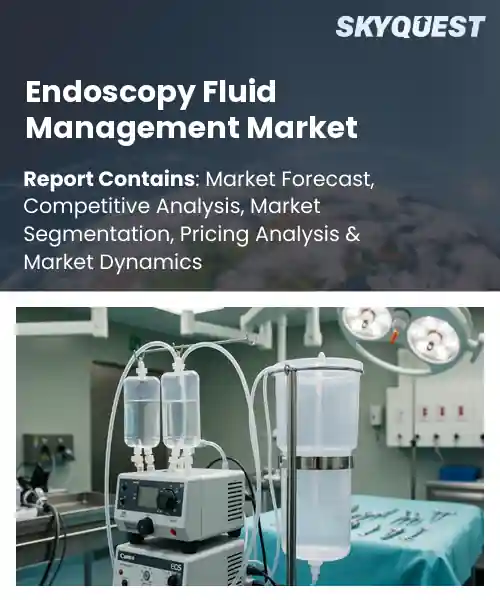
Endoscopy Fluid Management Market
Report ID: SQMIG35A3557
Report ID: SQMIG35A3557
[email protected]
USA +1 351-333-4748
Report ID:
SQMIG35A3557 |
Region:
Global |
Published Date: May, 2026
Pages:
157
|Tables:
91
|Figures:
76


Global Endoscopy Fluid Management Market size was valued at USD 1.32 Billion in 2024 and is poised to grow from USD 1.41 Billion in 2025 to USD 2.46 Billion by 2033, growing at a CAGR of 7.14% during the forecast period (2026-2033).
The primary driver of the endoscopy fluid management market growth is the shift toward minimally invasive diagnostics and surgery, which escalates demand for precise irrigation, suction and containment during procedures. Endoscopy fluid management includes devices and consumables that control lavage, suction and fluid containment to maintain visibility and safety, and it matters because effective fluid control reduces complications, shortens operative times and enables complex interventions. Over the last two decades the field advanced from manual suction and ad hoc tubing to purpose-built closed systems and automated pumps, with examples such as powered irrigation in gastrointestinal endoscopy and closed canisters in hospitals.
A key factor propelling the global endoscopy fluid management market growth is heightened infection control and efficiency demands, which create opportunities for automated, closed and single-use fluid systems. Hospitals facing stricter protocols adopt closed canisters to lower cross-contamination risk, causing reduced post-procedure infections and shorter patient stays, and ambulatory surgery centers implement compact irrigation pumps that increase case throughput and revenue. Regulatory emphasis and favorable reimbursement create incentives to invest, while manufacturers respond with integrated platforms and service contracts that simplify adoption.
How is AI improving efficiency in the endoscopy fluid management market?
AI is streamlining endoscopy fluid management by adding software intelligence to pumps sensors and control systems. Key aspects include automated inflow and outflow control consistent visualization and hands free documentation. The current state shows vendors embedding machine learning to anticipate fluid needs and stabilize cavity distension which reduces manual adjustments and clinician distraction. In practical terms this means smarter pump responses clearer optical fields and faster turnover between cases. Market context favors integrated solutions that connect fluid systems to imaging and OR workflows so teams can focus on decision making rather than routine adjustments.
Stryker March 2026, announced a SmartHospital Platform that brings ambient intelligence to the OR and links endoscopy devices including fluid management systems to broader workflows which helps automate pump behavior reduce setup time and support more efficient procedures.
Market snapshot - (2026-2033)
Global Market Size
USD 1.32 Billion
Largest Segment
Disposables and Accessories
Fastest Growth
Disposables and Accessories
Growth Rate
7.14% CAGR
To get more insights on this market click here to Request a Free Sample Report
Global endoscopy fluid management market is segmented by product, modality, end-user and region. Based on product, the market is segmented into Endoscopy Fluid Management Systems, Pumps, Disposables and Accessories and Others. Based on modality, the market is segmented into Floor Standing and Benchtop. Based on end-user, the market is segmented into Hospitals, Ambulatory Surgical Centers, Specialty Clinics and Diagnostic Centers. Based on region, the market is segmented into North America, Europe, Asia Pacific, Latin America and Middle East & Africa.
Endoscopy fluid management systems segment dominates with large endoscopy fluid management market share because these centralized platforms integrate suction, irrigation, fluid tracking, and automated controls into a cohesive workflow tool that directly impacts procedural consistency and patient safety. Their comprehensive functionality reduces manual interventions and standardizes irrigation parameters, which lowers the likelihood of human error and supports clinical protocols. Facilities favor them for durable capital investment that streamlines complex procedures and enhances staff confidence during interventions.
As per endoscopy fluid management market outlook, disposables and accessories segment is growing quickly as the usage of single use components prevent cross contamination, ease inventory and meet tougher infection control procedures. Clinician preference for sterile ready-to-use kits and recurring consumable revenue promotes manufacturer innovation, boosting acceptance across procedures and enabling ongoing potential for product extensions and packaged offers.
As per endoscopy fluid management market forecast, floor standing segment leads due to their larger form factor which allows higher capacity reservoirs, more powerful pumps and integrated waste management for extended continuous operation. The devices reduce the frequency of refilling and maintenance interruptions, provide steady irrigation performance with significant procedural loads, and link easily to existing operating room systems. They are used by high-throughput facilities to maintain reliable operations and reduce workflow interruptions during busy endoscopic schedules.
As per endoscopy fluid management market analysis, benchtop segment is the fastest expanding as compact design is suitable for space-constrained suites and outpatient settings, hence minimizing the adoption hurdles. Ambulatory centers and specialized clinics want to expand access to procedures with portable and easy-to-set-up solutions, while manufacturers may create new economic opportunities by offering modular point-of-care solutions.
To get detailed segments analysis, Request a Free Sample Report
As per endoscopy fluid management market regional outlook, North America’s dominance may be attributed to a combination of superior clinical infrastructure, focused industry leadership, and a supportive innovation ecosystem. The widespread adoption of minimally invasive treatments has increased demand for trustworthy solutions for fluid management. Large hospital systems and ambulatory surgery centers are concentrating on workflow efficiency and infection control. A strong network of manufacturers, distributors and specialist service providers provides rapid deployment and aftermarket support. Clear regulatory pathways and defined reimbursement channels decrease friction in the market and incentivize investment in increasingly automated and single use technology. Other drivers include clinical research activities and training programs that speed up adoption by clinicians and strategic collaborations between device manufacturers and healthcare providers that allow for customized solutions that meet procurement and quality targets, strengthening regional leadership.
As per endoscopy fluid management market regional forecast, United States is driven by sophisticated hospital networks, dense presence of original equipment manufacturers and active clinical research centers leading to early adoption of improved technologies. Large health systems procurement strategies favor incumbent suppliers by focusing on interoperability, vendor service models and evidence based performance. Focus on infection prevention and operational efficiency driving investment in automation and disposable practices. Industry and physicians closely partner to ensure implementation, training, and postmarket support are customized to sustain uptake across care settings.
Centralized procurement trends in a public health care setting leading to preference for cost effective, high quality solutions characterize Canada market. Regional centres of excellence and provincial health authorities are guided by standardized clinical standards and pilot projects when making purchase decisions. Suppliers tend to develop long term collaborations with focus on the durability of the devices, support with maintenance and clinical education. Balancing clinical need and stewardship of the budget drives interest in technology that shortens procedure time, increases safety, and simplifies supply chain management.
As per endoscopy fluid management industry analysis, Europe’s quick growth is attributed to a combination of healthcare modernity, regulatory harmonization, and a growing clinical emphasis on minimally invasive procedures, as per the industry analysis on endoscopic fluid management. National health systems and private hospitals are investing in equipment upgrades that improve procedural efficiency and patient safety. The CE regulatory framework provides a uniform route to market entry that facilitates cross border commercialisation. Local manufacturing hubs and a robust medtech supply chain encourage incremental innovation and adaptation to various healthcare contexts. Adoption driven by increased attention on infection prevention and single use technology, with collaborative clinical studies and sharing best practices among professional associations. There is a strong market momentum as procurement regimes in many countries increasingly reward value based solutions and lifecycle service offers.
Germany market is supported by a well-established medical technology sector and well-equipped hospitals with a focus on advanced clinical capabilities. Manufacturers and research institutions are closely in contact with hospital purchasing, resulting in early evaluation and use of innovative technology. Focus on accuracy, durability and serviceability addresses the needs of tertiary care centers and specialty clinics. Cycles of investment in public and commercial hospitals, together with strong networks for clinical training, underpin persistent uptake of solutions that enhance operational workflows and patient safety.
UK endoscopy fluid management market is affected by modernization of the national health sector and centralized procurement practices emphasizing infection control and efficiency. Technologies that optimize endoscopic procedures have scope for enhancing the throughput of elective care and standardizing clinical paths. Joint pilot initiatives between manufacturers and hospital trusts improve evidence development and wider acceptance. Cost containment and quality imperatives drive demand in integrated solutions that offer dependable performance along with strong service and training components.
France is characterized by measured but increasing adoption driven by national health authority guidance and investments in regional hospital networks. Clinical focus on safety and hygiene, coupled with structured evaluation processes, encourages gradual integration of newer fluid management technologies. Local supplier relationships and regional centers that champion best practices support implementation. Demand is shaped by the pursuit of reliable, user friendly systems that align with budgetary constraints while delivering improved procedural outcomes.
Strategic decisions in hospital infrastructure, expanded clinical capabilities and a rising base of local innovation are enhancing the region’s position in Asia Pacific. Endoscopy volume is increasing and patient expectations are rising, and regional markets are experiencing active adoption of technology that improve procedural efficiency and infection prevention. Regional manufacturers are strengthening their design and manufacturing capacities in major markets and partnering with multinational suppliers to tailor solutions to local clinical practices. Regulatory processes and reimbursement mechanisms are developing to accommodate new devices Government healthcare efforts encourage capacity building and training. Together with cross border cooperation and expanding clinical data created in local centers, specialized procurement methods are enhancing the region role in the global scene.
Japan is driven by a strong emphasis on high quality, precision engineered medical devices and close integration with hospital information systems. Conservative procurement practices favor proven performance and long term service relationships, while leading clinical centers conduct rigorous evaluations that inform broader adoption. Domestic manufacturers and research institutions collaborate to refine usability and safety features, supporting uptake in specialized hospitals and national health facilities that value durability and clinical validation.
South Korea is characterized by rapid clinical adoption and an innovative medical device industry that focuses on compact, high performance solutions. Hospital networks demonstrate agility in evaluating new technologies, and close ties between industry and clinical users facilitate iterative product enhancements. Export oriented manufacturers and collaborative ventures with global firms support technology transfer and competitive offerings. Emphasis on efficiency, infection control, and postmarket support encourages procurement of systems that deliver reliable performance across diverse care settings.
To know more about the market opportunities by region and country, click here to
Buy The Complete Report
Rising Minimally Invasive Procedures
Advancements In Fluid Management
High Device And Consumable Costs
Stringent Regulatory And Reprocessing Requirements
Request Free Customization of this report to help us to meet your business objectives.
Competitive landscape in global endoscopy fluid management industry is driven by a race to expand disposable tubing and integrated irrigation-suction platforms, prompting targeted M&A, distribution alliances, and device innovation. For example Cantel augmented its disposables portfolio via the Omnia acquisition, Motus GI advanced intra-procedural cleansing with Pure-Vu EVS, and UroViu scaled single-use platforms through group purchasing partnerships while Olympus invests in AI-enhanced endoscopy suites.
SkyQuest’s ABIRAW (Advanced Business Intelligence, Research & Analysis Wing) is our Business Information Services team that Collects, Collates, Correlates, and Analyses the Data collected by means of Primary Exploratory Research backed by robust Secondary Desk research.
As per SkyQuest analysis, the global endoscopy fluid management market trend is propelled by the growing shift toward minimally invasive diagnostics and surgery, which increases demand for precise irrigation, suction and fluid containment, and further supported by rapid advancements in fluid management technologies such as automation, sensor integration and AI-enabled workflow optimization. North America remains the dominant region due to advanced clinical infrastructure and robust adoption, with endoscopy fluid management systems as the leading segment because centralized platforms improve safety and procedural consistency. A key restraint slowing broader adoption is the high acquisition and recurring consumable costs, which challenge budget-conscious providers despite clear efficiency and infection control benefits.
| Report Metric | Details |
|---|---|
| Market size value in 2024 | USD 1.32 Billion |
| Market size value in 2033 | USD 2.46 Billion |
| Growth Rate | 7.14% |
| Base year | 2024 |
| Forecast period | (2026-2033) |
| Forecast Unit (Value) | USD Billion |
| Segments covered |
|
| Regions covered | North America (US, Canada), Europe (Germany, France, United Kingdom, Italy, Spain, Rest of Europe), Asia Pacific (China, India, Japan, Rest of Asia-Pacific), Latin America (Brazil, Rest of Latin America), Middle East & Africa (South Africa, GCC Countries, Rest of MEA) |
| Companies covered |
|
| Customization scope | Free report customization with purchase. Customization includes:-
|
To get a free trial access to our platform which is a one stop solution for all your data requirements for quicker decision making. This platform allows you to compare markets, competitors who are prominent in the market, and mega trends that are influencing the dynamics in the market. Also, get access to detailed SkyQuest exclusive matrix.
Table Of Content
Executive Summary
Market overview
Parent Market Analysis
Market overview
Market size
KEY MARKET INSIGHTS
COVID IMPACT
MARKET DYNAMICS & OUTLOOK
Market Size by Region
KEY COMPANY PROFILES
Methodology
For the Endoscopy Fluid Management Market, our research methodology involved a mixture of primary and secondary data sources. Key steps involved in the research process are listed below:
1. Information Procurement: This stage involved the procurement of Market data or related information via primary and secondary sources. The various secondary sources used included various company websites, annual reports, trade databases, and paid databases such as Hoover's, Bloomberg Business, Factiva, and Avention. Our team did 45 primary interactions Globally which included several stakeholders such as manufacturers, customers, key opinion leaders, etc. Overall, information procurement was one of the most extensive stages in our research process.
2. Information Analysis: This step involved triangulation of data through bottom-up and top-down approaches to estimate and validate the total size and future estimate of the Endoscopy Fluid Management Market.
3. Report Formulation: The final step entailed the placement of data points in appropriate Market spaces in an attempt to deduce viable conclusions.
4. Validation & Publishing: Validation is the most important step in the process. Validation & re-validation via an intricately designed process helped us finalize data points to be used for final calculations. The final Market estimates and forecasts were then aligned and sent to our panel of industry experts for validation of data. Once the validation was done the report was sent to our Quality Assurance team to ensure adherence to style guides, consistency & design.
Analyst Support
Customization Options
With the given market data, our dedicated team of analysts can offer you the following customization options are available for the Endoscopy Fluid Management Market:
Product Analysis: Product matrix, which offers a detailed comparison of the product portfolio of companies.
Regional Analysis: Further analysis of the Endoscopy Fluid Management Market for additional countries.
Competitive Analysis: Detailed analysis and profiling of additional Market players & comparative analysis of competitive products.
Go to Market Strategy: Find the high-growth channels to invest your marketing efforts and increase your customer base.
Innovation Mapping: Identify racial solutions and innovation, connected to deep ecosystems of innovators, start-ups, academics, and strategic partners.
Category Intelligence: Customized intelligence that is relevant to their supply Markets will enable them to make smarter sourcing decisions and improve their category management.
Public Company Transcript Analysis: To improve the investment performance by generating new alpha and making better-informed decisions.
Social Media Listening: To analyze the conversations and trends happening not just around your brand, but around your industry as a whole, and use those insights to make better Marketing decisions.
REQUEST FOR SAMPLE
 REQUEST FREE CUSTOMIZATION
Global Endoscopy Fluid Management Market size was valued at USD 1.32 Billion in 2024 and is poised to grow from USD 1.41 Billion in 2025 to USD 2.46 Billion by 2033, growing at a CAGR of 7.14% during the forecast period (2026-2033).
Competitive landscape in global endoscopy fluid management is driven by a race to expand disposable tubing and integrated irrigation-suction platforms, prompting targeted M&A, distribution alliances, and device innovation. For example Cantel augmented its disposables portfolio via the Omnia acquisition, Motus GI advanced intra-procedural cleansing with Pure-Vu EVS, and UroViu scaled single-use platforms through group purchasing partnerships while Olympus invests in AI-enhanced endoscopy suites. 'Stryker', 'Medtronic', 'Olympus Corporation', 'Smith & Nephew', 'Karl Storz SE', 'Johnson & Johnson', 'CONMED Corporation', 'B. Braun SE', 'Hologic', 'Arthrex', 'Richard Wolf GmbH', 'Fujifilm Holdings', 'HOYA Corporation', 'Boston Scientific Corporation', 'Thermax', 'Comeg Medical Technologies', 'VBM Medizintechnik', 'Cantel Medical', 'Zimmer Biomet', 'Integrated Endoscopy'
The growing preference for minimally invasive procedures has elevated demand for reliable fluid management solutions because these procedures require precise irrigation, aspiration, and continuous visibility within confined anatomical spaces. Improved procedural outcomes and shorter recovery times encourage healthcare providers to equip endoscopy suites with dedicated fluid management systems, fostering procurement of integrated devices and compatible consumables. As clinicians prioritize procedural efficiency and safety, hospitals and ambulatory centers invest in technologies that streamline fluid handling, contributing to broader adoption and market expansion.
Ai Enabled Workflow Integration: Endoscopy fluid management systems are increasingly integrated with imaging and procedural software, enabling smoother workflows and real time decision support. Interoperability with hospital information systems and surgical platforms streamlines data capture, enhances procedure documentation, and supports clinician preference settings for fluid handling. This integration reduces workflow fragmentation, improves team coordination, and fosters adoption of standardized protocols. Vendors focusing on seamless software ecosystems can position fluid management solutions as indispensable components of modern endoscopy suites, driving clinical preference based on usability and connectivity.
Why does North America Dominate the Global Endoscopy Fluid Management Market? |@12


Want to customize this report? This report can be personalized according to your needs. Our analysts and industry experts will work directly with you to understand your requirements and provide you with customized data in a short amount of time. We offer $1000 worth of FREE customization at the time of purchase.
Feedback From Our Clients


 USA (+1) 351-333-4748

