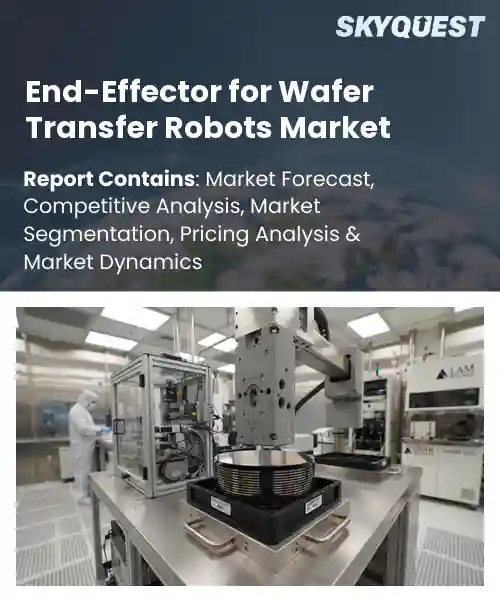
End-Effector for Wafer Transfer Robots Market
Report ID: SQMIG45N2284
Report ID: SQMIG45N2284
[email protected]
USA +1 351-333-4748
Report ID:
SQMIG45N2284 |
Region:
Global |
Published Date: September, 2026
Pages:
157
|Tables:
149
|Figures:
78


Global End-Effector For Wafer Transfer Robots Market size was valued at USD 1.52 Billion in 2024 and is poised to grow from USD 1.64 Billion in 2025 to USD 3.09 Billion by 2033, growing at a CAGR of 8.2% during the forecast period (2026-2033).
The global end‑effector market for wafer‑transfer robots revolves around specialized gripping devices that securely handle silicon wafers during semiconductor fabrication. Its importance stems from the need to minimize particle contamination and mechanical stress, both of which directly affect yield and device reliability. Historically, the market emerged in the early 2000s as fabs transitioned from manual handling to automated material‑handling systems, driven by the introduction of 300‑mm wafer lines. Companies such as Tokyo Electron and ASML subsequently integrated vacuum‑based suction and soft‑touch grippers, demonstrating measurable reductions in breakage rates. This evolution has positioned end‑effectors as a critical bottleneck‑removing component in high‑volume manufacturing. The dominant growth factor now is the adoption of advanced packaging techniques such as fan‑out wafer‑level packaging, which demand higher precision and faster cycle times from transfer robots. As manufacturers pursue thinner form factors and heterogeneous integration, end‑effectors must accommodate diverse wafer sizes and fragile substrates, prompting investment in adaptive suction pads and AI‑driven force‑control algorithms. For example, TSMC’s recent 5‑nm fab upgrade incorporated smart grippers that adjust pressure in real time, reducing defect density by 12 %. This capability unlocks new revenue streams for suppliers, while enabling fabs to meet escalating demand for high‑performance chips in automotive and AI applications.
How is AI-driven automation influencing the end‑effector market for wafer transfer robots?
AI driven automation is reshaping the end effector market for wafer transfer robots by embedding real time vision, predictive motion control and adaptive gripping. These capabilities allow robots to sense wafer orientation, adjust pressure instantly and avoid contamination, which shortens cycle time and boosts yield. Fab operators now favor modular end effectors that can be reprogrammed for different wafer sizes, supporting flexible production lines. Suppliers are integrating machine learning models that learn from each transfer, continuously refining handling strategies. The result is a shift from fixed mechanical tools to smart, software centric solutions that can be updated remotely, driving faster adoption across semiconductor fabs.In March 2024, ASML announced an AI enhanced wafer transfer robot end effector, showing that intelligent gripping reduces handling errors, shortens changeover time and accelerates fab throughput, reinforcing market growth. The solution integrates real time vision and self learning algorithms that adapt to new wafer formats without hardware changes.
Market snapshot - (2026-2033)
Global Market Size
USD 1.52 Billion
Largest Segment
Vacuum End-Effectors
Fastest Growth
Bernoulli End-Effectors
Growth Rate
8.2% CAGR
To get more insights on this market click here to Request a Free Sample Report
Global end-effector for wafer transfer robots market is segmented by end-effector type, wafer size, material, application, end user and region. Based on end-effector type, the market is segmented into Vacuum End-Effectors, Bernoulli End-Effectors, Edge-Grip End-Effectors and Mechanical Grip End-Effectors. Based on wafer size, the market is segmented into 150 mm, 200 mm, 300 mm and Other Wafer Sizes. Based on material, the market is segmented into Ceramic, Silicon Carbide, Quartz, Carbon Fiber and Other Materials. Based on application, the market is segmented into Wafer Handling, Wafer Inspection, Wafer Processing and Other Semiconductor Handling Applications. Based on end user, the market is segmented into Semiconductor Manufacturers, Semiconductor Equipment Manufacturers and Research & Development Facilities. Based on region, the market is segmented into North America, Europe, Asia Pacific, Latin America and Middle East & Africa.
Vacuum end effectors segment leads because they provide a non contact gripping method that aligns with the ultra clean requirements of semiconductor fabs. Their ability to generate consistent holding force across diverse wafer surfaces reduces particle generation and damage risk. This reliability encourages adoption across high volume production lines, while their compatibility with existing robotic arms simplifies integration, reinforcing their market leadership. Moreover, the ease of cleaning and minimal maintenance requirements further strengthen its appeal for continuous operation.
Meanwhile, Bernoulli end effectors segment emerges as the most rapidly expanding area in this market. Their air based suction mechanism eliminates direct contact, which is increasingly valued for handling fragile next generation wafers. Ongoing innovations in flow control algorithms and lightweight designs are boosting adoption, opening new opportunities in high precision transfer cells and supporting the shift toward more delicate substrate formats.
300 mm wafer size segment stands out because the industry’s shift toward larger substrates demands end effectors that can accommodate increased diameter while preserving flatness and minimal stress. Designers must integrate larger vacuum zones and reinforced fixturing to ensure uniform pressure distribution. This drives the selection of robust materials and precise actuation, cementing the 300 mm category as a primary focus for equipment manufacturers.
On the other hand, 150 mm wafer size segment is witnessing the strongest growth momentum in the market. Niche applications such as specialty sensors and MEMS continue to rely on smaller substrates, prompting manufacturers to develop adaptable end effectors with interchangeable grippers. This niche demand fuels design flexibility and creates a pipeline of new robotic solutions targeting emerging product lines.
To get detailed segments analysis, Request a Free Sample Report
Asia Pacific leads through a confluence of cutting‑edge semiconductor manufacturing capabilities, deep engineering expertise, and integrated supply chains that accelerate technology adoption. The region’s leading fabs prioritize automation to enhance yield and reduce contamination, creating strong demand for precise wafer‑handling solutions. Robust collaborations between equipment manufacturers, academic research institutes, and component suppliers foster continuous innovation in end‑effector design, materials, and control algorithms. Government initiatives that emphasize advanced manufacturing and strategic investments in robotics further reinforce market momentum. The cultural emphasis on meticulous quality and rapid iteration also enables faster validation cycles, positioning the region as the primary source of both demand and technological advancement for wafer transfer robotics.
End-Effector for Wafer Transfer Robots Market in Japan benefits from a longstanding tradition of precision engineering and a dense ecosystem of semiconductor fabs that prioritize ultra‑clean handling. Local manufacturers leverage advanced materials and miniaturization expertise to produce highly reliable grippers tailored to the stringent requirements of next‑generation chips. Collaborative research programs between universities and industry accelerate the introduction of novel actuation mechanisms, while domestic supply chains ensure rapid availability of critical components, reinforcing Japan’s role as a hub for high‑performance wafer transfer solutions.
End-Effector for Wafer Transfer Robots Market in South Korea is driven by aggressive expansion of memory and logic fabs that demand high‑throughput, low‑defect handling. The country's strong focus on automation and smart factory concepts encourages investment in sophisticated robotic end‑effectors equipped with AI‑based vision and force feedback. Close ties between major equipment vendors and local chipmakers facilitate co‑development of custom solutions, while government support for advanced manufacturing underpins sustained growth in precise wafer manipulation technologies.
North America experiences rapid expansion as manufacturers seek to maintain competitive edge through higher productivity and tighter process control. The region’s emphasis on digital integration and data‑driven manufacturing fuels demand for intelligent end‑effectors that can adapt in real time to wafer variations. Strong intellectual property frameworks encourage investment in proprietary gripping technologies, while a vibrant ecosystem of robotics specialists and semiconductor OEMs accelerates solution deployment. Collaborative initiatives between research labs and industry accelerate the translation of emerging materials and sensor technologies into practical wafer handling tools, reinforcing the market’s upward trajectory across the continent.
End-Effector for Wafer Transfer Robots Market in the United States is shaped by a concentration of leading semiconductor fabs that prioritize high‑volume production and advanced node development. Domestic equipment suppliers focus on integrating machine learning and precision sensing into gripper designs, enabling adaptive handling that minimizes particle contamination. Strong partnerships between academic research centers and industry accelerate the commercialization of novel actuation concepts, while a robust venture capital environment supports startups delivering next‑generation wafer‑handling solutions, reinforcing the United States as a central hub for innovation in this space.
End-Effector for Wafer Transfer Robots Market in Canada benefits from a growing cluster of research‑intensive facilities and a supportive policy landscape that encourages automation adoption. Canadian manufacturers emphasize modular, easily reconfigurable end‑effectors to serve both mature and emerging semiconductor processes. Collaboration between government‑funded institutes and private firms drives the integration of advanced materials and low‑temperature operation capabilities, addressing the specific needs of niche production lines and reinforcing Canada’s contribution to the broader North American market.
Europe strengthens its position by leveraging a tradition of high‑precision engineering, stringent quality standards, and collaborative research frameworks that span multiple countries. The region emphasizes sustainability and energy efficiency, prompting development of lightweight, low‑power end‑effectors that meet rigorous environmental criteria. Cross‑border initiatives and consortia facilitate the sharing of best practices and joint development of standards, enhancing interoperability and market confidence. Additionally, strong public‑private partnerships fund advanced prototyping and testing facilities, ensuring that European firms remain at the forefront of innovative wafer‑handling technologies.
End-Effector for Wafer Transfer Robots Market in Germany is anchored by a deep heritage of mechanical precision and a dense network of specialist suppliers. German manufacturers focus on robust, high‑accuracy grippers that incorporate advanced control algorithms to meet the exacting tolerances of leading fabs. Close collaboration with research institutions drives continuous refinement of material science and sensor integration, while the country’s emphasis on reliability and long‑term service support solidifies its reputation in the European market.
End-Effector for Wafer Transfer Robots Market in the United Kingdom benefits from a vibrant ecosystem of technology startups and established engineering firms that prioritize innovation in robotic handling. The sector leverages strong academic research in automation and artificial intelligence to develop adaptable end‑effectors capable of handling diverse wafer sizes. Collaborative projects funded by government and industry accelerate the translation of breakthrough concepts into commercial products, positioning the United Kingdom as a dynamic contributor to European wafer transfer solutions.
End-Effector for Wafer Transfer Robots Market in France is driven by a focus on precision optics and advanced materials, reflecting the country’s expertise in high‑tech manufacturing. French firms emphasize modular designs that can be quickly customized for varying process requirements, supported by a network of research laboratories specializing in micro‑fabrication. Partnerships with European semiconductor consortia promote the adoption of common standards and accelerate the diffusion of innovative end‑effector technologies across the continent.
To know more about the market opportunities by region and country, click here to
Buy The Complete Report
Increasing Adoption Of AI Integration
Growing Demand For Higher Throughput
High Capital Investment Required
Stringent Quality Standards
Request Free Customization of this report to help us to meet your business objectives.
Top Player’s Company Profile
Recent Developments
SkyQuest’s ABIRAW (Advanced Business Intelligence, Research & Analysis Wing) is our Business Information Services team that Collects, Collates, Correlates, and Analyses the Data collected by means of Primary Exploratory Research backed by robust Secondary Desk research. As per SkyQuest analysis, the market is being propelled primarily by the increasing adoption of AI integration which enables real‑time adaptive control and reduces wafer defects, while a second important driver is the growing demand for higher throughput that pushes fabs to seek faster yet gentle end‑effectors. The leading segment is vacuum end‑effectors, favored for their clean non‑contact gripping that aligns with stringent fab cleanliness standards. However, the high capital investment required for sophisticated end‑effector systems remains a notable restraint, slowing some adoption. Asia Pacific dominates the market thanks to its advanced semiconductor fabs, strong engineering ecosystem and aggressive automation investments, reinforcing its leadership position globally.
| Report Metric | Details |
|---|---|
| Market size value in 2024 | USD 1.52 Billion |
| Market size value in 2033 | USD 3.09 Billion |
| Growth Rate | 8.2% |
| Base year | 2024 |
| Forecast period | (2026-2033) |
| Forecast Unit (Value) | USD Billion |
| Segments covered |
|
| Regions covered | North America (US, Canada), Europe (Germany, France, United Kingdom, Italy, Spain, Rest of Europe), Asia Pacific (China, India, Japan, Rest of Asia-Pacific), Latin America (Brazil, Rest of Latin America), Middle East & Africa (South Africa, GCC Countries, Rest of MEA) |
| Companies covered |
|
| Customization scope | Free report customization with purchase. Customization includes:-
|
To get a free trial access to our platform which is a one stop solution for all your data requirements for quicker decision making. This platform allows you to compare markets, competitors who are prominent in the market, and mega trends that are influencing the dynamics in the market. Also, get access to detailed SkyQuest exclusive matrix.
Table Of Content
Executive Summary
Market overview
Parent Market Analysis
Market overview
Market size
KEY MARKET INSIGHTS
COVID IMPACT
MARKET DYNAMICS & OUTLOOK
Market Size by Region
KEY COMPANY PROFILES
Methodology
For the End-Effector for Wafer Transfer Robots Market, our research methodology involved a mixture of primary and secondary data sources. Key steps involved in the research process are listed below:
1. Information Procurement: This stage involved the procurement of Market data or related information via primary and secondary sources. The various secondary sources used included various company websites, annual reports, trade databases, and paid databases such as Hoover's, Bloomberg Business, Factiva, and Avention. Our team did 45 primary interactions Globally which included several stakeholders such as manufacturers, customers, key opinion leaders, etc. Overall, information procurement was one of the most extensive stages in our research process.
2. Information Analysis: This step involved triangulation of data through bottom-up and top-down approaches to estimate and validate the total size and future estimate of the End-Effector for Wafer Transfer Robots Market.
3. Report Formulation: The final step entailed the placement of data points in appropriate Market spaces in an attempt to deduce viable conclusions.
4. Validation & Publishing: Validation is the most important step in the process. Validation & re-validation via an intricately designed process helped us finalize data points to be used for final calculations. The final Market estimates and forecasts were then aligned and sent to our panel of industry experts for validation of data. Once the validation was done the report was sent to our Quality Assurance team to ensure adherence to style guides, consistency & design.
Analyst Support
Customization Options
With the given market data, our dedicated team of analysts can offer you the following customization options are available for the End-Effector for Wafer Transfer Robots Market:
Product Analysis: Product matrix, which offers a detailed comparison of the product portfolio of companies.
Regional Analysis: Further analysis of the End-Effector for Wafer Transfer Robots Market for additional countries.
Competitive Analysis: Detailed analysis and profiling of additional Market players & comparative analysis of competitive products.
Go to Market Strategy: Find the high-growth channels to invest your marketing efforts and increase your customer base.
Innovation Mapping: Identify racial solutions and innovation, connected to deep ecosystems of innovators, start-ups, academics, and strategic partners.
Category Intelligence: Customized intelligence that is relevant to their supply Markets will enable them to make smarter sourcing decisions and improve their category management.
Public Company Transcript Analysis: To improve the investment performance by generating new alpha and making better-informed decisions.
Social Media Listening: To analyze the conversations and trends happening not just around your brand, but around your industry as a whole, and use those insights to make better Marketing decisions.
REQUEST FOR SAMPLE
 REQUEST FREE CUSTOMIZATION


Want to customize this report? This report can be personalized according to your needs. Our analysts and industry experts will work directly with you to understand your requirements and provide you with customized data in a short amount of time. We offer $1000 worth of FREE customization at the time of purchase.
Feedback From Our Clients


 USA (+1) 351-333-4748

