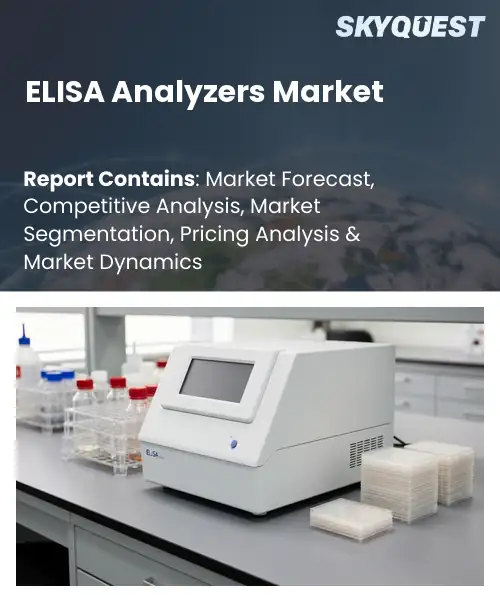
ELISA Analyzers Market
Report ID: SQMIG35A3494
Report ID: SQMIG35A3494
[email protected]
USA +1 351-333-4748
Report ID:
SQMIG35A3494 |
Region:
Global |
Published Date: May, 2026
Pages:
157
|Tables:
180
|Figures:
79


Global Elisa Analyzers Market size was valued at USD 735.5 Million in 2024 and is poised to grow from USD 766.39 Million in 2025 to USD 1065.1 Million by 2033, growing at a CAGR of 4.2% during the forecast period (2026-2033).
ELISA analyzers are automated and semi-automated platforms used to measure biomarkers with enzyme-linked immunosorbent assays. The ELISA Analyzers market is driven by the growing demand for high-throughput and standardized diagnostic testing. These systems are employed in clinical laboratories, pharmaceutical R & D and blood banks to realize reproducible results and have become strategically relevant in infectious disease screening, oncology marker monitoring and vaccine development. With the expansion of molecular diagnostics and regulatory expectations, the field has grown from manual plate reading to integrated robotic workflows that are being embraced by large hospital networks and manufacturers bringing productized solutions to market that reduce operator variability and increase throughput.
The main driver of global expansion is the integration of technology that increases throughput and connectivity. Analyzers supporting multiplex assays and LIMS interoperability enable laboratories to accurately process higher volumes of samples, and to share data for epidemiological surveillance. This ability has resulted in rapid uptake during the COVID-19 serology campaigns and continues to generate opportunities in blood screening for hepatitis and HIV, where solid automation cuts false results and cost per test. Manufacturers are introducing smaller, lower-cost bench-top systems aimed at regional laboratories, increasing penetration in Asia Pacific and Latin America, and promoting collaboration between vendors and public health programs that provide revenue streams and capacity building.
How is AI enhancing diagnostic accuracy in the ELISA analyzers market?
AI enhances diagnostic accuracy in ELISA analyzers, making their signals smarter and providing consistent quality control for routine immunoassays. Machine learning models are being used to standardize colorimetric and chemiluminescent readouts, to detect outlier wells, and to suggest automated re runs when the results are ambiguous. This minimises subjectivity and minimises pre-analytical and analytical errors. In the lab this means more definitive assay calls, fewer repeat tests and easier integration with laboratory information systems. Innovations include image based deep learning for microplate analysis to AI guided assay optimization for more reproducible results across sites.
Euroimmun presents the UNIQO 160 automation in neurology serology for further onboard processing and standardized analysis March 2026 This type of automated ELISA platform, in particular when combined with AI driven interpretation, supports market growth by improving turnaround, reducing manual variability and boosting confidence in diagnostic calls.
Market snapshot - (2026-2033)
Global Market Size
USD 735.5 Million
Largest Segment
Fully Automated ELISA Analyzers
Fastest Growth
Fully Automated ELISA Analyzers
Growth Rate
4.2% CAGR
To get more insights on this market click here to Request a Free Sample Report
Global elisa analyzers market is segmented by product type, application, technology, end user, test type, mode and region. Based on product type, the market is segmented into Open ELISA Analyzers, Closed ELISA Analyzers, Semi-Automated ELISA Analyzers, Fully Automated ELISA Analyzers and Others. Based on application, the market is segmented into Infectious Disease Testing, Oncology Testing, Immunology Testing, Hormone Testing, Drug Monitoring and Others. Based on technology, the market is segmented into Chemiluminescent ELISA, Fluorescent ELISA, Colorimetric ELISA, Multiplex ELISA and Others. Based on end user, the market is segmented into Hospitals, Diagnostic Laboratories, Academic & Research Institutes, Pharmaceutical & Biotechnology Companies and Others. Based on test type, the market is segmented into Sandwich ELISA, Competitive ELISA, Indirect ELISA and Direct ELISA. Based on mode, the market is segmented into Benchtop ELISA Analyzers and Portable ELISA Analyzers. Based on region, the market is segmented into North America, Europe, Asia Pacific, Latin America and Middle East & Africa.
Integrated robotics, reagent management, data management Fully Automated ELISA Analyzers are the most capable in the industry, offering end to end workflows that eliminate manual bottlenecks and reduce variability. High automation allows for continuous high throughput and standardized assay performance that drives adoption by high volume diagnostic settings and research groups looking for reproducible results. These systems offer the operational efficiencies and reliability that make them the preferred solution to complex testing demands and quality driven purchasers in a wide variety of laboratory environments.
But the fastest growing segment is Semi-Automated ELISA Analyzers as they are cost effective with partial automation for mid-volume laboratories. They also tend to be used in smaller diagnostic and research settings, as they can be adapted to existing workflows and require less capital outlay. Modular upgrades and improved user interfaces lead to faster adoption and new applications.
The multiplex ELISA segment is notable due to its ability to assess multiple analytes from a single sample which enhances assay throughput and saves precious specimen volume. The ability to multiplex in this way supports complex biomarker panels and expands diagnostic and research applications, driving labs to buy analyzers that can support them. The demand for platforms and instrument development priorities are driven by efficiency gains, richer data per run and alignment with precision medicine imperatives, which in turn reduce overall cost per test.
However, Chemiluminescent ELISA is having the best growth momentum as laboratories are seeking for higher sensitivity and wider dynamic range for clinical assays. Adoption in regulated testing is being driven by improvements in reagent chemistries, compact detector integration, and compatibility with automation. These performance improvements are driving priorities in instrument development and opening new clinical applications.
To get detailed segments analysis, Request a Free Sample Report
North America is expected to hold the biggest share due to the presence of advanced clinical infrastructure, combined research capabilities and developed diagnostics industry which together promote early adoption of laboratory automation. There is a constant demand for reliable immunoassay platforms in a dense network of clinical laboratories and academic centers. Good availability of products and aftercare from established manufacturers and specialist service providers. Supportive reimbursement models and clear regulatory pathways help with procurement and commercialization, while active collaboration between industry and research institutions encourages innovation. Strategic partnerships, a strong distribution network and a market focus on high throughputs and automated solutions add to the region’s strength as a hub for the development and deployment of ELISA analyzers.
United States ELISA Analyzers Market The United States has a well-established diagnostics ecosystem with strong clinical laboratory networks and high private sector penetration. The concentration of key instrument manufacturers and biotech companies fuels continuous innovation and product development. Clinical trials activity and translational research drive steady demand for robust assay platforms Comprehensive service and maintenance infrastructures support long term instrument uptime Large health systems’ reimbursement clarity and procurement practices drive broad adoption of automated and semi-automated ELISA analyzers.
Canada’s ELISA Analyzers Market is public-healthcare-oriented and provincial-laboratory-network-oriented and is focused on standardization and quality. Procurement usually prefers platforms that are reliable, serviceable, with good vendor support, and interoperable with laboratory information systems. Academic institutions can be locally validated and adopted for clinical and research use by collaborating with local distributors . Regional buying dynamics and an emphasis on patient safety are impacting the need for validated, easy-to-maintain ELISA analyzers with predictable lifecycle support.
Growth is accelerating across Europe driven by a combination of strong medtech manufacturing, an established clinical research environment and a growing demand for standardised diagnostic solutions across healthcare systems. Global collaboration and harmonization of regulatory frameworks are conducive to the spread of technology. The combination of centralized hospital laboratories and private diagnostic providers creates a range of analyzer use cases. The focus on infectious disease surveillance, personalized medicine and public health preparedness has elevated the strategic importance of robust immunoassay platforms. ELISA analyzer technologies are rapidly being commercialized and scaled up regionally through the use of local manufacturers, funding mechanisms to support research, and partnerships with contract research organizations.
Germany’s ELISA Analyzers Market benefits from a strong medtech manufacturing base and a strong culture of engineering excellence. Hospital networks and specialty diagnostic laboratories are requiring high quality automated solutions that can be incorporated into existing laboratory workflows. Close links of industrial manufacturers with research institutes facilitate product development and validation for clinical use. Buyers want precision and compliance, and they prefer analyzers with rigid performance parameters and comprehensive service packages, further cementing Germany’s position as a key market for sophisticated ELISA instruments.
The market for ELISA analyzers in the United Kingdom is fuelled by the dynamic uptake across public and private laboratories, supported by a strong clinical research community and centralized procurement practices within the major health systems. The market is driven toward flexible, scalable analyzers that can meet both routine diagnostics and high throughput testing needs. Active collaborations between universities, and diagnostic companies and contract laboratories allow rapid evaluation and adoption of new platforms. Demand for analyzers compatible with national laboratory networks and digital health initiatives is being driven by interoperability and data integration.
France ELISA Analyzers Market is expected to grow owing to increasing investment for modernization of laboratories and closer collaboration between private suppliers and public health agencies. Validated and easily standardizable assay platforms are needed by regional reference laboratories and hospital networks for routine diagnostics and clinical research. The local manufacturers and distributors play a key role in the demonstration of compliance with national quality standards and in providing customized service offerings. ELISA analyzers are increasingly being used in clinical settings as the demand for diagnostic readiness and lab workflow efficiency increases.
The Asia Pacific region is strengthening its position in the market by improving local manufacturing capabilities, increasing clinical research activity and establishing strategic partnerships with well-established global players. Rising investment in healthcare infrastructure and modernization of laboratories is driving the need for affordable and reliable immunoassay platforms for use in various clinical settings. Technology transfer and joint ventures are means of rapidly localizing production. Regional hubs for assay development and validation Application scenarios include focus on infectious disease surveillance and decentralized testing models. The service network improvement enhances the long-term usability and trust of ELISA analyzer solutions in the region.
Japan ELISA Analyzers Market is propelled by advanced technology know-how and robust domestic instrument manufacturing industry with emphasis on precision and integration. Clinical laboratories and research institutions require analysers that are highly reliable and compatible with automated laboratory systems. Such a close interaction between industry and academic centers allows the continuous improvement of assay protocols and instrument features. Mature regulatory environment and emphasis on product quality drives procurement of well supported platforms with established service and maintenance framework, further strengthening confidence in the market.
The South Korea ELISA Analyzers Market is marked by the presence of innovative manufacturers and a vibrant biotechnology ecosystem for the rapid development and implementation of diagnostic technologies. Labs need small, automated solutions to run high throughput, flexible testing workflows. Biotech is enabled through partnerships with strong government and private sector support for pilot implementations, and rapid validation and scale-up. Interoperability and aftersales service are often mentioned by local vendors as key features that can be leveraged for uptake by clinical and research laboratories looking for reliable immunoassay platforms.
To know more about the market opportunities by region and country, click here to
Buy The Complete Report
Increasing Demand For Diagnostic Testing
Technological Advancements In Automation
High Cost Of Ownership
Regulatory And Reimbursement Challenges
Request Free Customization of this report to help us to meet your business objectives.
The competitive landscape is characterized by legacy diagnostics firms defending assay menus via acquisitions, OEM partnerships and instrument launches . Agile entrants advocate cartridgeization and multiplexing in order to replace plate based workflows. For example, Thermo Fisher bought Mesa Biotech, Tecan is looking for OEM supply deals with diagnostics companies, and Beckman Coulter has launched a new immunoassay platform as a footprint and throughput play. Startups are addressing this with microfluidic ELISA cartridges and high plex chemistry as a way to capture consumables and placement revenue.
Recent Developments
SkyQuest’s ABIRAW (Advanced Business Intelligence, Research & Analysis Wing) is our Business Information Services team that Collects, Collates, Correlates, and Analyses the Data collected by means of Primary Exploratory Research backed by robust Secondary Desk research.
As per SkyQuest analysis, the global ELISA analyzers market is primarily driven by rising demand for high-throughput, standardized diagnostic testing and by rapid technological integration that enhances throughput and connectivity, including AI-enabled interpretation. Adoption is strongest in North America, where established clinical infrastructure and research capacity support the dominant fully automated ELISA analyzers segment. A significant restraint remains the high cost of ownership, encompassing instrument acquisition, proprietary reagents and ongoing service, which limits penetration in smaller labs and resource constrained regions. Overall, market growth reflects a balance between efficiency-seeking buyers and affordability challenges, with vendors focusing on scalable, connected solutions to broaden uptake.
| Report Metric | Details |
|---|---|
| Market size value in 2024 | USD 735.5 Million |
| Market size value in 2033 | USD 1065.1 Million |
| Growth Rate | 4.2% |
| Base year | 2024 |
| Forecast period | (2026-2033) |
| Forecast Unit (Value) | USD Million |
| Segments covered |
|
| Regions covered | North America (US, Canada), Europe (Germany, France, United Kingdom, Italy, Spain, Rest of Europe), Asia Pacific (China, India, Japan, Rest of Asia-Pacific), Latin America (Brazil, Rest of Latin America), Middle East & Africa (South Africa, GCC Countries, Rest of MEA) |
| Companies covered |
|
| Customization scope | Free report customization with purchase. Customization includes:-
|
To get a free trial access to our platform which is a one stop solution for all your data requirements for quicker decision making. This platform allows you to compare markets, competitors who are prominent in the market, and mega trends that are influencing the dynamics in the market. Also, get access to detailed SkyQuest exclusive matrix.
Table Of Content
Executive Summary
Market overview
Parent Market Analysis
Market overview
Market size
KEY MARKET INSIGHTS
COVID IMPACT
MARKET DYNAMICS & OUTLOOK
Market Size by Region
KEY COMPANY PROFILES
Methodology
For the ELISA Analyzers Market, our research methodology involved a mixture of primary and secondary data sources. Key steps involved in the research process are listed below:
1. Information Procurement: This stage involved the procurement of Market data or related information via primary and secondary sources. The various secondary sources used included various company websites, annual reports, trade databases, and paid databases such as Hoover's, Bloomberg Business, Factiva, and Avention. Our team did 45 primary interactions Globally which included several stakeholders such as manufacturers, customers, key opinion leaders, etc. Overall, information procurement was one of the most extensive stages in our research process.
2. Information Analysis: This step involved triangulation of data through bottom-up and top-down approaches to estimate and validate the total size and future estimate of the ELISA Analyzers Market.
3. Report Formulation: The final step entailed the placement of data points in appropriate Market spaces in an attempt to deduce viable conclusions.
4. Validation & Publishing: Validation is the most important step in the process. Validation & re-validation via an intricately designed process helped us finalize data points to be used for final calculations. The final Market estimates and forecasts were then aligned and sent to our panel of industry experts for validation of data. Once the validation was done the report was sent to our Quality Assurance team to ensure adherence to style guides, consistency & design.
Analyst Support
Customization Options
With the given market data, our dedicated team of analysts can offer you the following customization options are available for the ELISA Analyzers Market:
Product Analysis: Product matrix, which offers a detailed comparison of the product portfolio of companies.
Regional Analysis: Further analysis of the ELISA Analyzers Market for additional countries.
Competitive Analysis: Detailed analysis and profiling of additional Market players & comparative analysis of competitive products.
Go to Market Strategy: Find the high-growth channels to invest your marketing efforts and increase your customer base.
Innovation Mapping: Identify racial solutions and innovation, connected to deep ecosystems of innovators, start-ups, academics, and strategic partners.
Category Intelligence: Customized intelligence that is relevant to their supply Markets will enable them to make smarter sourcing decisions and improve their category management.
Public Company Transcript Analysis: To improve the investment performance by generating new alpha and making better-informed decisions.
Social Media Listening: To analyze the conversations and trends happening not just around your brand, but around your industry as a whole, and use those insights to make better Marketing decisions.
REQUEST FOR SAMPLE
 REQUEST FREE CUSTOMIZATION
Global Elisa Analyzers Market size was valued at USD 735.5 Million in 2024 and is poised to grow from USD 766.39 Million in 2025 to USD 1065.1 Million by 2033, growing at a CAGR of 4.2% during the forecast period (2026-2033).
The competitive landscape is shaped by legacy diagnostics firms protecting assay menus through acquisitions, OEM partnerships, and instrument launches while nimble entrants push cartridgeization and multiplexing to displace plate based workflows. For example Thermo Fisher acquired Mesa Biotech, Tecan pursues OEM supply deals with diagnostics companies, and Beckman Coulter has introduced a new immunoassay platform as a footprint and throughput play. Startups are responding with microfluidic ELISA cartridges and high plex chemistry to capture consumables and placement revenue. 'Dynex Technologies, Inc.', 'BioTek Instruments, Inc.', 'Thermo Fisher Scientific Inc.', 'Danaher Corporation', 'Bio-Rad Laboratories, Inc.', 'Siemens Healthineers AG', 'Tecan Group Ltd.', 'Awareness Technology, Inc.', 'PerkinElmer, Inc.', 'Agilent Technologies, Inc.', 'Becton, Dickinson and Company', 'Dynex Technologies Europe Ltd.', 'Robonik India Pvt. Ltd.', 'Erba Mannheim', 'Shenzhen Mindray Bio-Medical Electronics Co., Ltd.', 'Rayto Life and Analytical Sciences Co., Ltd.', 'Human Diagnostics Worldwide', 'Triturus Diagnostics', 'Grifols, S.A.', 'Promega Corporation'
Rising demand for diagnostic testing across healthcare settings is expanding the need for ELISA analyzers, as these platforms provide reliable immunoassay capability for identifying biomarkers, infectious agents, and immune responses. Clinical laboratories and research institutes prefer automated systems for consistent throughput and reduced manual variability, which enhances workflow efficiency and supports broader test menu implementation. As healthcare providers emphasize early detection and comprehensive diagnostics, procurement of ELISA analyzers is stimulated to meet clinical requirements and to enable reproducible, high quality testing outcomes.
Assay Miniaturization And Automation: Adoption of smaller-format assays and automated ELISA analyzers is reshaping laboratory workflows by enabling lower sample volumes, simplified reagent handling, and consistent assay performance. Manufacturers focus on integrated microfluidic and cartridge-based designs that reduce manual steps and operator variability while supporting parallel processing. This trend enhances scalability and broadens ELISA applicability across point-of-care, clinical, and research settings, promoting operational efficiency, faster turnaround, and more predictable results that align with laboratory demands for reproducibility and streamlined throughput, and improved laboratory safety.
Why does North America Dominate the Global ELISA Analyzers Market? |@12


Want to customize this report? This report can be personalized according to your needs. Our analysts and industry experts will work directly with you to understand your requirements and provide you with customized data in a short amount of time. We offer $1000 worth of FREE customization at the time of purchase.
Feedback From Our Clients


 USA (+1) 351-333-4748

