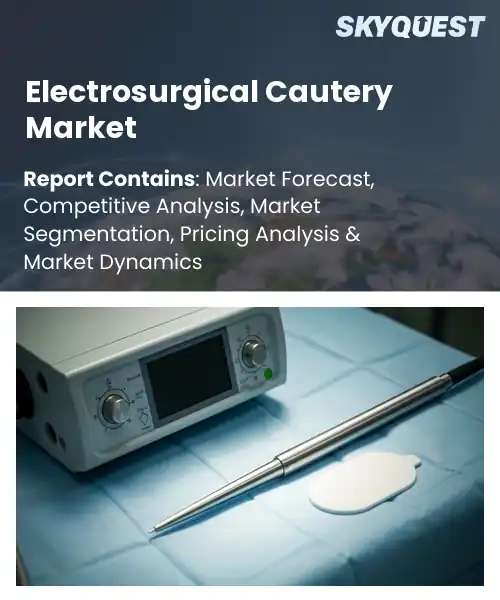
Electrosurgical Cautery Market
Report ID: SQMIG35A3346
Report ID: SQMIG35A3346
[email protected]
USA +1 351-333-4748
Report ID:
SQMIG35A3346 |
Region:
Global |
Published Date: March, 2026
Pages:
157
|Tables:
119
|Figures:
77


Global Electrosurgical Cautery Market size was valued at USD 800 Million in 2024 and is poised to grow from USD 860 Million in 2025 to USD 1460 Million by 2033, growing at a CAGR of 6.9% during the forecast period (2026-2033).
The key trend driving the global electrosurgical cautery sector is the shift toward minimally invasive surgical procedures supported by device innovation and demographic pressures. Electrosurgical cautery includes monopolar and bipolar generators, hand pieces, and improved vessel sealing systems found in general surgery, GYN, urology and oncology. They are used to cut/tissue and coagulate vessels by using an electric current. The benefits of electrosurgery include better hemostasis, shorter procedure times, faster patient recovery; which lead to lower cost of hospitalization and greater volume of procedures. Over time, the marketplace has evolved from simple Bovie-style pens to large integrated systems such as LigaSure and generator controlled systems, all of which provide increased safety features and availability worldwide.
A pivotal factor accelerating market expansion is the rapid advancement of energy platforms that enhance precision, safety, and procedural efficiency, which expands clinical applications and justifies purchases by hospitals and ambulatory centers. The use of generators enables tissue sensing and adjustable power profiles, as well as delivery through sealed-instrument systems, so that surgeons can achieve faster vessel-sealing procedures during laparoscopic hysterectomies and oncologic resections. Therefore allowing for lower transfusion rates, shorter operative times, and reduced overall costs in patient care. The resulting demonstrable results will drive the procurement decisions made by hospitals and will support higher levels of reimbursement for the use of minimally invasive surgical pathways. Emerging economies will continue to develop as their surgical volume increases and develop the surgical infrastructure, which will therefore create demand for electrosurgical solutions.
How is AI Improving Precision and Outcomes in the Electrosurgical Cautery Market?
With the integration of real-time recognition of tissue type with adaptive energy control and predictive guidance, artificial intelligence is increasing precision and improving outcomes in the electrosurgical cautery industry. Endoscopic imaging feeds are being analyzed using machine learning to differentiate planes of tissue within the operative field and then propose and/or adjust energy used for cautery in a manner that limits unintended thermal damage to adjacent tissue. This helps to decrease variability between users and facilitate safer alternatives to open surgery via minimally invasive surgery. Utilization of closed-loop generator feedback and robotic platforms is increasing the consistency of electrosurgical cautery procedures.
In October 2025, Techsomed and Medtronic pilot collaboration on AI guided ablation delivered real time visualization and predictive margin control which helps translate AI driven insights into more precise cautery application reduced retreatments and improved operating room efficiency.
Market snapshot - (2026-2033)
Global Market Size
USD 0.8 Billion
Largest Segment
Monopolar Electrosurgery Units
Fastest Growth
Argon Plasma Coagulation (APC) Units
Growth Rate
6.9% CAGR
To get more insights on this market click here to Request a Free Sample Report
Global electrosurgical cautery market is segmented by product type, component/accessory, application vertical, end-user and region. Based on product type, the market is segmented into monopolar electrosurgery units, bipolar electrosurgery units and argon plasma coagulation (APC) units. Based on component/accessory, the market is segmented into electrosurgical generators, cautery pencils & electrodes, forceps & probes and return electrodes/patient plates. Based on application vertical, the market is segmented into general surgery, gynecology & urology, cardiology & orthopedics and dermatology & cosmetic surgery. Based on end-user, the market is segmented into specialized surgical centers, multi-specialty hospitals and diagnostic & research labs. Based on region, the market is segmented into North America, Europe, Asia Pacific, Latin America and Middle East & Africa.
Based on the global electrosurgical cautery market growth, monopolar electrosurgery units segment dominates because its wide procedural flexibility and entrenched clinical familiarity make it the default energy modality across many operative settings. Monopolar systems accommodate diverse cutting and coagulation tasks with simple handpieces and established training pathways, which lowers adoption risk for providers. That broad utility encourages purchasing and consumable ecosystems, prompting manufacturers to maintain interoperability and support, thereby reinforcing market preference and sustained leadership.
However, Bipolar Electrosurgery Units are the fastest growing area as they deliver focused tissue effects with reduced thermal spread, aligning with minimally invasive and tissue-sparing techniques. The capabilities, connectivity, and evolving energy modulation have evolved through time to meet the demands of safety and effectiveness. Therefore, new advancements of electrical medical devices, and clinician preference for localised coagulation, are enhancing their procurement opportunities and creating new opportunities for clinical applications.
Electrosurgical generators segment leads because generators supply the foundational energy control, waveform shaping and safety interlocks that determine clinical performance and device compatibility. With the capability of providing many different modes, integrated monitoring, and standardized interfaces, the ability for vendors to reduce procedural variability and impact hospital purchasing decisions will depend on their ability to develop and certify generator platforms. Generator platform development and certification will also drive the generator as a platform for consumables, as well as drive generator prominence within manufacturers’ product roadmaps for their training and long-term total cost of ownership.
Meanwhile, cautery pencils & electrodes are emerging as the fastest growing component due to disposable trends, ergonomic refinements and specialty tip designs tailored for minimally invasive procedures. Infection control products used only once and creating new materials for products fosters clinical preference and subsequent materials sold per clinician will open up more market opportunities for companies involved; also leads to strategic partnerships, thus improving customer satisfaction.
To get detailed segments analysis, Request a Free Sample Report
As per the global electrosurgical cautery market share, North America dominates due to a combination of advanced healthcare infrastructure, concentrated networks of specialized surgical centers, and a robust medical device ecosystem that continually advances electrosurgical technology. By decreasing uncertainty in the regulatory process and reimbursement pathways, hospitals and ambulatory surgery centers are more likely to adopt novel technologies. Partnerships between manufacturers, academic institutions, and clinicians help generate clinical evidence and provide training needed for adoption. Adequate field service and distribution networks provide necessary post-sale support for devices and ensure uptime for devices for long periods of time. By having a culture of innovation with active venture capital and a receptive physician market, companies can have continual product improvement. The growing focus on outpatient surgical procedures and improving efficiencies continues to drive the need to eliminate outdated technologies.
Electrosurgical cautery market in United States is characterized by high technology adoption across hospitals and ambulatory surgical centers, driven by collaboration between clinicians and manufacturers. Emphasis on minimally invasive procedures, strong clinical trial activity, and market support enhances clinician confidence. Establishing procurement paths and having reimbursement structures allow for facilitating new technology uptake, while having a comprehensive variety of specialized training programs as well as engaging with key opinion leaders allows innovative systems to become integrated into everyday surgical methods.
Electrosurgical cautery market in Canada benefits from a centralized healthcare delivery model that supports standardized procurement and technology evaluation across provinces. The process that leads to the acceptance of new medical devices into clinical practice is based on interprofessional collaboration through health technology assessments and multi-stakeholder committees, which support the thoughtful integration of new advanced electrosurgical systems into clinical practice. The process includes a strong emphasis on clinician training and collaboration between clinicians and academic teaching hospitals to support evidence-based practices.
Based on global electrosurgical cautery market regional forecast, rapid expansion across Europe is driven by convergence of clinical practice shifts toward minimally invasive surgery, proactive hospital investment in surgical infrastructure, and a competitive device landscape that stimulates continuous innovation. Regulatory harmonization supports transformation of devices from a regional to an international context while national reimbursement pathways and hospital procurement methods allow for scale-up across both the public and private sectors. Collaborative efforts between manufacturers and high-profile clinical centers develop regional-specific training programs with structured evidence generation to create clinician confidence and ultimately lead to adherence with clinical guidelines. Research clusters, innovation hubs and specialty surgery centers accelerate both validation and dissemination of new products, while consortiums for procurement and investments made by the private sector help to expand access into outpatient and community surgical services.
Electrosurgical cautery market in Germany features strong research capacity and a dense network of university hospitals that evaluate and adopt advanced electrosurgical platforms. By using regional supply chain models, manufacturers can work closely with both clinicians and developers to facilitate continual innovation. Hospitals’ investment strategies include multi-functional procedures based on safety concerns. Clinicians are encouraged to purchase standardised items through the use of regional procurement programs. Clinician confidence is enhanced through education programs and post-market services by integrating new technology into everyday surgical procedures.
Electrosurgical cautery market in United Kingdom is marked by dynamic adoption in public and private surgical settings, with expansion in ambulatory centers and specialist clinics. Active involvement by clinicians, along with structured training programs, and collaboration between technology innovators and healthcare providers, have enabled rapid acceptance of new electrosurgical technology into daily clinical use. Furthermore, private hospitals and health systems are finding flexibility in procurement, allowing them to test "pilot" programs for new technologies before committing to wider adoption in all their care settings.
Electrosurgical cautery market in France is emerging through targeted hospital modernization efforts and strengthening relationships between international manufacturers and local distributors. The committees that assess health technology and purchase medical equipment help assure that the products are being carefully adopted. Validation of clinical utility is achieved through pilot testing in academic hospitals. Clinicians are primarily concerned with three issues: the safety of the devices, their ergonomics, and how well the devices will integrate into existing surgical workflows.
As per global electrosurgical cautery market regional outlook, Asia Pacific is strengthening its position through a combination of technological advancement, manufacturing capability, and evolving clinical practice that favors minimally invasive interventions. Innovation ecosystems at the national level provide a way for local electrosurgical solutions to be developed. At the same time, international manufacturers are forming new partnerships and service networks within their regional markets. In addition to strengthening hospital modernization programs, regulatory changes that clarify how to approve devices and improvements to the clinical research capabilities make more rigorous evaluation and implementation of electrosurgical solutions possible. Training programs targeted to surgery clinicians and the establishment of extensive after-sales support infrastructure in the region will increase familiarity and trust between surgery clinicians and electrosurgical technology. The ability of regional manufacturers to manufacture at a lower cost than similar products on the market, in conjunction with the existence of flexible procurement processes in different markets.
Electrosurgical cautery market in Japan is underpinned by advanced manufacturing and precision engineering guiding device development. Strong partnerships between industry and medical institutions support rigorous clinical evaluation and iterative product refinement. Hospitals emphasize integration with broader surgical technologies and robust maintenance programs, ensuring clinician confidence and reliable device performance. Training curricula and specialist workshops foster surgeon proficiency and encourage adoption of multifunctional electrosurgical platforms across tertiary centers and surgical units.
Electrosurgical cautery market in South Korea leverages a strong electronics and medtech sector that accelerates development of compact energy efficient electrosurgical systems. Collaboration between technology firms and clinical centers fosters prototyping for clinical validation. The government assists the development of new medical products through providing monetary support for both medical innovation and export manufacturing. This funding allows manufacturers enhance their service model and training systems which allows hospitals and clinics to adopt new products or systems more readily.
To know more about the market opportunities by region and country, click here to
Buy The Complete Report
Rising Minimally Invasive Procedures
The rise in popularity of minimally invasive surgical techniques has resulted in an increase in the need for electrosurgical equipment, given that electrosurgical instruments provide precise dissection of tissues and achieve hemostasis while causing less trauma to both the patient and the surgeon and allowing for quicker recovery times for patients. Surgeons prefer surgical instruments that facilitate the use of smaller incisions and provide better thermal control. Therefore, hospitals regularly purchase advanced electrosurgical devices. The practice of using standardized minimally invasive strategies throughout various surgical specialties increases the volume of surgical procedures where electrosurgical instruments are used.
Technological Advancements In Devices
Technological advances in electrosurgical equipment improve device precision, energy delivery control, and safety features, which enhances clinician confidence and broadens clinical applications. Improved ergonomics, compatibility of imaging, and a simpler approach to intraoperative workflows, all reduce complexity of operation and make the adoption of these systems into more surgical specialties easier. These advancements are realized through recent innovations from manufacturers; using improved algorithms for using modulation, integrated instrumentation, disposable accessories, and addressing specific clinical requirements, hospitals are being encouraged to update their current systems to maintain competitiveness in the delivery of care.
High Treatment Costs
The substantial capital investment required for advanced electrosurgical systems, together with ongoing expenses for maintenance and specialized disposables, constrains procurement by healthcare facilities with limited budgets. High per-procedure costs can discourage routine replacement of legacy equipment and reduce adoption rates in lower-resource settings, limiting market penetration. When there is a pressure to spend first on basic infrastructure and staffing needs, administrators postpone or reduce the purchase of the most current devices. The result of these cost barriers is a slowing of the frequency of adoption cycles and driving perspective buyers to look for either multifunctional or less expensive alternatives, versus purchasing dedicated electrosurgical upgrades.
Stringent Regulatory Approval Processes
Regulatory requirements for electrosurgical devices vary between jurisdictions; as a result, manufacturers are required to invest substantially more time and resources than would otherwise be necessary to obtain regulatory approvals for these products. Differences in submission criteria, expectations regarding clinical evidence, and obligations associated with post-market surveillance create strategic and operational uncertainty, and significantly increase product development costs; ultimately, this may limit the manufacturer's geographic distribution and initial product launch to one or more regions, with potential disproportionate impact on smaller companies, resulting in lower levels of competition and slower rates of diffusion for innovative new products.
Request Free Customization of this report to help us to meet your business objectives.
Competitive landscape in global electrosurgical market outlook shows incumbent consolidation through targeted acquisitions and partner deals while technology driven entrants push workflow focused innovations. Major M&A activity includes Boston Scientific’s purchases of Baylis and Farapulse, and startups such as Atraverse are advancing RF guidewire and zero exchange workflow strategies that directly challenge legacy transseptal systems, driving competition around regulatory clearances, clinical evidence and rapid commercialization.
SkyQuest’s ABIRAW (Advanced Business Intelligence, Research & Analysis Wing) is our Business Information Services team that Collects, Collates, Correlates, and Analyses the Data collected by means of Primary Exploratory Research backed by robust Secondary Desk research.
As per SkyQuest analysis, the global electrosurgical cautery industry is propelled by rising minimally invasive procedures, with one key driver being the shift toward less invasive surgery that increases demand for electrosurgical devices and boosts procedure volumes. One restraint is the high treatment and capital costs that limit adoption in resource constrained settings. Dominating region is North America due to advanced infrastructure and strong clinical adoption, while dominating segment is Monopolar Electrosurgery Units because of their procedural flexibility and entrenched clinical familiarity. A second driver is rapid technological advancement, including smarter generators, tissue sensing and AI enabled energy control that improve precision, safety and workflow efficiency.
| Report Metric | Details |
|---|---|
| Market size value in 2024 | USD 0.8 Billion |
| Market size value in 2033 | USD 1.46 Billion |
| Growth Rate | 6.9% |
| Base year | 2024 |
| Forecast period | (2026-2033) |
| Forecast Unit (Value) | USD Billion |
| Segments covered |
|
| Regions covered | North America (US, Canada), Europe (Germany, France, United Kingdom, Italy, Spain, Rest of Europe), Asia Pacific (China, India, Japan, Rest of Asia-Pacific), Latin America (Brazil, Rest of Latin America), Middle East & Africa (South Africa, GCC Countries, Rest of MEA) |
| Companies covered |
|
| Customization scope | Free report customization with purchase. Customization includes:-
|
To get a free trial access to our platform which is a one stop solution for all your data requirements for quicker decision making. This platform allows you to compare markets, competitors who are prominent in the market, and mega trends that are influencing the dynamics in the market. Also, get access to detailed SkyQuest exclusive matrix.
Table Of Content
Executive Summary
Market overview
Parent Market Analysis
Market overview
Market size
KEY MARKET INSIGHTS
COVID IMPACT
MARKET DYNAMICS & OUTLOOK
Market Size by Region
KEY COMPANY PROFILES
Methodology
For the Electrosurgical Cautery Market, our research methodology involved a mixture of primary and secondary data sources. Key steps involved in the research process are listed below:
1. Information Procurement: This stage involved the procurement of Market data or related information via primary and secondary sources. The various secondary sources used included various company websites, annual reports, trade databases, and paid databases such as Hoover's, Bloomberg Business, Factiva, and Avention. Our team did 45 primary interactions Globally which included several stakeholders such as manufacturers, customers, key opinion leaders, etc. Overall, information procurement was one of the most extensive stages in our research process.
2. Information Analysis: This step involved triangulation of data through bottom-up and top-down approaches to estimate and validate the total size and future estimate of the Electrosurgical Cautery Market.
3. Report Formulation: The final step entailed the placement of data points in appropriate Market spaces in an attempt to deduce viable conclusions.
4. Validation & Publishing: Validation is the most important step in the process. Validation & re-validation via an intricately designed process helped us finalize data points to be used for final calculations. The final Market estimates and forecasts were then aligned and sent to our panel of industry experts for validation of data. Once the validation was done the report was sent to our Quality Assurance team to ensure adherence to style guides, consistency & design.
Analyst Support
Customization Options
With the given market data, our dedicated team of analysts can offer you the following customization options are available for the Electrosurgical Cautery Market:
Product Analysis: Product matrix, which offers a detailed comparison of the product portfolio of companies.
Regional Analysis: Further analysis of the Electrosurgical Cautery Market for additional countries.
Competitive Analysis: Detailed analysis and profiling of additional Market players & comparative analysis of competitive products.
Go to Market Strategy: Find the high-growth channels to invest your marketing efforts and increase your customer base.
Innovation Mapping: Identify racial solutions and innovation, connected to deep ecosystems of innovators, start-ups, academics, and strategic partners.
Category Intelligence: Customized intelligence that is relevant to their supply Markets will enable them to make smarter sourcing decisions and improve their category management.
Public Company Transcript Analysis: To improve the investment performance by generating new alpha and making better-informed decisions.
Social Media Listening: To analyze the conversations and trends happening not just around your brand, but around your industry as a whole, and use those insights to make better Marketing decisions.
REQUEST FOR SAMPLE
 REQUEST FREE CUSTOMIZATION
Global Electrosurgical Cautery Market size was valued at USD 0.8 Billion in 2024 and is poised to grow from USD 0.86 Billion in 2025 to USD 1.46 Billion by 2033, growing at a CAGR of 6.9% during the forecast period (2026-2033).
Competitive landscape shows incumbent consolidation through targeted acquisitions and partner deals while technology driven entrants push workflow focused innovations; major M&A activity includes Boston Scientific’s purchases of Baylis and Farapulse, and startups such as Atraverse are advancing RF guidewire and zero exchange workflow strategies that directly challenge legacy transseptal systems, driving competition around regulatory clearances, clinical evidence and rapid commercialization. 'Medtronic', 'Johnson & Johnson', 'Covidien', 'Conmed Corporation', 'Olympus Corporation', 'B. Braun Melsungen AG', 'Stryker Corporation', 'Smith & Nephew', 'Ethicon, Inc.', 'Aesculap, Inc.', 'Integra LifeSciences', 'Karl Storz', 'CooperSurgical', 'Zimmer Biomet', 'Merit Medical Systems', 'Thermo Fisher Scientific', 'Hologic', 'AngioDynamics', 'Boston Scientific', 'Teleflex Incorporated'
The growing preference for minimally invasive surgical procedures increases demand for electrosurgical cautery devices because these tools enable precise tissue dissection and hemostasis with reduced operative trauma and faster patient recovery. Surgeons favor instruments that support smaller incisions and controlled thermal effects, driving hospital procurement decisions toward advanced electrosurgical systems. Adoption of minimally invasive approaches across specialties expands procedure volumes where cautery is essential, reinforcing manufacturers’ investment in product availability, training, and service support to meet clinicians’ procedural requirements and institutional efficiency goals.
Ambulatory And Outpatient Shift: Procedures moving into ambulatory and outpatient settings are driving demand for compact, portable electrosurgical systems designed for rapid turnover and simplified workflows. Providers prioritize devices that enable shorter procedure times, easy setup, integrated smoke management, and intuitive controls to support staff with varied experience. Manufacturers respond with ergonomically optimized handpieces, streamlined consumables, and service models that emphasize reliability and remote support. This convergence of convenience, infection control, and operational efficiency expands adoption beyond traditional hospital environments into community surgical centers.
Why does North America Dominate the Global Electrosurgical Cautery Market? |@12


Want to customize this report? This report can be personalized according to your needs. Our analysts and industry experts will work directly with you to understand your requirements and provide you with customized data in a short amount of time. We offer $1000 worth of FREE customization at the time of purchase.
Feedback From Our Clients


 USA (+1) 351-333-4748

