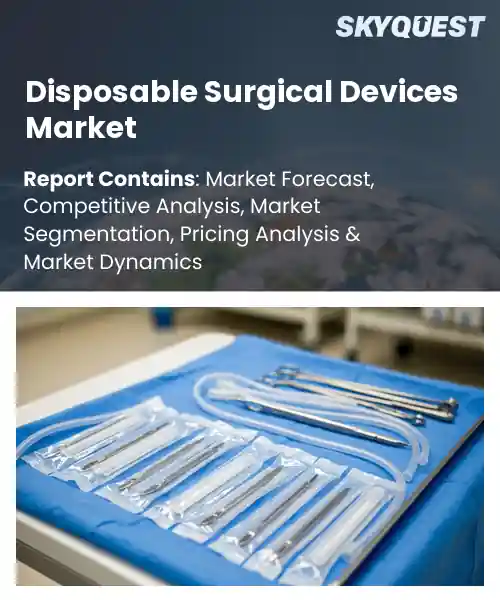
Disposable Surgical Devices Market
Report ID: SQMIG35A3870
Report ID: SQMIG35A3870
[email protected]
USA +1 351-333-4748
Report ID:
SQMIG35A3870 |
Region:
Global |
Published Date: June, 2026
Pages:
157
|Tables:
120
|Figures:
72


Global Disposable Surgical Devices Market size was valued at USD 18.52 Billion in 2024 and is poised to grow from USD 19.88 Billion in 2025 to USD 34.85 Billion by 2033, growing at a CAGR of 7.32% during the forecast period (2026-2033).
Patient safety concerns, especially the need to block hospital-acquired infections, are the main thing steering the disposable surgical devices market growth. In this space, there are single-use instruments and add-ons like trocars, scalpels, sutures, and endoscopic sheaths, which swap out reusable versions to cut down on cross-contamination. It matters because when infection rates drop usually see shorter hospital stays and lower total care costs, and both payers and providers tend to push that agenda.
Now building from those infection driven adoption waves, the strongest factor is a procedural change toward ambulatory workflows and minimally invasive surgeries, and that actually drives demand for “ready to use” disposables that help teams move faster, while also reducing reprocessing slowdowns. As outpatient numbers keep climbing, hospitals and surgery centers want single use kits and instruments, so makers end up investing in more integrated disposable platforms aimed at specific procedures, like laparoscopic clip appliers with built in seals, so the setup is shorter and less fussy. This setup boosts operational efficiency and gives suppliers more pricing leverage. On top of that, regulatory scrutiny around traceability keeps tightening, and emerging markets with rising surgical capacity open up noticeable chances for scaled production, plus more local supply chains.
AI is boosting quality control across the disposable surgical devices market by using computer vision inspection, anomaly detection, and predictive analytics together. These systems run at line speed, so they can catch surface defects, assembly mistakes, and packaging issues in real time while still delivering uniform, auditable decisions. The overall market structure encourages automation because single use devices are produced at huge volume, and regulators typically demand traceable records for lots and batches. Vendors are rolling out edge AI, validated models, and tight data capture so they can lower human variability and speed up lot release, but without losing clinical safety or traceability.
Market snapshot - (2026-2033)
Global Market Size
USD 18.52 Billion
Largest Segment
Disposable Syringes & Needles
Fastest Growth
Disposable Retractors
Growth Rate
7.32% CAGR
To get more insights on this market click here to Request a Free Sample Report
The global disposable surgical devices market is segmented by product type, material, application, end-user and region. Based on product type, the market is segmented into Disposable Scalpels, Disposable Retractors, Disposable Forceps & Clamps, Disposable Syringes & Needles and Others. Based on material, the market is segmented into Plastic, Metal and Others. Based on application, the market is segmented into Orthopedic Surgery, Cardiovascular Surgery, Laparoscopic Surgery and Others. Based on end-user, the market is segmented into Hospitals, Ambulatory Surgical Centers and Clinics. Based on region, the market is segmented into North America, Europe, Asia Pacific, Latin America and Middle East & Africa.
As per the disposable surgical devices market analysis, the Disposable Scalpels segment just runs the show because they can be used across so many surgical areas, and the single use setup helps cut down cross contamination risk, while also making the whole sterile process easier. When the blades stay sharp in a consistent way it supports better cutting accuracy and faster work, too. Plus, manufacturers keep pushing disposable scalpel design and supply, so procurement feels straightforward. On top of that clinicians often like ready to use instruments and not having to deal with reprocessing, which reinforces adoption, and it keeps them in a leading position in the disposable surgical devices market.
However, Disposable Retractors are the part that’s expanding fastest, for the plain reason that modular single use layouts plus ergonomic upgrades improve visibility or exposure, and they do it while also lowering turnover time. Companies are rolling out lighter retractors with integrated features that can reduce how many instruments are needed, and that’s helping adoption in minimally invasive cases and also routine procedures. This also creates fresh procurement angles and value use chances across multiple surgical specialties.
According to the disposable surgical devices market forecast, the plastic segment dominates because the material is relatively low cost and it’s easy to mold, which allows mass production of all disposable devices, including ones with integrated safety mechanisms, and still keeps quality steady. That pushes unit costs down, and also makes supply chains simpler. Also, there’s broad availability of biocompatible polymers, which supports single use disposables that can meet sterilization plus regulatory expectations. Manufacturers then use automated production systems to keep up with clinical demand, and that also reduces reprocessing burdens, even more.
Whereas Metal is becoming the fastest growing material category, since clinicians want more instrument strength during complex procedures, so disposable metal designs, sometimes with specialized coatings, are starting to show up more. Newer thin metal fabrication methods and hybrid build approaches make it possible to use single-use metal instruments in higher acuity settings. That creates high value opportunities and encourages supplier investment, so the momentum keeps building.
To get detailed segments analysis, Request a Free Sample Report
As per the disposable surgical devices market regional forecast, North America ends up dominating, more or less because there’s this confluence of advanced healthcare infrastructure , a high emphasis on infection prevention , and mature procurement systems that tend to favor single use devices. There’s a strong presence of established medical device companies and a dense network of hospitals and ambulatory surgery centers, which basically speeds up product adoption and market penetration. Clear regulatory pathways , plus rigorous safety standards back innovation and provider confidence. On top of that, well developed distribution channels and strategic partnerships between manufacturers and health systems, plus a focus on minimally invasive surgical techniques, really reinforce demand. Then reimbursement models and the way institutions purchase things incentivize adoption of disposables, while ongoing investment in clinical research and training keeps uptake moving and brings in new product classes relatively fast. There is a robust private sector investment and active venture funding backing local innovation ecosystems, and resilient supply chains and contract manufacturing capabilities that help scale quickly. Finally, academic medical centers run clinical evaluations that strengthen the clinical evidence, so guidelines get adopted more readily, and that loops back into institutional procurement decisions across the whole region.
United States Disposable Surgical Devices Market
The Disposable Surgical Devices sector in the United States mirrors how extensive hospital networks are , and how quickly they’re ready to implement single use solutions. That readiness seems driven by institutional safety priorities and clinician preference for convenience during procedures . There’s a strong manufacturing base, and developers collaborate closely with healthcare systems so improvements happen iteratively. With all that, the emphasis on clinical evidence generation, procurement frameworks that value lifecycle cost, and private sector investment together sustain demand and keep disposable surgical technologies integrated into day to day practice.
Canada Disposable Surgical Devices Market
The Disposable Surgical Devices industry in Canada benefits from integrated public healthcare delivery plus procurement mechanisms that lean hard toward patient safety and infection control. Hospitals , along with regional health authorities, tend to prioritize disposable options when the clinical value is obvious. That supports adoption across a range of surgical specialties. Local distributors and partnerships with international manufacturers help keep supply consistent and the product range wider. Clinical training efforts and centralized purchasing also encourage standardization of disposable device use, which boosts hospital confidence and helps operational efficiency at the same time.
Rapid disposable surgical devices market penetration in Europe is happening due to a convergence of clinical priorities, regulatory maturation, and procurement practices that increasingly favor safety alongside operational efficiency. Health systems across the region , are putting more weight on infection prevention and smoother surgical workflows, so hospitals start evaluating disposable devices to reduce cross contamination and simplify logistics. A strong regional medtech industry , active collaboration between manufacturers and clinical networks, and structured purchasing by hospital groups underpin that adoption. Regulatory clarity and harmonization of standards help market entry, while clinical guidelines and training programs build clinician acceptance. Also, cost management strategies that look at total procedural cost rather than just unit price, plus targeted pilot programs, push rollout in both large academic centers and community hospitals. Engagement with payers and health technology assessment bodies makes sure evidence generation lines up with reimbursement criteria. Finally, European innovation hubs and cross border research collaborations contribute to iterative product refinement and more localized market strategies.
Germany Disposable Surgical Devices Market
The Disposable Surgical Devices Market in Germany benefits from a deep medtech manufacturing base with a strong clinical research culture that supports adoption of single use instruments. Hospitals and surgical centers tend to focus on device reliability and supply chain continuity, which fosters collaboration with local suppliers . Evidence driven procurement , and influential clinical societies, help guide regional standardization across hospital groups. Public and private hospital networks join pilot programs that end up informing broader implementation, plus customization for specific surgical specialties.
United Kingdom Disposable Surgical Devices Market
The Disposable Surgical Devices Market in the United Kingdom is shaped by public health procurement and also by private sector activity that supports pilot adoption across hospital trusts. Infection control and streamlined procedural pathways are big drivers, so clinician interest in disposable options rises. Regional purchasing consortia and innovation partnerships with domestic suppliers enable trials, and those trials help achieve scalability. With the focus on clinical outcomes and operational efficiency, implementation stays selective at first in tertiary centers and community hospitals, which gradually advances market maturation overall.
France Disposable Surgical Devices Market
The Disposable Surgical Devices Market in France is gaining real momentum, mostly due to proactive hospital adoption and innovation across surgical specialties. Clinical leaders in major medical centers push pilot programs that evaluate disposables for efficiency and infection control, and that encourages wider hospital uptake. There’s also engagement between domestic manufacturers and procurement teams, so product alignment improves. Regional purchasing groups and clinician led evidence generation help align with reimbursement, and support integration into standard surgical protocols, accelerating broader market acceptance across the country.
Asia Pacific is tightening its position due to more surgical capacity, bigger strategic manufacturing spend, and that more active type of collaboration between device makers and clinical institutions. Regional production and contract manufacturing help to cut lead times and that makes it easier to offer products that are more tailored for different clinical environments, even when local needs shift. As minimally invasive procedures keep expanding, and private hospital networks grow, the appetite for disposable instruments rises too, mainly because they make logistics simpler and help with infection control. On top of that, regulatory modernization, plus the push for local clinical evidence, lowers barriers for market entry. Medical tourism and procurement reforms also push procedural volume, while clinician training, digital supply chain tools, and alliances between global plus local medtech firms speed up adoption and build regional manufacturing muscle. With better quality standards and stronger post market surveillance providers, trust gets reinforced, and then targeted investment in automation and packaging improvements typically cuts unit cost while boosting sterility assurance. Together these capabilities put the region in a shift mode, moving away from being only a low cost sourcing base toward becoming a more strategic market for advanced disposable surgical devices.
Japan Disposable Surgical Devices Market
The Disposable Surgical Devices Market in Japan, it’s often described as having very high expectations around device quality, plus a close working relationship between manufacturers and clinical institutions. Hospitals and specialized surgical centers tend to adopt disposables in a selective way, where the clinical advantage is noticeable and where the items integrate well with advanced surgical platforms. Domestic production is strong, there’s a clear focus on rigorous clinical evaluation, and pilot programs generally help clinicians feel confident. Partnerships with international companies and ergonomic design choices also support localized solutions that line up with what providers expect in day to day practice.
South Korea Disposable Surgical Devices Market
The Disposable Surgical Devices Market in South Korea benefits from a dynamic medtech ecosystem, centered on innovation and product development. Manufacturers there often team up with leading hospitals to test disposable options that match advanced surgical methods. A big emphasis on manufacturing quality and technology transfer helps keep product offerings competitive. Government actions aimed at smoothing approvals and encouraging clinical research are also driving adoption. And because industry, academia, and providers are closely connected, the conditions feel supportive for scaling disposable surgical technologies.
To know more about the market opportunities by region and country, click here to
Buy The Complete Report
Rising Focus on Infection Control
Advancements In Device Materials
High Procurement Costs are Limiting
Environmental Sustainability Concerns Persist
Request Free Customization of this report to help us to meet your business objectives.
The competitive landscape gets defined by incumbent device makers that keep expanding their single use offerings, and by more agile startups that push niche innovation, while hospitals steadily steer procurement toward infection control and operating room efficiency. The strategic plays usually look like supplier purchasing agreements, plus selective acquisitions, and can see the pattern in examples like Ambu winning a national purchasing contract , Xenocor moving a single use laparoscope forward via venture financing and launch investment, and bigger firms buying specialist startups in order to lock in new, different technologies.
Top Player’s Company Profile
Recent Developments in the Disposable Surgical Devices Market
SkyQuest’s ABIRAW (Advanced Business Intelligence, Research & Analysis Wing) is our Business Information Services team that Collects, Collates, Correlates, and Analyses the Data collected by means of Primary Exploratory Research backed by robust Secondary Desk research.
As per SkyQuest analysis, the global disposable surgical devices market is mostly pushed forward by stronger attention on infection control, since single use instruments reduce cross contamination and keep sterile workflows moving. North America stays the leading region because of its strong healthcare infrastructure and more mature procurement systems. In that mix, disposable scalpels still take a large share because they’re broadly applicable and fairly simple to use. Another supporting push is the procedural movement toward ambulatory care and minimally invasive surgeries, where ready-to-use disposables matter because they cut turnover time and also reduce the burden of reprocessing. On the flip side, there are restraints tied to procurement costs and environmental sustainability concerns, which could dampen adoption in settings where budgets are tight or sustainability goals are taken very seriously.
| Report Metric | Details |
|---|---|
| Market size value in 2024 | USD 18.52 Billion |
| Market size value in 2033 | USD 34.85 Billion |
| Growth Rate | 7.32% |
| Base year | 2024 |
| Forecast period | (2026-2033) |
| Forecast Unit (Value) | USD Billion |
| Segments covered |
|
| Regions covered | North America (US, Canada), Europe (Germany, France, United Kingdom, Italy, Spain, Rest of Europe), Asia Pacific (China, India, Japan, Rest of Asia-Pacific), Latin America (Brazil, Rest of Latin America), Middle East & Africa (South Africa, GCC Countries, Rest of MEA) |
| Companies covered |
|
| Customization scope | Free report customization with purchase. Customization includes:-
|
To get a free trial access to our platform which is a one stop solution for all your data requirements for quicker decision making. This platform allows you to compare markets, competitors who are prominent in the market, and mega trends that are influencing the dynamics in the market. Also, get access to detailed SkyQuest exclusive matrix.
Table Of Content
Executive Summary
Market overview
Parent Market Analysis
Market overview
Market size
KEY MARKET INSIGHTS
COVID IMPACT
MARKET DYNAMICS & OUTLOOK
Market Size by Region
KEY COMPANY PROFILES
Methodology
For the Disposable Surgical Devices Market, our research methodology involved a mixture of primary and secondary data sources. Key steps involved in the research process are listed below:
1. Information Procurement: This stage involved the procurement of Market data or related information via primary and secondary sources. The various secondary sources used included various company websites, annual reports, trade databases, and paid databases such as Hoover's, Bloomberg Business, Factiva, and Avention. Our team did 45 primary interactions Globally which included several stakeholders such as manufacturers, customers, key opinion leaders, etc. Overall, information procurement was one of the most extensive stages in our research process.
2. Information Analysis: This step involved triangulation of data through bottom-up and top-down approaches to estimate and validate the total size and future estimate of the Disposable Surgical Devices Market.
3. Report Formulation: The final step entailed the placement of data points in appropriate Market spaces in an attempt to deduce viable conclusions.
4. Validation & Publishing: Validation is the most important step in the process. Validation & re-validation via an intricately designed process helped us finalize data points to be used for final calculations. The final Market estimates and forecasts were then aligned and sent to our panel of industry experts for validation of data. Once the validation was done the report was sent to our Quality Assurance team to ensure adherence to style guides, consistency & design.
Analyst Support
Customization Options
With the given market data, our dedicated team of analysts can offer you the following customization options are available for the Disposable Surgical Devices Market:
Product Analysis: Product matrix, which offers a detailed comparison of the product portfolio of companies.
Regional Analysis: Further analysis of the Disposable Surgical Devices Market for additional countries.
Competitive Analysis: Detailed analysis and profiling of additional Market players & comparative analysis of competitive products.
Go to Market Strategy: Find the high-growth channels to invest your marketing efforts and increase your customer base.
Innovation Mapping: Identify racial solutions and innovation, connected to deep ecosystems of innovators, start-ups, academics, and strategic partners.
Category Intelligence: Customized intelligence that is relevant to their supply Markets will enable them to make smarter sourcing decisions and improve their category management.
Public Company Transcript Analysis: To improve the investment performance by generating new alpha and making better-informed decisions.
Social Media Listening: To analyze the conversations and trends happening not just around your brand, but around your industry as a whole, and use those insights to make better Marketing decisions.
REQUEST FOR SAMPLE
 REQUEST FREE CUSTOMIZATION
Global Disposable Surgical Devices Market size was valued at USD 18.52 Billion in 2024 and is poised to grow from USD 19.88 Billion in 2025 to USD 34.85 Billion by 2033, growing at a CAGR of 7.32% during the forecast period (2026-2033).
The competitive landscape is defined by incumbent device makers expanding single use portfolios and agile startups driving niche innovation, with hospitals pushing procurement toward infection control and operating room efficiency. Strategic plays include supplier purchasing agreements and selective acquisitions, exemplified by Ambu winning a national purchasing contract, Xenocor advancing a single use laparoscope through venture financing and launch investment, and larger firms acquiring specialist startups to secure novel technologies. 'Medtronic plc', 'Johnson & Johnson (Ethicon)', 'Becton Dickinson', 'Stryker Corporation', 'Boston Scientific', 'Abbott Laboratories', 'Zimmer Biomet', 'Smith & Nephew', 'B. Braun SE', 'Teleflex Inc.', 'Cardinal Health', 'Integra LifeSciences', 'Haemonetics Corporation', 'Integer Holdings', 'Natus Medical'
Heightened emphasis on preventing surgical site infections has increased demand for sterile, single use instruments that eliminate cross contamination risks and reduce sterilization burdens on healthcare providers. Hospitals and clinics favor disposable devices to streamline workflows and enhance patient safety perceptions, prompting procurement decisions that prioritize one time use instruments. Manufacturers respond by expanding portfolios and improving product availability, which further reinforces adoption. This focus on infection control supports market expansion by aligning clinical priorities with product offerings that mitigate contamination concerns and simplify perioperative processes.
Minimally Invasive Procedures Rise: Adoption of minimally invasive procedures is expanding demand for disposable surgical devices by prioritizing sterile single use instruments to reduce cross contamination and streamline operating room turnover. Manufacturers focus on ergonomic designs, procedure specific disposables and compatibility with advanced visualization platforms to support surgeon preferences. Hospitals are revising procurement and inventory practices to favor ready to use sterile kits that shorten preparation time and improve workflow efficiency, while clinicians emphasize disposables that consistently enhance patient safety and reproducible procedural outcomes.
Why does North America Dominate the Global Disposable Surgical Devices Market? |@12


Want to customize this report? This report can be personalized according to your needs. Our analysts and industry experts will work directly with you to understand your requirements and provide you with customized data in a short amount of time. We offer $1000 worth of FREE customization at the time of purchase.
Feedback From Our Clients


 USA (+1) 351-333-4748

