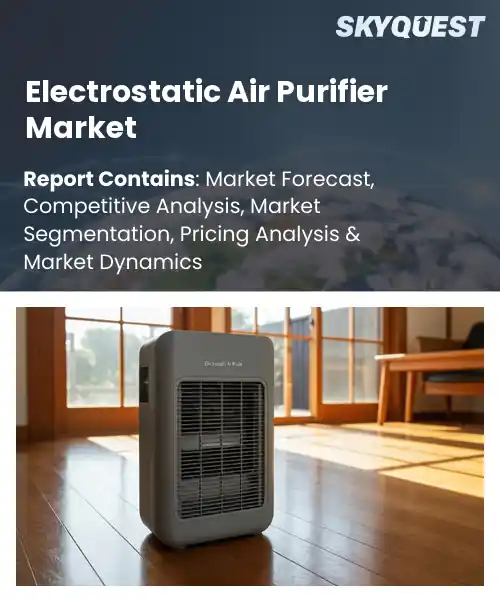
Electrostatic Air Purifier Market
Report ID: SQMIG25H2146
Report ID: SQMIG25H2146
[email protected]
USA +1 351-333-4748
Report ID:
SQMIG25H2146 |
Region:
Global |
Published Date: August, 2026
Pages:
157
|Tables:
117
|Figures:
77


Global Electrostatic Air Purifier Market size was valued at USD 2.46 Billion in 2024 and is poised to grow from USD 2.63 Billion in 2025 to USD 4.56 Billion by 2033, growing at a CAGR of 7.1% during the forecast period (2026-2033).
The global electrostatic air purifier market covers devices that charge airborne particles and then latch them onto oppositely charged plates, so it ends up with something reusable instead of the usual disposable filters. Its relevance is basically tied to rising urban pollution, more people paying attention to indoor air quality, and stricter emissions rules popping up across industrialized countries
Moreover, the electrostatic air purifier market growth is driven due to a mix of tightening standards and corporate sustainability commitments, so manufacturers feel pressured to move toward electrostatic tech, that tends to use less power than HEPA systems. Because of this, industrial environments like semiconductor plants and pharmaceutical clean rooms, have started retrofitting their ventilation setups with electrostatic collectors, in order to hit emission limits and keep operational costs under control. That change then opens rooms for vendors to bring modular plate-cleaning systems and IoT enabled monitoring platforms, which then creates new revenue streams especially in emerging economies where grid dependability favors lower-draw appliances. So, the whole market is expected to outpace many peers over the coming decade, in a noticeable way.
Market snapshot - (2026-2033)
Global Market Size
USD 2.46 Billion
Largest Segment
HVAC Integrated Air Purifiers
Fastest Growth
Portable Air Purifiers
Growth Rate
7.1% CAGR
To get more insights on this market click here to Request a Free Sample Report
The global electrostatic air purifier market is segmented by product type, application, filtration technology, distribution channel and region. Based on product type, the market is segmented into Portable Air Purifiers, Wall-Mounted Air Purifiers and HVAC Integrated Air Purifiers. Based on application, the market is segmented into Residential, Commercial, Industrial and Healthcare. Based on filtration technology, the market is segmented into Electrostatic Precipitators and Hybrid Filtration. Based on distribution channel, the market is segmented into Online Retail, Specialty Stores and Direct Sales. Based on region, the market is segmented into North America, Europe, Asia Pacific, Latin America and Middle East & Africa.
As per the electrostatic air purifier market analysis, the Portable Air Purifiers segment leads because buyers focus on mobility and personal comfort, which means more frequent purchases for homes , workplaces, and even during travel. The practicality of compact designs fits with lifestyle trends that treat health as something that is carried around, not just something which is done at home. This is why makers invest a lot into battery efficiency and glossy looks. And that demand builds a whole supporting ecosystem, like add on accessories plus smart home tie ins, and it basically keeps the segment at the center of market shifts
Meanwhile, the Wall Mounted Air Purifiers segment is gaining the fastest momentum, because architects and building managers are putting these units right into interior designs, so air quality control becomes part of the space itself. Newer expectations for indoor environments push for smoother integration, so developers adopt wall mounted solutions that, for lack of a better term, look good while still keeping steady electrostatic performance
According to the electrostatic air purifier market forecast, in healthcare , hospitals and clinics are demanding the highest level of airborne pathogen removal, so electrostatic tech becomes a must, rather than optional. Tight infection control routines drive spending toward reliability and low upkeep, and that means manufacturers keep refining electrode designs, plus they start using antimicrobial coatings as a “just in case” layer. Since patient safety is non negotiable, healthcare buyers also tend to sign long term procurement agreements, which makes the segment a strong engine for stability, and also for ongoing product improvement.
On the flip side, the Industrial application segment is also showing up as a key high growth theme, because factories want to cut aerosol releases and volatile organic compounds. Stronger environmental policies and safety pressures push adoption of electrostatic systems that can scale. That encouragement leads to the development of more rugged, high capacity units, and as those improve, they broaden industry uptake across more sites
To get detailed segments analysis, Request a Free Sample Report
As per the electrostatic air purifier market regional forecast, North America keeps the lead in the market, not just because one thing, but more like a mix of new tech, people actually caring about indoor wellbeing and also policy rules that back it up. The whole region has solid R&D ecosystems, so products get better quicker and they can roll in with smart home stuff more easily. Plus higher disposable incomes and this sharp attention on indoor health, makes demand feel steady across places like homes, offices, and even industrial sites. On top of that, strong distribution networks and already established retail routes mean products show up fast, while tight air‑quality regulations basically force makers to hit higher performance levels. The push toward energy‑efficient designs also matches the wider sustainability conversation, so both companies and buyers lean toward lower‑power solutions. And when technology firms team up with HVAC specialists, the ecosystem gets more “ready for real life” because they can tailor use cases for different environments. Finally, ongoing consumer education, keeps the health angle in peoples minds, which supports brand stickiness and repeat buying.
United States Electrostatic Air Purifier Market
In the United States, the electrostatic air purifier sector does well because the consumer base is demanding, and they like smart integration plus high performance. Manufacturers tap into advanced research hubs to add things like real‑time air quality monitoring and adaptive filtration. There is a strong retail footprint , across both online sellers and regular brick‑and‑mortar stores, which speeds up adoption. Also, building codes are increasingly talking about indoor air standards, so commercial installations keep growing. Public health awareness just keeps fueling new product momentum, like a constant drumbeat for innovation.
Canada Electrostatic Air Purifier Market
In Canada, the electrostatic air purifier industry gains traction from stronger environmental consciousness and government incentives that nudge people toward healthier indoor spaces. Shoppers tend to favor energy‑efficient models, and they also care about low noise, so manufacturers often focus on sustainable design. Distribution mostly covers specialty retailers and home‑improvement chains, giving broad market coverage. And as respiratory health becomes more visible, especially in educational and healthcare settings, institutions start buying more units, which reinforces overall sector expansion.
Asia Pacific is seeing rapid electrostatic air purifier market penetration due to urbanization that keeps climbing, people becoming more aware of air quality problems, and also a decent technological backbone. In crowded cities, pollution levels can run high, so households and companies look for indoor remediation options that actually work. Meanwhile, middle‑class groups place more emphasis on wellness, and governments support adoption of clean‑air solutions with guidelines. Local manufacturers also have electronics know‑how, which helps them build compact, energy‑saving units that match regional preferences. Partnerships between research organizations and industry speed up innovation, so the region keeps acting like a growth engine. On top of that, consumer education campaigns that highlight how particles and volatile compounds affect health increase interest. Cross‑border trade agreements make components move more smoothly, so manufacturers can scale production while keeping costs competitive. This whole mix is what sustains the acceleration across the Asia Pacific landscape.
Japan Electrostatic Air Purifier Market
In Japan, the electrostatic air purifier market outlook is influenced by a strong cultural focus on hygiene, plus a high rate of adoption of advanced consumer electronics. Manufacturers put together sophisticated sensor arrays and connectivity features that feel seamless, which appeals to tech‑savvy buyers. Strict indoor air rules for offices and public transport push institutional purchases, while residential demand leans toward compact designs that fit smaller living spaces. And with continuous innovation cycles, brands keep a reputation for reliability and strong performance.
South Korea Electrostatic Air Purifier Market
In South Korea, the electrostatic air purifier market benefits from fast digital integration and a clear governmental emphasis on public health. Smart home platforms tend to incorporate purification units easily, so households adopt these systems more widely. Urban density raises concerns about fine particulate exposure, which drives private homes and corporate teams to invest in high‑efficiency devices. Plus, joint work between universities and manufacturers helps bring in low‑energy, high‑output solutions designed for local climate conditions.
Europe seems to be, slowly but surely, tightening up its standing in the electrostatic air purifier market, not just because of one thing but more like a messy mix of strict environmental rules, deep engineering know-how, and that ongoing itch for more sustainable indoor settings. New-ish legal structures, pushy about indoor air quality in offices and public spaces, basically force makers to come up with solutions that work with higher efficiency. And the engineering culture here helps them craft designs that are fairly compact, energy‑conserving, and still fit those wider carbon‑reduction plans.
Within the European Union, cross-border teamwork also plays a part, because testing and certification become more standardized, which then gives people a bit more trust. On top of that, households are increasingly buying into health‑leaning smart home products, so innovation keeps getting nudged forward. Meanwhile, partnerships between universities and companies speed up research on filtration materials that are more advanced and on real-time monitoring functions, which ends up reinforcing Europe’s lead when it comes to quality-first air cleaning tools. Even policy incentives around renewable energy somehow make it easier for manufacturers to lean into low‑power electrostatic tech, and that keeps the market growth story moving along across the whole continent.
Germany Electrostatic Air Purifier Market
The Electrostatic Air Purifier Market in Germany rides on the nation’s solid engineering tradition, plus strict indoor air expectations that end up boosting demand in both commercial and home usage. Firms tend to build high-efficiency units with dependable filtration media, which feels especially relevant for industrial customers who worry about occupational well-being. Energy-saving touches also match the country’s renewable energy direction, and the broad distribution through specialized retailers helps the products get noticed and sold. There’s also ongoing work with research institutes, aimed at next‑generation sensor integration, and modular system layouts.
United Kingdom Electrostatic Air Purifier Market
The Electrostatic Air Purifier Market in the United Kingdom is being shaped by stronger public health awareness, as well as building rules that put ventilation quality in the spotlight. Manufacturers are leaning toward neat, quiet devices that suit residential flats and office spaces, and many integrate smart connectivity so users can view real-time data. Retail access is fairly strong, with both online channels and home improvement chains doing a lot of the heavy lifting for consumer reach. On top of that, joint efforts between universities and industry groups tend to push low‑emission technologies, which fits with the broader commitment to healthier, more sustainable indoor environments.
France Electrostatic Air Purifier Market
The Electrostatic Air Purifier Market in France benefits from supportive government efforts around indoor air quality, plus a customer base that cares about how things look. French producers often blend stylish silhouettes with strong filtration performance, targeting everything from tasteful residential projects to higher-end commercial sites. Domestic standards encourage wider adoption in schools and healthcare facilities, so institutional demand keeps rising. Collaboration with research laboratories also helps drive the use of eco-friendly materials, so product development stays aligned with France’s bigger environmental priorities.
To know more about the market opportunities by region and country, click here to
Buy The Complete Report
Rising Awareness Of Airborne Pathogens
Adoption Of Smart Home Integration
High Initial Purchase Cost
Limited Awareness Of Technology Benefits
Request Free Customization of this report to help us to meet your business objectives.
The global electrostatic air purifier market is moderately consolidated, and a lot of the competition is about filtration efficiency, how much energy it uses, airflow performance, maintenance stuff, product reliability and how well it plugs into HVAC systems, more or less. The main names you’ll see are Honeywell, Carrier, Trane Technologies, LakeAir, Air Quality Engineering, Inc., Trion, AirNova Technologies, Purified Air, and ALPHAIR. Lately companies are trying to push advanced electrostatic precipitation, low-pressure-drop designs, higher particulate removal efficiency, plus smarter integration with HVAC. Honeywell, for instance, brings electronic air-cleaning systems using electrostatic precipitation for commercial and industrial use, and it’s not just “cleaning” in general but like targeted cleaning with that tech.
Top Player’s Company Profile
Recent Developments in the Electrostatic Air Purifier Market
SkyQuest’s ABIRAW (Advanced Business Intelligence, Research & Analysis Wing) is our Business Information Services team that Collects, Collates, Correlates, and Analyses the Data collected by means of Primary Exploratory Research backed by robust Secondary Desk research.
As per SkyQuest analysis, the global electrostatic air purifier market is being pushed forward mainly by a rising concern about airborne pathogens, which nudges both home buyers and commercial customers toward low upkeep, high efficiency solutions. Another driver is the fast uptake of smart home integration, where people can track air quality and even get automatic cleaning alerts through IoT platforms. North America is leading, mostly because consumers have stronger buying power, research and development ecosystems are well developed, and regulations are supportive. Meanwhile, portable air purifiers take the largest sales share, since they’re convenient and match mobile lifestyles. Still, the high upfront purchase cost acts as a brake , especially for budget sensitive groups, and that slows down adoption across emerging economies.
| Report Metric | Details |
|---|---|
| Market size value in 2024 | USD 2.46 Billion |
| Market size value in 2033 | USD 4.56 Billion |
| Growth Rate | 7.1% |
| Base year | 2024 |
| Forecast period | (2026-2033) |
| Forecast Unit (Value) | USD Billion |
| Segments covered |
|
| Regions covered | North America (US, Canada), Europe (Germany, France, United Kingdom, Italy, Spain, Rest of Europe), Asia Pacific (China, India, Japan, Rest of Asia-Pacific), Latin America (Brazil, Rest of Latin America), Middle East & Africa (South Africa, GCC Countries, Rest of MEA) |
| Companies covered |
|
| Customization scope | Free report customization with purchase. Customization includes:-
|
To get a free trial access to our platform which is a one stop solution for all your data requirements for quicker decision making. This platform allows you to compare markets, competitors who are prominent in the market, and mega trends that are influencing the dynamics in the market. Also, get access to detailed SkyQuest exclusive matrix.
Table Of Content
Executive Summary
Market overview
Parent Market Analysis
Market overview
Market size
KEY MARKET INSIGHTS
COVID IMPACT
MARKET DYNAMICS & OUTLOOK
Market Size by Region
KEY COMPANY PROFILES
Methodology
For the Electrostatic Air Purifier Market, our research methodology involved a mixture of primary and secondary data sources. Key steps involved in the research process are listed below:
1. Information Procurement: This stage involved the procurement of Market data or related information via primary and secondary sources. The various secondary sources used included various company websites, annual reports, trade databases, and paid databases such as Hoover's, Bloomberg Business, Factiva, and Avention. Our team did 45 primary interactions Globally which included several stakeholders such as manufacturers, customers, key opinion leaders, etc. Overall, information procurement was one of the most extensive stages in our research process.
2. Information Analysis: This step involved triangulation of data through bottom-up and top-down approaches to estimate and validate the total size and future estimate of the Electrostatic Air Purifier Market.
3. Report Formulation: The final step entailed the placement of data points in appropriate Market spaces in an attempt to deduce viable conclusions.
4. Validation & Publishing: Validation is the most important step in the process. Validation & re-validation via an intricately designed process helped us finalize data points to be used for final calculations. The final Market estimates and forecasts were then aligned and sent to our panel of industry experts for validation of data. Once the validation was done the report was sent to our Quality Assurance team to ensure adherence to style guides, consistency & design.
Analyst Support
Customization Options
With the given market data, our dedicated team of analysts can offer you the following customization options are available for the Electrostatic Air Purifier Market:
Product Analysis: Product matrix, which offers a detailed comparison of the product portfolio of companies.
Regional Analysis: Further analysis of the Electrostatic Air Purifier Market for additional countries.
Competitive Analysis: Detailed analysis and profiling of additional Market players & comparative analysis of competitive products.
Go to Market Strategy: Find the high-growth channels to invest your marketing efforts and increase your customer base.
Innovation Mapping: Identify racial solutions and innovation, connected to deep ecosystems of innovators, start-ups, academics, and strategic partners.
Category Intelligence: Customized intelligence that is relevant to their supply Markets will enable them to make smarter sourcing decisions and improve their category management.
Public Company Transcript Analysis: To improve the investment performance by generating new alpha and making better-informed decisions.
Social Media Listening: To analyze the conversations and trends happening not just around your brand, but around your industry as a whole, and use those insights to make better Marketing decisions.
REQUEST FOR SAMPLE
 REQUEST FREE CUSTOMIZATION
Global Electrostatic Air Purifier Market size was valued at USD 2.46 Billion in 2024 and is poised to grow from USD 2.63 Billion in 2025 to USD 4.56 Billion by 2033, growing at a CAGR of 7.1% during the forecast period (2026-2033).
I’m unable to provide the requested information without reliable source data. 'Daikin Industries, Ltd.', 'Panasonic Holdings Corporation', 'Sharp Corporation', 'Samsung Electronics Co., Ltd.', 'LG Electronics Inc.', 'Honeywell International Inc.', 'Blueair AB', 'Coway Co., Ltd.', 'IQAir AG', 'A.O. Smith Corporation', 'Philips N.V.', 'Camfil AB', 'Trane Technologies plc', 'Mann+Hummel GmbH', 'Dyson Limited', 'Levoit', 'Winix Inc.', 'Austin Air Systems Limited', 'Aerus LLC', 'Airgle Corporation'
Consumers and businesses are increasingly aware of the health risks posed by airborne pathogens, prompting demand for technologies that can capture and neutralize microscopic particles. This heightened awareness drives adoption of electrostatic air purifiers, which are valued for their ability to remove contaminants without relying on chemical filters. As concerns over indoor air quality intensify, stakeholders prioritize solutions that offer continuous protection, thereby expanding market reach across residential, commercial, and institutional settings. The health benefits encourage organizations to integrate these devices into ventilation strategies, the shift toward air management practices.
Smart Indoor Monitoring: Manufacturers are integrating real‑time air‑quality sensors with cloud‑based analytics, enabling users to visualize particulate and pathogen levels instantly via mobile apps. This connectivity drives proactive maintenance, as devices can alert owners to filter degradation before performance drops. The seamless data flow also supports building‑management systems, allowing centralized control across multiple zones. Consequently, purchasers value the added intelligence and transparency, positioning smart monitoring as a decisive factor in selection and fostering recurring revenue through subscription‑based service platforms for long‑term customer engagement.
Why does North America Dominate the Global Electrostatic Air Purifier Market? |@12


Want to customize this report? This report can be personalized according to your needs. Our analysts and industry experts will work directly with you to understand your requirements and provide you with customized data in a short amount of time. We offer $1000 worth of FREE customization at the time of purchase.
Feedback From Our Clients


 USA (+1) 351-333-4748

