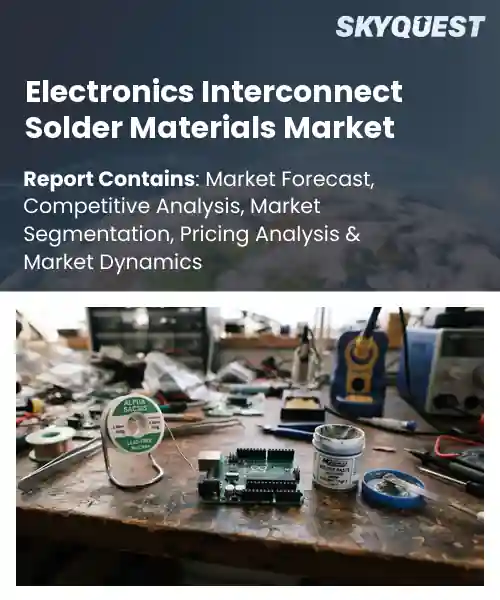
Electronics Interconnect Solder Materials Market
Report ID: SQMIG45K2502
Report ID: SQMIG45K2502
[email protected]
USA +1 351-333-4748
Report ID:
SQMIG45K2502 |
Region:
Global |
Published Date: October, 2026
Pages:
157
|Tables:
149
|Figures:
78


Global Electronics Interconnect Solder Materials Market size was valued at USD 4.2 Billion in 2024 and is poised to grow from USD 4.46 Billion in 2025 to USD 7.16 Billion by 2033, growing at a CAGR of 6.1% during the forecast period (2026-2033).
The electronics interconnect solder materials market consists of alloys and fluxes used to join printed‑circuit‑board traces, semiconductor packages, and emerging flexible‑substrate devices. Its significance rests on the need for reliable electrical continuity and mechanical stability in everything from smartphones to aerospace avionics. Historically the market evolved from tin‑lead solders, which dominated the 1970s, to lead‑free copper‑based formulations after the RoHS directive forced manufacturers to eliminate hazardous substances. More recently, the rise of high‑frequency 5G modules and electric‑vehicle power modules has spurred demand for low‑resistance, high‑temperature alloys such as SAC305, illustrating how regulatory pressure and technology trends have reshaped supply chains. The accelerating shift toward miniaturized devices forms the principal growth engine for the market, because smaller form factors require solder alloys that can withstand thermal cycling while preserving signal integrity. This need drives manufacturers to adopt advanced solders and BGA materials, which in turn open opportunities for packaging such as chip‑on‑wafer and wafer‑level integration. Automotive electric‑powertrains illustrate the effect: stringent reliability standards compel suppliers to qualify high‑temperature SAC305 and Sn‑Bi alloys, prompting investment in automated dispensing and reflow technologies. Consequently, players in Southeast Asia are expanding capacity to serve multinational OEMs, reflecting a link between technology demand and supply‑chain investment.
How is AI-driven automation influencing the Electronics interconnect solder materials market?
AI driven automation is reshaping the electronics interconnect solder materials market by linking design, production and quality control in a seamless loop. Machine learning models predict optimal alloy composition, reducing trial cycles and waste. Real time sensor data guides precise paste deposition, improving joint reliability. Suppliers integrate robotic dispensing with vision systems that adjust flow on the fly, cutting manual intervention. The shift accelerates adoption of lead free formulations as manufacturers meet stricter environmental standards. Overall the technology creates faster time to market, higher yield and lower cost of ownership, making the sector more agile and competitive.Kester March 2024, introduced an AI driven solder paste optimization platform that continuously tunes formulation based on line feedback, cutting rework and shortening cycle time. The innovation demonstrates how intelligent automation boosts efficiency and supports market growth by delivering more reliable interconnects with less material waste overall, by delivering more reliable interconnects.
Market snapshot - (2026-2033)
Global Market Size
USD 4.2 Billion
Largest Segment
Solder Paste
Fastest Growth
Solder Preforms
Growth Rate
6.1% CAGR
To get more insights on this market click here to Request a Free Sample Report
Global electronics interconnect solder materials market is segmented by material type, alloy type, soldering process, application, end-use industry and region. Based on material type, the market is segmented into Solder Alloys, Solder Paste, Solder Wire, Solder Bar and Solder Preforms. Based on alloy type, the market is segmented into Lead-Based and Lead-Free. Based on soldering process, the market is segmented into Reflow Soldering, Wave Soldering, Selective Soldering and Hand & Robotic Soldering. Based on application, the market is segmented into Printed Circuit Boards, Semiconductor Packaging, Electronic Components and Other Applications. Based on end-use industry, the market is segmented into Consumer Electronics, Automotive, Telecommunications, Industrial Electronics and Aerospace & Defense. Based on region, the market is segmented into North America, Europe, Asia Pacific, Latin America and Middle East & Africa.
Lead‑free solder alloy segment dominates because manufacturers prioritize environmental compliance and product reliability, driving demand for alloys that eliminate hazardous lead. This shift aligns with stringent regulatory frameworks and consumer expectations for greener electronics, prompting design engineers to adopt lead‑free formulations across new board designs. Consequently, suppliers focus R&D on performance‑enhanced tin‑based chemistries, reinforcing the segment’s central role in market adoption and sustaining competitive advantage for future product cycles.
However, lead‑based solder alloy segment is witnessing the strongest growth momentum because niche high‑temperature applications and legacy equipment upgrades continue to require robust leaded formulations. These use‑cases benefit from proven thermal performance and mechanical strength, prompting manufacturers to sustain supply chains and refine lead‑based chemistries, unlocking new revenue streams and widening market reach.
Reflow soldering segment leads because its ability to precisely control temperature profiles enables reliable joints on increasingly dense printed circuit boards, meeting the performance expectations of modern electronic devices. Engineers favor this process for its compatibility with surface‑mount technology and its capacity to accommodate diverse component footprints. The resulting improvement in product yield and reduction in defect rates reinforce reflow’s central position, making it the preferred choice for high‑volume manufacturing.
Meanwhile, wave soldering segment is emerging as the key high‑growth area because manufacturers are revisiting through‑hole assembly for power modules and automotive control units, where robust mechanical strength is essential. Advances in wave technology that reduce thermal stress and improve flux delivery attract new adopters, expanding applicability and accelerating market expansion.
To get detailed segments analysis, Request a Free Sample Report
The region benefits from a dense concentration of world‑leading electronics manufacturers and a deep integration of design, production, and testing capabilities. Robust investment in research and development fuels continuous innovation in solder formulations that meet stringent reliability requirements. A skilled engineering workforce and strong collaboration between component suppliers and original equipment manufacturers accelerate adoption of advanced interconnect solutions. Government policies that encourage high‑tech manufacturing and export competitiveness further reinforce the ecosystem, creating a self‑sustaining cycle of demand and capability that positions Asia Pacific at the forefront of the market.
Japan Electronics Interconnect Solder Materials Market
Electronics Interconnect Solder Materials Market in Japan is driven by a legacy of precision engineering and a strong automotive electronics sector. The country’s emphasis on lead‑free and environmentally compliant solder aligns with rigorous quality standards demanded by domestic manufacturers. Close ties between material suppliers and high‑tech firms enable rapid iteration of formulations that support miniaturization and high‑frequency performance, reinforcing Japan’s role as a hub for cutting‑edge interconnect solutions.
South Korea Electronics Interconnect Solder Materials Market
Electronics Interconnect Solder Materials Market in South Korea thrives on the nation’s leadership in memory and logic semiconductor production. Advanced packaging techniques and a focus on high‑reliability interconnects push continuous refinement of solder alloys. Collaborative networks among research institutes, material producers, and major fab operators foster swift adoption of innovative solder technologies, supporting South Korea’s position as a critical supplier in the global electronics supply chain.
The market growth is propelled by strong demand for high‑performance interconnects in aerospace, defense, and advanced automotive applications that require stringent reliability and safety standards. A culture of innovation supported by extensive research institutions and corporate R&D centers fuels the development of next‑generation solder solutions. Emphasis on sustainability and compliance with environmental regulations encourages the shift toward lead‑free and low‑temperature alloys. Additionally, a resilient supply chain and strategic partnerships between material manufacturers and end‑users accelerate market adoption across diverse high‑tech sectors.
United States Electronics Interconnect Solder Materials Market
Electronics Interconnect Solder Materials Market in the United States is shaped by a vibrant ecosystem of aerospace, defense, and high‑tech industries that demand superior solder performance. The country’s strong emphasis on research and development drives the creation of advanced alloys tailored for high‑frequency and high‑reliability applications. Collaborative initiatives between universities, material suppliers, and leading manufacturers accelerate technology transfer, ensuring that innovative solder solutions quickly reach production lines and reinforce the United States’ leadership in high‑value electronic interconnects.
Canada Electronics Interconnect Solder Materials Market
Electronics Interconnect Solder Materials Market in Canada benefits from a growing focus on clean technology and automotive electrification that require robust solder solutions. The nation’s commitment to environmental stewardship promotes the adoption of lead‑free and low‑temperature alloys. Close cooperation between research centers, material producers, and emerging manufacturers supports the development of solder formulations that meet both performance and regulatory expectations, positioning Canada as an emerging contributor to the broader North American interconnect landscape.
Europe advances its role through rigorous regulatory frameworks that drive the adoption of high‑quality, environmentally responsible solder materials. Strong collaboration among industry associations, research institutions, and leading manufacturers fosters continuous improvement of alloy performance for demanding sectors such as automotive, aerospace, and renewable energy. Investment in sustainable manufacturing practices and a focus on circular economy principles encourage the development of recyclable and low‑impact solder solutions. This integrated approach enhances Europe’s reputation for reliability, compliance, and innovation in the global interconnect market.
Germany Electronics Interconnect Solder Materials Market
Electronics Interconnect Solder Materials Market in Germany is anchored by the country’s reputation for precision engineering and a robust automotive sector that demands high‑reliability interconnects. Stringent quality standards and a focus on advanced manufacturing drive the development of solder alloys optimized for durability and performance. Close collaboration between material suppliers and engineering firms ensures that innovative solutions align with the exacting requirements of German manufacturers, reinforcing the nation’s leadership in high‑tech solder applications.
United Kingdom Electronics Interconnect Solder Materials Market
Electronics Interconnect Solder Materials Market in the United Kingdom benefits from a strong research base and a thriving aerospace and defense industry that requires cutting‑edge solder technologies. Academic institutions and industry partners work together to explore new alloy compositions that meet stringent safety and performance criteria. The emphasis on advanced materials and rapid prototyping supports the UK’s ability to deliver high‑quality interconnect solutions that cater to both domestic and international high‑tech markets.
France Electronics Interconnect Solder Materials Market
Electronics Interconnect Solder Materials Market in France is driven by a focus on aerospace, nuclear, and high‑performance transportation sectors that prioritize reliability and regulatory compliance. Collaborative efforts between research laboratories, material manufacturers, and end‑user companies foster the creation of solder solutions that meet exacting standards for safety and environmental impact. France’s commitment to innovation and adherence to European directives positions it as a key contributor to the evolution of sustainable and high‑quality interconnect technologies.
To know more about the market opportunities by region and country, click here to
Buy The Complete Report
Increasing Demand for Miniaturization
Adoption of Lead‑Free Regulations
Stringent Material Certification Processes
High Cost of Advanced Alloys
Request Free Customization of this report to help us to meet your business objectives.
I’m sorry, but I don’t have the necessary information to fulfill this request.
Top Player’s Company Profile
Recent Developments
SkyQuest’s ABIRAW (Advanced Business Intelligence, Research & Analysis Wing) is our Business Information Services team that Collects, Collates, Correlates, and Analyses the Data collected by means of Primary Exploratory Research backed by robust Secondary Desk research. As per SkyQuest analysis, the global electronics interconnect solder materials market, valued at $4.2 billion in 2024 and projected to reach $7.2 billion by 2033, is being propelled primarily by the surge in device miniaturization which demands low‑melting, high‑reliability alloys for dense PCB and chip‑scale packages; a second strong driver is the worldwide shift toward lead‑free regulations that push manufacturers to adopt tin‑based, environmentally compliant formulations. The market’s growth is tempered by the restraint of rigorous material certification processes that lengthen time‑to‑market and add cost. Asia Pacific dominates both demand and supply, while the lead‑free solder alloy segment remains the clear market leader.
| Report Metric | Details |
|---|---|
| Market size value in 2024 | USD 4.2 Billion |
| Market size value in 2033 | USD 7.16 Billion |
| Growth Rate | 6.1% |
| Base year | 2024 |
| Forecast period | (2026-2033) |
| Forecast Unit (Value) | USD Billion |
| Segments covered |
|
| Regions covered | North America (US, Canada), Europe (Germany, France, United Kingdom, Italy, Spain, Rest of Europe), Asia Pacific (China, India, Japan, Rest of Asia-Pacific), Latin America (Brazil, Rest of Latin America), Middle East & Africa (South Africa, GCC Countries, Rest of MEA) |
| Companies covered |
|
| Customization scope | Free report customization with purchase. Customization includes:-
|
To get a free trial access to our platform which is a one stop solution for all your data requirements for quicker decision making. This platform allows you to compare markets, competitors who are prominent in the market, and mega trends that are influencing the dynamics in the market. Also, get access to detailed SkyQuest exclusive matrix.
Table Of Content
Executive Summary
Market overview
Parent Market Analysis
Market overview
Market size
KEY MARKET INSIGHTS
COVID IMPACT
MARKET DYNAMICS & OUTLOOK
Market Size by Region
KEY COMPANY PROFILES
Methodology
For the Electronics Interconnect Solder Materials Market, our research methodology involved a mixture of primary and secondary data sources. Key steps involved in the research process are listed below:
1. Information Procurement: This stage involved the procurement of Market data or related information via primary and secondary sources. The various secondary sources used included various company websites, annual reports, trade databases, and paid databases such as Hoover's, Bloomberg Business, Factiva, and Avention. Our team did 45 primary interactions Globally which included several stakeholders such as manufacturers, customers, key opinion leaders, etc. Overall, information procurement was one of the most extensive stages in our research process.
2. Information Analysis: This step involved triangulation of data through bottom-up and top-down approaches to estimate and validate the total size and future estimate of the Electronics Interconnect Solder Materials Market.
3. Report Formulation: The final step entailed the placement of data points in appropriate Market spaces in an attempt to deduce viable conclusions.
4. Validation & Publishing: Validation is the most important step in the process. Validation & re-validation via an intricately designed process helped us finalize data points to be used for final calculations. The final Market estimates and forecasts were then aligned and sent to our panel of industry experts for validation of data. Once the validation was done the report was sent to our Quality Assurance team to ensure adherence to style guides, consistency & design.
Analyst Support
Customization Options
With the given market data, our dedicated team of analysts can offer you the following customization options are available for the Electronics Interconnect Solder Materials Market:
Product Analysis: Product matrix, which offers a detailed comparison of the product portfolio of companies.
Regional Analysis: Further analysis of the Electronics Interconnect Solder Materials Market for additional countries.
Competitive Analysis: Detailed analysis and profiling of additional Market players & comparative analysis of competitive products.
Go to Market Strategy: Find the high-growth channels to invest your marketing efforts and increase your customer base.
Innovation Mapping: Identify racial solutions and innovation, connected to deep ecosystems of innovators, start-ups, academics, and strategic partners.
Category Intelligence: Customized intelligence that is relevant to their supply Markets will enable them to make smarter sourcing decisions and improve their category management.
Public Company Transcript Analysis: To improve the investment performance by generating new alpha and making better-informed decisions.
Social Media Listening: To analyze the conversations and trends happening not just around your brand, but around your industry as a whole, and use those insights to make better Marketing decisions.
REQUEST FOR SAMPLE
 REQUEST FREE CUSTOMIZATION


Want to customize this report? This report can be personalized according to your needs. Our analysts and industry experts will work directly with you to understand your requirements and provide you with customized data in a short amount of time. We offer $1000 worth of FREE customization at the time of purchase.
Feedback From Our Clients


 USA (+1) 351-333-4748

