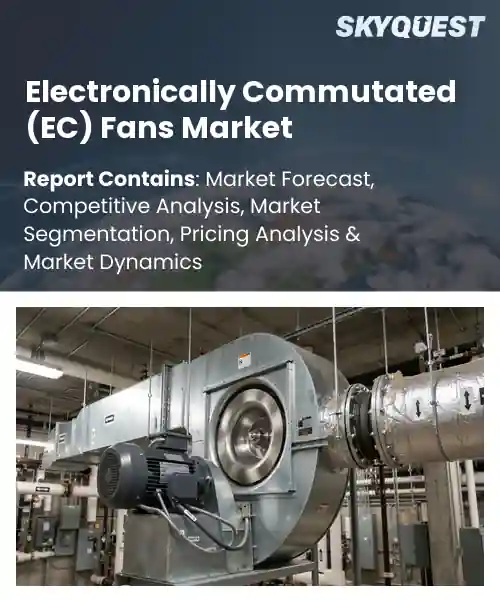
Electronically Commutated (EC) Fans Market
Report ID: SQMIG20B2322
Report ID: SQMIG20B2322
[email protected]
USA +1 351-333-4748
Report ID:
SQMIG20B2322 |
Region:
Global |
Published Date: August, 2026
Pages:
157
|Tables:
120
|Figures:
77


Global Electronically Commutated (Ec) Fans Market size was valued at USD 3.21 Billion in 2024 and is poised to grow from USD 3.38 Billion in 2025 to USD 5.13 Billion by 2033, growing at a CAGR of 5.34% during the forecast period (2026-2033).
Electronically commutated EC fans, which replace traditional brushed motors with brushless DC technology, constitute an expanding niche within HVAC and industrial ventilation sectors. Their importance stems from the ability to deliver up to 70 percent energy savings while maintaining airflow control, a characteristic that aligns with efficiency standards. The market emerged in the early 2000s as manufacturers responded to rising electricity costs and mandates such as the U.S. Energy Policy Act. Over the past decade, adoption accelerated in data centers, commercial buildings, and automotive cooling systems, illustrating a significant shift from legacy AC induction fans to smarter, environmentally greener alternatives. The principal growth catalyst for the global EC fans market is the convergence of energy‑efficiency rules with controls that enable predictive maintenance and adaptive airflow. As buildings pursue Net‑Zero certifications, designers select fans programmable through Building Management Systems to cut consumption during off‑peak periods, directly lowering costs. This pressure prompts manufacturers to embed IoT sensors, creating data streams that forecast motor wear and trigger replacements, which shortens downtime for facilities such as hospitals and data centers. Consequently, the market expands into automotive electrification, where EC fans cool battery packs with minimal loss, opening revenue streams and reinforcing the sustainability narrative.
How is IoT integration shaping demand for EC fans in industrial applications?
IoT integration is turning EC fans into smart components that can be monitored and controlled in real time. Sensors embedded in the motors feed data on speed, temperature and power use to a cloud platform where algorithms detect inefficiencies and predict failures. This visibility lets plant managers fine‑tune airflow to match process demands, cut energy waste and avoid costly downtime. Industrial sectors such as manufacturing, data centers and HVAC are adopting networked fans to meet tighter sustainability goals while maintaining high reliability. The ability to link fan performance with broader building management systems creates a feedback loop that continuously optimises operation and extends equipment life.LongwellFans, 2026, launched an IoT‑enabled EC fan series that streams performance metrics to a central dashboard, demonstrating how connected hardware can boost efficiency and drive market adoption.
Market snapshot - (2026-2033)
Global Market Size
USD 3.21 Billion
Largest Segment
Non-Invasive Transcutaneous Devices
Fastest Growth
Implantable Electroceutical Devices
Growth Rate
5.34% CAGR
To get more insights on this market click here to Request a Free Sample Report
Global electronically commutated (ec) fans market is segmented by product type, voltage, application, end user and region. Based on product type, the market is segmented into Axial Fans, Centrifugal Fans, Cross-Flow Fans and Other Fan Types. Based on voltage, the market is segmented into AC and DC. Based on application, the market is segmented into HVAC, Refrigeration, Data Centers, Industrial Equipment, Residential Appliances and Other Applications. Based on end user, the market is segmented into Residential, Commercial and Industrial. Based on region, the market is segmented into North America, Europe, Asia Pacific, Latin America and Middle East & Africa.
Axial fans segment dominates because its geometry and high airflow efficiency align perfectly with the energy saving goals of modern EC fan designs. The straight through flow reduces pressure losses, enabling lower motor currents and extended lifespan. Manufacturers favor axial configurations for cost effective production, and end users appreciate easy integration into existing housings. These attributes collectively drive widespread adoption across diverse applications, cementing its leadership in the EC fans market.
Meanwhile, centrifugal fans segment is emerging as the key high growth area because its ability to generate higher static pressure suits increasingly stringent HVAC and data center cooling requirements. Innovations in blade geometry and sensor controls are unlocking superior performance, prompting system designers to replace solutions and accelerating market expansion.
DC voltage segment leads because EC fans powered by current can exploit speed drives that precisely match airflow to load, delivering superior energy efficiency. The inherent compatibility with renewable power sources and battery back up systems reduces reliance on converters, simplifying system architecture. These benefits attract OEMs seeking greener solutions, reinforcing DC’s prominence in the EC fan ecosystem. Additionally, heat generation improves reliability in compact installations, further driving adoption across sectors.
On the other hand, AC voltage segment is witnessing the strongest growth momentum because infrastructure remains AC centric, prompting manufacturers to develop EC fans with AC drives that simplify retrofits. Advances in factor correction and noise reduction make AC based EC fans attractive for upgrades, spurring market penetration and creating opportunities.
To get detailed segments analysis, Request a Free Sample Report
North America’s leadership in the EC fans market stems from a confluence of mature manufacturing ecosystems, aggressive energy‑efficiency standards, and deep integration of EC technology across commercial, industrial, and residential applications. The United States and Canada host a concentration of original equipment manufacturers and component suppliers that benefit from advanced engineering capabilities and robust supply chains. Regulatory frameworks that prioritize reduced power consumption drive early adoption, while large‑scale HVAC and data‑center projects provide a steady demand pipeline. Investment in research and development fuels continuous product innovation, reinforcing the region’s ability to deliver high‑performance, reliable solutions that meet stringent performance criteria. This combination of policy support, technical expertise, and market scale sustains North America’s dominant position.
United States Electronically Commutated (EC) Fans Market
Electronically Commutated (EC) Fans Market in the United States is propelled by a vast industrial base that seeks high‑efficiency airflow solutions for manufacturing, data‑centers, and commercial buildings. Strong OEM presence and a culture of sustainability encourage rapid integration of EC technology. Government incentives for green building certifications further accelerate adoption, while a well‑established distribution network ensures timely delivery of advanced fan systems to end users across the country.
Canada Electronically Commutated (EC) Fans Market
Electronically Commutated (EC) Fans Market in Canada benefits from a national emphasis on energy conservation and climate‑responsive design. Cold‑climate requirements drive demand for reliable, low‑power fans in residential and commercial heating, ventilation, and air‑conditioning systems. Federal and provincial programs that reward energy‑efficient upgrades create a supportive environment for EC fan deployment. Local manufacturers collaborate closely with research institutions, fostering innovation that aligns with Canada’s broader sustainability objectives.
Europe’s rapid expansion of the EC fans market is anchored in stringent energy‑efficiency directives, ambitious carbon‑reduction targets, and a strong tradition of engineering excellence. The region’s diverse industrial landscape—from automotive and aerospace to building services—creates multiple avenues for EC fan integration. Policy frameworks that mandate lower power consumption in HVAC and industrial equipment stimulate early adoption, while a dense network of specialized manufacturers accelerates product development. Collaborative research initiatives across borders enhance technology transfer, and the focus on retrofitting existing infrastructure with smart, low‑energy solutions further fuels market momentum, positioning Europe as a hub of innovation and growth for EC fan technologies.
Germany Electronically Commutated (EC) Fans Market
Electronically Commutated (EC) Fans Market in Germany is driven by a robust engineering sector and a national commitment to energy efficiency. The country’s strong automotive and industrial machinery industries demand high‑performance, low‑energy airflow solutions, encouraging widespread EC fan adoption. Government programs that support green building standards and industrial retrofits create a favorable environment, while a dense cluster of specialized component suppliers ensures rapid innovation and supply chain resilience.
United Kingdom Electronically Commutated (EC) Fans Market
Electronically Commutated (EC) Fans Market in the United Kingdom is experiencing accelerated growth due to aggressive sustainability policies and a thriving construction sector focused on net‑zero building standards. The push for smart, energy‑saving HVAC systems in commercial and residential projects drives demand for EC fans. Collaborative research hubs and a proactive regulatory landscape promote early integration of advanced fan technologies, positioning the United Kingdom as a leading growth engine within the European market.
France Electronically Commutated (EC) Fans Market
Electronically Commutated (EC) Fans Market in France is emerging as a focal point for energy‑saving initiatives within the building and industrial sectors. National incentives for low‑carbon renovations and a growing emphasis on smart city projects stimulate interest in EC fan solutions. French manufacturers are increasingly aligning with European research consortia, fostering innovation that meets the country’s evolving efficiency standards and supports the gradual expansion of EC fan deployment across diverse applications.
Asia Pacific is strengthening its position in the EC fans market through a combination of rapid industrialization, heightened focus on energy conservation, and expanding smart‑building initiatives. Nations such as Japan and South Korea are investing heavily in advanced manufacturing and green technology, creating a fertile environment for EC fan integration across data‑centers, automotive production, and high‑rise construction. Government policies that encourage low‑power solutions and provide incentives for retrofitting legacy systems accelerate market uptake. The region’s strong component‑supply capabilities and close collaboration between OEMs and research institutions drive continuous product refinement, enabling the delivery of highly efficient, reliable fan systems that meet the diverse needs of a growing customer base.
Japan Electronically Commutated (EC) Fans Market
Electronically Commutated (EC) Fans Market in Japan is propelled by a mature manufacturing ecosystem and a national agenda focused on carbon neutrality. High‑rise commercial buildings and extensive data‑center infrastructure demand low‑energy airflow solutions, fostering strong adoption of EC fans. Government incentives for energy‑efficient retrofits and a culture of continuous improvement support ongoing market expansion. Collaboration between leading electronics firms and research universities accelerates innovation, ensuring that Japanese EC fan offerings remain at the forefront of performance and reliability.
South Korea Electronically Commutated (EC) Fans Market
Electronically Commutated (EC) Fans Market in South Korea benefits from a dynamic technology sector and aggressive sustainability targets. The country’s emphasis on smart factories and energy‑efficient HVAC systems in urban developments drives demand for advanced EC fan solutions. Public policies that reward low‑power consumption and support domestic component production reinforce market growth. Partnerships between major manufacturers and research institutes foster rapid development of high‑efficiency fan designs, positioning South Korea as a key contributor to the region’s expanding EC fan landscape.
To know more about the market opportunities by region and country, click here to
Buy The Complete Report
Energy Efficiency Regulations
Growing Demand For Smart Buildings
High Initial Cost Of EC Fans
Complex Integration With Legacy Systems
Request Free Customization of this report to help us to meet your business objectives.
The EC fan market is shaped by intense competition among established manufacturers and emerging innovators, with technology upgrades and strategic collaborations driving differentiation. ebm‑papst has accelerated product development by launching a new brushless EC motor series in 2025, while also forming a supply‑chain partnership to enhance component sourcing efficiency. These moves intensify rivalry and push the market toward higher energy‑saving standards and faster time‑to‑market for advanced fan solutions.
Top Player’s Company Profile
Recent Developments
SkyQuest’s ABIRAW (Advanced Business Intelligence, Research & Analysis Wing) is our Business Information Services team that Collects, Collates, Correlates, and Analyses the Data collected by means of Primary Exploratory Research backed by robust Secondary Desk research. As per SkyQuest analysis the global EC fans market is being propelled primarily by stringent energy‑efficiency regulations that push manufacturers and users toward brushless technology, while a second important driver is the rapid rise of smart‑building initiatives that demand IoT‑connected fans for real‑time control and predictive maintenance. The market is led by North America, where mature supply chains and aggressive standards foster the highest adoption rates, and axial fans remain the dominant segment because their geometry delivers superior airflow efficiency and lower power use. However, high upfront costs continue to restrain wider uptake, especially in cost‑sensitive projects, tempering the overall growth pace.
| Report Metric | Details |
|---|---|
| Market size value in 2024 | USD 3.21 Billion |
| Market size value in 2033 | USD 5.13 Billion |
| Growth Rate | 5.34% |
| Base year | 2024 |
| Forecast period | (2026-2033) |
| Forecast Unit (Value) | USD Billion |
| Segments covered |
|
| Regions covered | North America (US, Canada), Europe (Germany, France, United Kingdom, Italy, Spain, Rest of Europe), Asia Pacific (China, India, Japan, Rest of Asia-Pacific), Latin America (Brazil, Rest of Latin America), Middle East & Africa (South Africa, GCC Countries, Rest of MEA) |
| Companies covered |
|
| Customization scope | Free report customization with purchase. Customization includes:-
|
To get a free trial access to our platform which is a one stop solution for all your data requirements for quicker decision making. This platform allows you to compare markets, competitors who are prominent in the market, and mega trends that are influencing the dynamics in the market. Also, get access to detailed SkyQuest exclusive matrix.
Table Of Content
Executive Summary
Market overview
Parent Market Analysis
Market overview
Market size
KEY MARKET INSIGHTS
COVID IMPACT
MARKET DYNAMICS & OUTLOOK
Market Size by Region
KEY COMPANY PROFILES
Methodology
For the Electronically Commutated (EC) Fans Market, our research methodology involved a mixture of primary and secondary data sources. Key steps involved in the research process are listed below:
1. Information Procurement: This stage involved the procurement of Market data or related information via primary and secondary sources. The various secondary sources used included various company websites, annual reports, trade databases, and paid databases such as Hoover's, Bloomberg Business, Factiva, and Avention. Our team did 45 primary interactions Globally which included several stakeholders such as manufacturers, customers, key opinion leaders, etc. Overall, information procurement was one of the most extensive stages in our research process.
2. Information Analysis: This step involved triangulation of data through bottom-up and top-down approaches to estimate and validate the total size and future estimate of the Electronically Commutated (EC) Fans Market.
3. Report Formulation: The final step entailed the placement of data points in appropriate Market spaces in an attempt to deduce viable conclusions.
4. Validation & Publishing: Validation is the most important step in the process. Validation & re-validation via an intricately designed process helped us finalize data points to be used for final calculations. The final Market estimates and forecasts were then aligned and sent to our panel of industry experts for validation of data. Once the validation was done the report was sent to our Quality Assurance team to ensure adherence to style guides, consistency & design.
Analyst Support
Customization Options
With the given market data, our dedicated team of analysts can offer you the following customization options are available for the Electronically Commutated (EC) Fans Market:
Product Analysis: Product matrix, which offers a detailed comparison of the product portfolio of companies.
Regional Analysis: Further analysis of the Electronically Commutated (EC) Fans Market for additional countries.
Competitive Analysis: Detailed analysis and profiling of additional Market players & comparative analysis of competitive products.
Go to Market Strategy: Find the high-growth channels to invest your marketing efforts and increase your customer base.
Innovation Mapping: Identify racial solutions and innovation, connected to deep ecosystems of innovators, start-ups, academics, and strategic partners.
Category Intelligence: Customized intelligence that is relevant to their supply Markets will enable them to make smarter sourcing decisions and improve their category management.
Public Company Transcript Analysis: To improve the investment performance by generating new alpha and making better-informed decisions.
Social Media Listening: To analyze the conversations and trends happening not just around your brand, but around your industry as a whole, and use those insights to make better Marketing decisions.
REQUEST FOR SAMPLE
 REQUEST FREE CUSTOMIZATION


Want to customize this report? This report can be personalized according to your needs. Our analysts and industry experts will work directly with you to understand your requirements and provide you with customized data in a short amount of time. We offer $1000 worth of FREE customization at the time of purchase.
Feedback From Our Clients


 USA (+1) 351-333-4748

