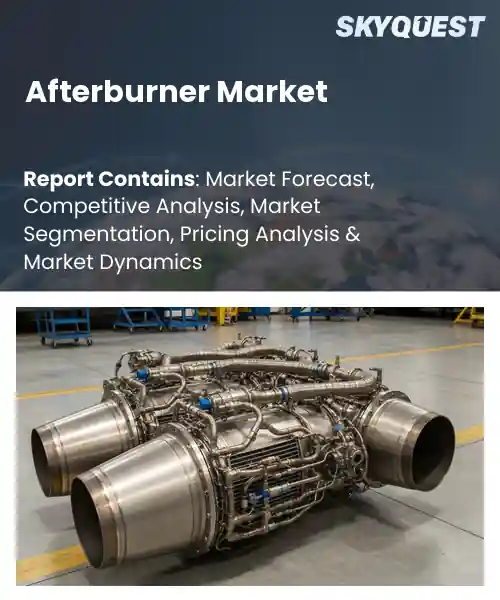
Afterburner Market
Report ID: SQMIG20A2630
Report ID: SQMIG20A2630
[email protected]
USA +1 351-333-4748
Report ID:
SQMIG20A2630 |
Region:
Global |
Published Date: June, 2026
Pages:
157
|Tables:
143
|Figures:
78


Global Afterburner Market size was valued at USD 180.0 Million in 2024 and is poised to grow from USD 195.3 Million in 2025 to USD 375.09 Million by 2033, growing at a CAGR of 8.5% during the forecast period (2026-2033).
The primary driver has been sustained defense modernization and geopolitical tensions that compel nations to field faster, more maneuverable platforms, and this has shaped demand over decades. Initially propelled by Cold War era supersonic fighters such as the F-4 and MiG families, the market evolved through technological refinements in materials, fuel control and integration with turbofan cores. OEM consolidation and rising aftermarket services have professionalized the supply chain and raised lifecycle value.
Principal growth factor for the global afterburner market is rising defense procurement and retrofit programs because nations respond to regional tensions by upgrading air combat capabilities, which directly increases orders for OEM installations and aftermarket overhauls. This dynamic creates opportunities in MRO, composite liners, advanced fuel metering and digital control systems that reduce thermal stress while preserving thrust output, enabling cost-effective fleet extension as seen in F-16 upgrade initiatives and carrier aircraft requiring short takeoff power. Simultaneously, advances in materials and control electronics cause demand for lighter, more responsive afterburners used in new-generation fighters and unmanned systems, expanding supplier margins.
How is AI improving performance and reliability in the afterburner market?
Artificial Intelligence enhances performance and reliability in the afterburner sector by facilitating intelligent design, real-time control, and predictive maintenance. Essential elements encompass sensor fusion for combustion oversight, machine learning for degradation detection, digital twins for simulating transient reheat dynamics, and generative design tools to expedite combustor development. Engine original equipment manufacturers and maintenance, repair, and overhaul suppliers employ artificial intelligence to consolidate fleet data, minimize unplanned downtime, and enhance control maps for improved combustion stability throughout various flight regimes. These advancements enhance operational preparedness and streamline sustainment, hence rendering afterburner systems more reliable in service.
In March 2026, GE Aerospace expanded their AI relationship to enhance military aircraft readiness, directly facilitating propulsion sustainment. Utilizing AI in supply chain and maintenance processes facilitates early failure detection and enhances parts availability for afterburner subsystems, hence increasing fleet availability and lifecycle efficiency.
Market snapshot - (2026-2033)
Global Market Size
USD 180.0 Million
Largest Segment
Turbofan Engine
Fastest Growth
Turbofan Engine
Growth Rate
8.5% CAGR
To get more insights on this market click here to Request a Free Sample Report
Global afterburner market is segmented by engine type, aircraft type, application, technology, end-use and region. Based on engine type, the market is segmented into Turbofan Engine and Turbojet Engine. Based on aircraft type, the market is segmented into Air Superiority Fighter, Interceptor Aircraft and Light Fighter. Based on application, the market is segmented into Combat Operations, Flight Training, Transport Aircraft and Passenger Aircraft. Based on technology, the market is segmented into Digital Afterburners, Analog Afterburners and Hybrid Afterburners. Based on end-use, the market is segmented into Military Aviation and Commercial Aviation. Based on region, the market is segmented into North America, Europe, Asia Pacific, Latin America and Middle East & Africa.
Turbofan engine segment dominates with large afterburner market share because its engine architecture provides the pressure balance and bypass characteristics that enable stable afterburner ignition and sustained high-thrust operation across diverse mission profiles. Enhanced thermal and airflow management supports integration of advanced nozzle designs and fuel delivery systems, lowering operational risk and easing maintenance. Strong alignment with contemporary airframe designs and established OEM supply chains further reinforces procurement preference and continuous development for optimized afterburner performance.
As per afterburner market outlook, turbojet engine is the most rapidly expanding segment as its simpler, high specific thrust architecture suits lightweight interceptors and upgraded legacy platforms. Growing interest in high-speed point defense, experimental platforms, and certain unmanned systems is driving targeted adoption, while lower integration complexity and retrofit potential accelerate aftermarket conversions and open niche opportunities for focused afterburner innovation.
As per afterburner market forecast, digital afterburners segment dominates due to sophisticated electronic control, which facilitates accurate fuel metering and nozzle modulation, hence optimizing thrust and fuel consumption throughout mission phases, enhancing operating efficiency and responsiveness. The seamless interface with engine control systems and diagnostics minimizes maintenance downtime and facilitates predictive servicing, while software-driven calibration permits expedited configuration modifications. These capabilities align with operator requirements for performance, reliability, and lifecycle cost reduction, facilitating implementation in both new constructions and retrofit projects.
As per afterburner market analysis, hybrid afterburners are emerging as the fastest growing segment due to their integration of digital control benefits with established analog reliability, attracting operators who seek to balance modernity and cost. Incremental enhancements of hybrid architectures facilitate gradual integration into current fleets, promote supplier innovation, and establish retrofit markets where complete digital conversion may be fiscally or technically limited.
To get detailed segments analysis, Request a Free Sample Report
North America leads the afterburner market because to the concentration of innovative aerospace initiatives, cohesive defense procurement, and proximity to prominent engine manufacturers and system integrators. An advanced supply chain environment, robust aftermarket support capabilities, and significant investment in operational preparedness facilitate the swift deployment of enhanced propulsion augmentation technologies. Joint research between industry and military end customers expedites the implementation of performance advancements and reliability improvements. Strong regulatory frameworks and established maintenance, repair, and overhaul networks enhance market leadership by mitigating lifecycle risk and promoting technology transfer across commercial and defense sectors. Comprehensive testing facilities, a proficient personnel, and procurement methods that prioritize proven performance systems foster an environment conducive to rapid incremental advancements. Diversity in the supply base and the existence of specialized component manufacturers provide adaptation for diverse platform requirements, while robust spare parts logistics guarantee availability throughout operational theaters.
As per afterburner market regional outlook, United States thrives due to its profound integration with prominent engine manufacturers, extensive defense initiatives, and robust MRO networks that emphasize performance improvements and reliability advances. A culture of iterative invention, comprehensive flight test infrastructure, and robust supplier ecosystems facilitate quick prototyping and deployment. Strong relationships between original equipment manufacturers and operators enable customized solutions across many platforms, sustaining demand for enhanced afterburner system capabilities.
As per afterburner market regional forecast, Canada capitalizes on robust connections between national defense procurement initiatives and specialist providers, promoting collaboration on enhancements in dependability and sustainment. Focus on flexible integration and maintenance strategies facilitates exportable solutions and compatibility with partner fleets. A proficient engineering team and targeted investment in qualification testing enable Canadian operators to use advanced propulsion augmentation technology while ensuring compatibility with diverse airframe configurations for military and commercial missions and lifecycle support.
As per afterburner industry analysis, the expansion in the Asia Pacific region is propelled by concentrated modernization initiatives, enhanced indigenous engine development capabilities, and a strategic emphasis on platform performance among regional air forces. Japan and South Korea have developed sophisticated manufacturing ecosystems and precision engineering capabilities that facilitate the creation and integration of propulsion augmentation technologies. Enhanced coordination between local prime contractors and multinational suppliers expedites technology transfer and adaption to regional platform requirements. The increasing focus on interoperability, sustainment efficiency, and competitive export positioning promotes investment in upgradeable afterburner modules and servicing infrastructure, while existing test facilities and skilled labor pools facilitate expedited qualification and operational deployment. Policy endorsement for domestic industry competencies and export enhancement, coupled with the desire for lifecycle cost reductions, compels local enterprises to implement modular afterburner designs. The focus on digital engineering, supplier networks, and localized MRO hubs enhances market expansion and strengthens regional supply chain resilience.
Japan benefits from a mature precision manufacturing base, strong avionics and engine systems expertise, and close collaboration between established manufacturers and research institutes. A focus on high quality standards and incremental innovation supports integration of refined propulsion augmentation technologies into national platforms. Local supply chains provide specialized components and advanced testing capabilities, enabling tailored solutions that meet stringent reliability expectations and support export oriented partnerships across the region.
South Korea is shaped by a rapidly developing defense industrial base, emphasis on domestic propulsion programs, and strong collaboration with international technology partners. Local system integrators and component manufacturers focus on adaptable solutions that align with national modernization priorities and export competitiveness. Investment in testing infrastructure and skilled engineering teams supports qualification and integration, enabling tailored afterburner configurations for a range of national and partner platform requirements.
Europe is reinforcing its role in the afterburner market through concentrated industrial expertise, collaborative development across borders, and established original equipment manufacturers with deep propulsion knowledge. Germany, United Kingdom, and France lead technical advancement via joint programs, shared test capabilities, and aligned certification practices that ease cross national integration and deployment. Emphasis on sustainment, component standardization, and comprehensive aftermarket services enhances lifecycle value while partnerships between primes and specialist suppliers foster modular, upgradeable solutions. A dense network of small and medium enterprises supplies niche technologies in combustion, sensing, and materials, and investment in digital engineering supports efficient qualification and retrofit on legacy platforms for international customers. Regulatory alignment and pooled procurement approaches across partners reduce duplication and enable economies in qualification, while growing attention to efficiency and emissions shapes development priorities toward lower risk, higher reliability systems that appeal to both domestic operators and export markets.
Germany is supported by a robust aerospace supply chain, leading propulsion research centers, and established manufacturers focused on high performance systems. Emphasis on engineering rigor, advanced materials, and precision manufacturing enables development of reliable, high quality afterburner assemblies. Strong collaboration between primes and specialized suppliers facilitates modular design and efficient qualification pathways, while comprehensive aftermarket services and test capabilities support operational readiness for domestic and partner fleets.
United Kingdom draws on aerospace capabilities, integrated defense procurement programs, and a strong cluster of specialist component makers. Focus on systems integration, test validation, and lifecycle support enables delivery of performance oriented afterburner upgrades tailored to varied platform requirements. Collaboration between primes, research institutions, and maintenance providers strengthens qualification processes and aftermarket services, supporting operational availability while international partnerships extend the reach of developed propulsion augmentation solutions.
France is advantageous due to established aerospace primes, concentrated propulsion research, and integrated defense programs that emphasize performance and sustainment. National engineers and specialized suppliers provide experience in combustion systems, materials, and validation testing, facilitating the development of resilient afterburner designs. Focusing on export coordination, maintenance networks, and synchronized qualification paths facilitates the adaption of solutions to partner fleet needs, while guaranteeing robust aftermarket support and operational continuity across various mission profiles.
To know more about the market opportunities by region and country, click here to
Buy The Complete Report
Defense Modernization and Demand
Commercial Aviation Performance Needs
Environmental Emissions and Regulatory Pressure
High Operating and Lifecycle Costs
Request Free Customization of this report to help us to meet your business objectives.
Competitive landscape is concentrated among legacy engine OEMs and nimble propulsion startups, driven by defense modernization and a global hypersonic race that elevates afterburner relevance. Companies pursue M&A and joint ventures such as the Safran MTU collaboration for future combat engines, incumbents deploy additive manufacturing to shorten afterburner development cycles, and startups partner on hydrogen afterburner testbeds as seen with Destinus and ITP Aero.
SkyQuest’s ABIRAW (Advanced Business Intelligence, Research & Analysis Wing) is our Business Information Services team that Collects, Collates, Correlates, and Analyses the Data collected by means of Primary Exploratory Research backed by robust Secondary Desk research.
As per SkyQuest analysis, the global afterburner market growth is being driven primarily by rising defense procurement and retrofit programs that push demand for thrust augmentation systems, while a secondary driver is AI-enabled design, control and predictive maintenance improving performance and availability. Environmental emissions and tightening regulatory pressure remain a key restraint, constraining operational use and procurement. North America continues to dominate the market due to concentrated aerospace programs, OEM presence and mature MRO networks, with turbofan engines representing the leading segment due to their favorable architecture for stable afterburner integration. Suppliers benefit from material advances, digital diagnostics and retrofit opportunities that support sustained market growth. The global afterburner market trend driven by rising investments in military aviation modernization programs, increasing procurement of advanced fighter aircraft, and growing demand for high-thrust propulsion systems.
| Report Metric | Details |
|---|---|
| Market size value in 2024 | USD 180.0 Million |
| Market size value in 2033 | USD 375.09 Million |
| Growth Rate | 8.5% |
| Base year | 2024 |
| Forecast period | (2026-2033) |
| Forecast Unit (Value) | USD Million |
| Segments covered |
|
| Regions covered | North America (US, Canada), Europe (Germany, France, United Kingdom, Italy, Spain, Rest of Europe), Asia Pacific (China, India, Japan, Rest of Asia-Pacific), Latin America (Brazil, Rest of Latin America), Middle East & Africa (South Africa, GCC Countries, Rest of MEA) |
| Companies covered |
|
| Customization scope | Free report customization with purchase. Customization includes:-
|
To get a free trial access to our platform which is a one stop solution for all your data requirements for quicker decision making. This platform allows you to compare markets, competitors who are prominent in the market, and mega trends that are influencing the dynamics in the market. Also, get access to detailed SkyQuest exclusive matrix.
Table Of Content
Executive Summary
Market overview
Parent Market Analysis
Market overview
Market size
KEY MARKET INSIGHTS
COVID IMPACT
MARKET DYNAMICS & OUTLOOK
Market Size by Region
KEY COMPANY PROFILES
Methodology
For the Afterburner Market, our research methodology involved a mixture of primary and secondary data sources. Key steps involved in the research process are listed below:
1. Information Procurement: This stage involved the procurement of Market data or related information via primary and secondary sources. The various secondary sources used included various company websites, annual reports, trade databases, and paid databases such as Hoover's, Bloomberg Business, Factiva, and Avention. Our team did 45 primary interactions Globally which included several stakeholders such as manufacturers, customers, key opinion leaders, etc. Overall, information procurement was one of the most extensive stages in our research process.
2. Information Analysis: This step involved triangulation of data through bottom-up and top-down approaches to estimate and validate the total size and future estimate of the Afterburner Market.
3. Report Formulation: The final step entailed the placement of data points in appropriate Market spaces in an attempt to deduce viable conclusions.
4. Validation & Publishing: Validation is the most important step in the process. Validation & re-validation via an intricately designed process helped us finalize data points to be used for final calculations. The final Market estimates and forecasts were then aligned and sent to our panel of industry experts for validation of data. Once the validation was done the report was sent to our Quality Assurance team to ensure adherence to style guides, consistency & design.
Analyst Support
Customization Options
With the given market data, our dedicated team of analysts can offer you the following customization options are available for the Afterburner Market:
Product Analysis: Product matrix, which offers a detailed comparison of the product portfolio of companies.
Regional Analysis: Further analysis of the Afterburner Market for additional countries.
Competitive Analysis: Detailed analysis and profiling of additional Market players & comparative analysis of competitive products.
Go to Market Strategy: Find the high-growth channels to invest your marketing efforts and increase your customer base.
Innovation Mapping: Identify racial solutions and innovation, connected to deep ecosystems of innovators, start-ups, academics, and strategic partners.
Category Intelligence: Customized intelligence that is relevant to their supply Markets will enable them to make smarter sourcing decisions and improve their category management.
Public Company Transcript Analysis: To improve the investment performance by generating new alpha and making better-informed decisions.
Social Media Listening: To analyze the conversations and trends happening not just around your brand, but around your industry as a whole, and use those insights to make better Marketing decisions.
REQUEST FOR SAMPLE
 REQUEST FREE CUSTOMIZATION
Global Afterburner Market size was valued at USD 180.0 Million in 2024 and is poised to grow from USD 195.3 Million in 2025 to USD 375.09 Million by 2033, growing at a CAGR of 8.5% during the forecast period (2026-2033).
Competitive landscape is concentrated among legacy engine OEMs and nimble propulsion startups, driven by defense modernization and a global hypersonic race that elevates afterburner relevance. Companies pursue M&A and joint ventures such as the Safran MTU collaboration for future combat engines, incumbents deploy additive manufacturing to shorten afterburner development cycles, and startups partner on hydrogen afterburner testbeds as seen with Destinus and ITP Aero. 'General Electric Aviation', 'Pratt & Whitney', 'Rolls-Royce plc', 'Safran Aircraft Engines', 'Honeywell Aerospace', 'MTU Aero Engines', 'Eurojet GmbH', 'Klimov (UEC)', 'Aviadvigatel', 'Kawasaki Heavy Industries', 'IHI Corporation', 'HAL (Hindustan Aeronautics Limited)', 'Rostec', 'Snecma', 'Boeing Defense', 'Lockheed Martin', 'Northrop Grumman', 'BAE Systems', 'Raytheon Technologies', 'United Engine Corporation'
Defense modernization programs across many nations are prioritizing upgrades to tactical aircraft and engine capabilities, which increases demand for advanced afterburner systems. Manufacturers incorporate afterburners to deliver short burst high thrust necessary for certain mission profiles, prompting procurement and retrofit activity. Collaborative development between engine makers and defense contractors supports integration and sustainment, while logistics and aftermarket support expand as fleets remain operational. The combined effect of program prioritization, capability requirements, and support infrastructure encourages investment in afterburner technologies and supplier capacity.
Advanced Materials Adoption: Suppliers and manufacturers increasingly adopt advanced materials like high temperature alloys, ceramic composites and additive manufactured parts to improve afterburner durability, reduce weight and extend maintenance intervals. This transition supports more compact designs, greater thermal resilience and better compatibility with varied fuel types, enabling extended operational availability and lower unplanned downtime. Collaboration among material scientists, system integrators and suppliers is accelerating component qualification and supply chain adjustment, creating opportunities for differentiated product offerings and sustained lifecycle performance improvements and reliability.
Why does North America Dominate the Global Afterburner Market? |@12


Want to customize this report? This report can be personalized according to your needs. Our analysts and industry experts will work directly with you to understand your requirements and provide you with customized data in a short amount of time. We offer $1000 worth of FREE customization at the time of purchase.
Feedback From Our Clients


 USA (+1) 351-333-4748

