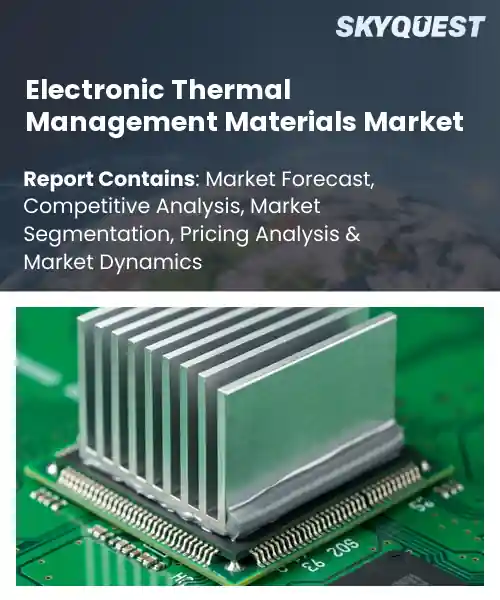
Electronic Thermal Management Materials Market
Report ID: SQMIG15E3477
Report ID: SQMIG15E3477
[email protected]
USA +1 351-333-4748
Report ID:
SQMIG15E3477 |
Region:
Global |
Published Date: May, 2026
Pages:
157
|Tables:
192
|Figures:
79


Global Electronic Thermal Management Materials Market size was valued at USD 6.3 Billion in 2024 and is poised to grow from USD 6.8 Billion in 2025 to USD 12.49 Billion by 2033, growing at a CAGR of 7.9% during the forecast period (2026-2033).
The electronic thermal management materials market growth is greatly affected by increasing consumer electronics, telecom, & electric vehicle power density, which creates a demand for products that can effectively manage heat to support reliable performance. Materials including thermal interface materials, phase-change materials, heat spreaders and vapor chambers serve to connect cooling systems and components; since excessive heat leads to increased failure rates, throttling, and safety issues. Historically, the market has shifted from using metal heatsinks and fans to using engineered composite and nano-fillers, following the trend towards smaller processors and battery packs, such as vapor chambers used as part of smartphone cooling systems or conductive pads installed in electric vehicle battery modules.
The end-markets being electrified and digitized are driving global thermal management solutions. This is because higher computer and powertrain thermal densities are creating a greater need for materials that manage heat efficiently. Subsequently, companies are investing more in R&D and adopting advanced technologies at an accelerated pace. For example, hyperscale data centers are using direct liquid cooling and copper cold plates, while creating a larger need for thermally conductive interface materials (which can be used as gap fillers) designed for durability. In addition, automobile manufacturers need silicone thermal pads and phase-change materials to stabilize EV battery temperatures during fast charging. Consequently suppliers scaling nano-filled composites and certifying materials for automotive and telecom standards gain market share and pricing leverage globally.
How is AI Optimizing Performance In The Electronic Thermal Management Materials Market?
The use of AI technologies has made advancements in electronic thermal management materials that are more efficient and faster to produce than previous methods. The methods include machine-learning assisted screening of material formulations, physics-based simulations and digital twins that allow for an accurate prediction for the thermal conductivity of the material through the testing process, and AI-assisted process controls that create batch-to-batch consistency. The growth of data centers, edge computing, and electric vehicles presents a significant problem concerning the amount of power delivered to these devices; therefore, there is a need for high-performance thermal pathways through these materials.
Examples of how this technology can improve the thermal management of electronic components include the use of generative models to suggest new filler combinations, as well as automated simulation workflows that are designed to reduce experimental test cycles by the use of machine learning algorithms. In April 2026, Henkel launched Loctite Solve which uses AI-assisted simulations to create virtual materials data cards that predict the thermal properties of thermal interface materials. The implementation of this technology into the production process enables engineers to reduce trial and error, as well as the qualification process time for thermal conductive materials, thereby enabling engineers to be able to scale the production of optimized solutions to meet the ever-growing demand for high-performance electronics.
Market snapshot - (2026-2033)
Global Market Size
USD 6.3 Billion
Largest Segment
Thermal Interface Materials (TIMs)
Fastest Growth
Graphite & Graphene-Based Materials
Growth Rate
7.9% CAGR
To get more insights on this market click here to Request a Free Sample Report
Global electronic thermal management materials market is segmented by material type, product form, conductivity type, device type, application, end user and region. Based on material type, the market is segmented into Thermal Interface Materials (TIMs), Thermally Conductive Plastics, Thermally Conductive Adhesives & Sealants, Ceramic-Based Thermal Materials, Graphite & Graphene-Based Materials, Metal-Based Thermal Materials and Other Thermal Management Materials. Based on product form, the market is segmented into Sheets & Films, Tapes, Gels & Pastes, Encapsulants, Liquid-Based Materials, Molded Components and Other Forms. Based on conductivity type, the market is segmented into Electrically Conductive Thermal Materials and Electrically Insulative Thermal Materials. Based on device type, the market is segmented into Consumer Electronics, Computing & Data Center Equipment, Telecommunications Equipment, Automotive Electronics, Industrial Electronics, Medical Electronics, Aerospace & Defense Electronics and Power Electronics. Based on application, the market is segmented into Heat Dissipation, Thermal Insulation, Chip Packaging, Battery Thermal Management, LED Thermal Management, Power Module Cooling, PCB Thermal Management and Semiconductor Cooling. Based on end user, the market is segmented into Electronics Manufacturers, Semiconductor Manufacturers, Automotive OEMs, Telecom Equipment Manufacturers, Industrial Equipment Manufacturers, Aerospace & Defense Manufacturers and Healthcare Device Manufacturers. Based on region, the market is segmented into North America, Europe, Asia Pacific, Latin America and Middle East & Africa.
As per electronic thermal management materials market analysis, the Thermal Interface Material segment is the most important as it is the key bonded pathway that removes heat from the chip to the heat spreader. This means that thermal interface material has a direct impact on both reliability and performance of devices. There is also broad compatibility with various form factors, well established supply chains and consistent, proven performance with high density assembly makes them a popular choice among many designers, as they often prefer a minimum of predictability with respect to thermal impedance. Advances in engineering materials, along with customisation to align to certain pressures and fill in gaps will only continue to solidify the primary importance of thermal interface materials in existing and new electronic thermal solutions.
As per electronic thermal management materials market outlook, Graphite and eventually Graphene materials represent the fastest growing category as designers look for ways to implement ultrathin, in-place conductivity solutions for use with passive and/or lightweight heat spreaders that can accommodate the demands of thin devices. Advancements in scaling of production and integration into portable electronics and high-end modules will create new opportunities for these companies to supply thermal solutions.
As sheets & films give a low-profile, flexible solution to thermal management, they are by far the most widely used interface for boards and modules that need consistent thermal pathways. The ability to produce sheets & films in custom thicknesses and large area formats makes assembling them into compact designs easier as well as provides thermal design consistency for this size of a product. The compatibility of sheets & films with an adhesive backing, electrical insulation layer, and high-throughput production capability allows OEMs to utilize them to provide consistent thermal control capabilities without having to re-engineer mechanically.
As per electronic thermal management materials market forecast, tapes should continue to grow in use due to their ease of application and accuracy of placement when used in automated assembly applications that require utilizing constrained space. The improvements in adhesive chemistry and improvements in thermal conductivity of tapes will extend their uses into battery and power module cooling and will help develop more supplier partnerships and increase use in a wider variety of electronic products.
To get detailed segments analysis, Request a Free Sample Report
As per electronic thermal management materials market regional analysis, the Asia-Pacific has advanced manufacturing systems, the ability to fabricate semiconductors, and to manufacture electronics. Access to thermal components and thermal materials has created a very strong demand for advanced thermal interface materials, heat spreaders, and phase change solutions based upon there being a concentration of both component and finished product manufacturers. Material manufacturers that produce these materials and material formulators are also typically located in close proximity to OEMs which makes it very easy to validate products very rapidly and create scale. The combination of private sector investment with government policy support and targeted industrial strategies create an environment where skilled technical expertise is of utmost importance and dedicated R&D institutions further accelerate application development. Additional regulatory and licensed production facilities add to the production cost advantage while being near to the suppliers of raw materials and having extensive downstream assembly capabilities provide supply chain advantages as well. The development of collaborative partnerships between the material provider and the device maker are developing specialized thermal solutions for high performance computing products, power management products, and consumer electronic devices creating regional leadership in these types of products.
The Electronic Thermal Management Materials Market in Japan connects cutting-edge research in materials development with several of the best semiconductor and automotive technology companies, a network of suppliers who provide precision manufacturing services and a complete range of thermal solutions. Increased emphasis on reliability has caused many manufacturers to require performance-based specifications for their interface materials and integrated system heat dissipation designs. As a result, joint research between industrial research labs and manufacturers is continuously producing new application-specific formulations. Strong domestic standards as well as quality focused procurement practices are contributing to the rapid adoption of high-end thermal materials by manufacturers throughout the electronic, automotive, and industrial equipment industries.
In South Korea, the Electronic Thermal Management Materials Market benefits from the high concentration of electronic manufacturing (packaged memory and system suppliers) as well as from the capabilities in materials engineering. Collaboration between device manufacturing companies and innovative thermal material suppliers are allowing for rapid prototype and integration of interface films, phase change material and heat spreader products. The continued focus on miniaturization and high thermal performance in dense assemblies has driven demand for customized materials. The development of industrial consortia and collaborative industry research partnerships will continue to accelerate industry acceptance of thermal materials across the commercial sector.
As per electronic thermal management materials market regional outlook, the rapid growth of North America is due to a large demand from fast-growing segments, robust research and development ecosystems, and close ties between material developers and system integrators. The large number of cloud providers and enterprise computing companies, together with the wide variety of industries that use cloud technology, have created a long-term requirement for advanced thermal management solutions designed for high-power density devices. The existence of strong university research programs and specialized manufacturers of thermal materials promotes the development of new methods and products using novel materials. The desire for reliability in products that will be used in "lifetime" applications by government and commercial customers, combined with the need to purchase using sources that have received domestic product approval, has contributed to the growth of the supply chain. The success of collaborative pilot projects and partnerships with original equipment manufacturers (OEMs) has Accelerated to accelerate the qualification and commercialization of thermal management solutions. An increased focus on the environmental performance and recyclability of thermal materials has been used as a standard for the design and selection of thermal materials, thus not only creating new market opportunities, but also changing the competitive landscape for thermal materials. Regional contract manufacturing and testing facilities provide a means to increase the speed of qualification and commercialization by source and application of thermal management solutions.
There has been rapid growth in the Electronic Thermal Management Materials sector in the U.S. fueled by growing demand from cloud computing as well as High Performance Computing (HPC) and defense industries. Expansion is also being aided through the availability of an innovative material research and manufacturing base. The proximity of Original Equipment Manufacturers (OEM's), specialist suppliers and test labs has provided a solid foundation to expedite product validation. Two main factors that drive manufacturers when choosing suppliers are reliability and regulatory compliance; therefore, collaboration within the industry helps drive innovation in thermal interface materials, encapsulants, and engineered heat spreaders used with mission-critical/commercial electronics across all categories.
The Electronic Thermal Management Material Market in Canada continues to grow with the electrification of the automotive industry, as well as related aerospace and industrial applications, due to the introduction of new material innovators and the presence of testing facilities in Canada. The primary focus throughout product development, successful product qualification, and ongoing performance improvement is to ensure the reliability of ETMM products over a wide range of environmental conditions. A collaborative approach among universities, national laboratories, and manufacturers enables the industry to achieve the expertise and facilities required for ongoing innovation and development of new products. Finally, the emphasis on supply chain resilience and environmental stewardship is increasingly driving the development of recyclable thermal materials as well as the development of low-emission thermal material formulations specifically developed for industrial applications; both of these trends are positive for improving thermal management throughout the supply chain.
Europe is strengthening position through coordinated industrial strategies, emphasis on sustainability and targeted investments in materials innovation and qualification infrastructure. Automotive electrification and energy transition efforts drive demand for reliable, recyclable and low emission thermal solutions, while strong engineering firms and equipment makers push for high performance materials that meet strict regulatory and safety standards. Regional clusters in advanced manufacturing, supported by collaborative consortia and academic partnerships, accelerate application development and pilot production. Attention to supply chain resilience and localized production capacity reduces reliance on distant sources of key components. Standards harmonization and certification pathways further ease commercial adoption, enabling European material suppliers to deliver differentiated, compliance ready solutions for mobility, industrial and computing markets. Integration of digital design tools, simulation capability and advanced testing laboratories supports rapid material qualification and tailored solutions for evolving device architectures.
Electronic Thermal Management Materials Market in Germany is anchored by a strong automotive and machinery manufacturing base with demanding requirements for thermal performance. Leading material formulators, component manufacturers and facilities collaborate closely with OEMs to develop tailored thermal interface materials, heat spreaders and integrated solutions. Emphasis on engineering excellence, standards compliance and long term supplier relationships supports qualification cycles. Active research institutes and industrial consortia accelerate production and application innovation.
Electronic Thermal Management Materials Market in United Kingdom relies on advanced research, electronics design firms and defense for qualified thermal solutions. Universities and research centers support development of novel formulations and process technologies, while material suppliers collaborate with system integrators to meet safety and performance standards. Tailored supply models and customization enhance responsiveness. Testing facilities and pilot production support commercialization across industrial and high performance electronics markets and telecommunications service providers.
Electronic Thermal Management Materials Market in France draws on aerospace and automotive engineering expertise, material chemistry firms and research centers to develop tailored thermal solutions. Focus on lightweight design and thermal efficiency encourages adoption of advanced interface materials and heat dissipation components. Collaborative networks linking firms, industrial groups and laboratories support qualification. Procurement emphasis on durability and environmental performance steers material selection, while industry partnerships facilitate sector deployment across multiple applications.
To know more about the market opportunities by region and country, click here to
Buy The Complete Report
Advancements In Thermal Interface Materials
Rising Demand For Miniaturized Electronics
High Cost Of Advanced Materials
Complex Certification Processes
Request Free Customization of this report to help us to meet your business objectives.
Competitive pressure in electronic thermal management stems from hyperscalers shifting to liquid cooling and AI driven chip power increases, prompting suppliers to pursue acquisitions, strategic investments, and materials innovation; recent examples include TDK backing of NovoLINC for a nanocomposite thermal interface, Gentherm acquiring Promethient intellectual property, and OCSiAl expanding graphene nanotube production to secure supply.
SkyQuest’s ABIRAW (Advanced Business Intelligence, Research & Analysis Wing) is our Business Information Services team that Collects, Collates, Correlates, and Analyses the Data collected by means of Primary Exploratory Research backed by robust Secondary Desk research.
As per SkyQuest analysis, one key driver is rising power density in consumer electronics, telecommunications and electric vehicles, and a second driver is accelerating electrification and digitization that increase compute and powertrain thermal loads. Thermal interface materials are the dominating segment and Asia Pacific is the dominating region thanks to dense manufacturing ecosystems and close OEM collaboration. One restraint is the high cost of advanced thermal materials, which limits uptake by cost-sensitive manufacturers and extends qualification timelines. Suppliers that deliver scalable, certified and more sustainable formulations stand to benefit as OEMs prioritize performance, reliability and circular design across high-density electronics and mobility applications.
| Report Metric | Details |
|---|---|
| Market size value in 2024 | USD 6.3 Billion |
| Market size value in 2033 | USD 12.49 Billion |
| Growth Rate | 7.9% |
| Base year | 2024 |
| Forecast period | (2026-2033) |
| Forecast Unit (Value) | USD Billion |
| Segments covered |
|
| Regions covered | North America (US, Canada), Europe (Germany, France, United Kingdom, Italy, Spain, Rest of Europe), Asia Pacific (China, India, Japan, Rest of Asia-Pacific), Latin America (Brazil, Rest of Latin America), Middle East & Africa (South Africa, GCC Countries, Rest of MEA) |
| Companies covered |
|
| Customization scope | Free report customization with purchase. Customization includes:-
|
To get a free trial access to our platform which is a one stop solution for all your data requirements for quicker decision making. This platform allows you to compare markets, competitors who are prominent in the market, and mega trends that are influencing the dynamics in the market. Also, get access to detailed SkyQuest exclusive matrix.
Table Of Content
Executive Summary
Market overview
Parent Market Analysis
Market overview
Market size
KEY MARKET INSIGHTS
COVID IMPACT
MARKET DYNAMICS & OUTLOOK
Market Size by Region
KEY COMPANY PROFILES
Methodology
For the Electronic Thermal Management Materials Market, our research methodology involved a mixture of primary and secondary data sources. Key steps involved in the research process are listed below:
1. Information Procurement: This stage involved the procurement of Market data or related information via primary and secondary sources. The various secondary sources used included various company websites, annual reports, trade databases, and paid databases such as Hoover's, Bloomberg Business, Factiva, and Avention. Our team did 45 primary interactions Globally which included several stakeholders such as manufacturers, customers, key opinion leaders, etc. Overall, information procurement was one of the most extensive stages in our research process.
2. Information Analysis: This step involved triangulation of data through bottom-up and top-down approaches to estimate and validate the total size and future estimate of the Electronic Thermal Management Materials Market.
3. Report Formulation: The final step entailed the placement of data points in appropriate Market spaces in an attempt to deduce viable conclusions.
4. Validation & Publishing: Validation is the most important step in the process. Validation & re-validation via an intricately designed process helped us finalize data points to be used for final calculations. The final Market estimates and forecasts were then aligned and sent to our panel of industry experts for validation of data. Once the validation was done the report was sent to our Quality Assurance team to ensure adherence to style guides, consistency & design.
Analyst Support
Customization Options
With the given market data, our dedicated team of analysts can offer you the following customization options are available for the Electronic Thermal Management Materials Market:
Product Analysis: Product matrix, which offers a detailed comparison of the product portfolio of companies.
Regional Analysis: Further analysis of the Electronic Thermal Management Materials Market for additional countries.
Competitive Analysis: Detailed analysis and profiling of additional Market players & comparative analysis of competitive products.
Go to Market Strategy: Find the high-growth channels to invest your marketing efforts and increase your customer base.
Innovation Mapping: Identify racial solutions and innovation, connected to deep ecosystems of innovators, start-ups, academics, and strategic partners.
Category Intelligence: Customized intelligence that is relevant to their supply Markets will enable them to make smarter sourcing decisions and improve their category management.
Public Company Transcript Analysis: To improve the investment performance by generating new alpha and making better-informed decisions.
Social Media Listening: To analyze the conversations and trends happening not just around your brand, but around your industry as a whole, and use those insights to make better Marketing decisions.
REQUEST FOR SAMPLE
 REQUEST FREE CUSTOMIZATION
Global Electronic Thermal Management Materials Market size was valued at USD 6.3 Billion in 2024 and is poised to grow from USD 6.8 Billion in 2025 to USD 12.49 Billion by 2033, growing at a CAGR of 7.9% during the forecast period (2026-2033).
Competitive pressure in electronic thermal management stems from hyperscalers shifting to liquid cooling and AI driven chip power increases, prompting suppliers to pursue acquisitions, strategic investments, and materials innovation; recent examples include TDK backing of NovoLINC for a nanocomposite thermal interface, Gentherm acquiring Promethient intellectual property, and OCSiAl expanding graphene nanotube production to secure supply. '3M', 'Henkel AG & Co. KGaA', 'DuPont', 'Shin-Etsu Chemical Co., Ltd.', 'Momentive Technologies', 'Parker Hannifin Corporation', 'Laird Thermal Systems', 'Honeywell International Inc.', 'Fujipoly Corporation', 'Indium Corporation', 'Zhejiang Feilu Thermal Technology Co., Ltd.', 'AI Technology, Inc.', 'Boyd Corporation', 'Panasonic Industry Co., Ltd.', 'Wakefield Thermal', 'Celanese Corporation', 'Kitagawa Industries Co., Ltd.', 'T-Global Technology Co., Ltd.', 'Universal Science', 'Dow Inc.'
Improvements in thermal interface materials reduce thermal resistance and enable more efficient heat transfer between electronic components and cooling systems, which supports higher device performance and reliability. These material advancements facilitate integration into diverse form factors, making them suitable for emerging applications that require compact, high-power solutions. Enhanced material properties also simplify thermal management design choices for manufacturers, reducing the need for bulky external cooling and encouraging adoption across consumer and industrial segments due to perceived performance benefits and compatibility with existing manufacturing processes.
𝐒𝐮𝐩𝐩𝐥𝐲 𝐂𝐡𝐚𝐢𝐧 𝐃𝐢𝐯𝐞𝐫𝐬𝐢𝐟𝐢𝐜𝐚𝐭𝐢𝐨𝐧 𝐃𝐫𝐢𝐯𝐞𝐬 𝐈𝐧𝐧𝐨𝐯𝐚𝐭𝐢𝐨𝐧: Manufacturers are prioritizing diversified supplier networks and regionalized production to reduce dependency and accelerate innovation. This trend fosters closer collaboration between material developers, OEMs and manufacturers, enabling rapid collaborative development of thermal materials and system integration. Emphasis on flexible sourcing and modular design encourages experimentation with novel formulations and assembly techniques, shortening development cycles while improving reliability. Participants invest in partnerships and local capabilities to enhance responsiveness, protect continuity and capture new application opportunities across consumer electronics and industrial markets.
Why does Asia Pacific Dominate the Global Electronic Thermal Management Materials Market? |@12


Want to customize this report? This report can be personalized according to your needs. Our analysts and industry experts will work directly with you to understand your requirements and provide you with customized data in a short amount of time. We offer $1000 worth of FREE customization at the time of purchase.
Feedback From Our Clients


 USA (+1) 351-333-4748

