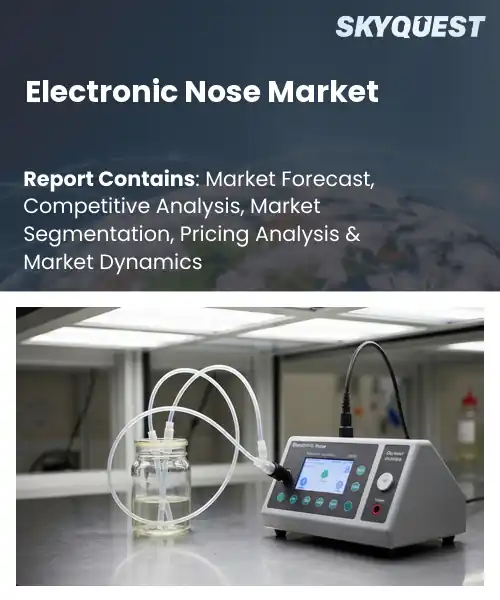
Electronic Nose Market
Report ID: SQMIG45J2556
Report ID: SQMIG45J2556
[email protected]
USA +1 351-333-4748
Report ID:
SQMIG45J2556 |
Region:
Global |
Published Date: June, 2026
Pages:
157
|Tables:
92
|Figures:
76


Global Electronic Nose Market size was valued at USD 382.5 Million in 2024 and is poised to grow from USD 425.03 Million in 2025 to USD 985.4 Million by 2033, growing at a CAGR of 11.12% during the forecast period (2026-2033).
The global electronic nose industry includes systems that use electronic sensors that simulate human senses of smell to identify and measure various compounds. The importance of this industry is that it enables analytical methods that will not require expensive laboratory analysis procedures, thus speeding up the process of quality control in food safety, environmental monitoring, and medicine. The main factor that led to the development of this industry is an increased need for real-time aroma analysis in the food and beverages market, where major corporations such as Nestlé and Coca-Cola use electronic noses for quality control of flavors produced during the production process.
An important determinant of the global electronic nose market is also the interaction between regulations and consumer requirements for safety, compelling the industry to implement monitoring tools. In light of increased restrictions for the presence of pesticide residues, volatile organic compounds, and spoilage agents, companies need to prove their compliance to regulations using facts, and thus need to install electronic noses providing alerting and maintenance options.
How are AI and IoT Transforming the Electronic Nose Market?
Electronic nose systems are changing as a result of AI and IoT technologies that transform their basic functionality into connected and learning systems. AI algorithms analyze the information from the sensor array in real time, picking up the patterns that could not be detected by the human analyzer, while IoT technology connects each e-nose to cloud platforms to ensure constant data flow. This integration results in remote monitoring, predictive maintenance, and quick adjustment to any new odorous substance profiles. Market growth is stimulated because of using low-power processors and wireless modules in these devices, which makes them portable and scalable. The technology is being used by manufacturers to replace expensive laboratory analyses with on-site instant analysis.
Market snapshot - (2026-2033)
Global Market Size
USD 382.5 Million
Largest Segment
Metal Oxide Semiconductor (MOS)
Fastest Growth
Conducting Polymers
Growth Rate
11.12% CAGR
To get more insights on this market click here to Request a Free Sample Report
Global electronic nose market is segmented by sensor type, application, end-user and region. Based on sensor type, the market is segmented into Metal Oxide Semiconductor (MOS), Conducting Polymers, Quartz Crystal Microbalance and Optical Sensors. Based on application, the market is segmented into Food & Beverage Quality Control, Medical Diagnostics (Breath Analysis), Environmental Monitoring and Security & Defense. Based on end-user, the market is segmented into Food Industry, Healthcare and Government & Defense. Based on region, the market is segmented into North America, Europe, Asia Pacific, Latin America and Middle East & Africa.
The Metal Oxide Semiconductor segment leads the market due to high sensitivity to a large number of volatile substances and years of expertise in semiconductor production. The strength of this technology in different environmental conditions makes it the most suitable solution for industrial-grade electronic noses. Companies can utilize their fabrication lines to decrease risks, whereas customers appreciate its reliability in continuous monitoring operations and therefore favor it.
On the other hand, the Conducting Polymers segment is the fastest-growing one due to the inherent flexibility of the technology, allowing it to be integrated into wearable and low-power devices. Innovations in materials will continue to make this technology less energy-consuming and able to detect more odorants, thus gaining momentum in the market.
Medical diagnostics (Breath Analysis) is the leader as it changes the way noninvasive disease screening is done through detecting disease-specific biomarkers in exhaled breath. Clinicians appreciate quick and pain free tests that can be conducted at point of care without the need for expensive laboratory tests. Scientific research proves the clinical effectiveness of the technology leading to implementation of electronic noses in the workflow of healthcare institutions, thus securing its crucial importance for market penetration in various clinical fields.
Environmental monitoring, on the other hand, has become the most dynamically growing segment due to increased awareness about air quality and the need for odor and pollution detection systems. Miniaturization of sensors and cloud-based analysis allow for massive implementation of the technology and create new opportunities for service provision.
To get detailed segments analysis, Request a Free Sample Report
North America stands dominant on account of a variety of factors such as technological competence, research capacity and an industrial sector that is quite advanced and adopts sophisticated sensing technology. Universities and colleges in North America work hand in hand with innovative start-ups and companies to hasten product innovation processes. The availability of strong venture capital and a regulatory framework that encourages safety and quality results in the early adoption of this product in sectors such as food processing, medicine, and environmental monitoring. The involvement of defense and aerospace industries also increases the need for sophisticated electronic noses.
US Electronic Nose Market is positively impacted by a highly vibrant environment including research universities, venture capitalists, and top-notch sensor manufacturers. The cooperation between health care institutions and food safety institutions facilitates the transition from lab-based prototypes to market products. Robust IP laws encourage constant innovations, whereas big time manufacturing makes it possible to scale up the production of the latest arrays of sensors.
Canadian Electronic Nose Industry reflects its priority toward food assurance and environmental conservation. The government funded research projects aim at creating affordable and portable sensor systems that cater to the requirements of the Canadian agriculture and natural resource sector. Academic labs in association with specialized technology companies create customized solutions to regional requirements for produce and air-quality management in Canada.
The fast expansion of Europe is attributed to policy measures that emphasize food safety, emission management, and healthcare innovations. There is an abundance of research institutions working collaboratively across borders that enable them to share their findings and speed up innovations in nanosensors and data analysis technologies. Stringent standards of cars and industries lead to the need for accurate odor detection systems in the production process and environment management. Moreover, consumer interest in quality food products makes this technology more popular in retail outlets and food processing facilities. In addition, the focus on the circular economy approach makes Europe recycle this sensor technology in waste management and recycling processes.
Germany’s Electronic Nose Market rests upon the foundations provided by its world-class engineering companies and expertise in precision engineering. The strong ties that exist between chemical industry clusters and universities have enabled the successful translation of innovative sensor designs into high-quality sensors that can be mass-produced. The strict focus on quality standards makes it an attractive choice for use in pharmaceutical manufacturing and emissions testing in automobiles.
The Electronic Nose Market in the United Kingdom sees tremendous growth due to high venture capital activity and presence of a flourishing biotechnology industry. Application of the electronic nose in medical diagnostics, especially in breath-analysis systems, is an example of quick transition of ideas from lab to clinic. Collaboration between university researchers and industry partners helps develop prototypes for application in food safety, while the government encourages incorporation of sensors in smart city air quality control systems.
French Electronic Nose Market involves nascent technology with an emphasis on the production of premium products in foodstuffs and perfumes based on the use of aroma detection sensors. The research and development carried out collaboratively by culinary schools, perfume producers, and sensor manufacturers results in customized electronic noses that ensure quality control. The government’s efforts to promote sustainable farming make it possible to have portable sensors for crop monitoring in France.
The strategy that Asia Pacific uses to enhance its market strength involves utilizing quick adoption of technology, increasing the middle-class population, and effective manufacturing systems for affordable sensor manufacturing. Research centers in the area have been focusing on integrating AI into the electronic nose system to improve its pattern recognition ability for various purposes. Food-processing industry developments call for effective monitoring of aromas to cater to consumer demands, whereas the increasing environmental consciousness is causing the use of the electronic nose system in air quality and waste management solutions.
The Japanese Electronic Nose market is distinguished by its emphasis on high precision instruments and robotic technology integration. The partnership of electronics companies and food safety institutions results in highly efficient detectors of freshness and contamination control. The development of compact and energy-efficient sensor technology is directed to the application in health care and auto cabin air quality control sectors.
Market for Electronic Noses in South Korea gains momentum from its vibrant semiconductor industry and robust government efforts for promoting smart manufacturing. Collaborations between top chip makers and biotech companies make possible the production of tiny but sensitive sensors that work both as part of industrial process controls and personal wellness devices. The focus on fast prototyping and export-driven production makes South Korea a growing destination for electronic noses.
To know more about the market opportunities by region and country, click here to
Buy The Complete Report
Advancements in Sensor Technology
Innovations in sensors are improving the accuracy, specificity, and speed of electronic nose technologies, making them better equipped for detecting complicated volatile substances. This is making more users interested in implementing the technologies in their work for better quality control, environmental and safety purposes. Better performance also results in reduced risks of getting false alarms and having to maintain equipment, thus creating confidence in users. This leads to increased market growth as users find more application areas for the technologies due to improvements in their capabilities.
Integration with IoT Platforms
Integration with Internet of Things (IoT) platforms is enabling electronic noses to provide streaming real-time data to cloud-based analytics services, thus enhancing predictive maintenance and remote monitoring. Through this integration, easy scalability in various locations is possible as well as easy data collection for the purpose of getting a complete understanding of the process conditions. Through the use of networked communication, automatic response programs, reduction of labor intensity, and general increased operational efficiency can be achieved.
High Initial Capital Investment
The high requirement of capital during the initial phases is a major constraint that keeps many from adopting such technology, especially small- and medium-sized businesses with restricted options in their budgeting. The cost incurred through procurement of advanced equipment for electronic noses, establishment of the necessary infrastructure, and staff training is not always worth the apparent immediate gains. For this reason, some companies choose to delay or altogether avoid adoption of electronic noses, preferring conventional testing because it requires less investment.
Regulatory Compliance Challenges
Market growth is currently facing obstacles as far as regulatory compliance is concerned as applications involving electronic noses are bound to come up against tough rules governing safety, health, and environment issues. It is difficult to get certification along with proof of consistent results and it involves a lot of documentation which can result in delaying entry into the market and increase expenses on development work. Also, due to differences in regulations of various regions, companies might have to produce tailor-made solutions for each region.
Request Free Customization of this report to help us to meet your business objectives.
The world market for electronic nose technology is dominated by fierce competition due to innovations, AI implementation, and broader application areas. Companies invest in strategic collaborations, product introductions, and research and development to improve accuracy of sensors and analytical abilities. Cooperations between businesses from health care, food, environment, and industry sectors and M&As increase their position in the market and speed up product commercialization. Players like Alpha MOS, Airsense, Odotech, Sensigent, and Electronic Sensor are competing against each other to increase their sensor efficiency and minimize their size; the competition leads to quick development of technology and collaboration among businesses because of the need for the new application areas.
Advanced Sensor Fusion Integration: Today's manufacturers are making use of electronic nose technology as part of the larger sensor network systems. The combination of olfaction with visual information, audio information, and chemical information helps develop multimodal detection systems which enable better pattern recognition, faster detection of anomalies, and decision-making support. Using common technologies for processing as well as a single data framework can help manufacturers save time during development processes, minimize costs of integration, and offer a reliable solution for dealing with various quality control issues.
Sustainable Packaging and Lifecycle: The industry is moving towards making devices that are environmentally friendly by focusing on the use of reusable materials, reduction of energy consumption, and modular elements that help increase the longevity of products. The stakeholders have started using the framework of cradle to grave assessments in order to decrease any potential harm to the environment and to be able to fulfill the demands of customers. By making use of biodegradable housing units, low-energy consuming sensors, and maintenance through services, businesses will be able to create sustainable partnerships.
SkyQuest’s ABIRAW (Advanced Business Intelligence, Research & Analysis Wing) is our Business Information Services team that Collects, Collates, Correlates, and Analyses the Data collected by means of Primary Exploratory Research backed by robust Secondary Desk research.
As per SkyQuest analysis, the global market for electronic noses is driven mainly by fast technological advancements in sensors that increase sensitivity and speed, whereas the other key driver is easy integration with IoT platforms to facilitatereal-time data collection and predictive maintenance. Metal Oxide Semiconductor sensor is the most widely used sensor type due to their strength and production base. North America is currently leading in the market owing to its well-established research & development environment and advanced manufacturing capability. However, one of the major challenges is the heavy capital cost required at the start, which is a deterrent for small- and medium-sized enterprises.
| Report Metric | Details |
|---|---|
| Market size value in 2024 | USD 382.5 Million |
| Market size value in 2033 | USD 985.4 Million |
| Growth Rate | 11.12% |
| Base year | 2024 |
| Forecast period | (2026-2033) |
| Forecast Unit (Value) | USD Million |
| Segments covered |
|
| Regions covered | North America (US, Canada), Europe (Germany, France, United Kingdom, Italy, Spain, Rest of Europe), Asia Pacific (China, India, Japan, Rest of Asia-Pacific), Latin America (Brazil, Rest of Latin America), Middle East & Africa (South Africa, GCC Countries, Rest of MEA) |
| Companies covered |
|
| Customization scope | Free report customization with purchase. Customization includes:-
|
To get a free trial access to our platform which is a one stop solution for all your data requirements for quicker decision making. This platform allows you to compare markets, competitors who are prominent in the market, and mega trends that are influencing the dynamics in the market. Also, get access to detailed SkyQuest exclusive matrix.
Table Of Content
Executive Summary
Market overview
Parent Market Analysis
Market overview
Market size
KEY MARKET INSIGHTS
COVID IMPACT
MARKET DYNAMICS & OUTLOOK
Market Size by Region
KEY COMPANY PROFILES
Methodology
For the Electronic Nose Market, our research methodology involved a mixture of primary and secondary data sources. Key steps involved in the research process are listed below:
1. Information Procurement: This stage involved the procurement of Market data or related information via primary and secondary sources. The various secondary sources used included various company websites, annual reports, trade databases, and paid databases such as Hoover's, Bloomberg Business, Factiva, and Avention. Our team did 45 primary interactions Globally which included several stakeholders such as manufacturers, customers, key opinion leaders, etc. Overall, information procurement was one of the most extensive stages in our research process.
2. Information Analysis: This step involved triangulation of data through bottom-up and top-down approaches to estimate and validate the total size and future estimate of the Electronic Nose Market.
3. Report Formulation: The final step entailed the placement of data points in appropriate Market spaces in an attempt to deduce viable conclusions.
4. Validation & Publishing: Validation is the most important step in the process. Validation & re-validation via an intricately designed process helped us finalize data points to be used for final calculations. The final Market estimates and forecasts were then aligned and sent to our panel of industry experts for validation of data. Once the validation was done the report was sent to our Quality Assurance team to ensure adherence to style guides, consistency & design.
Analyst Support
Customization Options
With the given market data, our dedicated team of analysts can offer you the following customization options are available for the Electronic Nose Market:
Product Analysis: Product matrix, which offers a detailed comparison of the product portfolio of companies.
Regional Analysis: Further analysis of the Electronic Nose Market for additional countries.
Competitive Analysis: Detailed analysis and profiling of additional Market players & comparative analysis of competitive products.
Go to Market Strategy: Find the high-growth channels to invest your marketing efforts and increase your customer base.
Innovation Mapping: Identify racial solutions and innovation, connected to deep ecosystems of innovators, start-ups, academics, and strategic partners.
Category Intelligence: Customized intelligence that is relevant to their supply Markets will enable them to make smarter sourcing decisions and improve their category management.
Public Company Transcript Analysis: To improve the investment performance by generating new alpha and making better-informed decisions.
Social Media Listening: To analyze the conversations and trends happening not just around your brand, but around your industry as a whole, and use those insights to make better Marketing decisions.
REQUEST FOR SAMPLE
 REQUEST FREE CUSTOMIZATION
Global Electronic Nose Market size was valued at USD 382.5 Million in 2024 and is poised to grow from USD 425.03 Million in 2025 to USD 985.4 Million by 2033, growing at a CAGR of 11.12% during the forecast period (2026-2033).
The United States portable electronic nose market is intensely competitive, with firms such as Alpha MOS, Airsense, Odotech, Sensigent and Electronic Sensor racing to enhance sensor accuracy and miniaturization; this rivalry fuels rapid tech innovation and drives strategic partnerships, as companies seek to capture emerging applications in food safety, environmental monitoring and health diagnostics. 'Alpha MOS', 'Owlstone Medical', 'Smiths Detection', 'Sensigent LLC', 'Electronic Sensor Technology', 'Aryballe Technologies', 'NeOse Technologies', 'Scentian Bio', 'Nemesys Engineering', 'Cyrano Sciences (Smiths Detection)', 'Airsense Analytics', 'Common Sense (Israel)', 'RoboScientific', 'SacmiGroup', 'Multisensor Systems', 'Olfactor Laboratories', 'ASIN AB', 'Comon Invent', 'JLM Innovation', 'Bosch Sensortec'
Advancements in sensor technology are enhancing the sensitivity, selectivity, and response time of electronic nose devices, enabling more accurate detection of complex volatile compounds across diverse applications. This technical progress drives broader adoption by manufacturers seeking reliable quality control, environmental monitoring, and safety solutions. Improved performance also reduces false alarms and maintenance requirements, fostering confidence among end‑users and encouraging integration into automated systems. Consequently, the market experiences accelerated growth as new opportunities emerge in sectors previously limited by earlier, less capable sensor capabilities.
Advanced Sensor Fusion Integration: Manufacturers are increasingly embedding electronic nose technology within broader sensor ecosystems, merging olfactory data with visual, acoustic, and chemical inputs to create multi‑modal detection platforms. This convergence enables richer pattern recognition, faster anomaly identification, and more nuanced decision support across sectors such as food safety, environmental monitoring, and pharmaceuticals. By leveraging shared processing architectures and unified data frameworks, companies can reduce development cycles, lower integration costs, and deliver turnkey solutions that address complex quality‑control challenges with greater reliability and scalability.
Why does North America Dominate the Global Electronic Nose Market? |@12


Want to customize this report? This report can be personalized according to your needs. Our analysts and industry experts will work directly with you to understand your requirements and provide you with customized data in a short amount of time. We offer $1000 worth of FREE customization at the time of purchase.
Feedback From Our Clients


 USA (+1) 351-333-4748

