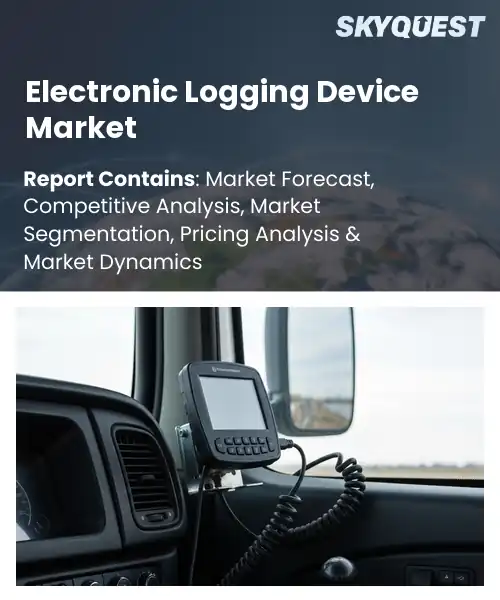
Electronic Logging Device Market
Report ID: SQMIG45J2618
Report ID: SQMIG45J2618
[email protected]
USA +1 351-333-4748
Report ID:
SQMIG45J2618 |
Region:
Global |
Published Date: July, 2026
Pages:
157
|Tables:
145
|Figures:
78


Global Electronic Logging Device Market size was valued at USD 14.07 Billion in 2024 and is poised to grow from USD 14.73 Billion in 2025 to USD 21.27 Billion by 2033, growing at a CAGR of 4.7% during the forecast period (2026-2033).
The electronic logging device market, or ELD, is a mix of hardware and software that automatically captures a commercial driver’s hours of service. It’s supposed to replace those older manual paper logs, the ones that were filled in by hand. This matters a lot because it improves road safety, helps keep fleets on the right side of the rules, and cuts down the paperwork headaches for fleet operators.
In addition, the main driver for the global electronic logging device market growth is shifting toward ELD integration with data analytics and connectivity platforms. So instead of just having raw log information sitting there, fleets get insights they can actually use, for day to day operational efficiency. Fleet managers use things like location data, fuel consumption patterns, and driver behavior signals, to fine tune routing, reduce emissions, and catch violations earlier, before they turn into problems. For example, one major U.S. trucking company reportedly reduced idle time by 15 percent after rolling out a cloud based ELD suite. That outcome is making demand move across multiple markets, including insurers and logistics providers who want better inputs for risk models. And when that happens, it creates space for both hardware makers and software developers to jump in.
IoT sensors mounted in trucks keep watching the whole setup, things like driver activity, vehicle speed, and engine diagnostics, all the time. On top of that AI algorithms, do the analyzing of the incoming stream, in real time too, and they can flag unsafe behavior like harsh braking, or when a driver appears to have excessive hours. Put together, it becomes this closed loop process where warnings get sent right away to both drivers and fleet managers, which lowers the odds of fatigue related incidents happening in the first place. The AI portion also helps clean up the raw logs by filtering out noise, and correcting timestamp errors , so compliance reports end up with better fidelity when submitted to regulators. As fleets adopt these smarter ELD setups, road safety improves and the reliability of the recorded data strengthens trust across the whole industry and that supports wider adoption.
Market snapshot - (2026-2033)
Global Market Size
USD 14.07 Billion
Largest Segment
Telematics Unit
Fastest Growth
Other Accessories
Growth Rate
4.7% CAGR
To get more insights on this market click here to Request a Free Sample Report
The global electronic logging device market is segmented by component, form factor, vehicle type, service type, end user and region. Based on component, the market is segmented into Telematics Unit, Display Unit and Other Accessories. Based on form factor, the market is segmented into Embedded ELDs and Integrated (App-Based/Wireless) ELDs. Based on vehicle type, the market is segmented into Light Commercial Vehicles, Trucks and Buses & Coaches. Based on service type, the market is segmented into Hours-of-Service (HOS) Compliance, GPS & Fleet Tracking, Driver Behavior Monitoring, Predictive Maintenance, and Route Optimization. Based on end user, the market is segmented into Large Fleets, Small & Medium Fleets and Owner-Operators. Based on region, the market is segmented into North America, Europe, Asia Pacific, Latin America and Middle East & Africa.
As per the electronic logging device market analysis, the Telematics unit segment dominates because it acts like the main data-grabbing engine that turns vehicle signals into usable records, supporting compliance and fleet visibility, almost like everything else depends on it. When it connects to the vehicle CAN bus, it can pull real‑time information on duty status, mileage, and engine diagnostics. That part is needed by both regulators and operators, for sure. Manufacturers keep leaning on sturdy, secure silicon and firmware too, so the unit stays central, and that’s what keeps its market leadership going across different fleet sizes and regulatory regions. It ends up feeling universally relevant, even when the rules vary.
Meanwhile, the display unit segment is showing up as the fastest growing, mostly because touchscreens and voice‑enabled interfaces are getting embedded to make driver interaction easier and to lower manual entry mistakes. Better ergonomics plus tighter integration with mobile apps helps adoption, and that tends to open fresh revenue streams. OEMs then get pushed to focus on more novel visual solutions, because drivers notice those things, and apparently dashboards sell the idea.
According to the electronic logging device market forecast, the Hours‑of‑service compliance segment dominates, because it directly targets the regulatory requirements for exact driver duty recording. It forms a backbone for adoption across fleet types, and that makes it hard to skip. There’s pressure for verifiable electronic logs, audit trails, and automatic violation alerts, so carriers push for hardware and software that can pass scrutiny. That keeps this function sitting right at the core of the product development. Regulators keep tightening enforcement mechanics, so manufacturers build in firmware updates, plus cloud‑based validation. So reliance on this capability stays strong, and it keeps the segment prominent.
On the other hand, the predictive maintenance segment is seeing the strongest growth momentum. Sensor fusion plus AI analytics help fleets plan service windows, which reduces downtime and lowers operating costs for carriers. As fleets try to stretch asset lifespan and still pass inspections, putting maintenance alerts inside ELD platforms starts looking like real value. That combination speeds up market expansion and also draws in more investor attention.
To get detailed segments analysis, Request a Free Sample Report
As per the electronic logging device market regional forecast, North America dominates because the regulatory environment is mature, like it requires electronic logging for commercial fleets and that means a big, mandatory base of adoption. Then there’s the tech side too, with major hardware makers and software developers around it, so they keep pushing innovation and they integrate with other fleet management stuff without much friction. Add in heavy investment in transportation infrastructure and this whole compliance culture, and penetration stays high. Also, huge logistics operators are there, and they care a lot about safety and efficiency, so the demand stays sticky for advanced features like real‑time data analytics and driver behavior monitoring. In the end it’s that mix of strict rules, sophisticated supply chains, and proactive industry stakeholders, that keeps North America out in front.
United States Electronic Logging Device Market
The Electronic Logging Device sector in United States benefits from a full regulatory approach, where driver hours tracking has to be precise, so installation spreads across different carrier sizes. The market also gets a push from joint initiatives between tech companies and transportation associations, which speed up deployment and smoother integration with telematics platforms. People are becoming more aware of safety results and saving on operations costs, so upgrades keep happening. And there’s a strong venture capital presence, supporting new service models that are aimed at fleet optimization, not just basic compliance.
Canada Electronic Logging Device Market
The Electronic Logging Device Market outlook in Canada is shaped by early adoption of safety standards and a national focus on reducing road incidents. Because of that, big carrier networks standardize electronic logging solutions sooner rather than later. Collaborative research programs between universities and industry players help improve data security and connectivity, which makes systems more reliable even with tough weather and diverse climatic conditions. Government incentives for modernizing fleet operations also push investment into interoperable platforms that match cross‑border transportation requirements, and it all reinforces market resilience, directly.
Europe’s rapid growth is driven by harmonized regulatory directives; they require electronic logging across member states, so the demand becomes unified and predictable. There are also stronger environmental agendas, focusing on smarter route planning and lower idle time, so electronic logging gets framed as a key enabler of greener logistics. The region’s advanced automotive engineering ecosystem helps with seamless integration of logging hardware with vehicle systems, while software innovators keep delivering more sophisticated analytics that can fit the various regulatory nuances. Industry forums and cooperative groups promote best practices, standardization, and a confidence among carriers. Together, these factors create a good setup for faster adoption and ongoing improvement, without too many blockers.
Germany Electronic Logging Device Market
The Electronic Logging Device industry in Germany is propelled by strict enforcement of transport compliance, and that ties directly to reputation for precision in the industry. Local manufacturers take advantage of deep engineering know how to build robust devices that connect smoothly with existing fleet telematics, keeping high reliability even when operations are demanding. Partnerships between logistics firms and technology providers put more weight on data‑driven decision making, improving route efficiency and driver safety at the same time. On top of that, academic research continues refining algorithmic capabilities, so Germany stays positioned as a technology leader in this sector.
United Kingdom Electronic Logging Device Market
The Electronic Logging Device Market in the United Kingdom sees quick growth because proactive regulatory bodies push digital transformation in road transport. There’s also a lively startup scene bringing agile solutions, where emphasis is on driver engagement and real‑time compliance monitoring. Since the nation has broad broadband infrastructure, high frequency data transmission becomes easier, which supports advanced fleet analytics. Collaborative initiatives between government agencies and industry associations also speed up standard adoption. And because road safety culture is emphasized strongly, companies keep investing in device upgrades, constantly.
France Electronic Logging Device Market
The Electronic Logging Device Market penetration in France is emerging as something like a focal point for sustainable mobility strategies, where policymakers encourage digital tools for improving driver compliance and reducing congestion. Local technology firms tend to focus on user‑friendly interfaces that match French language preferences and regulatory nuances, so acceptance increases for small and medium carriers too. Partnerships with transportation clusters support knowledge sharing and co-development of interoperable solutions. This nurturing environment helps a growing ecosystem take shape, and it positions France as an emerging hub for innovative electronic logging applications.
Asia Pacific is getting stronger, through two lanes at once expanding commercial freight operations and those gradually stricter regulatory steps that push electronic logging adoption. At the same time the region is urbanizing fast, and the logistics routes keep shifting so there’s a real need for tighter driver hour control and better operational transparency . Manufacturing is also a quiet advantage here, because it supports low cost but sturdy production of the devices, while the growth in digital infrastructure keeps things connected across huge distances. What’s more, governments, industry associations, and technology providers are leaning into collaboration , trying to align standards ,and also train capabilities, so the market can mature faster and Asia Pacific keeps looking like a key growth driver.
Japan Electronic Logging Device Market
In Japan, the electronic logging device market rides on a mindset of careful safety expectations and a car industry that’s quick to adopt newer tech, including logging systems built into the vehicle design early. Logistics companies working close with device makers tend to come up with setups suited for crowded city routes, plus different terrain conditions. There’s also a strong pull toward predictive servicing and driver assist functions, which matches national targets for improving road safety and running fleets more efficiently. All that, in practice, keeps the market moving forward steadily.
South Korea Electronic Logging Device Market
In South Korea, the electronic logging device market is backed by a well-linked digital environment and meaningful government backing for smart mobility programs. Local vendors typically concentrate on advanced sensing components and cloud-based platforms, delivering compliance information in near real time to fleet managers. Telecom providers plus logistics firms also cooperate to protect dependable connectivity, even along quieter rural stretches, which helps adoption spread widely. That combination reinforces South Korea’s growing influence in the broader electronic logging sector and makes the ecosystem feel even more mature.
To know more about the market opportunities by region and country, click here to
Buy The Complete Report
Increasing Regulatory Compliance Requirements
Advancements In Connectivity Technologies
High Initial Installation Costs
Data Privacy And Security Concerns
Request Free Customization of this report to help us to meet your business objectives.
The competitive landscape gets shaped by that aggressive M&A push, plus strategic alliances, and then this rapid tech wave where companies try to stitch in advanced telematics, AI‑powered compliance analytics, and cloud based fleet control platforms; lately there are recent moves like KeepTruckin’s acquisition of a driver‑safety AI startup and GenLogs landing a funding round to broaden its U.S. footprint, alongside industry names such as Einride.
Top Player’s Company Profile
Recent Developments in the Electronic Logging Device Market
SkyQuest’s ABIRAW (Advanced Business Intelligence, Research & Analysis Wing) is our Business Information Services team that Collects, Collates, Correlates, and Analyses the Data collected by means of Primary Exploratory Research backed by robust Secondary Desk research.
As per SkyQuest analysis, the global electronic logging device market is moving forward mainly because regulatory compliance requirements are tightening, and those requirements push fleets to swap paper logs for electronic logging. At the same time, connectivity technology keeps improving, which speeds adoption by letting data move in real time and by making it easier to integrate with existing fleet platforms, no extra fuss. The telematics unit segment is leading because it’s basically the core data engine that supports compliance monitoring and overall visibility, not just “nice-to-have” reporting. As for regions, North America is still the dominant one due to strict mandates and a fairly mature tech environment. Still, the high up-front installation costs can slow things down, particularly for small and medium operators, and that restraint limits how quickly full penetration happens.
| Report Metric | Details |
|---|---|
| Market size value in 2024 | USD 14.07 Billion |
| Market size value in 2033 | USD 21.27 Billion |
| Growth Rate | 4.7% |
| Base year | 2024 |
| Forecast period | (2026-2033) |
| Forecast Unit (Value) | USD Billion |
| Segments covered |
|
| Regions covered | North America (US, Canada), Europe (Germany, France, United Kingdom, Italy, Spain, Rest of Europe), Asia Pacific (China, India, Japan, Rest of Asia-Pacific), Latin America (Brazil, Rest of Latin America), Middle East & Africa (South Africa, GCC Countries, Rest of MEA) |
| Companies covered |
|
| Customization scope | Free report customization with purchase. Customization includes:-
|
To get a free trial access to our platform which is a one stop solution for all your data requirements for quicker decision making. This platform allows you to compare markets, competitors who are prominent in the market, and mega trends that are influencing the dynamics in the market. Also, get access to detailed SkyQuest exclusive matrix.
Table Of Content
Executive Summary
Market overview
Parent Market Analysis
Market overview
Market size
KEY MARKET INSIGHTS
COVID IMPACT
MARKET DYNAMICS & OUTLOOK
Market Size by Region
KEY COMPANY PROFILES
Methodology
For the Electronic Logging Device Market, our research methodology involved a mixture of primary and secondary data sources. Key steps involved in the research process are listed below:
1. Information Procurement: This stage involved the procurement of Market data or related information via primary and secondary sources. The various secondary sources used included various company websites, annual reports, trade databases, and paid databases such as Hoover's, Bloomberg Business, Factiva, and Avention. Our team did 45 primary interactions Globally which included several stakeholders such as manufacturers, customers, key opinion leaders, etc. Overall, information procurement was one of the most extensive stages in our research process.
2. Information Analysis: This step involved triangulation of data through bottom-up and top-down approaches to estimate and validate the total size and future estimate of the Electronic Logging Device Market.
3. Report Formulation: The final step entailed the placement of data points in appropriate Market spaces in an attempt to deduce viable conclusions.
4. Validation & Publishing: Validation is the most important step in the process. Validation & re-validation via an intricately designed process helped us finalize data points to be used for final calculations. The final Market estimates and forecasts were then aligned and sent to our panel of industry experts for validation of data. Once the validation was done the report was sent to our Quality Assurance team to ensure adherence to style guides, consistency & design.
Analyst Support
Customization Options
With the given market data, our dedicated team of analysts can offer you the following customization options are available for the Electronic Logging Device Market:
Product Analysis: Product matrix, which offers a detailed comparison of the product portfolio of companies.
Regional Analysis: Further analysis of the Electronic Logging Device Market for additional countries.
Competitive Analysis: Detailed analysis and profiling of additional Market players & comparative analysis of competitive products.
Go to Market Strategy: Find the high-growth channels to invest your marketing efforts and increase your customer base.
Innovation Mapping: Identify racial solutions and innovation, connected to deep ecosystems of innovators, start-ups, academics, and strategic partners.
Category Intelligence: Customized intelligence that is relevant to their supply Markets will enable them to make smarter sourcing decisions and improve their category management.
Public Company Transcript Analysis: To improve the investment performance by generating new alpha and making better-informed decisions.
Social Media Listening: To analyze the conversations and trends happening not just around your brand, but around your industry as a whole, and use those insights to make better Marketing decisions.
REQUEST FOR SAMPLE
 REQUEST FREE CUSTOMIZATION
Global Electronic Logging Device Market size was valued at USD 14.07 Billion in 2024 and is poised to grow from USD 14.73 Billion in 2025 to USD 21.27 Billion by 2033, growing at a CAGR of 4.7% during the forecast period (2026-2033).
The competitive landscape is shaped by aggressive M&A activity, strategic partnerships, and rapid tech innovation as firms race to integrate advanced telematics, AI‑driven compliance analytics, and cloud‑based fleet management platforms; recent examples include KeepTruckin’s acquisition of a driver‑safety AI startup and GenLogs securing a funding round to expand its U.S. operations alongside industry players such as Einride. 'Samsara Inc.', 'Geotab Inc.', 'Verizon Connect', 'Omnitracs LLC', 'Motive Technologies Inc. (Keep Truckin)', 'Trimble Inc.', 'Teletrac Navman', 'Garmin Ltd.', 'Rand McNally & Co.', 'Azuga Inc.', 'ORBCOMM Inc.', 'Powerfleet Inc.', 'I.D. Systems Inc.', 'SkyBell Technologies', 'ELD Mandate Compliance (Elogs)', 'Fleetmatics (Verizon)', 'MobileDemand', 'Blue Ink Technology', 'Transflo', 'Stoneridge Inc.'
Regulatory bodies worldwide have mandated electronic logging devices to ensure accurate driver hours and enhance road safety. This requirement compels fleet operators to replace traditional paper logs with compliant digital solutions, driving demand across commercial and private sectors. The necessity to meet legal standards encourages rapid adoption, prompting manufacturers to expand product offerings and support services. Consequently, the market experiences sustained growth as compliance becomes a core operational priority for transportation companies. Additionally, the enforcement of penalties for non‑compliance further accelerates investment in compliant technologies.
Connected Fleet Management: The integration of real‑time telematics with electronic logging devices is reshaping fleet operations by delivering instantaneous driver behavior insights, route optimization recommendations, and predictive maintenance alerts, enabling carriers to enhance safety compliance while reducing operational downtime and fuel consumption through data‑driven decisions. Additionally, seamless cloud connectivity allows centralized oversight across multiple jurisdictions, facilitating rapid adaptation to evolving regulatory requirements and fostering collaborative communication between drivers, dispatch teams, and compliance officers, thus creating a more resilient and responsive logistics network globally.
Why does North America Dominate the Global Electronic Logging Device Market? |@12


Want to customize this report? This report can be personalized according to your needs. Our analysts and industry experts will work directly with you to understand your requirements and provide you with customized data in a short amount of time. We offer $1000 worth of FREE customization at the time of purchase.
Feedback From Our Clients


 USA (+1) 351-333-4748

