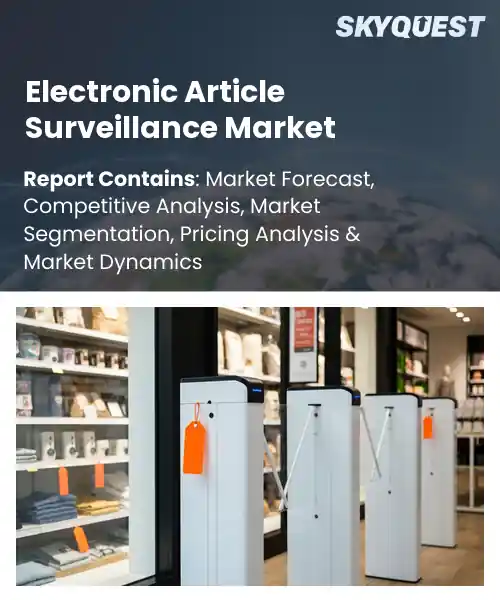
Electronic Article Surveillance Market
Report ID: SQMIG45F2402
Report ID: SQMIG45F2402
[email protected]
USA +1 351-333-4748
Report ID:
SQMIG45F2402 |
Region:
Global |
Published Date: July, 2026
Pages:
157
|Tables:
178
|Figures:
79


Global Electronic Article Surveillance Market size was valued at USD 1.8 Billion in 2024 and is poised to grow from USD 1.89 Billion in 2025 to USD 2.77 Billion by 2033, growing at a CAGR of 4.9% during the forecast period (2026-2033).
High retail shrinkage, increasing adoption of RFID-based security solutions, rising demand for real-time inventory visibility, advancements in electronic article surveillance technologies, and growing emphasis on retail loss prevention are driving demand for electronic article surveillance solutions.
Increased use of electronic article surveillance systems in grocery stores, department stores, specialist retailers, warehouses, and ecommerce fulfillment facilities is enhancing the safety of merchandise and improving operational efficiency. Continued developments in RFID technology, IoT inventory management, cloud analytics, and intelligent security systems have enhanced inventory visibility and minimized stock discrepancies. Increasing investments in smart retail infrastructure and inventory management systems are also expected to contribute to increased demand for electronic article surveillance solutions. Increased concerns regarding inventory theft across retail stores coupled with increasing focus on improving loss prevention and inventory management are expected to primarily drive electronic article surveillance market growth.
In contrast, high installation and implementation costs, integration challenges with existing retail infrastructure, privacy concerns associated with RFID technology, and maintenance expenses for large-scale deployments are anticipated to slow down electronic article surveillance market penetration through 2033.
How is AI Enhancing Loss Prevention In Electronic Article Surveillance Operations?
The advent of AI has helped revolutionize the electronic article surveillance market by making the loss prevention process more efficient and accurate. Using AI-driven computer vision and pattern recognition technology, the system can monitor shopper behavior for any suspicious activity without mistaking it for any normal customer activity. In addition, the technology works together with RFID and surveillance system to issue immediate alerts, allowing the store employees to take appropriate action against the theft. The analytics cloud gathers information from different store sites and helps retailers detect any patterns of theft and refine their security and inventory management policies accordingly.
Market snapshot - (2026-2033)
Global Market Size
USD 1.8 Billion
Largest Segment
Radio Frequency (RF) Systems
Fastest Growth
Microwave Systems
Growth Rate
4.9% CAGR
To get more insights on this market click here to Request a Free Sample Report
Global electronic article surveillance market is segmented by technology, component, application, tag type, end user, installation type, and region. Based on technology, the market is segmented into Radio Frequency (RF) Systems, Acousto-Magnetic (AM) Systems, Electromagnetic (EM) systems, and microwave systems. Based on component, the market is segmented into tags & labels, antennas & pedestals, deactivators & detachers, and software & services. Based on application, the market is segmented into apparel & fashion retail, supermarkets & hypermarkets, electronics retail, libraries, healthcare & pharmacies, and others. Based on tag type, the market is segmented into hard tags, soft labels, disposable tags, and reusable tags. Based on end user, the market is segmented into retail stores, libraries, healthcare facilities, commercial facilities, and others. Based on installation type, the market is segmented into new installations and retrofit installations. Based on region, the market is segmented into North America, Europe, Asia Pacific, Latin America, and Middle East & Africa.
The Radio Frequency (RF) Systems segment is anticipated to account for the highest global electronic article surveillance market share going forward. It provides a good balance between the range of detection and cost effectiveness which is consistent with the nature of most retail stores that have high volume but low margin. The technology’s capability to detect tags regardless of packaging materials lowers false alerts, whereas its proven supply chain ensures cost predictability of components. Such features build up retailers’ confidence in using this technology.
However, acousto-magnetic systems are witnessing the strongest growth momentum as retailers seek increased protection for valuable goods. Its ability to read deeply and withstand any kind of interference is what makes the technology so well suited for luxury clothing and electronics, driving adoption that increases its market presence and creates scope for enhanced analytics.
The antennas & pedestals segment is expected to lead the global electronic article surveillance market revenue generation across the study period. They serve as the foundation of the infrastructure that ensures accurate detection despite varying store designs. They can be deployed both in narrow aisles as well as open spaces on the floor to ensure full coverage without creating any dead spots. In combination with their sturdy nature that can handle heavy foot traffic, these components play an integral part in the functioning of the system.
Meanwhile, software & services are emerging as the key high growth subsegment as per this electronic article surveillance market forecast, as providers package together analytics, cloud-based monitoring, and remote management. With data-driven approaches to loss prevention becoming increasingly common, retailers will look at solutions that can provide them with real-time analytics and predictive alerts that can be easily integrated with their point-of-sale systems.
To get detailed segments analysis, Request a Free Sample Report
Sophisticated technology ecosystems, expansive retail corridors, and deep manufacturing expertise are expected to help this region maintain its dominant stance. . The presence of OEMs offering top-performing tagging technologies in addition to the use of advanced loss prevention systems by major retailers helps secure different kinds of product assortments. In light of consumer demands for convenience and efficient services, retailers require real-time tracking that is compatible with digital payments and inventory systems. Collaboration among technology vendors, system integrators, and retail firms expedites the implementation of advanced RFID and electromagnetic detection networks. Favorable legislation, on the one hand, spurs investment in anti-theft systems, whereas, on the other, the proximity of supply chains shortens lead times and strengthens the region’s strategic advantage in the global competition.
Electronic article surveillance market in Japan thrives on synergy between sensor design and a retail environment that prioritizes loss control. Local manufacturers leverage expertise in miniaturized tag production, supporting luxury fashion and consumer electronics sectors. Retail chains integrate analytics‑driven monitoring with omnichannel strategies, enhancing shopper safety while protecting inventory. Research initiatives between universities and industry accelerate adoption of detection frequencies, cementing Japan’s reputation as an innovation hub within the Asia Pacific framework.
Electronic article surveillance market in South Korea is propelled by emphasis on retail solutions and integration of RFID technologies across department stores and convenience outlets. Domestic chipset producers deliver detection modules that align with the nation’s focus on tags. Retail operators adopt monitoring platforms that provide real‑time alerts and analytics, strengthening inventory visibility. Collaborative standards committees drive interoperability, ensuring South Korea remains a pivotal source of innovative anti‑theft systems within the Asia Pacific arena.
The rapid expansion of electronic article surveillance across North America is fueled by a convergence of sophisticated loss‑prevention strategies, extensive retail networks, and a cultural emphasis on enhanced security and shopper confidence. Retailers adopt integrated detection systems that combine RFID, electromagnetic, and video analytics to safeguard high‑margin merchandise while delivering seamless checkout experiences. Technology providers collaborate closely with major chains to embed sensors directly into product packaging, enabling real‑time inventory insight and rapid response to theft incidents. Consumer demand for transparent, frictionless shopping encourages adoption of unobtrusive tagging that does not compromise aesthetics. Supportive industry standards and robust supply chains ensure timely delivery of customized solutions, reinforcing the region’s leadership in advanced anti‑theft infrastructure and driving continuous ongoing steady market momentum.
Electronic Article Surveillance Market in the United States is shaped by retailer adoption of integrated detection networks that blend RFID, electromagnetic and video analytics. Technology firms collaborate with chains to embed sensors within product packaging, delivering inventory visibility and rapid theft response. Consumer expectations for a secure shopping journey drive demand for unobtrusive tags that preserve product aesthetics. Ongoing research and standardization sustain innovation, reinforcing the United States as a hub for loss‑prevention solutions.
Electronic Article Surveillance Market in Canada benefits from a collaborative ecosystem that emphasizes sustainability and technology integration across a diverse retail landscape. Local manufacturers focus on energy‑efficient tag designs that align with environmental standards, while major retailers adopt cloud‑based monitoring platforms to synchronize loss‑prevention with inventory management. The emphasis on cross‑border supply chain compatibility encourages adoption of interoperable solutions, strengthening Canada’s role as a conduit for North American anti‑theft innovation and reinforcing its market relevance.
Europe is strengthening its position in electronic article surveillance through a combination of harmonized regulatory frameworks, robust retail ecosystems, and a strategic focus on data privacy and sustainability. Retail operators across the continent integrate RFID and electromagnetic solutions that align with stringent privacy standards, fostering consumer confidence while enhancing loss‑prevention effectiveness. Continual collaborative research hubs link universities with technology manufacturers, accelerating development of low‑power, recyclable tags that meet circular‑economy objectives. Cross‑border trade initiatives simplify supply‑chain logistics, encouraging adoption of interoperable detection systems throughout the European market. Significant investment in cloud‑based analytics platforms enables real‑time insight into inventory and theft patterns, supporting proactive security measures and operational efficiency, thereby cementing Europe’s reputation as a leader in sophisticated, responsible anti‑theft technology deployment.
Electronic Article Surveillance Market in Germany benefits from a strong engineering tradition and a regulated retail environment that emphasizes precision and reliability. German manufacturers specialize in detection hardware and tag solutions that meet environmental standards. Leading retailers adopt integrated platforms that combine RFID data with supply‑chain analytics, enabling loss‑prevention insights. Associations drive standardization across borders, ensuring German solutions remain interoperable throughout the European market and reinforcing the country’s reputation for technological excellence in anti‑theft systems.
Electronic Article Surveillance Market in the United Kingdom aligns with data protection legislation and a focus on consumer trust. British firms develop compact, low‑energy tags compatible with retail strategies, allowing integration across physical stores and online platforms. Major retailers deploy monitoring networks that provide actionable insights into inventory movement and potential theft, enhancing operational efficiency. Standards bodies ensure interoperability, positioning the United Kingdom as a benchmark for innovative anti‑theft technology deployment within Europe.
Electronic Article Surveillance Market in France benefits from a retail sector that values stylish store design paired with subtle security solutions. French manufacturers develop tags that blend with fashion and goods, meeting functional and visual standards. Retail chains implement integrated monitoring systems that synchronize with point‑of‑sale data, delivering real‑time alerts and loss‑prevention reporting. National industry forums promote harmonized standards, facilitating cross‑border compatibility and reinforcing France’s role as a contributor to Europe’s sophisticated anti‑theft technology landscape.
To know more about the market opportunities by region and country, click here to
Buy The Complete Report
Increasing Retail Theft Prevention
Adoption Of Cloud‑Based Monitoring
High Initial Capital Expenditure
Regulatory Compliance Concerns
Request Free Customization of this report to help us to meet your business objectives.
The competitive landscape is shaped by intense rivalry among leading EAS providers, driving rapid adoption of RFID and IoT‑enabled tags, while strategic moves such as the 2025 acquisition of a RFID‑chip maker by a major surveillance firm and a 2024 partnership between a global retailer and a sensor technology company accelerate product differentiation and market penetration.
SkyQuest’s ABIRAW (Advanced Business Intelligence, Research & Analysis Wing) is our Business Information Services team that Collects, Collates, Correlates, and Analyses the Data collected by means of Primary Exploratory Research backed by robust Secondary Desk research.
As per SkyQuest analysis, increasing adoption of RFID-based security solutions, rising demand for real-time inventory visibility, and advancements in electronic article surveillance technologies are anticipated to drive the demand for electronic article surveillance solutions going forward. However, high installation and implementation costs, integration challenges with existing retail infrastructure, and privacy concerns associated with RFID technology are slated to slow down the adoption of electronic article surveillance solutions in the future. Asia Pacific is slated to spearhead the demand for electronic article surveillance solutions owing to widespread adoption of advanced retail security technologies, strong presence of leading retail solution providers, high investments in smart retail infrastructure, and increasing focus on inventory loss prevention. AI-powered video analytics and integration of cloud-based inventory intelligence are anticipated to be key trends driving the electronic article surveillance sector in the long run.
| Report Metric | Details |
|---|---|
| Market size value in 2024 | USD 1.8 Billion |
| Market size value in 2033 | USD 2.77 Billion |
| Growth Rate | 4.9% |
| Base year | 2024 |
| Forecast period | (2026-2033) |
| Forecast Unit (Value) | USD Billion |
| Segments covered |
|
| Regions covered | North America (US, Canada), Europe (Germany, France, United Kingdom, Italy, Spain, Rest of Europe), Asia Pacific (China, India, Japan, Rest of Asia-Pacific), Latin America (Brazil, Rest of Latin America), Middle East & Africa (South Africa, GCC Countries, Rest of MEA) |
| Companies covered |
|
| Customization scope | Free report customization with purchase. Customization includes:-
|
To get a free trial access to our platform which is a one stop solution for all your data requirements for quicker decision making. This platform allows you to compare markets, competitors who are prominent in the market, and mega trends that are influencing the dynamics in the market. Also, get access to detailed SkyQuest exclusive matrix.
Table Of Content
Executive Summary
Market overview
Parent Market Analysis
Market overview
Market size
KEY MARKET INSIGHTS
COVID IMPACT
MARKET DYNAMICS & OUTLOOK
Market Size by Region
KEY COMPANY PROFILES
Methodology
For the Electronic Article Surveillance Market, our research methodology involved a mixture of primary and secondary data sources. Key steps involved in the research process are listed below:
1. Information Procurement: This stage involved the procurement of Market data or related information via primary and secondary sources. The various secondary sources used included various company websites, annual reports, trade databases, and paid databases such as Hoover's, Bloomberg Business, Factiva, and Avention. Our team did 45 primary interactions Globally which included several stakeholders such as manufacturers, customers, key opinion leaders, etc. Overall, information procurement was one of the most extensive stages in our research process.
2. Information Analysis: This step involved triangulation of data through bottom-up and top-down approaches to estimate and validate the total size and future estimate of the Electronic Article Surveillance Market.
3. Report Formulation: The final step entailed the placement of data points in appropriate Market spaces in an attempt to deduce viable conclusions.
4. Validation & Publishing: Validation is the most important step in the process. Validation & re-validation via an intricately designed process helped us finalize data points to be used for final calculations. The final Market estimates and forecasts were then aligned and sent to our panel of industry experts for validation of data. Once the validation was done the report was sent to our Quality Assurance team to ensure adherence to style guides, consistency & design.
Analyst Support
Customization Options
With the given market data, our dedicated team of analysts can offer you the following customization options are available for the Electronic Article Surveillance Market:
Product Analysis: Product matrix, which offers a detailed comparison of the product portfolio of companies.
Regional Analysis: Further analysis of the Electronic Article Surveillance Market for additional countries.
Competitive Analysis: Detailed analysis and profiling of additional Market players & comparative analysis of competitive products.
Go to Market Strategy: Find the high-growth channels to invest your marketing efforts and increase your customer base.
Innovation Mapping: Identify racial solutions and innovation, connected to deep ecosystems of innovators, start-ups, academics, and strategic partners.
Category Intelligence: Customized intelligence that is relevant to their supply Markets will enable them to make smarter sourcing decisions and improve their category management.
Public Company Transcript Analysis: To improve the investment performance by generating new alpha and making better-informed decisions.
Social Media Listening: To analyze the conversations and trends happening not just around your brand, but around your industry as a whole, and use those insights to make better Marketing decisions.
REQUEST FOR SAMPLE
 REQUEST FREE CUSTOMIZATION
Global Electronic Article Surveillance Market size was valued at USD 1.8 Billion in 2024 and is poised to grow from USD 1.89 Billion in 2025 to USD 2.77 Billion by 2033, growing at a CAGR of 4.9% during the forecast period (2026-2033).
The competitive landscape is shaped by intense rivalry among leading EAS providers, driving rapid adoption of RFID and IoT‑enabled tags, while strategic moves such as the 2025 acquisition of a RFID‑chip maker by a major surveillance firm and a 2024 partnership between a global retailer and a sensor technology company accelerate product differentiation and market penetration. 'Johnson Controls International plc', 'Checkpoint Systems, Inc.', 'Nedap N.V.', 'Gunnebo Safe Storage AB', 'Ketec, Inc.', 'ALL-TAG Corporation', 'WG Security Products, Inc.', 'Hangzhou Century Co., Ltd.', 'Agon Systems Ltd.', 'Cross Point B.V.', 'Gateway Security, Inc.', 'Sentry Technology Corporation', 'Amersec AB', 'Shenzhen Emeno Technology Co., Ltd.', 'Retail Security Solutions Ltd.', 'MTC EAS Corp.', 'Dragon Guard EAS', 'Universe EAS', 'Invengo Information Technology Co., Ltd.', 'NXP Semiconductors N.V.'
Retailers are investing heavily in electronic article surveillance to deter shoplifting and protect profit margins. Advanced detection technologies provide real-time alerts, enabling swift response and reducing loss incidents. This proactive security approach enhances customer confidence and supports brand reputation. By integrating surveillance with inventory management, retailers achieve operational efficiencies that further encourage adoption. The resulting reduction in shrinkage drives profitability, prompting more businesses to adopt these solutions as essential components of loss prevention strategies across various retail formats and geographic regions.
Smart Tag Integration: Retailers are increasingly adopting smart tag technologies that combine RFID, NFC, and sensor capabilities, enabling real-time item tracking and adaptive anti‑theft responses. These multifunctional tags not only deter shoplifting but also feed data into inventory management systems, improving stock visibility and reducing out‑of‑stock incidents. As merchants seek seamless omnichannel experiences, the convergence of surveillance and analytics within a single electronic article surveillance solution drives higher adoption across both brick‑and‑mortar and e‑commerce environments through integrated loss‑prevention strategies and customer‑centric insights globally.
Why does Asia Pacific Dominate the Global Electronic Article Surveillance Market? |@12


Want to customize this report? This report can be personalized according to your needs. Our analysts and industry experts will work directly with you to understand your requirements and provide you with customized data in a short amount of time. We offer $1000 worth of FREE customization at the time of purchase.
Feedback From Our Clients


 USA (+1) 351-333-4748

