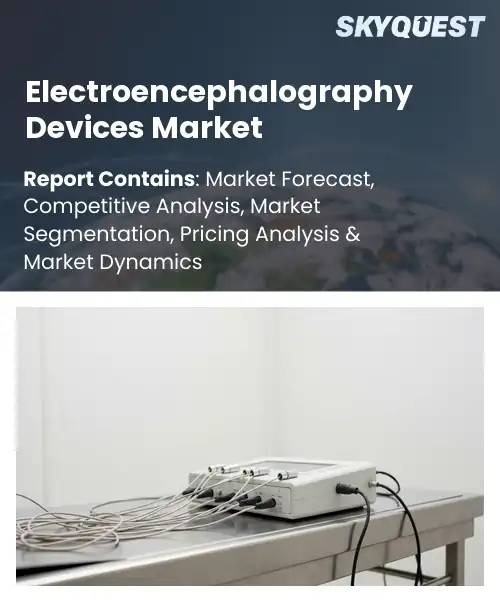
Electroencephalography Devices Market
Report ID: SQMIG35A3553
Report ID: SQMIG35A3553
[email protected]
USA +1 351-333-4748
Report ID:
SQMIG35A3553 |
Region:
Global |
Published Date: May, 2026
Pages:
157
|Tables:
144
|Figures:
78


Global Electroencephalography Devices Market size was valued at USD 1.52 Billion in 2024 and is poised to grow from USD 1.65 Billion in 2025 to USD 3.22 Billion by 2033, growing at a CAGR of 8.72% during the forecast period (2026-2033).
Electroencephalography devices market encompasses manufacturers and suppliers of systems that record brain electrical activity for clinical, research and consumer applications, and its importance has grown as neurological disorders and neurotechnology converge. Historically EEG moved from bulky analog consoles confined to hospitals toward compact digital, high-density and wireless platforms used in ambulatory monitoring and brain computer interfaces, with firms such as Nihon Kohden, Natus and start-ups catalyzing this shift.
The primary driver is rising demand for accessible, noninvasive neural monitoring tied to aging populations and increasing epilepsy and dementia prevalence, which pushes healthcare systems to adopt continuous, remote and cost-effective EEG solutions.Because increasing demand compelled clinicians to seek scalable, interpretable outputs, the integration of cloud platforms and artificial intelligence has emerged as the defining growth factor for the global electroencephalography devices market, and this integration creates measurable opportunities. When algorithms reduce artifact and highlight epileptiform patterns in ambulatory recordings, neurologists can triage cases faster and reduce inpatient monitoring costs, as seen in remote epilepsy programs that shorten diagnostic latency. Similarly, when wearables stream annotated EEG to telemedicine portals, stroke and ICU teams achieve earlier interventions, thereby expanding device adoption and enabling new business models tied to subscription analytics and remote-care reimbursement.
How is AI improving diagnostic accuracy in the electroencephalography devices market?
The market experienced significant improvement in diagnostic accuracy due to the inclusion of AI technologies. AI is used to clean up and interpret complex signals from the brain using automation, machine learning and other innovative technologies; removing artifacts and providing a clearer image of clinically significant patterns allows for more accurate documentation to be provided to clinicians. In application AI is being used at the bedside to quickly and accurately detect seizures and provide standardized interpretations of EEGs, which has reduced the amount of time required to diagnose patients and has extended monitoring capabilities to non-specialized units.
Ceribell in April 2025, the company received pediatric clearance for its Clarity algorithm, a development that illustrates how AI powered point of care EEG can speed diagnosis at the bedside and support broader market growth by improving efficiency and access to timely neurological care.
Market snapshot - (2026-2033)
Global Market Size
USD 1.52 Billion
Largest Segment
EEG Equipment
Fastest Growth
Standalone EEG Devices
Growth Rate
8.72% CAGR
To get more insights on this market click here to Request a Free Sample Report
Global electroencephalography devices market is segmented by product, type, application, end-user, distribution and region. Based on product, the market is segmented into EEG Equipment, EEG Caps & Electrodes and Standalone EEG Devices. Based on type, the market is segmented into Clinical EEG, Ambulatory EEG and Wireless/Wearable EEG. Based on application, the market is segmented into Epilepsy Monitoring, Sleep Disorders, Brain-Computer Interface (BCI) and Neurofeedback. Based on end-user, the market is segmented into Hospitals, Research Institutes and Consumer (Wellness). Based on distribution, the market is segmented into Direct and Distributors. Based on region, the market is segmented into North America, Europe, Asia Pacific, Latin America and Middle East & Africa.
EEG equipment segment dominates with large electroencephalography devices market share because comprehensive system platforms provide multi channel acquisition, integrated signal processing and clinician workflow tools that support complex diagnostics and monitoring. Their proven reliability, interoperability with hospital information systems, and strong clinical validation drive preference among medical professionals, which sustains procurement and long replacement cycles. This entrenched utility creates high barriers to entry and anchors revenue streams across clinical and research settings.
As per electroencephalography devices market analysis, EEG caps and electrodes are witnessing the strongest growth momentum as demand grows for comfortable, rapid‑setup sensors that enable ambulatory and home monitoring. Material and connector innovations, plus compatibility with portable and wireless amplifiers, are broadening applications in consumer wellness, sleep studies and brain interface research, unlocking new product and procurement opportunities.
As per electroencephalography devices market outlook, clinical EEG segment dominates because its established role in diagnostic workflows, mandated use in hospital care and extensive clinical evidence underpin procurement decisions and reimbursement pathways. Robust hardware designs, certified software suites and clinician familiarity reduce implementation risk, encouraging adoption across acute and specialty care. This institutional preference concentrates investments in systems engineered for regulated environments, reinforcing supplier relationships and channel partnerships while shaping standards for interoperability and data governance.
As per electroencephalography devices market forecast, wireless/wearable EEG is emerging as the fastest growing area driven by miniaturization, low power electronics and demand for remote monitoring and consumer neurofeedback. Integration with mobile platforms and telehealth workflows is expanding use beyond clinical settings, enabling scalable data capture for algorithm development and opening new commercial channels and personalized applications.
To get detailed segments analysis, Request a Free Sample Report
As per electroencephalography devices industry analysis, North America is spearheading the race with a mix of sophisticated clinical infrastructure, focused research expertise, and a robust medical device ecosystem that enables quick commercialization. Robust collaborations among academic centers, specialist clinics, and industry also further speed the validation of new EEG technology and clinical procedures. Established manufacturers and a supportive regulatory environment ensure a continual pipeline of improved equipment and software, and payer systems and clinical guidelines stimulate clinical use across care settings. Technology hubs and investment groups are further pushing innovation in portable systems, integrated diagnostic platforms and cloud analytics. The region also boasts a strong concentration of neurological research and specialty training programs, which together support demand for advanced monitoring solutions and continuing advancements in clinical value.
As per electroencephalography devices market regional outlook, United States is marked by dense network of major hospitals, research institutes and specialized neurodiagnostic centers that promote adoption of modern EEG platforms. A robust domestic manufacturing base and active venture investment create a climate for product creation and quick iteration. Clinical trial activity and academic alliances allow for evidence production for novel applications. Integration with digital health infrastructure and telemedicine extends use beyond traditional settings to include ambulatory and home monitoring options.
As per electroencephalography devices market regional forecast, Canada depicts the healthcare scenario with equitable access and system integration, where tertiary hospitals and regional centers are embracing reliable EEG technologies for diagnostic and monitoring purposes. International manufacturing collaborations and collaborative research funding encourage the emergence of portable and tele-EEG systems that mitigate the geographic dispersion of care. Emphasis on interoperability, patient-centred implementation and physician training facilitates incremental modernization of neurodiagnostic services across public care networks.
European expansion is being pushed by healthcare modernization, increased clinical knowledge of neurological diseases, and an innovation ecosystem that stresses digital health integration. Pan-regional regulatory frameworks and reimbursement channels that recognize clinical utility encourage adoption across different healthcare systems. Supply chain resilience and specialized device development are supported by local manufacturing strengths in key countries, and translational research in neurodiagnostics is growing in academic consortia and clinical facilities. The trend to decentralize treatment and include remote monitoring is leading to an increasing need for mobile and user-friendly EEG equipment. The market growth is driven by investment in AI and analytics for EEG interpretation, and regulatory measures encouraging medical technology adoption, creating potential for existing vendors as well as new regional companies.
Germany has a strong base of medical technology manufacturing and a dense network of university hospitals with a focus on advanced neurodiagnostics. There are strong linkages between industry, clinical research and engineering institutes supporting the development and validation of high performance EEG systems. Procurement procedures in hospital networks and an emphasis on quality and reliability foster the use of advanced platforms, while regional suppliers and export orientation solidify Germany’s position as a production and innovation engine.
United Kingdom is experiencing dynamic expansion driven by a vibrant digital health ecosystem and active clinical innovation. Startups and established firms leverage strong clinical research sites and funding mechanisms to pilot novel EEG applications, including AI-enhanced interpretation and remote monitoring models. Health system engagement and partnerships with private and public providers accelerate scaling of promising technologies, while emphasis on outcomes and cost-effectiveness informs procurement and adoption decisions across care pathways.
France is developing through collective public research efforts and an increasing capacity of the country to develop medical devices. Portable and easy-to-use EEG devices are increasingly being adopted by regional hospitals and specialist centers to extend the reach of diagnostics. This is supported by government support for health innovation and partnerships between academic laboratories and industry to assist early-stage innovations, with a practical focus on clinical integration and increasing access to neurodiagnostic services.
Asia Pacific region is expanding its presence with strategic investments in healthcare infrastructure, increasing emphasis on neurodiagnostic capacity, and a growing number of domestic manufacturers and technology companies. Strategic agreements with worldwide manufacturers provide technology transfer and modification of goods to local clinical demands. There is an increased focus by policymakers and healthcare providers on remote and ambulatory monitoring technologies that overcome care delivery constraints in different regions. Growing clinical knowledge and academic research promotes validation of new applications and the region’s excellent electronics and software capabilities accelerates development of wearable and AI-enabled EEG systems.
Japan has high clinical standards, a robust domestic medical technology industry, and a commitment to accuracy and reliability. Hospitals and specialist clinics look for high-quality EEG platforms that interface with hospital IT systems and analytical tools. Collaboration with academic institutes and manufacturers allows iterative improvement and validation of novel features, while demand for strong, clinician-oriented solutions continues uptake in tertiary and community care settings.
South Korea uses a strong electronics and software industry to build small, connected EEG devices and intelligence analysis tools. Government policies to encourage medical innovation and export orientation assist the rapid uptake of hospitals and clinics. Local startups are also collaborating with global companies to transfer and commercialize technologies, resulting in the implementation of advanced EEG solutions in clinical and ambulatory settings.
To know more about the market opportunities by region and country, click here to
Buy The Complete Report
Advances In Signal Processing
Rising Demand For Ambulatory Monitoring
High Cost Of Advanced Systems
Regulatory And Reimbursement Challenges
Request Free Customization of this report to help us to meet your business objectives.
The competitive landscape combines consolidation and AI driven differentiation, with established device makers pursuing acquisitions and clinical partnerships while AI first entrants push software led EEG solutions. Recent examples include Beacon Biosignals acquisitions and pharma partnerships to scale at home EEG and Nihon Kohden acquisition of an electrode specialist to broaden epilepsy offerings. Startups like Cogitat emphasize decoding algorithms to compete on analytics and robustness.
SkyQuest’s ABIRAW (Advanced Business Intelligence, Research & Analysis Wing) is our Business Information Services team that Collects, Collates, Correlates, and Analyses the Data collected by means of Primary Exploratory Research backed by robust Secondary Desk research.
As per SkyQuest analysis, the key driver is the integration of AI and cloud analytics into EEG platforms, which improves signal interpretation and workflow efficiency; a second driver is rising demand for ambulatory and home monitoring that expands use beyond hospitals. A major restraint is the high acquisition and maintenance cost of advanced systems that limits adoption in smaller or resource-constrained settings. North America remains the dominating region due to advanced clinical infrastructure, research ecosystems and favorable commercialization pathways, while the dominating segment continues to be Clinical EEG because of its established role in diagnostics, reimbursement support and clinician familiarity. Overall, growth balances technological promise with economic and regulatory challenges.
| Report Metric | Details |
|---|---|
| Market size value in 2024 | USD 1.52 Billion |
| Market size value in 2033 | USD 3.22 Billion |
| Growth Rate | 8.72% |
| Base year | 2024 |
| Forecast period | (2026-2033) |
| Forecast Unit (Value) | USD Billion |
| Segments covered |
|
| Regions covered | North America (US, Canada), Europe (Germany, France, United Kingdom, Italy, Spain, Rest of Europe), Asia Pacific (China, India, Japan, Rest of Asia-Pacific), Latin America (Brazil, Rest of Latin America), Middle East & Africa (South Africa, GCC Countries, Rest of MEA) |
| Companies covered |
|
| Customization scope | Free report customization with purchase. Customization includes:-
|
To get a free trial access to our platform which is a one stop solution for all your data requirements for quicker decision making. This platform allows you to compare markets, competitors who are prominent in the market, and mega trends that are influencing the dynamics in the market. Also, get access to detailed SkyQuest exclusive matrix.
Table Of Content
Executive Summary
Market overview
Parent Market Analysis
Market overview
Market size
KEY MARKET INSIGHTS
COVID IMPACT
MARKET DYNAMICS & OUTLOOK
Market Size by Region
KEY COMPANY PROFILES
Methodology
For the Electroencephalography Devices Market, our research methodology involved a mixture of primary and secondary data sources. Key steps involved in the research process are listed below:
1. Information Procurement: This stage involved the procurement of Market data or related information via primary and secondary sources. The various secondary sources used included various company websites, annual reports, trade databases, and paid databases such as Hoover's, Bloomberg Business, Factiva, and Avention. Our team did 45 primary interactions Globally which included several stakeholders such as manufacturers, customers, key opinion leaders, etc. Overall, information procurement was one of the most extensive stages in our research process.
2. Information Analysis: This step involved triangulation of data through bottom-up and top-down approaches to estimate and validate the total size and future estimate of the Electroencephalography Devices Market.
3. Report Formulation: The final step entailed the placement of data points in appropriate Market spaces in an attempt to deduce viable conclusions.
4. Validation & Publishing: Validation is the most important step in the process. Validation & re-validation via an intricately designed process helped us finalize data points to be used for final calculations. The final Market estimates and forecasts were then aligned and sent to our panel of industry experts for validation of data. Once the validation was done the report was sent to our Quality Assurance team to ensure adherence to style guides, consistency & design.
Analyst Support
Customization Options
With the given market data, our dedicated team of analysts can offer you the following customization options are available for the Electroencephalography Devices Market:
Product Analysis: Product matrix, which offers a detailed comparison of the product portfolio of companies.
Regional Analysis: Further analysis of the Electroencephalography Devices Market for additional countries.
Competitive Analysis: Detailed analysis and profiling of additional Market players & comparative analysis of competitive products.
Go to Market Strategy: Find the high-growth channels to invest your marketing efforts and increase your customer base.
Innovation Mapping: Identify racial solutions and innovation, connected to deep ecosystems of innovators, start-ups, academics, and strategic partners.
Category Intelligence: Customized intelligence that is relevant to their supply Markets will enable them to make smarter sourcing decisions and improve their category management.
Public Company Transcript Analysis: To improve the investment performance by generating new alpha and making better-informed decisions.
Social Media Listening: To analyze the conversations and trends happening not just around your brand, but around your industry as a whole, and use those insights to make better Marketing decisions.
REQUEST FOR SAMPLE
 REQUEST FREE CUSTOMIZATION
Global Electroencephalography Devices Market size was valued at USD 1.52 Billion in 2024 and is poised to grow from USD 1.65 Billion in 2025 to USD 3.22 Billion by 2033, growing at a CAGR of 8.72% during the forecast period (2026-2033).
The competitive landscape combines consolidation and AI driven differentiation, with established device makers pursuing acquisitions and clinical partnerships while AI first entrants push software led EEG solutions. Recent examples include Beacon Biosignals acquisitions and pharma partnerships to scale at home EEG and Nihon Kohden acquisition of an electrode specialist to broaden epilepsy offerings. Startups like Cogitat emphasize decoding algorithms to compete on analytics and robustness. 'Natus Medical (Neuro)', 'Compumedics Ltd.', 'Nihon Kohden', 'Philips Healthcare', 'Siemens Healthineers', 'GE Healthcare', 'BrainVision (Brain Products)', 'g.tec medical engineering', 'Emotiv Inc.', 'NeuroSky', 'Cadwell Laboratories', 'Xltek (Natus)', 'Moberg ICU Solutions', 'Electrical Geodesics (Philips)', 'Dreem (ResMed)', 'Advanced Brain Monitoring', 'InteraXon (Muse)', 'Neurable Inc.', 'Cognionics Inc.', 'Muse (InteraXon)'
Advances in signal processing and machine learning have improved the clarity and interpretability of EEG readings, enabling clinicians to detect subtle patterns and reduce artifacts, which increases diagnostic confidence and broadens clinical utility. These technical improvements support the development of portable, user friendly systems and allow integration with decision support tools, encouraging adoption across hospitals and outpatient settings. As manufacturers leverage improved algorithms to offer reliable and easier to use devices, healthcare providers are more likely to invest in EEG technologies for a wider range of neurological and monitoring applications.
Ai Driven Signal Interpretation: Incorporation of artificial intelligence and machine learning into electroencephalography devices enables more reliable artifact rejection, nuanced pattern recognition, and automated preliminary reporting that supports clinical workflow. These capabilities expand diagnostic reach into complex neurophysiological and behavioral health presentations and facilitate monitoring strategies. Vendors prioritize explainability, clinical validation and integration with health records. As clinicians accept AI as an assistive tool, demand rises for platforms that combine robust algorithms with secure, interoperable data pipelines and intuitive interfaces.
Why does North America Dominate the Global Electroencephalography Devices Market? |@12


Want to customize this report? This report can be personalized according to your needs. Our analysts and industry experts will work directly with you to understand your requirements and provide you with customized data in a short amount of time. We offer $1000 worth of FREE customization at the time of purchase.
Feedback From Our Clients


 USA (+1) 351-333-4748

