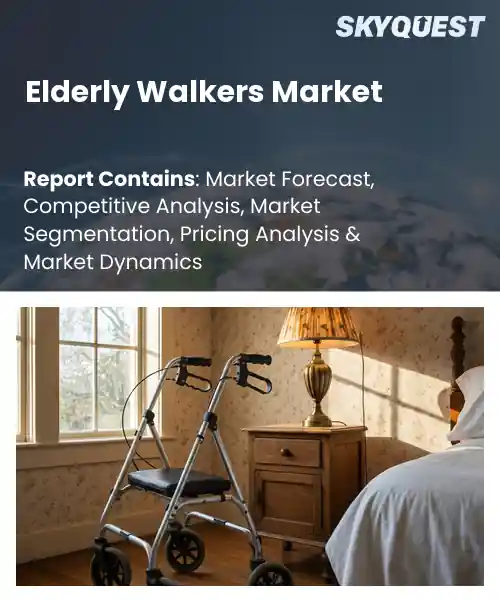
Elderly Walkers Market
Report ID: SQMIG35B2391
Report ID: SQMIG35B2391
[email protected]
USA +1 351-333-4748
Report ID:
SQMIG35B2391 |
Region:
Global |
Published Date: June, 2026
Pages:
157
|Tables:
142
|Figures:
78


Global Elderly Walkers Market size was valued at USD 3.52 Billion in 2024 and is poised to grow from USD 3.72 Billion in 2025 to USD 5.85 Billion by 2033, growing at a CAGR of 5.82% during the forecast period (2026-2033).
The increasing lifespan of people and the subsequent increase in numbers of seniors have become the major factor driving the elderly walkers market. Elderly walkers include aid frames, rollators, and other types of assisted walking devices intended to help regain independence in people aged more than sixty-five years. In moving from an industrial economy to economies, the aging people tend to prefer an active way of living, leading to demand for ergonomic devices. In the past, walkers used to be heavy metal constructions confined to rehabilitation facilities only. However, with the advent of aluminum alloys and ergonomic handles in the first decades of the new century, the emergence of rollators in Walmart stores can be seen.
The increased need for ambulatory physiotherapy and home therapy services acts as the growth driver for elderly walkers at present. Considering the decreased reimbursement on hospital stays on the part of insurers, patients move into recovery mode and require devices that can serve both exercise and mobility functions. To address these demands, firms like Invacare have come up with rollators that have feedback loops enabling the doctors to check the gait pattern of the patient from a distance without requiring them to visit the clinics. Such technological innovations have not only increased the size of the market but also provided room for service-based business models.
How is AI Enhancing Safety Features in the Elderly Walkers Market?
AI is changing elderly walkers through the inclusion of intelligent sensors that constantly track balance, gait and any hazards that may be in the immediate environment. Through the machine learning capability, the information gathered is used in predicting the instability and initiating the process of braking and vibrations to prevent falls. Voice assistants in the walkers are used to asking for assistance or slow down without having to use manual controls while the internet connectivity ensures the caregiver gets instant alerts and can monitor any gait patterns. With the growth in the number of elderly people, the demand for such AI enabled products increases and the need to create a differentiated product.
Market snapshot - (2026-2033)
Global Market Size
USD 3.52 Billion
Largest Segment
Standard Walkers (No Wheels)
Fastest Growth
Four-Wheel Rollators
Growth Rate
5.82% CAGR
To get more insights on this market click here to Request a Free Sample Report
Global elderly walkers market is segmented by type, material, end-user, distribution, setting and region. Based on type, the market is segmented into Standard Walkers (No Wheels), Two-Wheel Walkers, Four-Wheel Rollators and Knee Walkers. Based on material, the market is segmented into Aluminum and Steel. Based on end-user, the market is segmented into Elderly Patients and Post-Surgical Rehabilitation. Based on distribution, the market is segmented into Medical Equipment Dealers, Online, and Pharmacies. Based on settings, the market is segmented into Home Use and Healthcare Facility. Based on the region, the market is segmented into North America, Europe, Asia Pacific, Latin America and Middle East & Africa.
The Aluminum segment has the largest share because of its light weight, which minimizes user fatigue and improves maneuverability, an essential factor among the elderly who are striving for independence. The resistance to corrosion of this product will increase its lifetime, a feature that would be appreciated by caregivers and institutions with long-term cost savings in mind. For this reason, aluminum products are preferred by producers, and this quality is emphasized by retailers, making this segment one of the key factors in purchasing processes today.
Nevertheless, the Steel segment is the fastest growing because its strong design provides improved stability to users after surgery or having difficulties in maintaining balance. New product lines feature ergonomic handles and light-weight alloy mixes.
Segment of Two-Wheel Walkers is the leading one since the two wheels offer an optimal balance between support and maneuverability that fits the requirements of senior users. This model enables safe movement across various floor surfaces and maintains stable posture, minimizing the risks of falling. Ergonomic grips and braking systems are included in this segment by manufacturers, increasing the level of consumer confidence and making it attractive for private households and assisted living centers.
On the contrary, Four-Wheel Rollators are the most rapidly developing segments as their four-wheel stability responds to the growing need for more safety of severely impaired users. Some advanced models are equipped with seats and storage compartments, becoming very popular for caregivers looking for multifunctional mobility products.
To get detailed segments analysis, Request a Free Sample Report
North America's market is advantaged by the availability of an experienced healthcare sector and a high level of awareness of mobility devices within aging demographics. Retail infrastructure is well-developed, allowing for convenient access to a wide variety of products and ensuring brand loyalty. The innovation ecosystem of both the U.S. and Canada promotes improvements in ergonomics, safety, and material quality of the devices, contributing to consumer confidence. The cultural importance of senior independence creates the need for reliable walking aids, and reimbursements add value to the market potential. All these factors provide a solid basis for leadership and performance benchmarking in the global market.
The Elderly Walkers Market in the USA is highly integrated, considering that there is a high level of incorporation of sophisticated designs into the products with features of high user orientation, enabled by a wide network of distributors that can cover both urban and rural environments. The need for high-quality, long-lasting products makes consumers seek better products, which motivates continuous improvement, while effective advocacy ensures proper consumer education on the health of their mobility.
Market for Elderly Walkers in Canada can be identified by the value of accessibility and inclusiveness through the programs related to public health that consider the welfare of seniors. There is an ideal balance in the market of local and international producers, which results in better competition and improved products. The contribution from the health professionals towards recommending the right choices is highly significant, which promotes its use. Another factor that sets the Canadian market apart is the collaboration among the regions and sustainable production.
The development of Europe is driven by an extensive social security network that drives elderly individuals to take initiatives towards maintaining their well-being through proactive health care. Increasing awareness among the general population about the advantages of assisted mobility along with stringent regulations help in ensuring that all products produced are of superior quality and highly safe. Research conducted across Europe leads to developments in terms of lightweight materials and ergonomic design, while various different types of retail environments from medical outlets to online shopping make up the sales environment. Aging population with the need for staying physically active increases the demand while intra-EU trade makes the process easier.
The Elderly Walkers Market in Germany boasts an extensive history of engineering excellence and strict quality control, making it the dominating player in the European market. Customers can choose from a great variety of technically innovative products, backed up by full-scale healthcare advice on maintaining mobility. Collaboration between manufacturers and research organizations promotes constant advancement of security systems, whereas effective distribution networks guarantee widespread availability of the product range.
In the UK, the market for Elderly Walkers has been showing the highest rate of growth owing to increased public health awareness and increased emphasis on independent living among elderly people. With more products being sold by retailers and available through the Internet, the availability of a range of walking aids has become easy. The cooperation between manufacturers and NHS specialists facilitates the development of ergonomically designed walkers.
Market for Elderly Walkers in France is developing into a lively market due to increasing knowledge about the advantages of movement among the aged. The efforts made by the government towards improving health among the aged through various programs have encouraged the use of devices that help in walking. Boutique stores and online platforms have expanded the scope for customers.
Asia Pacific is moving towards becoming more prominent with a combination of culturally rooted approaches to elder care with modern mobility aids. Investment in research and development led to the creation of new models that are light and user-friendly, attracting customers that want to remain mobile. Diverse channels of distribution, both traditional and online, are helping to increase the availability of the products in large cities and rural areas alike. Combined efforts of governments and the private sector are concentrated on making the products affordable and safe, thus further establishing Asia Pacific’s position in the global market of elderly walkers.
The market for elderly walkers in Japan is a result of a careful design strategy, characterized by small size and elegance in its appearance to satisfy consumer demands. High-level support within the healthcare system encourages the incorporation of walking aids into everyday life, while the use of modern material technology helps produce quality and convenient products. Different retail networks provide great availability throughout the country.
South Korea’s Elderly Walkers Market is boosted by fast adoption of technology and societal focus on healthy aging. Technology companies and healthcare providers work together to add smart technology that increases the security and confidence of users. Diversity in the retail sector, including development of online stores, widens the scope of the products, and public health programs promote the use of mobility aids from an early age.
To know more about the market opportunities by region and country, click here to
Buy The Complete Report
Increasing Elderly Population
The rising number of people aged above sixty-five years provides a continuous requirement for walkers that can aid in leading an independent life. Families who want safety and comfort for their senior citizens look for walkers that have been developed using ergonomic designs and enhanced stability. This trend has motivated producers to diversify their offerings and develop user-friendly products, thus supporting market growth. The consumer knowledge about the benefits provided by fall prevention has also acted as a driving force for buying.
Advancements in Assistive Technology
The advances in technology of light and innovative material use, as well as smart sensors, are leading to the evolution of the performance of the walker, allowing for increased comfort and responsiveness. Companies are introducing new attributes into their walkers that include posture sensing, automatic braking, and connection with health monitoring platforms, thus improving safety and enabling proactive healthcare practices. Such changes will appeal to the technologically savvy elderly as well as their caretakers and hence ensure better adoption of these products.
High Product Cost
Due to the advanced technology and quality materials used in the construction of superior walking aids, their high prices make it difficult for most elderly people and their families to afford them. The inability to purchase because of costs may delay their acquisition and force them to choose other inferior alternatives. Besides, insufficient coverage of these devices in some healthcare systems makes the financial gain from using them low. This makes their cost sensitivity inhibit their growth in the market.
Limited Distribution Channels
Access to such devices might be limited to specialty stores or those located in metropolitan cities that offer medical supplies; thus, there will be inadequate reach in the rural areas or underserved areas. Where the distribution network is narrow, consumers will have difficulty finding suitable products and end up using generic and less effective ones. Such geographical limitation prevents proper marketing and awareness among consumers about the advantages of the products, resulting in slow growth of the market.
Request Free Customization of this report to help us to meet your business objectives.
The dynamics of competition in the global market for elderly walkers revolve around stiff competition between existing players and new entrants in the industry. The result has been swift differentiation of products and collaboration among firms. These companies engage in mergers and acquisitions to diversify their offerings, partner with healthcare organizations to incorporate walking aids, and innovate in the field of smart-walkers technology.
Smart Assistive Technology Integration: Sensors, Bluetooth technology, and algorithms powered by artificial intelligence are included within the walker, allowing for real-time gait assessment and remote monitoring of health status. These elements combined provide an integration of these two areas and create a seamless connection between mobility devices and telehealth applications where caregivers can get warnings concerning possible falls or walker usage patterns. All these factors make the new requirements for consumers who start considering these walkers not just as mobility devices but also as preventive health care ones.
Age‑Inclusive Retail Expansion: Chain stores and specialty stores are adopting new designs of the shop floor in terms of layout, signage, and staff procedures to cater to older customers who look for walking aids and associated equipment. The adoption of age-appropriate mobility zones along with training staff in ergonomic designs is making shopping experience better for this segment of the population, thereby winning their confidence. Not only does this strategy widen the market, but it also promotes loyalty, as older people like shops that show sympathy and knowledge of their needs.
SkyQuest’s ABIRAW (Advanced Business Intelligence, Research & Analysis Wing) is our Business Information Services team that Collects, Collates, Correlates, and Analyses the Data collected by means of Primary Exploratory Research backed by robust Secondary Desk research.
As per SkyQuest analysis, the global elderly walker market is getting driven mainly by the increasing number of elderly people that creates the demand for mobility products that will provide seniors with mobility on their own, while technological developments within the field of assistive technologies like artificial intelligence sensors and light alloy materials act as the second factor driving product attractiveness. High product cost works as a constraint that prevents price-sensitive consumers from adopting the devices. North America holds a leading position in the market due to a well-developed healthcare system and distribution channels. Two-wheel walkers have gained the leadership in the type of segment.
| Report Metric | Details |
|---|---|
| Market size value in 2024 | USD 3.52 Billion |
| Market size value in 2033 | USD 5.85 Billion |
| Growth Rate | 5.82% |
| Base year | 2024 |
| Forecast period | (2026-2033) |
| Forecast Unit (Value) | USD Billion |
| Segments covered |
|
| Regions covered | North America (US, Canada), Europe (Germany, France, United Kingdom, Italy, Spain, Rest of Europe), Asia Pacific (China, India, Japan, Rest of Asia-Pacific), Latin America (Brazil, Rest of Latin America), Middle East & Africa (South Africa, GCC Countries, Rest of MEA) |
| Companies covered |
|
| Customization scope | Free report customization with purchase. Customization includes:-
|
To get a free trial access to our platform which is a one stop solution for all your data requirements for quicker decision making. This platform allows you to compare markets, competitors who are prominent in the market, and mega trends that are influencing the dynamics in the market. Also, get access to detailed SkyQuest exclusive matrix.
Table Of Content
Executive Summary
Market overview
Parent Market Analysis
Market overview
Market size
KEY MARKET INSIGHTS
COVID IMPACT
MARKET DYNAMICS & OUTLOOK
Market Size by Region
KEY COMPANY PROFILES
Methodology
For the Elderly Walkers Market, our research methodology involved a mixture of primary and secondary data sources. Key steps involved in the research process are listed below:
1. Information Procurement: This stage involved the procurement of Market data or related information via primary and secondary sources. The various secondary sources used included various company websites, annual reports, trade databases, and paid databases such as Hoover's, Bloomberg Business, Factiva, and Avention. Our team did 45 primary interactions Globally which included several stakeholders such as manufacturers, customers, key opinion leaders, etc. Overall, information procurement was one of the most extensive stages in our research process.
2. Information Analysis: This step involved triangulation of data through bottom-up and top-down approaches to estimate and validate the total size and future estimate of the Elderly Walkers Market.
3. Report Formulation: The final step entailed the placement of data points in appropriate Market spaces in an attempt to deduce viable conclusions.
4. Validation & Publishing: Validation is the most important step in the process. Validation & re-validation via an intricately designed process helped us finalize data points to be used for final calculations. The final Market estimates and forecasts were then aligned and sent to our panel of industry experts for validation of data. Once the validation was done the report was sent to our Quality Assurance team to ensure adherence to style guides, consistency & design.
Analyst Support
Customization Options
With the given market data, our dedicated team of analysts can offer you the following customization options are available for the Elderly Walkers Market:
Product Analysis: Product matrix, which offers a detailed comparison of the product portfolio of companies.
Regional Analysis: Further analysis of the Elderly Walkers Market for additional countries.
Competitive Analysis: Detailed analysis and profiling of additional Market players & comparative analysis of competitive products.
Go to Market Strategy: Find the high-growth channels to invest your marketing efforts and increase your customer base.
Innovation Mapping: Identify racial solutions and innovation, connected to deep ecosystems of innovators, start-ups, academics, and strategic partners.
Category Intelligence: Customized intelligence that is relevant to their supply Markets will enable them to make smarter sourcing decisions and improve their category management.
Public Company Transcript Analysis: To improve the investment performance by generating new alpha and making better-informed decisions.
Social Media Listening: To analyze the conversations and trends happening not just around your brand, but around your industry as a whole, and use those insights to make better Marketing decisions.
REQUEST FOR SAMPLE
 REQUEST FREE CUSTOMIZATION
Global Elderly Walkers Market size was valued at USD 3.52 Billion in 2024 and is poised to grow from USD 3.72 Billion in 2025 to USD 5.85 Billion by 2033, growing at a CAGR of 5.82% during the forecast period (2026-2033).
The competitive landscape of the global elderly walkers market is shaped by intense rivalry among established manufacturers and emerging innovators, driving rapid product differentiation and strategic collaborations. Companies are pursuing M&A to broaden their portfolios, forming partnerships with healthcare providers to integrate mobility solutions, and investing in smart‑walker technology that combines navigation, health monitoring, and connectivity to stay ahead of rivals. 'Drive DeVilbiss Healthcare', 'Invacare Corporation', 'Medline Industries', 'Graham-Field Health Products', 'Hugo Mobility', 'NOVA Medical Products', 'Karman Healthcare', 'Lumex (Graham-Field)', 'Carex Health Brands', 'Dolomite (Etac AB)', 'Topro (Etac AB)', 'Etac AB', 'Able Life', 'AMG Medical', 'PQUIP', 'Kaye Products', 'Roscoe Medical', 'Cardinal Health', 'McKesson Corporation', 'Mobb Healthcare'
The growing proportion of adults over sixty-five creates a sustained demand for mobility aids that support independent living. As families prioritize safety and comfort for aging relatives, they actively seek walkers designed with ergonomic features and stability enhancements. This demographic shift encourages manufacturers to expand product portfolios and invest in user‑friendly designs, thereby reinforcing market expansion. Consumer awareness of fall‑prevention benefits further motivates purchases, ensuring that the increasing elderly population directly fuels growth in the global walkers market today worldwide.
Smart Assistive Technology Integration: Manufacturers embed sensors, Bluetooth connectivity, and AI‑driven stability algorithms into walkers, enabling real‑time gait analysis and remote health monitoring. This convergence creates a seamless link between mobility aids and telehealth platforms, allowing caregivers to receive alerts about fall risk or usage patterns. The added convenience and safety features reshape consumer expectations, positioning walkers as proactive health devices rather than passive support tools, and driving demand among tech‑savvy seniors and their families. Manufacturers also explore subscription models for data analytics, creating ongoing revenue opportunities.
Why does North America Dominate the Global Elderly Walkers Market? |@12


Want to customize this report? This report can be personalized according to your needs. Our analysts and industry experts will work directly with you to understand your requirements and provide you with customized data in a short amount of time. We offer $1000 worth of FREE customization at the time of purchase.
Feedback From Our Clients


 USA (+1) 351-333-4748

