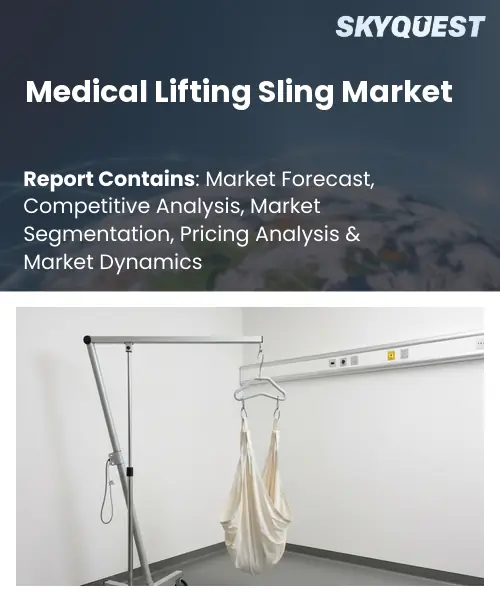
Medical Lifting Sling Market
Report ID: SQMIG35B2372
Report ID: SQMIG35B2372
[email protected]
USA +1 351-333-4748
Report ID:
SQMIG35B2372 |
Region:
Global |
Published Date: June, 2026
Pages:
157
|Tables:
119
|Figures:
72


Global Medical Lifting Sling Market size was valued at USD 784.5 Million in 2024 and is poised to grow from USD 838.0 Million in 2025 to USD 1422.8 Million by 2033, growing at a CAGR of 6.82% during the forecast period (2026-2033).
The global medical lifting sling industry centers on devices used to move or support immobile patients during transfers and repositioning, a niche that matters because it directly affects patient safety and caregiver ergonomics. Its primary driver is demographic change, notably aging populations and rising chronic disease prevalence, which have increased demand for safe patient handling across hospitals, long-term care and homecare settings. Historically the market evolved from simple canvas strap designs toward ergonomically shaped, antimicrobial, and bariatric-rated slings as clinicians sought solutions that reduce pressure injuries and manual handling incidents, for example widespread adoption of multihook slings in Europe today.
Policy-driven demand forces suppliers to invest in differentiated offerings such as bariatric, quick-fit and antimicrobial slings that solve clinical handling challenges; consequently clinicians perform faster, lower-risk transfers, which reduces staff injury rates and operational costs, as seen when long-term care facilities replace manual lifts with sling-based systems. Growth in homecare and emerging markets occurs where simplified designs and reimbursement convert need into sales.
How is IoT improving safety and monitoring in the medical lifting sling market?
Internet of Things improves safety and monitoring in the medical lifting sling market by combining sensor enabled textiles with wireless connectivity to capture load distribution, pressure points and sling integrity. Manufacturers now embed low power sensors and smart tags so systems can detect mispositioning, excessive strain and wear. That data flows to caregiver dashboards and maintenance teams enabling immediate alerts, more accurate handovers and recorded usage histories. The current market is driven by aging populations and caregiver shortages which increase demand for solutions that reduce manual checks and support safer transfers. Practical examples include slings that warn when positioning is unsafe and systems that guide staff through correct application.
Invacare in May 2022, the company launched the Birdie Evo XPLUS patient lift, and broader adoption of sensor enabled components is helping the market grow. IoT connectivity links slings and lifts so caregivers receive real time safety alerts, equipment managers plan service and facilities improve transfer efficiency.
Market snapshot - (2026-2033)
Global Market Size
USD 784.5 Million
Largest Segment
Universal Slings
Fastest Growth
Stand Assist Slings
Growth Rate
6.82% CAGR
To get more insights on this market click here to Request a Free Sample Report
Global medical lifting sling market is segmented by product type, material, application, end-user and region. Based on product type, the market is segmented into Universal Slings, Divided Leg Slings, Stand Assist Slings, Toileting Slings and Others. Based on material, the market is segmented into Polyester, Mesh and Hammock/Canvas. Based on application, the market is segmented into Patient Transfer, Bathing & Toileting and Rehabilitation. Based on end-user, the market is segmented into Hospitals, Long-Term Care Facilities and Home Care. Based on region, the market is segmented into North America, Europe, Asia Pacific, Latin America and Middle East & Africa.
Universal slings segment dominates with large medical lifting sling market share because their broad compatibility with different lift systems and patient profiles reduces SKU complexity and simplifies procurement for care providers. This versatility drives institutional preference as staff training becomes standardized, operational workflows streamline, and inventory management eases. Manufacturers focus on incremental improvements and supply reliability, reinforcing adoption through cost efficiencies and predictable performance that together sustain leadership across care settings.
As per medical lifting sling market outlook, divided leg slings are witnessing the strongest growth momentum because ergonomic leg separation improves positioning and caregiver access during transfers and toileting. Comfort focused padding and adjustable fittings increase patient acceptance in rehabilitation and home care, while product innovations expand clinical uses and create focused procurement demand that drives future market opportunity.
As per medical lifting sling market forecast, polyester segment dominates because its high tensile strength, dimensional stability, and compatibility with industrial laundering meet institutional demands for durable, reusable lifting slings. Care facilities prioritize materials that withstand repeated cycles while preserving structural integrity and infection control protocols, prompting procurement preference. The manufacturing base and supply chains favor polyester production, enabling consistent quality, cost effective sterilization processes, and widespread clinical acceptance that reinforce its leading market position.
Meanwhile, mesh is emerging as the key high growth area because breathable construction improves skin health during prolonged support and speeds drying after bathing, reducing infection risk. Antimicrobial finishes and hybrid weaves enhance comfort and hygiene, prompting broader adoption in rehabilitation and home care and opening new product niches that expand market opportunity.
To get detailed segments analysis, Request a Free Sample Report
As per medical lifting sling market regional outlook, North America combines advanced clinical infrastructure, strong reimbursement frameworks, concentrated medical device procurement, and a mature ecosystem of manufacturers and distributors that together underpin market dominance. Clinical adoption is driven by integrated care pathways in hospitals and long term care facilities where patient handling safety and caregiver ergonomics are prioritized. Robust product development and regulatory clarity enable rapid introduction of specialized sling designs and materials, while established training programs and service networks support adoption across acute and post acute settings. Concentration of capital investment and willingness of payers to reimburse for assistive technologies incentivize procurement of higher quality sling systems and related services. A dense network of clinical research institutions producing evidence on patient outcomes and cost effectiveness expedites clinician confidence and institutional purchasing.
As per medical lifting sling market regional forecast, United States is characterized by broad hospital adoption, extensive product variety, and strong clinical support services. Provider networks prioritize patient handling protocols and caregiver safety, creating demand for customizable sling solutions and advanced materials. Close collaboration between manufacturers and clinical research centers accelerates product refinement. Comprehensive training, maintenance services, and integrated procurement channels support sustained use across acute care, rehabilitation, and long term care environments.
Canada emphasizes integrated care delivery, regional procurement strategies, and support for long term and community based care providers. Providers value ergonomic designs and versatile sling configurations that accommodate diverse care settings. Manufacturer partnerships with provincial health agencies and rehabilitation centers foster localized product adaptation and training programs. Focus on safety, caregiver ergonomics, and efficient logistics supports broader adoption in hospitals, home care, and elder care services nationwide.
Europe rapid market expansion is propelled by harmonized regulatory frameworks, emphasis on patient safety, and strong clinical advocacy for improved patient handling solutions. Demographic shifts and well developed rehabilitation and long term care infrastructures raise clinical demand across institutional and community settings. Coordinated procurement and cross border collaboration among healthcare providers and suppliers accelerate standardization and dissemination of best practices. A diverse manufacturer landscape and growing product specialization respond to varied clinical needs. Variability in national reimbursement approaches creates areas of accelerated uptake where procurement prioritizes technologies that improve patient outcomes and operational efficiency. Strategic partnerships between device makers, clinical research centers, and specialist suppliers drive localized innovation in materials and sling customization. Growing emphasis on integrated care pathways and staff training accreditation enhances clinician confidence and supports sustained market penetration.
Germany is shaped by strong hospital infrastructure, centralized procurement among provider networks, and a focus on clinical evidence supporting device selection. Providers emphasize safety, durability, and integration with patient transfer systems, encouraging use of advanced sling designs and materials. Manufacturer partnerships with rehabilitation hospitals and service providers facilitate implementation, training, and maintenance, sustaining preference for clinically validated sling solutions across acute and long term care.
United Kingdom is characterized by dynamic adoption driven by procurement reforms, strong focus on patient safety, and active clinical networks that champion improved patient handling. Regional innovation hubs support trials of novel sling designs while manufacturers engage with rehabilitation specialists and care providers to optimize fit and training. Emphasis on staff welfare, value driven purchasing, and service offerings accelerates uptake across hospitals and community care.
France is emerging with growing attention to patient comfort, sling configurations, and integration with care pathways. French providers favor solutions that combine clinical performance with ease of use in rehabilitation and home care environments. Collaboration among manufacturers, clinical centers, and regional health authorities fosters localized product adaptation and training. Emphasis on ergonomics, material quality, and aftercare supports adoption across hospitals, clinics, and community care providers.
Asia Pacific is strengthening its role through a combination of localized manufacturing capabilities, growing clinical infrastructure, and targeted product adaptation suited to regional care settings. Manufacturers in the region leverage cost efficient production and agile supply chains to offer competitive slings and accessory services tailored to hospital and home care needs. Investment in clinician training, partnerships with rehabilitation centers, and incremental regulatory harmonization support safer adoption. Rising attention to elderly care models and community rehabilitation creates sustained demand for versatile sling designs. Adoption of higher quality standards and focus on innovative materials and attachment systems enhances clinician confidence and broadens acceptance across tertiary and community providers. Robust after sales service and localized distribution reduce adoption friction and support long term utilization, strengthening regional market position.
Japan benefits from advanced technology adoption, high product quality standards, and collaboration between manufacturers and clinical institutions. Providers prioritize ergonomic design, precision fit, and materials that balance comfort with durability. Integration with hospital transfer systems and emphasis on caregiver safety drive demand for specialized sling variants. Strong after sales support and training programs build clinician confidence, encouraging deployment across acute, rehabilitation, and elder care settings.
South Korea is supported by strong device manufacturing, rapid clinical adoption of innovative materials, and partnerships between industry and healthcare institutions. Korean providers value modular designs that integrate with mechanical lifts and address diverse patient needs. Government health initiatives and export firms encourage development of high quality, cost competitive sling solutions. Robust training and services facilitate uptake across hospitals, rehabilitation centers, and home care providers.
To know more about the market opportunities by region and country, click here to
Buy The Complete Report
Rising Geriatric Population Demand
Expansion Of Home Healthcare Services
High Product Cost And Reimbursement
Safety Concerns And Regulatory Burden
Request Free Customization of this report to help us to meet your business objectives.
The competitive landscape is concentrated and dynamic, driven by consolidation among large medtech firms and targeted technology partnerships that reshape product portfolios and distribution. Strategic M&A such as Baxter’s Hillrom buyout and product launches like Invacare’s Birdie Evo illustrate how incumbents use acquisitions, new product development and hospital system partnerships to neutralize startup threats while startups commercialize focused transfer innovations to win pilot contracts.
SkyQuest’s ABIRAW (Advanced Business Intelligence, Research & Analysis Wing) is our Business Information Services team that Collects, Collates, Correlates, and Analyses the Data collected by means of Primary Exploratory Research backed by robust Secondary Desk research.
As per SkyQuest analysis, the global medical lifting sling market growth is being propelled by one key driver aging population demand that increases need for safe patient handling, while one restraint is high product cost and inconsistent reimbursement that limits adoption in budget constrained settings. North America remains the dominating region due to advanced clinical infrastructure and strong reimbursement frameworks, and the dominating segment is universal slings which simplify procurement and workflows. A second driver is expansion of home healthcare services which fuels demand for portable, easy to use sling solutions. Overall, manufacturers and providers must balance innovation in materials and IoT enabled safety with cost and regulatory pressures to capture growth. A key medical lifting sling market trend is the adoption of ergonomic and patient-specific lifting slings designed to improve comfort, reduce caregiver injuries, and enhance patient safety during transfers and repositioning.
| Report Metric | Details |
|---|---|
| Market size value in 2024 | USD 784.5 Million |
| Market size value in 2033 | USD 1422.8 Million |
| Growth Rate | 6.82% |
| Base year | 2024 |
| Forecast period | (2026-2033) |
| Forecast Unit (Value) | USD Million |
| Segments covered |
|
| Regions covered | North America (US, Canada), Europe (Germany, France, United Kingdom, Italy, Spain, Rest of Europe), Asia Pacific (China, India, Japan, Rest of Asia-Pacific), Latin America (Brazil, Rest of Latin America), Middle East & Africa (South Africa, GCC Countries, Rest of MEA) |
| Companies covered |
|
| Customization scope | Free report customization with purchase. Customization includes:-
|
To get a free trial access to our platform which is a one stop solution for all your data requirements for quicker decision making. This platform allows you to compare markets, competitors who are prominent in the market, and mega trends that are influencing the dynamics in the market. Also, get access to detailed SkyQuest exclusive matrix.
Table Of Content
Executive Summary
Market overview
Parent Market Analysis
Market overview
Market size
KEY MARKET INSIGHTS
COVID IMPACT
MARKET DYNAMICS & OUTLOOK
Market Size by Region
KEY COMPANY PROFILES
Methodology
For the Medical Lifting Sling Market, our research methodology involved a mixture of primary and secondary data sources. Key steps involved in the research process are listed below:
1. Information Procurement: This stage involved the procurement of Market data or related information via primary and secondary sources. The various secondary sources used included various company websites, annual reports, trade databases, and paid databases such as Hoover's, Bloomberg Business, Factiva, and Avention. Our team did 45 primary interactions Globally which included several stakeholders such as manufacturers, customers, key opinion leaders, etc. Overall, information procurement was one of the most extensive stages in our research process.
2. Information Analysis: This step involved triangulation of data through bottom-up and top-down approaches to estimate and validate the total size and future estimate of the Medical Lifting Sling Market.
3. Report Formulation: The final step entailed the placement of data points in appropriate Market spaces in an attempt to deduce viable conclusions.
4. Validation & Publishing: Validation is the most important step in the process. Validation & re-validation via an intricately designed process helped us finalize data points to be used for final calculations. The final Market estimates and forecasts were then aligned and sent to our panel of industry experts for validation of data. Once the validation was done the report was sent to our Quality Assurance team to ensure adherence to style guides, consistency & design.
Analyst Support
Customization Options
With the given market data, our dedicated team of analysts can offer you the following customization options are available for the Medical Lifting Sling Market:
Product Analysis: Product matrix, which offers a detailed comparison of the product portfolio of companies.
Regional Analysis: Further analysis of the Medical Lifting Sling Market for additional countries.
Competitive Analysis: Detailed analysis and profiling of additional Market players & comparative analysis of competitive products.
Go to Market Strategy: Find the high-growth channels to invest your marketing efforts and increase your customer base.
Innovation Mapping: Identify racial solutions and innovation, connected to deep ecosystems of innovators, start-ups, academics, and strategic partners.
Category Intelligence: Customized intelligence that is relevant to their supply Markets will enable them to make smarter sourcing decisions and improve their category management.
Public Company Transcript Analysis: To improve the investment performance by generating new alpha and making better-informed decisions.
Social Media Listening: To analyze the conversations and trends happening not just around your brand, but around your industry as a whole, and use those insights to make better Marketing decisions.
REQUEST FOR SAMPLE
 REQUEST FREE CUSTOMIZATION
Global Medical Lifting Sling Market size was valued at USD 784.5 Million in 2024 and is poised to grow from USD 838.0 Million in 2025 to USD 1422.8 Million by 2033, growing at a CAGR of 6.82% during the forecast period (2026-2033).
The competitive landscape is concentrated and dynamic, driven by consolidation among large medtech firms and targeted technology partnerships that reshape product portfolios and distribution. Strategic M&A such as Baxter’s Hillrom buyout and product launches like Invacare’s Birdie Evo illustrate how incumbents use acquisitions, new product development and hospital system partnerships to neutralize startup threats while startups commercialize focused transfer innovations to win pilot contracts. 'Arjo AB', 'Invacare Corporation', 'Handicare Group', 'Hill-Rom Holdings', 'Stryker Corporation', 'Liko (Hill-Rom)', 'Guldmann Inc.', 'Etac AB', 'Joerns Healthcare', 'Oxford Optronix', 'Performance Health', 'Sunrise Medical', 'ROPOX A/S', 'Medline Industries', 'Cardinal Health'
An increasing geriatric population with mobility limitations and chronic conditions elevates demand for medical lifting slings, prompting healthcare providers and caregivers to prioritize safe patient handling and transfer solutions. This demographic shift encourages procurement by hospitals, long-term care facilities, and homecare services, driving manufacturers to expand product ranges, invest in ergonomics, and develop specialized materials. Greater visibility of patient safety objectives and care standards further supports adoption, as institutions seek devices that reduce caregiver strain and improve patient dignity, thereby sustaining market expansion.
Aging Population Demand: An expanding elderly demographic is reshaping demand for medical lifting slings as care providers prioritize comfort, dignity and safe patient handling in diverse settings. Home based care and assisted living emphasize ease of use, reduced caregiver strain and adaptability to varying body types. Manufacturers are responding with ergonomic materials, modular sizing and softer interfaces to enhance acceptance and long term use, creating opportunities for differentiated product portfolios and service offerings. This trend drives closer collaboration between suppliers and care teams.
Why does North America Dominate the Global Medical Lifting Sling Market? |@12


Want to customize this report? This report can be personalized according to your needs. Our analysts and industry experts will work directly with you to understand your requirements and provide you with customized data in a short amount of time. We offer $1000 worth of FREE customization at the time of purchase.
Feedback From Our Clients


 USA (+1) 351-333-4748

