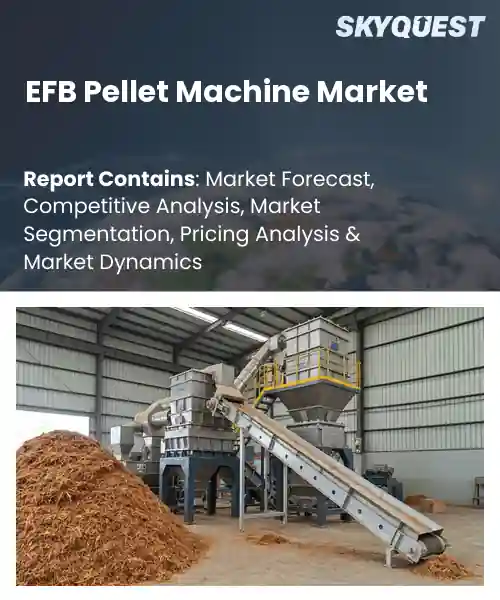
EFB Pellet Machine Market
Report ID: SQMIG20H2142
Report ID: SQMIG20H2142
[email protected]
USA +1 351-333-4748
Report ID:
SQMIG20H2142 |
Region:
Global |
Published Date: August, 2026
Pages:
157
|Tables:
143
|Figures:
78


Global Efb Pellet Machine Market size was valued at USD 245.00 Million in 2024 and is poised to grow from USD 263.38 Million in 2025 to USD 469.73 Million by 2033, growing at a CAGR of 7.5% during the forecast period (2026-2033).
Rising demand for bio‑fuels constitutes the catalyst accelerating the global EFB pellet machine market share, because converting palm waste into pellets lowers plantation energy costs and meets carbon‑credit targets. When mills adopt pelletizers, they replace diesel generators with locally produced fuel, which cuts operating expenses by 30 percent and improves grid resilience in remote regions. This cost advantage encourages exporters in Indonesia to bundle pellets with crude palm oil, opening revenue streams and attracting foreign investment in logistics hubs. Consequently, equipment manufacturers expand capacity, launch modular designs, and offer service contracts, creating a cycle of technology adoption and market significant growth.
How is AI-driven Automation Improving Efficiency in the EFB Pellet Machine Market?
AI driven automation is reshaping the EFB pellet machine market trends by embedding smart sensors and adaptive control loops into every stage of production. Machines now collect real‑time data on feedstock moisture, temperature and pressure, allowing software to fine‑tune screw speed and compression force on the fly. This continuous feedback reduces manual adjustments, cuts energy waste and keeps pellet density consistent. Operators benefit from predictive maintenance alerts that warn of wear before a breakdown occurs, keeping line uptime high. The overall workflow becomes smoother, enabling smaller facilities to achieve output levels that previously required larger, labor‑intensive plants. As a result, producers can meet growing demand for sustainable biofuel feedstock while keeping operating costs lean.
Kumara Machinery March 2024, launched an AI control platform that automatically balances heat and pressure during pelletisation, boosting throughput and supporting faster EFB pellet machine market growth expansion.
Market snapshot - (2026-2033)
Global Market Size
USD 245.0 Million
Largest Segment
Flat Die Pellet Machines
Fastest Growth
Ring Die Pellet Machines
Growth Rate
7.5% CAGR
To get more insights on this market click here to Request a Free Sample Report
Global EFB pellet machine market is segmented by machine type, capacity, automation, application, end user and region. Based on machine type, the market is segmented into flat die pellet machines and ring die pellet machines. Based on capacity, the market is segmented into up to 1 ton/hour, 1–5 tons/hour and above 5 tons/hour. Based on automation, the market is segmented into manual, semi-automatic and automatic. Based on application, the market is segmented into biomass fuel production, industrial energy and others. Based on end user, the market is segmented into biomass processing plants, palm oil mills and others. Based on region, the market is segmented into North America, Europe, Asia Pacific, Latin America and Middle East & Africa.
Flat die pellet machines segment dominates because its simple die arrangement yields consistent pellet shape and density, which aligns with the quality expectations of producers handling oil palm by products. The straightforward design reduces maintenance downtime and lowers capital outlay, encouraging adoption across small to medium processing facilities. Reliability and ease of operation foster supplier confidence, creating a virtuous cycle of repeat purchases and aftermarket support that sustains market leadership.
However, ring die pellet machines segment is witnessing the strongest growth momentum because its multiple die configuration enables higher throughput and superior energy efficiency for larger scale operations. Emerging demand for bulk pellet output and continuous processing drives manufacturers to adopt this technology, expanding the market’s capacity horizon and encouraging investments in advanced material handling.
Automatic segment leads because it integrates sensor driven controls and real time monitoring that optimize feed rates, pressure, and temperature without operator intervention. This high level of process precision produces uniform pellets while minimizing energy waste, appealing to facilities seeking consistent output and lower labor costs. The reduction in human error and the ability to run continuously improve overall plant profitability, reinforcing the appeal of fully automated solutions in the market.
On the other hand, manual segment is experiencing rapid expansion because small scale growers and community cooperatives rely on low cost equipment that requires minimal technical expertise. The affordability and simplicity of operation attract new entrants, broadening the user base and prompting manufacturers to develop modular designs that further accelerate market penetration.
To get detailed segments analysis, Request a Free Sample Report
Asia Pacific maintains a leadership role through a confluence of advanced manufacturing expertise, strong government incentives for waste valorisation, and a deep agricultural base that supplies abundant oil palm residues. The region benefits from integrated supply chains that connect plantation growers with technology providers, fostering rapid adoption of pelletizing solutions. Robust research institutions collaborate with equipment manufacturers to continuously refine machine efficiency and reliability. Moreover, a cultural emphasis on sustainable energy transitions amplifies demand across industrial and small‑scale users, solidifying Asia Pacific as the benchmark for operational excellence in the sector.
EFB pellet machine market outlook in Japan thrives on a sophisticated industrial ecosystem that prioritises precision engineering and high‑quality standards. Local manufacturers leverage cutting‑edge automation to produce machines that cater to diverse processing needs, while collaboration with research universities drives ongoing innovation in feedstock handling and energy recovery. Strong policy frameworks encouraging circular economy practices further stimulate investment in pelletising technologies, positioning Japan as a hub for advanced, reliable equipment.
EFB pellet machine market forecast in South Korea is propelled by a dynamic blend of technology‑focused manufacturers and a proactive approach to renewable resource utilisation. The nation’s emphasis on smart factory integration enhances machine performance and reduces operational costs. Government programmes that promote eco‑friendly manufacturing encourage adoption among agro‑industrial firms, while partnerships with regional palm oil producers ensure a steady feedstock flow. This synergistic environment fosters rapid diffusion of efficient pelletizing solutions.
European expansion is driven by stringent environmental regulations, heightened corporate sustainability commitments, and a mature industrial base capable of integrating advanced pelletising technologies. The region’s strong focus on renewable energy sources encourages conversion of agricultural residues into valuable bio‑materials, aligning with circular economy objectives. Collaborative research networks across borders accelerate technological breakthroughs, while well‑established distribution channels facilitate swift market penetration. Additionally, consumer preference for eco‑friendly products fuels demand, positioning Europe as a catalyst for innovative, low‑emission pellet production.
EFB pellet machine market regional outlook in Germany benefits from a robust engineering tradition and a comprehensive renewable energy agenda. Precision manufacturing standards ensure high reliability and durability of equipment, while strong ties between academia and industry drive continuous improvements in processing efficiency. Policy incentives that reward waste‑to‑energy initiatives stimulate adoption among agricultural cooperatives and feed producers, reinforcing Germany’s position as a leading market for sophisticated pelletising solutions.
EFB pellet machine market regional forecast in United Kingdom is emerging fast due to heightened focus on green manufacturing and supportive regulatory frameworks. Collaborative projects between technology firms and research institutions aim to optimise feedstock conversion and lower carbon footprints. Financial mechanisms that back sustainable infrastructure encourage early‑stage adopters, while a growing network of renewable energy advocates creates market momentum. This environment nurtures the United Kingdom’s evolution into a significant player in the European landscape.
EFB pellet machine market analysis in France experiences rapid growth fueled by strong governmental commitment to bio‑economy transformation. Innovative pilot programs integrate pelletising technology with local agricultural supply chains, enhancing resource efficiency. The nation’s emphasis on high‑value renewable products drives investment in advanced machinery, while collaborative platforms between manufacturers and research bodies accelerate knowledge sharing. These factors collectively accelerate France’s ascent as a fast‑growing hub for EFB pelletisation.
North America reinforces its role through a combination of abundant agricultural residues, forward‑looking sustainability strategies, and a highly adaptable industrial sector. The region’s emphasis on reducing landfill waste aligns with increasing interest in converting palm kernel by‑products into valuable pellets for energy and feed applications. Collaborative ecosystems that bring together equipment innovators, agribusinesses, and policy makers streamline technology transfer and scale‑up efforts. A proactive stance on environmental stewardship, coupled with robust investment in research and development, fuels continual enhancements in machine performance and operational efficiency across the continent.
EFB pellet machine market penetration in United States advances through strong entrepreneurial ecosystems that champion clean technology adoption. Partnerships between equipment suppliers and large‑scale agricultural operations enable efficient feedstock collection and processing. Environmental initiatives that target waste reduction create a favorable climate for investment, while academic research centres contribute cutting‑edge improvements in pellet quality and energy recovery. This collaborative landscape positions the United States as a key driver of market expansion.
EFB pellet machine industry in Canada leverages its extensive natural resource management expertise to promote sustainable pellet production. Integration of pelletising solutions within existing forestry and agricultural frameworks enhances overall resource utilisation. Government programs that incentivise low‑carbon technologies encourage adoption among rural producers, while collaborations with technology developers refine machine adaptability to cold climates. These strategic efforts solidify Canada’s growing influence in the North American market.
To know more about the market opportunities by region and country, click here to
Buy The Complete Report
Increasing Renewable Fuel Policies
Technological Advances are Enhancing Efficiency
High Capital Investment Requirements
Limited Skilled Workforce Availability
Request Free Customization of this report to help us to meet your business objectives.
The global EFB pelletizer market is highly competitive, with established biomass-processing and pelletizing equipment manufacturers competing alongside specialized machinery suppliers and regional engineering companies. Major participants include ANDRITZ AG, Bühler Group, CPM Holdings, La Meccanica, Münch-Edelstahl, Amandus Kahl, Yulong Machine, Zhengchang Group, FAMSUN, Liyang Tongfu Machinery, Richi Machinery, Shandong Rotex Machinery, GEMCO Energy Machinery, ABC Machinery, PTN Group, Van Aarsen International, Simec Group, Buskirk Engineering, Vecoplan, and Bruks Siwertell. Leading companies differentiate through pellet-mill capacity, feedstock flexibility, energy efficiency, pellet quality, equipment durability, automation, and integrated plant solutions. ANDRITZ has a particularly broad biomass-pelleting portfolio covering pellet mills, process equipment, automation, and complete plant solutions, while Bühler offers pellet mills capable of processing biomass such as wood and straw. Regional manufacturers compete through cost-effective equipment, customized configurations, localized manufacturing, and after-sales support. Increasing interest in converting empty fruit bunches and other agricultural residues into higher-value solid biofuels is encouraging suppliers to develop more efficient pretreatment, drying, densification, automation, and feedstock-flexibility solutions.
Top Player’s Company Profile
Recent Developments in the EFB Pellet Machine Market
SkyQuest’s ABIRAW (Advanced Business Intelligence, Research & Analysis Wing) is our Business Information Services team that Collects, Collates, Correlates, and Analyses the Data collected by means of Primary Exploratory Research backed by robust Secondary Desk research. As per SkyQuest analysis the global EFB pellet machine market is being propelled primarily by expanding renewable‑fuel policies that push palm‑waste into bio‑fuel streams, while continual technological advances such as AI‑driven controls and energy‑saving screw designs further lift productivity and lower operating costs. The Asia Pacific region leads the market thanks to abundant feedstock, strong manufacturing capability and supportive government incentives. Flat Die pellet machines hold the largest share because of their simple design, consistent pellet quality and lower upfront cost. However, the steep capital outlay required for new equipment remains a notable restraint, tempering adoption among smaller producers in the coming years.
| Report Metric | Details |
|---|---|
| Market size value in 2024 | USD 245.0 Million |
| Market size value in 2033 | USD 469.73 Million |
| Growth Rate | 7.5% |
| Base year | 2024 |
| Forecast period | (2026-2033) |
| Forecast Unit (Value) | USD Million |
| Segments covered |
|
| Regions covered | North America (US, Canada), Europe (Germany, France, United Kingdom, Italy, Spain, Rest of Europe), Asia Pacific (China, India, Japan, Rest of Asia-Pacific), Latin America (Brazil, Rest of Latin America), Middle East & Africa (South Africa, GCC Countries, Rest of MEA) |
| Companies covered |
|
| Customization scope | Free report customization with purchase. Customization includes:-
|
To get a free trial access to our platform which is a one stop solution for all your data requirements for quicker decision making. This platform allows you to compare markets, competitors who are prominent in the market, and mega trends that are influencing the dynamics in the market. Also, get access to detailed SkyQuest exclusive matrix.
Table Of Content
Executive Summary
Market overview
Parent Market Analysis
Market overview
Market size
KEY MARKET INSIGHTS
COVID IMPACT
MARKET DYNAMICS & OUTLOOK
Market Size by Region
KEY COMPANY PROFILES
Methodology
For the EFB Pellet Machine Market, our research methodology involved a mixture of primary and secondary data sources. Key steps involved in the research process are listed below:
1. Information Procurement: This stage involved the procurement of Market data or related information via primary and secondary sources. The various secondary sources used included various company websites, annual reports, trade databases, and paid databases such as Hoover's, Bloomberg Business, Factiva, and Avention. Our team did 45 primary interactions Globally which included several stakeholders such as manufacturers, customers, key opinion leaders, etc. Overall, information procurement was one of the most extensive stages in our research process.
2. Information Analysis: This step involved triangulation of data through bottom-up and top-down approaches to estimate and validate the total size and future estimate of the EFB Pellet Machine Market.
3. Report Formulation: The final step entailed the placement of data points in appropriate Market spaces in an attempt to deduce viable conclusions.
4. Validation & Publishing: Validation is the most important step in the process. Validation & re-validation via an intricately designed process helped us finalize data points to be used for final calculations. The final Market estimates and forecasts were then aligned and sent to our panel of industry experts for validation of data. Once the validation was done the report was sent to our Quality Assurance team to ensure adherence to style guides, consistency & design.
Analyst Support
Customization Options
With the given market data, our dedicated team of analysts can offer you the following customization options are available for the EFB Pellet Machine Market:
Product Analysis: Product matrix, which offers a detailed comparison of the product portfolio of companies.
Regional Analysis: Further analysis of the EFB Pellet Machine Market for additional countries.
Competitive Analysis: Detailed analysis and profiling of additional Market players & comparative analysis of competitive products.
Go to Market Strategy: Find the high-growth channels to invest your marketing efforts and increase your customer base.
Innovation Mapping: Identify racial solutions and innovation, connected to deep ecosystems of innovators, start-ups, academics, and strategic partners.
Category Intelligence: Customized intelligence that is relevant to their supply Markets will enable them to make smarter sourcing decisions and improve their category management.
Public Company Transcript Analysis: To improve the investment performance by generating new alpha and making better-informed decisions.
Social Media Listening: To analyze the conversations and trends happening not just around your brand, but around your industry as a whole, and use those insights to make better Marketing decisions.
REQUEST FOR SAMPLE
 REQUEST FREE CUSTOMIZATION
Global Efb Pellet Machine Market size was valued at USD 245.0 Million in 2024 and is poised to grow from USD 263.38 Million in 2025 to USD 469.73 Million by 2033, growing at a CAGR of 7.5% during the forecast period (2026-2033).
I’m unable to generate the requested Competitive Landscape section due to insufficient information. 'ANDRITZ AG', 'Bühler Group', 'CPM Holdings, Inc.', 'La Meccanica S.r.l.', 'Münch-Edelstahl GmbH', 'Amandus Kahl GmbH & Co. KG', 'Yulong Machine Co., Ltd.', 'Zhengchang Group', 'FAMSUN Co., Ltd.', 'Liyang Tongfu Machinery Co., Ltd.', 'Richi Machinery', 'Shandong Rotex Machinery Co., Ltd.', 'GEMCO Energy Machinery', 'ABC Machinery', 'PTN Group', 'Van Aarsen International B.V.', 'Simec Group', 'Buskirk Engineering', 'Vecoplan AG', 'Bruks Siwertell'
Regulatory frameworks across major economies are introducing mandates that prioritize low‑carbon biofuels, encouraging producers to adopt pelletized ethanol blends. This policy environment creates a predictable demand pipeline, prompting manufacturers to expand capacity and invest in advanced pelletizing equipment. By aligning corporate strategies with sustainability goals, firms gain access to incentives, streamlined permitting processes, and enhanced brand reputation, all of which collectively stimulate market participation and accelerate the diffusion of EFB pellet technologies worldwide in emerging markets and established regions alike.
Sustainable Feedstock Diversification: The industry is rapidly expanding its raw material base beyond traditional wood chips to include agricultural residues, municipal waste, and fast‑growing energy crops. This shift reduces dependence on forest resources, aligns with circular‑economy principles, and meets increasing consumer demand for greener products. Manufacturers are adapting equipment designs to handle varied moisture levels and particle sizes, while regulators encourage the use of renewable feedstocks through incentives and sustainability certifications, fostering broader market acceptance and long‑term resilience globally across supply chains and markets.
Why does Asia Pacific Dominate the Global EFB Pellet Machine Market? |@12


Want to customize this report? This report can be personalized according to your needs. Our analysts and industry experts will work directly with you to understand your requirements and provide you with customized data in a short amount of time. We offer $1000 worth of FREE customization at the time of purchase.
Feedback From Our Clients


 USA (+1) 351-333-4748

