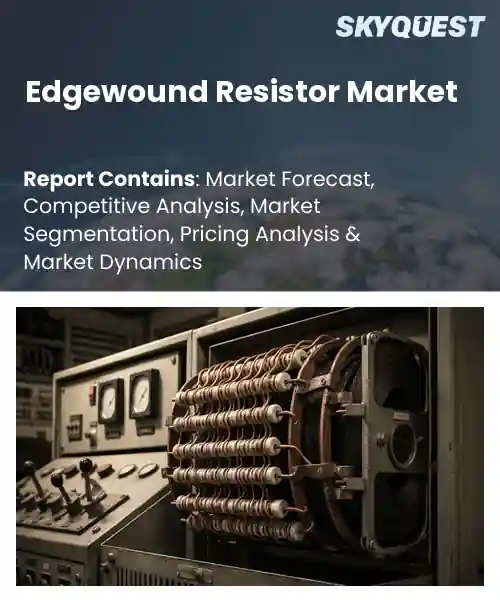
Edgewound Resistor Market
Report ID: SQMIG45K2462
Report ID: SQMIG45K2462
[email protected]
USA +1 351-333-4748
Report ID:
SQMIG45K2462 |
Region:
Global |
Published Date: August, 2026
Pages:
157
|Tables:
143
|Figures:
78


Global Edgewound Resistor Market size was valued at USD 420.00 Million in 2024 and is poised to grow from USD 446.88 Million in 2025 to USD 734.05 Million by 2033, growing at a CAGR of 6.4% during the forecast period (2026-2033).
The edgewound resistor market trends comprises manufacturers of precision film resistors in which the resistive film is spirally wrapped around a ceramic core, delivering stability and low inductance for applications. Its importance stems from the growing demand for power‑conversion and RF modules in automotive, aerospace, and data‑center equipment. Historically, the market originated in the 1970s when semiconductor devices required tighter tolerance components; by the early 2000s, advances in film technology enabled mass production and cost reductions. Recent examples include electric‑vehicle inverters that rely on edge‑wound resistors to maintain voltage regulation under load transients, illustrating the sector’s evolution from niche to mainstream.
The dominant factor in the global edgewound resistor market growth is the adoption of renewable‑energy systems, which creates technical requirements that edge‑wound devices satisfy. As solar‑panel inverters and wind‑turbine converters demand precise voltage control under fluctuating conditions, manufacturers integrate these resistors to reduce harmonic distortion and improve thermal performance, thereby extending equipment lifespan. This causality fuels investment in new production lines, especially in Asia where cost‑effective fabrication aligns with expanding offshore wind projects. Consequently, supplier portfolios broaden to include high‑power variants, opening opportunities for hardware designers to replace bulkier traditional resistors with lighter, efficient components in smart‑grid infrastructures, supporting deployments.
How is AI-driven Automation Impacting the Edgewound Resistor Market?
AI‑driven automation is reshaping the edgewound resistor market share by streamlining design, production and quality control. Machine‑learning algorithms now predict optimal material mixes and geometry, reducing trial‑and‑error cycles. Robotics handle soldering and inspection, delivering consistent tolerances while cutting waste. These technologies enable faster response to customer specifications and support higher volume runs without sacrificing precision. As manufacturers adopt smarter factories, supply chains become more resilient, and new product variants reach the market more quickly, reinforcing growth in sectors such as automotive and industrial electronics.
Market snapshot - (2026-2033)
Global Market Size
USD 420.0 Million
Largest Segment
Fixed Edgewound Resistors
Fastest Growth
Adjustable Edgewound Resistors
Growth Rate
6.4% CAGR
To get more insights on this market click here to Request a Free Sample Report
Global edgewound resistor market is segmented by product type, mounting type, resistance range, application, distribution channel and region. Based on product type, the market is segmented into fixed edgewound resistors and adjustable edgewound resistors. Based on mounting type, the market is segmented into panel mount, chassis mount and others. Based on resistance range, the market is segmented into low resistance, medium resistance and high resistance. Based on application, the market is segmented into industrial equipment, power supplies, railways and others. Based on distribution channel, the market is segmented into OEM and aftermarket. Based on region, the market is segmented into North America, Europe, Asia Pacific, Latin America and Middle East & Africa.
Fixed edgewound resistors segment dominates because designers favor their inherent stability and predictable performance in high‑current circuits, which reduces design complexity and improves reliability. Their mature manufacturing processes yield consistent tolerances, making them the default choice for cost‑sensitive applications. Consequently, OEMs prioritize these parts for bulk procurement, reinforcing their market leadership. Additionally, their ability to handle high power dissipation without excessive heating supports critical industrial equipment, further cementing their preferred status across multiple sectors.
Meanwhile, adjustable edgewound resistors emerge as the most rapidly expanding because they offer tunable resistance that accommodates evolving circuit requirements, enabling designers to prototype and fine‑tune systems without inventory changes. This flexibility drives adoption in emerging renewable energy converters and smart grid interfaces, accelerating market expansion and new opportunity creation.
Panel mount segment leads because its flat form factor integrates seamlessly onto printed circuit boards, enabling efficient space utilization and straightforward automated assembly. The design improves thermal management by exposing the resistor to ambient airflow, extending longevity in densely packed systems. Manufacturers favor panel mounting for its cost‑effective production workflow, and easy testing reduces service downtime, reinforcing its widespread use in industrial equipment.
On the other hand, chassis mount emerges as the fastest growing because it secures resistors within metal frames that provide superior shielding and mechanical robustness, essential for high‑vibration environments. The increasing demand for ruggedized power modules in transportation and defense sectors fuels its adoption, creating new avenues for market expansion.
To get detailed segments analysis, Request a Free Sample Report
Asia Pacific dominance stems from a deep concentration of high‑tech electronics manufacturers combined with sophisticated materials expertise. Japan and South Korea benefit from tightly integrated supply chains that enable rapid development of precision winding techniques and enhanced thermal management. Government policies that prioritize advanced component production reinforce investment in research and development, while a culture of continuous improvement drives relentless refinement of performance standards. The region’s extensive involvement in automotive electrification, renewable energy conversion, and consumer electronics creates sustained demand for reliable, high‑current resistors, positioning Asia Pacific as the preferred source for global OEMs seeking quality and innovation.
Edgewound resistor market outlook in Japan leverages a tradition of precision engineering and a dense network of component suppliers. Collaboration between automotive giants and electronics firms drives refinement of high‑current designs. Emphasis on quality assurance and stringent reliability standards positions Japan as a benchmark for performance. Continual investment in advanced ceramics and thin‑film technologies sustains a robust pipeline of innovative products that meet global demand.
Edgewound resistor market forecast in South Korea is propelled by a vibrant semiconductor ecosystem and aggressive adoption of power‑efficiency standards. Leading manufacturers integrate cutting‑edge winding processes with local material suppliers, yielding components optimized for compact electric vehicles and renewable‑energy inverters. Strong government incentives for high‑tech component development reinforce research collaboration with universities. The focus on rapid prototyping and scalable production enables South Korea to supply diversified markets with reliable, high‑performance resistors.
North America experiences accelerated growth due to the convergence of data‑center proliferation, electrified transportation initiatives, and heightened emphasis on power reliability across industrial sectors. Companies in the United States and Canada prioritize components that can handle increasing current densities while maintaining compact form factors, fostering demand for edgewound technology. Robust research institutions collaborate closely with manufacturers to push material limits and improve thermal characteristics. The region’s strong aftermarket support network and focus on sustainability further amplify the market’s expansion, establishing North America as a dynamic hub for innovative resistor solutions.
Edgewound resistor market regional outlook in the United States is shaped by extensive investment in semiconductor design and a thriving ecosystem of original equipment manufacturers. High‑performance requirements in aerospace, defense, and electric‑vehicle platforms drive the need for components that combine durability with precise resistance values. Close partnerships between component makers and end‑user firms accelerate the translation of emerging materials into commercial products. A customer‑centric approach that emphasizes rapid qualification cycles ensures that US manufacturers remain responsive to evolving application demands.
Edgewound resistor market regional forecast in Canada benefits from a strong focus on clean‑technology deployment and a well‑established aerospace sector. Collaborative research programs between universities and industry promote advancements in winding precision and thermal stability. Emphasis on environmental standards encourages the adoption of high‑efficiency resistors in renewable‑energy conversion systems. The market’s growth is reinforced by a supportive regulatory environment that aligns with broader sustainability goals, positioning Canada as a reliable source of cutting‑edge edgewound components.
Europe advances its position by leveraging a legacy of engineering excellence, stringent regulatory frameworks, and coordinated R&D initiatives across borders. The region’s emphasis on safety and performance standards drives manufacturers to adopt edgewound technology for critical infrastructure, automotive safety systems, and high‑precision medical equipment. Collaborative networks linking universities, research institutes, and component producers accelerate material innovations and process optimization. Moreover, Europe’s commitment to circular economy principles encourages the development of durable, recyclable resistor solutions, reinforcing its reputation as a leader in sustainable, high‑quality electronic components.
Edgewound resistor market analysis in Germany is anchored by a strong automotive engineering tradition and a meticulous approach to component reliability. German manufacturers integrate advanced winding processes with locally sourced high‑purity alloys, ensuring consistent performance under demanding thermal conditions. Close cooperation with technical universities fuels continuous material research, while adherence to rigorous certification regimes reinforces confidence among global vehicle makers. This systematic focus on precision and durability sustains Germany’s influence in the European resistor landscape.
Edgewound resistor market penetration in the United Kingdom draws on a vibrant electronics design community and a proactive innovation ecosystem. Partnerships between start‑ups and established firms accelerate the translation of novel winding techniques into market‑ready products. Emphasis on aerospace and defense applications demands components that meet exacting performance thresholds, prompting UK manufacturers to prioritize reliability and miniaturization. Strategic government support for high‑tech manufacturing further amplifies the sector’s capacity to deliver cutting‑edge resistor solutions.
Edgewound resistor industry in France benefits from a strong emphasis on high‑speed rail, renewable‑energy infrastructure, and precision medical devices. French firms combine sophisticated material science expertise with robust quality management practices to produce resistors capable of handling elevated power loads. Collaborative projects linking research laboratories with industrial partners foster continuous improvement in thermal performance and product longevity. This dedication to excellence and sustainability reinforces France’s role as a key contributor to Europe’s edgewound resistor advancement.
To know more about the market opportunities by region and country, click here to
Buy The Complete Report
Rising Demand For Miniaturization
Adoption Of High Frequency Applications
Stringent Environmental Regulations
Limited Availability Of Rare Materials
Request Free Customization of this report to help us to meet your business objectives.
The global edgewound resistor market is characterized by competition among established power-resistor manufacturers offering high-current, high-power, and overload-resistant solutions for industrial, transportation, energy, and electrical-control applications. Major participants include Vishay Intertechnology, Ohmite Manufacturing Company, TE Connectivity, Cressall Resistors, Kanthal, Isabellenhütte Heusler, Post Glover Resistors, VPG Foil Resistors, Murata Manufacturing, TT Electronics, Stackpole Electronics, Riedon, Yageo, Bourns, KOA Speer Electronics, Miba, Riedon Powertron, Arcol Resistors, and Frizlen. Competition centers on power and current ratings, resistance range, thermal management, overload capability, mounting configuration, durability, customization, and application-specific design. Vishay offers EDGF, EDGA, EDGU, and EDGS edgewound power-resistor families, while Ohmite supplies edgewound products for high-power and dynamic-braking applications and Cressall provides edgewound coiled-strip resistor elements for neutral earthing, dynamic braking, motor starting, and load testing.
Top Player’s Company Profile
Recent Developments in the Edgewound Resistor Market
SkyQuest’s ABIRAW (Advanced Business Intelligence, Research & Analysis Wing) is our Business Information Services team that Collects, Collates, Correlates, and Analyses the Data collected by means of Primary Exploratory Research backed by robust Secondary Desk research. As per SkyQuest analysis, the global edgewound resistor market is driven primarily by the rising demand for miniaturization that pushes designers toward compact, high‑performance resistors; a second strong catalyst is the growing adoption of high‑frequency applications such as 5G and renewable‑energy converters that require low‑inductance components. The market’s leading segment remains fixed edgewound resistors, favored for their stability in high‑current designs, while Asia Pacific dominates the landscape thanks to its dense electronics supply chain and aggressive R&D investment. However, stringent environmental regulations pose a notable restraint, adding compliance costs and limiting material choices.
| Report Metric | Details |
|---|---|
| Market size value in 2024 | USD 420.0 Million |
| Market size value in 2033 | USD 734.05 Million |
| Growth Rate | 6.4% |
| Base year | 2024 |
| Forecast period | (2026-2033) |
| Forecast Unit (Value) | USD Million |
| Segments covered |
|
| Regions covered | North America (US, Canada), Europe (Germany, France, United Kingdom, Italy, Spain, Rest of Europe), Asia Pacific (China, India, Japan, Rest of Asia-Pacific), Latin America (Brazil, Rest of Latin America), Middle East & Africa (South Africa, GCC Countries, Rest of MEA) |
| Companies covered |
|
| Customization scope | Free report customization with purchase. Customization includes:-
|
To get a free trial access to our platform which is a one stop solution for all your data requirements for quicker decision making. This platform allows you to compare markets, competitors who are prominent in the market, and mega trends that are influencing the dynamics in the market. Also, get access to detailed SkyQuest exclusive matrix.
Table Of Content
Executive Summary
Market overview
Parent Market Analysis
Market overview
Market size
KEY MARKET INSIGHTS
COVID IMPACT
MARKET DYNAMICS & OUTLOOK
Market Size by Region
KEY COMPANY PROFILES
Methodology
For the Edgewound Resistor Market, our research methodology involved a mixture of primary and secondary data sources. Key steps involved in the research process are listed below:
1. Information Procurement: This stage involved the procurement of Market data or related information via primary and secondary sources. The various secondary sources used included various company websites, annual reports, trade databases, and paid databases such as Hoover's, Bloomberg Business, Factiva, and Avention. Our team did 45 primary interactions Globally which included several stakeholders such as manufacturers, customers, key opinion leaders, etc. Overall, information procurement was one of the most extensive stages in our research process.
2. Information Analysis: This step involved triangulation of data through bottom-up and top-down approaches to estimate and validate the total size and future estimate of the Edgewound Resistor Market.
3. Report Formulation: The final step entailed the placement of data points in appropriate Market spaces in an attempt to deduce viable conclusions.
4. Validation & Publishing: Validation is the most important step in the process. Validation & re-validation via an intricately designed process helped us finalize data points to be used for final calculations. The final Market estimates and forecasts were then aligned and sent to our panel of industry experts for validation of data. Once the validation was done the report was sent to our Quality Assurance team to ensure adherence to style guides, consistency & design.
Analyst Support
Customization Options
With the given market data, our dedicated team of analysts can offer you the following customization options are available for the Edgewound Resistor Market:
Product Analysis: Product matrix, which offers a detailed comparison of the product portfolio of companies.
Regional Analysis: Further analysis of the Edgewound Resistor Market for additional countries.
Competitive Analysis: Detailed analysis and profiling of additional Market players & comparative analysis of competitive products.
Go to Market Strategy: Find the high-growth channels to invest your marketing efforts and increase your customer base.
Innovation Mapping: Identify racial solutions and innovation, connected to deep ecosystems of innovators, start-ups, academics, and strategic partners.
Category Intelligence: Customized intelligence that is relevant to their supply Markets will enable them to make smarter sourcing decisions and improve their category management.
Public Company Transcript Analysis: To improve the investment performance by generating new alpha and making better-informed decisions.
Social Media Listening: To analyze the conversations and trends happening not just around your brand, but around your industry as a whole, and use those insights to make better Marketing decisions.
REQUEST FOR SAMPLE
 REQUEST FREE CUSTOMIZATION
Global Edgewound Resistor Market size was valued at USD 420.0 Million in 2024 and is poised to grow from USD 446.88 Million in 2025 to USD 734.05 Million by 2033, growing at a CAGR of 6.4% during the forecast period (2026-2033).
Global edgewound resistor manufacturers intensify competition through strategic acquisitions, joint development agreements, and rapid technology roll‑outs, accelerating product differentiation and supply chain integration. Recent M&A activity sees a leading resistor group acquiring a specialty thin‑film capacitor developer to broaden high‑frequency offerings, while a key player partnered with a semiconductor foundry to co‑engineer ultra‑compact, high‑power modules for automotive applications, exemplifying how collaboration and consolidation drive market positioning. 'Vishay Intertechnology, Inc.', 'Ohmite Manufacturing Company', 'TE Connectivity Ltd.', 'Cressall Resistors Ltd.', 'Kanthal AB', 'Isabellenhütte Heusler GmbH & Co. KG', 'Post Glover Resistors', 'VPG Foil Resistors', 'Murata Manufacturing Co., Ltd.', 'TT Electronics plc', 'Stackpole Electronics, Inc.', 'Riedon Inc.', 'Yageo Corporation', 'Bourns, Inc.', 'KOA Speer Electronics, Inc.', 'Rhopoint Components Ltd.', 'Miba AG', 'Riedon Powertron', 'Arcol Resistors', 'Frizlen GmbH & Co. KG'
Manufacturers are increasingly integrating complex functions into smaller form‑factors, which drives a need for resistors that occupy minimal board area while delivering reliable performance. Edgewound resistor designs provide a compact footprint, excellent thermal dissipation, and stable electrical characteristics, making them well‑suited to densely packed modules. This alignment with miniaturization trends encourages component designers to specify edgewound types, thereby expanding market demand as designers prioritize space‑efficient solutions without compromising reliability. The resulting design flexibility also reduces the need for additional passive components, further streamlining product architecture.
Advanced Miniaturization Drives Integration: Manufacturers are increasingly embedding edgewound resistors directly into compact modules to meet the rising demand for space‑efficient electronic assemblies. This shift enables higher performance in constrained form factors, reduces interconnect complexity, and supports faster time‑to‑market for next‑generation devices such as wearables, IoT sensors, and medical implants. As design teams prioritize integrated solutions, the market is seeing a surge in customized resistor geometries and collaborative engineering services that align with rapid product cycles and stringent reliability expectations throughout the global supply.
Why does Asia Pacific Dominate the Global Edgewound Resistor Market? |@12


Want to customize this report? This report can be personalized according to your needs. Our analysts and industry experts will work directly with you to understand your requirements and provide you with customized data in a short amount of time. We offer $1000 worth of FREE customization at the time of purchase.
Feedback From Our Clients


 USA (+1) 351-333-4748

