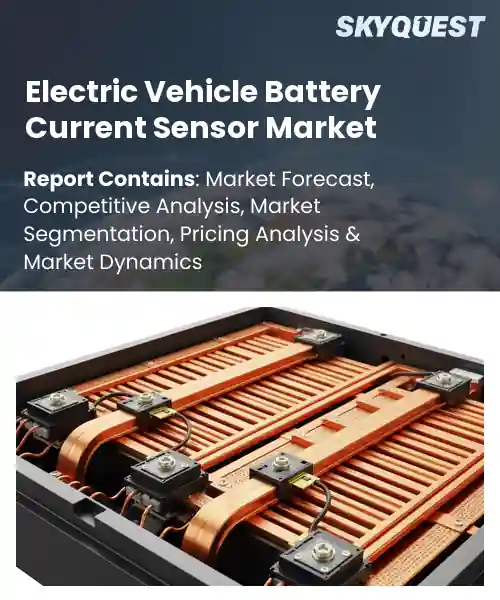
Electric Vehicle Battery Current Sensor Market
Report ID: SQMIG45N2205
Report ID: SQMIG45N2205
[email protected]
USA +1 351-333-4748
Report ID:
SQMIG45N2205 |
Region:
Global |
Published Date: April, 2026
Pages:
157
|Tables:
118
|Figures:
77


Global Electric Vehicle Battery Current Sensor Market size was valued at USD 1.5 Billion in 2024 and is poised to grow from USD 1.71 Billion in 2025 to USD 4.88 Billion by 2033, growing at a CAGR of 14.0% during the forecast period (2026-2033).
Rapid electrification of transport is the primary driver of the electric vehicle battery current sensor market because isolated current measurement underpins SoC estimation, cell balancing, safety monitoring and regenerative braking. The market includes shunt resistors, Hall-effect devices and closed-loop fluxgate or Rogowski sensors that serve battery management and power electronics. Accurate sensing matters since measurement errors propagate into range estimation, charging strategy and thermal controls, which influence consumer satisfaction and regulatory compliance. Historically the sector shifted from simple low-cost shunts to precision high-voltage isolated sensors as battery capacities and pack voltages rose from Nissan Leaf models to Tesla and BYD.Because battery packs deliver higher voltages and peak currents, a key factor shaping the sensor market is the demand for wider dynamic range with galvanic isolation, which forces redesign of sensing architectures and supplier roadmaps. Technical need drives investment in closed-loop and isolated silicon solutions, enabling sensors that remain accurate during fast charging and aggressive regenerative braking. In practice fleet operators use precise current data to improve energy efficiency and maintenance scheduling, fast-charging networks require metering accuracy for billing and safety, and V2G demonstrations rely on bidirectional sensing, creating new openings for integrated modules, diagnostic software and aftermarket retrofit services.
How is AI enhancing accuracy in the electric vehicle battery current sensor market?
Electric vehicle battery current sensors measure charge and discharge currents and form the backbone of battery management systems. Key aspects include sensor type such as shunt resistors Hall effect and TMR plus signal conditioning and pack placement. The market is shifting to AI enabled measurement stacks. Edge machine learning and sensor fusion correct temperature drift noise and aging bias and detect anomalies early. That improves state of charge and state of health estimates and supports safer fast charging. Suppliers and automakers are piloting AI models that combine current voltage and thermal signals to deliver steadier readings in driving.Allegro MicroSystems April 2026, the company highlighted the ACS37200 current sensor in its newsletter. When paired with AI driven calibration and onboard analytics this sensor class can be refined in the field to reduce systematic error enable predictive diagnostics and streamline battery pack validation which supports wider adoption and efficiency.
Market snapshot - (2026-2033)
Global Market Size
USD 1.5 Billion
Largest Segment
Direct Sensing
Fastest Growth
Indirect Sensing
Growth Rate
14.0% CAGR
To get more insights on this market click here to Request a Free Sample Report
Global electric vehicle battery current sensor market is segmented by sensing methods, sensor types, application, end use and region. Based on sensing methods, the market is segmented into Direct Sensing and Indirect Sensing. Based on sensor types, the market is segmented into Hall Effect Sensors, Shunt Resistors, Rogowski Coils and Magnetic Sensors. Based on application, the market is segmented into Battery Management Systems, Electric Power Steering, On-Board Chargers and Drive Motors. Based on end use, the market is segmented into Passenger Electric Vehicles, Commercial Electric Vehicles and Two-Wheel Electric Vehicles. Based on region, the market is segmented into North America, Europe, Asia Pacific, Latin America and Middle East & Africa.
Direct Sensing segment dominates because direct coupling to the current path delivers inherently higher fidelity measurements that BMS require for accurate state estimation and fast protective actions. Because sensing is placed in-line, signal latency is minimized and calibration complexity is reduced, enabling tighter thermal management and charge balancing. This direct measurement approach simplifies control loop design and supports stringent safety requirements, causing manufacturers to prefer it for core battery monitoring.
However, Indirect Sensing is emerging as the fastest growing approach because its nonintrusive installation and lower intrusion into high voltage stacks reduce system complexity and enable easier retrofits. Advances in algorithmic compensation and improved magnetic coupling materials are increasing accuracy, opening opportunities in cost sensitive applications and facilitating broader adoption across diverse battery architectures.
Hall Effect Sensors segment dominates because their contactless measurement capability provides galvanic isolation while delivering reliable bidirectional current detection across wide operating ranges, aligning with safety and insulation requirements in battery systems. Low insertion loss and compatibility with compact modules reduce thermal stress and support modular pack designs, allowing tighter integration with battery management electronics. These attributes drive their adoption in core monitoring tasks where isolation and continuous sensing are prioritized.
However, Rogowski Coils are the fastest growing choice as their flexibility and wide bandwidth make them suited to capturing high frequency transients from fast charging and power electronics within electric drivetrains. Improvements in integrator design and digital signal processing are enhancing accuracy and usability, creating opportunities for advanced diagnostics and power quality monitoring in next generation battery systems.
To get detailed segments analysis, Request a Free Sample Report
Asia Pacific commands the market through a combination of deep manufacturing ecosystems, concentrated battery and vehicle production, and ongoing technology refinement that aligns sensor development with mass production needs. The regional advantage stems from integrated supply chains linking material suppliers, battery makers, and tier suppliers, enabling rapid iteration and cost optimization. Strong engineering talent and focused industrial clusters support sensor miniaturization, robustness, and integration into advanced battery management systems. Collaborative relationships between original equipment manufacturers and local electronics specialists accelerate validation cycles and standardization efforts. Policy signals and incentives in multiple markets encourage investment in domestic capabilities, further strengthening the region as a center for innovation, scalable production, and export oriented solutions that meet diverse vehicle platform requirements.
Electric Vehicle Battery Current Sensor Market benefits from deep integration with global automotive manufacturers, advanced electronics suppliers, and a focus on high reliability for premium vehicle platforms. Strengths include strong engineering ecosystems, robust quality control practices, and collaboration between battery producers and sensor designers to optimize performance for diverse vehicle architectures. Local supply chain resilience and emphasis on miniaturization support application in both electrified passenger cars and commercial platforms globally.
Electric Vehicle Battery Current Sensor Market leverages strong semiconductor industries, rapid prototype capabilities, and tight integration with battery manufacturers to deliver sensors tailored for high power density applications. Emphasis on cost efficient production, quality assurance, and collaborative research fosters solutions optimized for local and export vehicle programs while enabling quick scaling across varied vehicle segments. Strong government and industry alignment accelerates commercialization and supports sophisticated testing infrastructure for global markets.
Europe is experiencing rapid expansion driven by a convergence of ambitious vehicle electrification goals, concentrated automotive engineering expertise, and a resilient supplier base adapting to new component demands. The market is energized by a culture of rigorous safety and performance standards that elevates sensor requirements, encouraging innovation in accuracy, thermal resilience, and functional safety. OEM commitments to platform modularity and localization of supply chains create demand for adaptable sensor solutions compatible with diverse battery chemistries and vehicle architectures. Cross border collaboration among research institutions, testing centers, and manufacturers accelerates product maturation. Policy frameworks that support electrified mobility and industrial investment further motivate manufacturing capacity growth and technological differentiation, positioning Europe as a strategic arena for advanced sensing solutions and premium system integration.
Electric Vehicle Battery Current Sensor Market benefits from proximity to leading automotive manufacturers, deep engineering talent pools, and established testing facilities focused on safety and reliability. Strong supplier networks and emphasis on modular platform strategies encourage integration of advanced sensing solutions. Collaborative programs between OEMs and sensor developers prioritize robustness for demanding vehicle platforms and support technology transfer to production scale across multiple mobility segments while fostering export opportunities broadly.
Electric Vehicle Battery Current Sensor Market benefits from a growing ecosystem of innovative suppliers, dynamic startup activity, and supportive testing centers that enable rapid prototyping. Emerging collaboration between automotive engineers and electronics specialists accelerates product refinement for local vehicle programs. Focus on interoperability, cybersecurity of battery management systems, and tailored sensor designs positions market participants to capture opportunities across electrified vehicle segments and export oriented partnerships with global reach ambitions.
Electric Vehicle Battery Current Sensor Market experiences rapid growth driven by focused investments in electrification, strong collaboration between research institutes and industry, and increasing localization of battery manufacturing. Emphasis on lightweight designs, energy efficiency, and safety testing accelerates sensor adoption for a range of vehicle architectures. Domestic suppliers are scaling capabilities to meet demand while engaging international partners to enhance technology transfer and commercialization potential across diverse markets and segments.
North America is reinforcing its role through strategic investment in domestic supply chains, deeper cooperation between OEMs and electronics suppliers, and expansion of battery production ecosystems that demand localized sensing solutions. Innovation hubs and advanced semiconductor capabilities support development of high precision, high reliability sensors tailored to stringent vehicle safety and performance requirements. Industry initiatives focused on standardization, testing infrastructure, and workforce development enhance the region’s ability to commercialize new designs rapidly. Cross sector partnerships between vehicle manufacturers, battery producers, and sensor developers facilitate integration of sensing technologies into comprehensive battery management systems. Emphasis on export readiness and resilient sourcing further positions North America to compete on both technological sophistication and scalable production.
Electric Vehicle Battery Current Sensor Market is propelled by close ties between major vehicle manufacturers, advanced semiconductor supply chains, and growing domestic battery production ecosystems. Emphasis on safety validation, integration into sophisticated battery management systems, and partnerships with tier suppliers drives demand for high performance sensors. Robust prototyping hubs and quality focused manufacturing practices support rapid commercialization and export oriented strategies. Advanced testing infrastructure and collaborative research clusters strengthen competitiveness.
Electric Vehicle Battery Current Sensor Market benefits from a growing network of battery material suppliers, research institutions, and incentives for clean mobility integration. Focus on ruggedized sensor designs for cold climate performance and modular solutions for diverse vehicle types supports adoption. Collaborative supply chain initiatives and export focused manufacturing help domestic firms align product development with global OEM requirements while fostering incremental innovation and quality assurance capabilities and competitiveness growth.
To know more about the market opportunities by region and country, click here to
Buy The Complete Report
Rising Electric Vehicle Adoption
Stringent Safety and Performance Standards
High Integration Complexity
Elevated Sensor Component Costs
Request Free Customization of this report to help us to meet your business objectives.
Competition in the global electric vehicle battery current sensor market is intensifying as OEMs demand higher accuracy, integration, and functional safety. Consolidation and capability buys are common, for example Infineon acquired edge AI specialist Imagimob to integrate tiny machine learning into sensor platforms and Allegro bought Crocus to add advanced TMR sensing while also launching high bandwidth current sensor ICs to capture fast transients and improve pack diagnostics.
Top Player’s Company Profile
Recent Developments
SkyQuest’s ABIRAW (Advanced Business Intelligence, Research & Analysis Wing) is our Business Information Services team that Collects, Collates, Correlates, and Analyses the Data collected by means of Primary Exploratory Research backed by robust Secondary Desk research. As per SkyQuest analysis, the global electric vehicle battery current sensor market is being propelled primarily by rapid electrification of transport, with stringent safety and performance standards serving as an additional driver. Demand for higher accuracy and isolated measurements favors contactless Hall effect sensors, which alongside modular architectures support integration into battery management systems. Asia Pacific dominates the market thanks to its dense manufacturing and supply chains, but growth is constrained by high integration complexity as OEMs validate sensors across diverse pack topologies and thermal conditions. Suppliers investing in embedded analytics, isolation technologies and scalable modules are best positioned to capture expanding opportunities across passenger and commercial EV segments.
| Report Metric | Details |
|---|---|
| Market size value in 2024 | USD 1.5 Billion |
| Market size value in 2033 | USD 4.88 Billion |
| Growth Rate | 14.0% |
| Base year | 2024 |
| Forecast period | (2026-2033) |
| Forecast Unit (Value) | USD Billion |
| Segments covered |
|
| Regions covered | North America (US, Canada), Europe (Germany, France, United Kingdom, Italy, Spain, Rest of Europe), Asia Pacific (China, India, Japan, Rest of Asia-Pacific), Latin America (Brazil, Rest of Latin America), Middle East & Africa (South Africa, GCC Countries, Rest of MEA) |
| Companies covered |
|
| Customization scope | Free report customization with purchase. Customization includes:-
|
To get a free trial access to our platform which is a one stop solution for all your data requirements for quicker decision making. This platform allows you to compare markets, competitors who are prominent in the market, and mega trends that are influencing the dynamics in the market. Also, get access to detailed SkyQuest exclusive matrix.
Table Of Content
Executive Summary
Market overview
Parent Market Analysis
Market overview
Market size
KEY MARKET INSIGHTS
COVID IMPACT
MARKET DYNAMICS & OUTLOOK
Market Size by Region
KEY COMPANY PROFILES
Methodology
For the Electric Vehicle Battery Current Sensor Market, our research methodology involved a mixture of primary and secondary data sources. Key steps involved in the research process are listed below:
1. Information Procurement: This stage involved the procurement of Market data or related information via primary and secondary sources. The various secondary sources used included various company websites, annual reports, trade databases, and paid databases such as Hoover's, Bloomberg Business, Factiva, and Avention. Our team did 45 primary interactions Globally which included several stakeholders such as manufacturers, customers, key opinion leaders, etc. Overall, information procurement was one of the most extensive stages in our research process.
2. Information Analysis: This step involved triangulation of data through bottom-up and top-down approaches to estimate and validate the total size and future estimate of the Electric Vehicle Battery Current Sensor Market.
3. Report Formulation: The final step entailed the placement of data points in appropriate Market spaces in an attempt to deduce viable conclusions.
4. Validation & Publishing: Validation is the most important step in the process. Validation & re-validation via an intricately designed process helped us finalize data points to be used for final calculations. The final Market estimates and forecasts were then aligned and sent to our panel of industry experts for validation of data. Once the validation was done the report was sent to our Quality Assurance team to ensure adherence to style guides, consistency & design.
Analyst Support
Customization Options
With the given market data, our dedicated team of analysts can offer you the following customization options are available for the Electric Vehicle Battery Current Sensor Market:
Product Analysis: Product matrix, which offers a detailed comparison of the product portfolio of companies.
Regional Analysis: Further analysis of the Electric Vehicle Battery Current Sensor Market for additional countries.
Competitive Analysis: Detailed analysis and profiling of additional Market players & comparative analysis of competitive products.
Go to Market Strategy: Find the high-growth channels to invest your marketing efforts and increase your customer base.
Innovation Mapping: Identify racial solutions and innovation, connected to deep ecosystems of innovators, start-ups, academics, and strategic partners.
Category Intelligence: Customized intelligence that is relevant to their supply Markets will enable them to make smarter sourcing decisions and improve their category management.
Public Company Transcript Analysis: To improve the investment performance by generating new alpha and making better-informed decisions.
Social Media Listening: To analyze the conversations and trends happening not just around your brand, but around your industry as a whole, and use those insights to make better Marketing decisions.
REQUEST FOR SAMPLE
 REQUEST FREE CUSTOMIZATION


Want to customize this report? This report can be personalized according to your needs. Our analysts and industry experts will work directly with you to understand your requirements and provide you with customized data in a short amount of time. We offer $1000 worth of FREE customization at the time of purchase.
Feedback From Our Clients


 USA (+1) 351-333-4748

