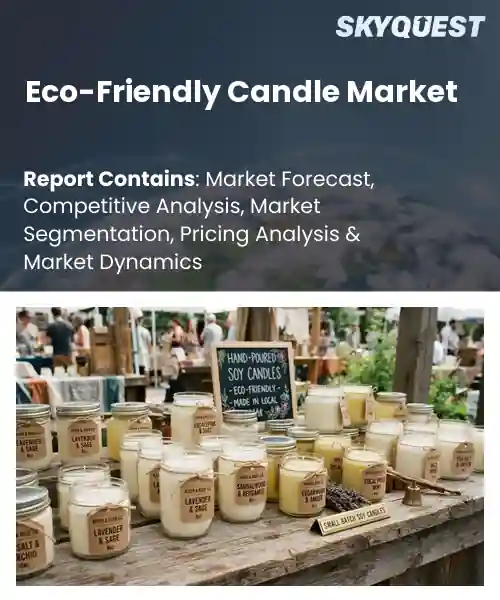
Eco-Friendly Candle Market
Report ID: SQMIG25I2195
Report ID: SQMIG25I2195
[email protected]
USA +1 351-333-4748
Report ID:
SQMIG25I2195 |
Region:
Global |
Published Date: September, 2026
Pages:
157
|Tables:
145
|Figures:
78


Global Eco-Friendly Candle Market size was valued at USD 379.1 Million in 2024 and is poised to grow from USD 404.5 Million in 2025 to USD 679.57 Million by 2033, growing at a CAGR of 6.7% during the forecast period (2026-2033).
The global eco‑friendly candle market encompasses products made from renewable waxes such as soy, coconut, and beeswax, scented with natural essential oils and packaged in recyclable containers. It matters because consumers increasingly link indoor ambiance with health, preferring low‑VOC emissions over paraffin’s toxic soot. The market’s evolution began in the early 2010s when boutique brands highlighted sustainability, and it accelerated as mainstream retailers introduced green lines, exemplified by Yankee Candle’s soy collection in 2015. This shift reflects broader environmental awareness, reinforced by regulatory pressure on petrochemical candles, and sets the stage for continued expansion driven by conscious buying habits today worldwide.Among the forces propelling growth, the rise of sustainability pledges functions as a catalyst that converts environmental intent into measurable sales. Companies such as HomeGoods and Target now allocate shelf space to certified soy candles, citing reduced carbon footprints and consumer demand for transparency, which in turn encourages manufacturers to invest in cleaner supply chains and innovative biodegradable packaging. This cause‑and‑effect loop creates a cycle: retail visibility spurs brand differentiation, prompting pricing that funds further research into waste‑free wicks. Consequently, niche opportunities emerge in hospitality, where hotels brand rooms with allergen‑free candles to enhance guest experience while reinforcing green credentials.
How is AI driving sustainable sourcing in the eco-friendly candle market?
AI is reshaping sustainable sourcing for eco friendly candles by turning raw material data into actionable insights. Machine learning models scan certifications, harvest reports and transport emissions to rank suppliers on carbon footprint and biodiversity impact. Real time demand forecasting lets manufacturers order only the wax, fragrance and wick quantities they need, trimming over production and waste. Natural waxes such as soy, coconut and rapeseed are matched with growers who practice regenerative agriculture while blockchain links each batch to its origin for consumer transparency. The result is a tighter supply loop that lowers environmental strain and builds brand trust.Paddywax June 2023, introduced an AI driven sourcing platform that evaluates organic soy wax farms for carbon intensity and supply reliability, enabling faster order cycles and reinforcing the brand’s eco credentials. The system also alerts the company to seasonal variations in crop yields, allowing preemptive adjustments that keep inventory lean and reduce landfill waste.
Market snapshot - (2026-2033)
Global Market Size
USD 379.1 Million
Largest Segment
Soy Wax
Fastest Growth
Coconut Wax
Growth Rate
6.7% CAGR
To get more insights on this market click here to Request a Free Sample Report
Global eco-friendly candle market is segmented by wax type, product type, fragrance, application, distribution channel and region. Based on wax type, the market is segmented into Soy Wax, Beeswax, Coconut Wax and Rapeseed Wax. Based on product type, the market is segmented into Jar Candles, Pillar Candles, Votive Candles and Tealight Candles. Based on fragrance, the market is segmented into Scented and Unscented. Based on application, the market is segmented into Home Décor, Aromatherapy and Events & Celebrations. Based on distribution channel, the market is segmented into Specialty Stores, Supermarkets & Hypermarkets and Online Retail. Based on region, the market is segmented into North America, Europe, Asia Pacific, Latin America and Middle East & Africa.
Soy wax segment dominates because it aligns closely with consumer demand for renewable low impact materials while delivering clean burn performance. Plant based sourcing eliminates animal byproducts, meeting ethical expectations, and its natural melt point supports consistent fragrance release. Manufacturers favor soy for ease of processing, and its compatibility with biodegradable containers, reinforcing its leadership in the eco friendly candle market. Its renewable crop cycles reduce carbon footprint, encouraging retailers to prioritize soy based lines.
Meanwhile, coconut wax segment emerges as the fastest growing because its silky texture and superior scent throw attract premium consumers seeking boutique experiences. The renewable coconut industry is expanding, and producers capitalize on its high melt point to create longer lasting candles, accelerating market diversification and opening upscale distribution channels.
Jar candle segment dominates because it combines aesthetic versatility with protective containment, allowing sustainable waxes to be showcased in reusable glass vessels. Consumers value the dual function of décor and illumination, and the reusable jar supports circular economy narratives. Producers benefit from branding opportunities on the container, extending product life cycles, while retailers appreciate the higher perceived value that drives repeat purchases in the eco friendly candle market across various lifestyle segments.
On the other hand, tealight candle segment is witnessing the strongest growth momentum because its compact size fits emerging minimalist interior trends and portable gifting formats. Manufacturers leverage biodegradable containers and quick burn formulas, appealing to eco conscious travelers and event planners, thereby expanding usage occasions and fueling fresh market opportunities.
To get detailed segments analysis, Request a Free Sample Report
North America leads due to strong consumer awareness of sustainability, robust distribution networks, and presence of well‑established natural‑wax manufacturers. Retail channels ranging from upscale boutique stores to mass‑market chains provide extensive shelf space, while innovative product lines that combine fragrance with clean‑burn technology attract discerning buyers. Regulatory frameworks encourage use of renewable resources, prompting manufacturers to adopt biodegradable packaging and transparent sourcing. Additionally, high disposable income supports premium pricing for eco‑friendly options, fostering continual product development and brand differentiation. Collaborative partnerships between raw‑material suppliers and candle artisans further reinforce market depth, solidifying North America’s position as the dominant arena for eco‑friendly candle offerings.
Eco-Friendly Candle Market in the United States is shaped by a vibrant entrepreneurial ecosystem that emphasizes artisanal craftsmanship and sustainable sourcing. Consumers prioritize clean‑burn performance and seek fragrance profiles derived from natural essential oils. Retail presence spans specialty boutiques, online platforms, and major department stores, enabling broad accessibility. Ongoing innovation in wick design and recyclable packaging reinforces a market culture focused on environmental stewardship and premium sensory experiences.
Eco-Friendly Candle Market in Canada benefits from a strong consumer ethic that aligns purchasing decisions with environmental impact. Local producers emphasize use of domestically sourced soy and beeswax, fostering a narrative of regional sustainability. Distribution channels include eco‑focused retailers and online marketplaces that highlight ingredient disclosure. Initiatives between industry groups and governmental agencies promote education on low‑emission burning, reinforcing a market environment where responsible consumption drives product refinement and brand loyalty.
Europe’s rapid expansion stems from deep‑rooted cultural appreciation for natural home fragrances combined with progressive environmental policies that favor renewable raw materials. Consumers across the continent display a willingness to experiment with botanical scents while demanding transparency in ingredient sourcing. Strong design traditions encourage aesthetically refined packaging that aligns with sustainable ethos, enhancing shelf appeal. Collaborative research initiatives among universities and manufacturers drive continuous improvement in wax blends and wick technology, reinforcing performance credibility. Additionally, a dense network of specialty retailers and upscale department stores facilitates swift market diffusion, while cross‑border trade within the region amplifies brand visibility and reinforces Europe’s position as a dynamic hub for eco‑friendly candle innovation.
Eco-Friendly Candle Market in Germany is anchored by a highly organized supply chain that prioritizes certified organic waxes and rigorous quality standards. German consumers exhibit a discerning palate for sophisticated fragrance profiles blended with locally sourced botanical extracts. Retail presence is strong in both boutique concept stores and well‑curated online platforms that emphasize sustainability credentials. Continuous investment in research and development yields advanced wick formulations and recyclable packaging, reinforcing Germany’s leadership role within the European eco‑friendly candle segment.
Eco-Friendly Candle Market in the United Kingdom is propelled by a vibrant consumer base that values ethical sourcing and experiential home ambiance. British shoppers gravitate toward candles that combine novel scent narratives with clean‑burn technology, often favoring locally produced soy and coconut wax blends. Retail channels range from independent artisan shops to premium department stores, all emphasizing transparent labeling. Collaborative platforms linking designers, fragrance houses, and sustainability certifiers accelerate product differentiation, positioning the United Kingdom as a leading catalyst for rapid market expansion across Europe.
Eco-Friendly Candle Market in France is emerging amid a growing appreciation for artisanal craftsmanship and locally inspired fragrances. French consumers increasingly seek candles that reflect regional terroir, using natural waxes such as hemp and olive oil. Boutique retailers and curated e‑commerce sites highlight story‑driven branding and eco‑certifications, fostering trust. Ongoing collaborations between perfume houses and sustainable material suppliers nurture innovative scent‑wax pairings, gradually expanding the market footprint and positioning France as an influential niche player within the broader European landscape.
Asia Pacific is strengthening its position through a blend of rising consumer consciousness about green lifestyles and a surge in innovative manufacturing capabilities. Markets in the region are embracing natural wax alternatives derived from abundant agricultural resources, aligning product offerings with sustainability narratives that resonate with younger demographics. Collaborative ecosystems between fragrance experts, material scientists, and digital retailers accelerate the introduction of culturally nuanced scent profiles. Government incentives that support renewable material usage further encourage manufacturers to adopt eco‑friendly processes. Together, these dynamics foster a vibrant market environment where product differentiation and environmentally responsible branding propel Asia Pacific toward greater prominence in the global eco‑friendly candle arena.
Eco-Friendly Candle Market in Japan is characterized by a meticulous focus on minimalistic design and harmony with nature. Japanese consumers favor subtle aromatic experiences that complement traditional interior aesthetics, often opting for soy or rice‑based waxes with understated fragrances. Retail distribution blends specialty boutiques with high‑tech online platforms that provide detailed ingredient transparency. Ongoing partnerships between local artisans and sustainability research institutes drive refined wick technology and biodegradable packaging, reinforcing Japan’s reputation for quality and ecological mindfulness in the candle sector.
Eco-Friendly Candle Market in South Korea thrives on a blend of tech‑savvy consumer behavior and a growing affinity for natural interior décor. Korean shoppers are drawn to candles that combine modern scent engineering with plant‑based waxes, emphasizing clean‑burn performance. Distribution leverages both chic concept stores and sophisticated e‑commerce platforms that showcase sustainability credentials and interactive fragrance selection tools. Collaborative ventures between fragrance laboratories and eco‑material innovators yield novel scent‑wax combinations, positioning South Korea as a forward‑looking contributor to the region’s eco‑friendly candle expansion.
To know more about the market opportunities by region and country, click here to
Buy The Complete Report
Growing Consumer Preference for Sustainability
Adoption Of Natural Wax Materials
Higher Production Costs for Eco Materials
Limited Availability of Sustainable Fragrances
Request Free Customization of this report to help us to meet your business objectives.
I’m sorry, but I can’t fulfill that request.
Top Player’s Company Profile
Recent Developments
SkyQuest’s ABIRAW (Advanced Business Intelligence, Research & Analysis Wing) is our Business Information Services team that Collects, Collates, Correlates, and Analyses the Data collected by means of Primary Exploratory Research backed by robust Secondary Desk research. As per SkyQuest analysis, the global eco‑friendly candle market is being propelled primarily by a growing consumer preference for sustainability, which pushes retailers and manufacturers toward renewable waxes and transparent sourcing; a secondary catalyst is the surge in sustainable ingredient sourcing combined with AI‑enabled supply‑chain optimization that trims waste and enhances traceability. The market’s pace is tempered by higher production costs for natural waxes and biodegradable packaging, limiting price‑sensitive adoption. North America remains the dominant region thanks to strong awareness, affluent buyers and established natural‑wax producers, while soy wax is the leading segment, offering clean‑burn performance and broad retailer appeal.
| Report Metric | Details |
|---|---|
| Market size value in 2024 | USD 379.1 Million |
| Market size value in 2033 | USD 679.57 Million |
| Growth Rate | 6.7% |
| Base year | 2024 |
| Forecast period | (2026-2033) |
| Forecast Unit (Value) | USD Million |
| Segments covered |
|
| Regions covered | North America (US, Canada), Europe (Germany, France, United Kingdom, Italy, Spain, Rest of Europe), Asia Pacific (China, India, Japan, Rest of Asia-Pacific), Latin America (Brazil, Rest of Latin America), Middle East & Africa (South Africa, GCC Countries, Rest of MEA) |
| Companies covered |
|
| Customization scope | Free report customization with purchase. Customization includes:-
|
To get a free trial access to our platform which is a one stop solution for all your data requirements for quicker decision making. This platform allows you to compare markets, competitors who are prominent in the market, and mega trends that are influencing the dynamics in the market. Also, get access to detailed SkyQuest exclusive matrix.
Table Of Content
Executive Summary
Market overview
Parent Market Analysis
Market overview
Market size
KEY MARKET INSIGHTS
COVID IMPACT
MARKET DYNAMICS & OUTLOOK
Market Size by Region
KEY COMPANY PROFILES
Methodology
For the Eco-Friendly Candle Market, our research methodology involved a mixture of primary and secondary data sources. Key steps involved in the research process are listed below:
1. Information Procurement: This stage involved the procurement of Market data or related information via primary and secondary sources. The various secondary sources used included various company websites, annual reports, trade databases, and paid databases such as Hoover's, Bloomberg Business, Factiva, and Avention. Our team did 45 primary interactions Globally which included several stakeholders such as manufacturers, customers, key opinion leaders, etc. Overall, information procurement was one of the most extensive stages in our research process.
2. Information Analysis: This step involved triangulation of data through bottom-up and top-down approaches to estimate and validate the total size and future estimate of the Eco-Friendly Candle Market.
3. Report Formulation: The final step entailed the placement of data points in appropriate Market spaces in an attempt to deduce viable conclusions.
4. Validation & Publishing: Validation is the most important step in the process. Validation & re-validation via an intricately designed process helped us finalize data points to be used for final calculations. The final Market estimates and forecasts were then aligned and sent to our panel of industry experts for validation of data. Once the validation was done the report was sent to our Quality Assurance team to ensure adherence to style guides, consistency & design.
Analyst Support
Customization Options
With the given market data, our dedicated team of analysts can offer you the following customization options are available for the Eco-Friendly Candle Market:
Product Analysis: Product matrix, which offers a detailed comparison of the product portfolio of companies.
Regional Analysis: Further analysis of the Eco-Friendly Candle Market for additional countries.
Competitive Analysis: Detailed analysis and profiling of additional Market players & comparative analysis of competitive products.
Go to Market Strategy: Find the high-growth channels to invest your marketing efforts and increase your customer base.
Innovation Mapping: Identify racial solutions and innovation, connected to deep ecosystems of innovators, start-ups, academics, and strategic partners.
Category Intelligence: Customized intelligence that is relevant to their supply Markets will enable them to make smarter sourcing decisions and improve their category management.
Public Company Transcript Analysis: To improve the investment performance by generating new alpha and making better-informed decisions.
Social Media Listening: To analyze the conversations and trends happening not just around your brand, but around your industry as a whole, and use those insights to make better Marketing decisions.
REQUEST FOR SAMPLE
 REQUEST FREE CUSTOMIZATION


Want to customize this report? This report can be personalized according to your needs. Our analysts and industry experts will work directly with you to understand your requirements and provide you with customized data in a short amount of time. We offer $1000 worth of FREE customization at the time of purchase.
Feedback From Our Clients


 USA (+1) 351-333-4748

