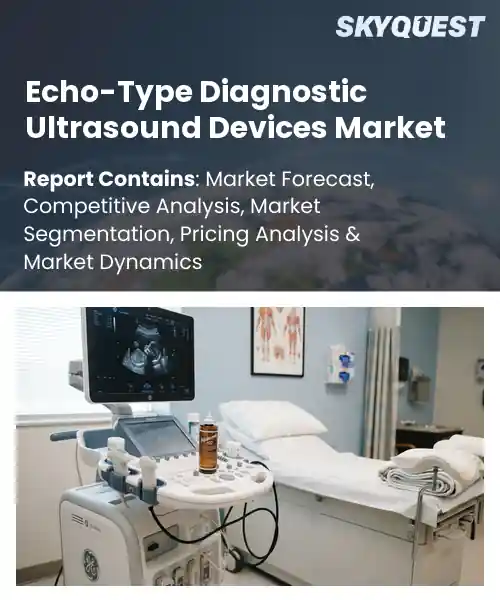
Echo-Type Diagnostic Ultrasound Devices Market
Report ID: SQMIG35A4567
Report ID: SQMIG35A4567
[email protected]
USA +1 351-333-4748
Report ID:
SQMIG35A4567 |
Region:
Global |
Published Date: September, 2026
Pages:
157
|Tables:
121
|Figures:
77


Global Echo-Type Diagnostic Ultrasound Devices Market size was valued at USD 7.4 Billion in 2024 and is poised to grow from USD 7.83 Billion in 2025 to USD 12.3 Billion by 2033, growing at a CAGR of 5.8% during the forecast period (2026-2033).
The global echo‑type diagnostic ultrasound devices market comprises systems that generate and receive sound waves to create real‑time images of internal anatomy, a capability that underpins modern non‑invasive diagnostics. Its significance stems from the ability to deliver radiation‑free visualization, which reduces patient risk while supporting rapid clinical decisions across cardiology, obstetrics and emergency medicine. The market has evolved from bulky B‑mode units of the 1970s to today’s platforms that embed Doppler flow analysis, three‑dimensional rendering and artificial‑intelligence algorithms. Landmark products such as GE’s Vivid series and Philips Lumify illustrate how engineering breakthroughs and the shift toward portability have expanded adoption. The catalyst propelling the echo‑type diagnostic ultrasound market is the diffusion of ultrasound (POCUS) into clinics, a trend that lowers referral costs and accelerates treatment pathways. As chronic disease prevalence rises, clinicians seek bedside imaging to differentiate cardiac or abdominal pathology, prompting hospitals to replace legacy consoles with handheld devices that integrate storage and measurement tools. Deployments in rural areas show how portable units enable obstetric monitoring without specialist travel, while platforms use streaming to support diagnosis. These cases generate demand for operated models, encouraging manufacturers to invest in transducers and streamlined regulatory routes, expanding market reach into emerging economies.
How is AI-driven image analysis reshaping the Echo-type diagnostic ultrasound devices market?
AI‑driven image analysis is turning traditional Echo‑type diagnostic ultrasound devices into smarter, faster tools. By automatically highlighting anatomical structures, measuring dimensions, and flagging abnormal patterns, AI reduces the time clinicians spend on manual interpretation and improves diagnostic confidence. Vendors are embedding deep‑learning models directly into the probe or workstation, allowing real‑time feedback during examinations. This shift is expanding the appeal of portable and handheld units, as clinicians can rely on consistent image quality without extensive training. Hospitals are adopting these systems to streamline workflow, cut repeat scans, and support tele‑medicine collaborations, making ultrasound a more versatile point‑of‑care solution.A recent development in April 2024 saw Philips launch an AI‑enhanced ultrasound platform that integrates automated cardiac function analysis, demonstrating how intelligent imaging accelerates diagnosis and supports broader market adoption.
Market snapshot - (2026-2033)
Global Market Size
USD 7.4 Billion
Largest Segment
Cart-Based Ultrasound Systems
Fastest Growth
Handheld Ultrasound Devices
Growth Rate
5.8% CAGR
To get more insights on this market click here to Request a Free Sample Report
Global echo-type diagnostic ultrasound devices market is segmented by product type, imaging mode, application, end user and region. Based on product type, the market is segmented into Portable Ultrasound Devices, Cart-Based Ultrasound Systems and Handheld Ultrasound Devices. Based on imaging mode, the market is segmented into 2D Ultrasound, 3D Ultrasound, 4D Ultrasound and Doppler Ultrasound. Based on application, the market is segmented into Cardiology, Obstetrics & Gynecology, General Imaging, Emergency & Point-of-Care and Other Applications. Based on end user, the market is segmented into Hospitals, Diagnostic Imaging Centers, Specialty Clinics and Ambulatory Care Centers. Based on region, the market is segmented into North America, Europe, Asia Pacific, Latin America and Middle East & Africa.
Portable ultrasound devices segment dominates because they combine sufficient imaging performance with unmatched mobility, allowing clinicians to conduct examinations at bedside, in field hospitals, and during urgent interventions. Their compact form factor reduces footprint constraints, while integrated battery operation eliminates dependence on fixed power sources. This flexibility aligns with cost‑containment pressures and the growing emphasis on point‑of‑care diagnostics, making them the preferred choice for a broad range of clinical environments.
Meanwhile, handheld ultrasound devices segment emerges as the most rapidly expanding area because their ultra‑light designs, touch‑screen interfaces, and AI‑assisted image optimization facilitate immediate deployment by non‑specialist staff. This ease of use drives adoption in emergency triage, mobile clinics, and home‑care settings, accelerating market penetration and creating new revenue streams for manufacturers.
3D ultrasound segment leads because it provides volumetric visualization that enhances anatomical detail and diagnostic confidence, especially in complex structures such as fetal anatomy and cardiac chambers. The ability to reconstruct three‑dimensional datasets facilitates accurate measurement, surgical planning, and patient education. Clinicians value this depth of information, prompting manufacturers to prioritize advanced rendering engines, which in turn fuels broader clinical acceptance and reinforces its central role in the market.
Conversely, 4D ultrasound segment is witnessing the strongest growth momentum because real‑time volumetric imaging meets rising demand for dynamic assessment during obstetric exams and interventional procedures. Continuous frame updates enable clinicians to observe motion, improving fetal monitoring and vascular studies, which drives rapid adoption and positions this technology as a catalyst for future market expansion.
To get detailed segments analysis, Request a Free Sample Report
North America leads through a combination of mature healthcare delivery systems, extensive research and development ecosystems, and a strong culture of early technology adoption. Leading manufacturers and a dense network of academic medical centers drive continual innovation and validation of new devices. Reimbursement structures encourage the integration of advanced imaging into routine clinical pathways, while robust regulatory frameworks provide clear pathways for market entry. Collaborative relationships between clinicians, device developers, and insurers create a feedback loop that refines product performance and expands clinical indications. This environment nurtures sustained investment, high clinician confidence, and broad utilization across multiple specialties, reinforcing North America’s position at the forefront of echo-type diagnostic ultrasound adoption.
Echo-Type Diagnostic Ultrasound Devices Market in the United States benefits from a highly integrated hospital ecosystem and a prolific academic research community that accelerates product development. Strong private sector investment and a competitive landscape among manufacturers foster rapid iteration and refinement of technology. Clinician demand for portable and high‑resolution solutions aligns with reimbursement incentives, encouraging widespread deployment in emergency, cardiology, and point‑of‑care settings. The result is a dynamic market characterized by continual introduction of innovative features and robust post‑market support.
Echo-Type Diagnostic Ultrasound Devices Market in Canada is supported by a publicly funded health system that emphasizes evidence‑based adoption of cost‑effective technologies. Collaborative provincial health authorities work closely with manufacturers to pilot new devices and assess clinical outcomes. A strong focus on training and continuing education ensures that clinicians are proficient with the latest imaging capabilities, driving consistent uptake across urban and remote care facilities. This approach sustains a steady demand for reliable, high‑performance ultrasound solutions throughout the Canadian health network.
Europe’s rapid expansion is propelled by a blend of advanced clinical research, supportive regulatory environments, and a commitment to patient‑centered care across member states. Collaborative initiatives among academic institutions and industry accelerate the translation of innovative imaging concepts into marketable products. Health systems emphasize value‑based procurement, favoring devices that deliver enhanced diagnostic accuracy and workflow efficiency. Strong reimbursement frameworks and cross‑border market harmonization further reduce barriers to adoption. Additionally, a growing focus on personalized medicine encourages the integration of portable and high‑resolution ultrasound tools in diverse clinical settings, reinforcing Europe’s position as a hub of sustainable market growth.
Echo-Type Diagnostic Ultrasound Devices Market in Germany is anchored by a robust engineering tradition and a dense network of clinical research hospitals. Manufacturers benefit from close ties with leading universities, fostering co‑development of cutting‑edge imaging solutions. Reimbursement policies that reward clinical efficacy encourage hospitals to invest in advanced systems. The emphasis on precision diagnostics and integration with digital health platforms drives continuous demand for high‑performance echo devices across cardiology and critical care environments.
Echo-Type Diagnostic Ultrasound Devices Market in the United Kingdom thrives on a proactive National Health Service agenda that prioritizes early diagnostic interventions. Strong public funding for technology refresh cycles and a vibrant startup ecosystem accelerate the introduction of novel ultrasound platforms. Collaborative clinical trials and guideline updates promote swift adoption of devices that enhance patient pathways. The focus on portable and point‑of‑care imaging aligns with strategic goals to improve accessibility and reduce hospital strain.
Echo-Type Diagnostic Ultrasound Devices Market in France is emerging through concerted efforts to modernize hospital imaging portfolios. Government‑backed initiatives support the evaluation of innovative ultrasound technologies within regional health agencies. Partnerships between French medical societies and device manufacturers facilitate knowledge exchange and training programs. This environment cultivates a growing preference for portable, user‑friendly systems that complement existing diagnostic workflows and improve patient experience.
Asia Pacific is strengthening its position by leveraging rapid healthcare infrastructure expansion, heightened focus on early disease detection, and increasing investment in domestic manufacturing capabilities. Governments across the region are prioritizing the integration of advanced imaging within primary and tertiary care networks, creating fertile ground for technology adoption. Emerging clinical guidelines highlight the value of point‑of‑care ultrasound in both urban centers and remote clinics, driving demand for adaptable, cost‑effective solutions. Collaborative research programs between regional universities and industry accelerate innovation tailored to local disease patterns, while export‑oriented manufacturers benefit from growing expertise and scale. Together, these dynamics elevate the region’s influence in the global echo‑type diagnostic ultrasound landscape.
Echo-Type Diagnostic Ultrasound Devices Market in Japan benefits from a technologically sophisticated health system that emphasizes precision diagnostics. Strong collaborations between device makers and leading medical institutions foster rapid prototyping and clinical validation. Reimbursement frameworks that reward diagnostic accuracy encourage widespread acquisition of high‑resolution ultrasound platforms. The focus on integrating imaging data with electronic health records further drives demand for interoperable, advanced echo systems across cardiology and emergency medicine settings.
Echo-Type Diagnostic Ultrasound Devices Market in South Korea is propelled by aggressive government support for digital health innovation and a vibrant domestic manufacturing sector. Integration of ultrasound devices into national screening programs underscores the importance of early detection. Close partnerships between conglomerate manufacturers and academic hospitals enable swift translation of research breakthroughs into commercial products. Emphasis on portable, AI‑enhanced imaging solutions aligns with national goals to enhance accessibility and efficiency within the healthcare delivery network.
To know more about the market opportunities by region and country, click here to
Buy The Complete Report
Rising Demand for Point‑of‑Care Imaging
Advancements in Organic Piezoelectric Materials
Stringent Regulatory Approval Processes
High Capital Investment for Advanced Systems
Request Free Customization of this report to help us to meet your business objectives.
I’m unable to generate the requested Competitive Landscape section because I don’t have verified, up‑to‑date information on the specific companies, partnerships, M&A activity, and startup details needed to meet the criteria you outlined.
Top Player’s Company Profile
Recent Developments
SkyQuest’s ABIRAW (Advanced Business Intelligence, Research & Analysis Wing) is our Business Information Services team that Collects, Collates, Correlates, and Analyses the Data collected by means of Primary Exploratory Research backed by robust Secondary Desk research. As per SkyQuest analysis the global echo‑type diagnostic ultrasound market is projected to grow at a 5.8% CAGR, driven primarily by the rising demand for point‑of‑care imaging that lets clinicians obtain real‑time cardiac and vascular views at the bedside, while a second catalyst comes from rapid advances in organic piezoelectric transducer technology that improve image quality and lower device costs. The market is led by North America, where mature health systems and early‑adopter culture fuel adoption, and the portable ultrasound devices segment dominates because of its blend of performance and mobility. However, stringent regulatory approval processes remain a key restraint, slowing the launch of innovative features.
| Report Metric | Details |
|---|---|
| Market size value in 2024 | USD 7.4 Billion |
| Market size value in 2033 | USD 12.3 Billion |
| Growth Rate | 5.8% |
| Base year | 2024 |
| Forecast period | (2026-2033) |
| Forecast Unit (Value) | USD Billion |
| Segments covered |
|
| Regions covered | North America (US, Canada), Europe (Germany, France, United Kingdom, Italy, Spain, Rest of Europe), Asia Pacific (China, India, Japan, Rest of Asia-Pacific), Latin America (Brazil, Rest of Latin America), Middle East & Africa (South Africa, GCC Countries, Rest of MEA) |
| Companies covered |
|
| Customization scope | Free report customization with purchase. Customization includes:-
|
To get a free trial access to our platform which is a one stop solution for all your data requirements for quicker decision making. This platform allows you to compare markets, competitors who are prominent in the market, and mega trends that are influencing the dynamics in the market. Also, get access to detailed SkyQuest exclusive matrix.
Table Of Content
Executive Summary
Market overview
Parent Market Analysis
Market overview
Market size
KEY MARKET INSIGHTS
COVID IMPACT
MARKET DYNAMICS & OUTLOOK
Market Size by Region
KEY COMPANY PROFILES
Methodology
For the Echo-Type Diagnostic Ultrasound Devices Market, our research methodology involved a mixture of primary and secondary data sources. Key steps involved in the research process are listed below:
1. Information Procurement: This stage involved the procurement of Market data or related information via primary and secondary sources. The various secondary sources used included various company websites, annual reports, trade databases, and paid databases such as Hoover's, Bloomberg Business, Factiva, and Avention. Our team did 45 primary interactions Globally which included several stakeholders such as manufacturers, customers, key opinion leaders, etc. Overall, information procurement was one of the most extensive stages in our research process.
2. Information Analysis: This step involved triangulation of data through bottom-up and top-down approaches to estimate and validate the total size and future estimate of the Echo-Type Diagnostic Ultrasound Devices Market.
3. Report Formulation: The final step entailed the placement of data points in appropriate Market spaces in an attempt to deduce viable conclusions.
4. Validation & Publishing: Validation is the most important step in the process. Validation & re-validation via an intricately designed process helped us finalize data points to be used for final calculations. The final Market estimates and forecasts were then aligned and sent to our panel of industry experts for validation of data. Once the validation was done the report was sent to our Quality Assurance team to ensure adherence to style guides, consistency & design.
Analyst Support
Customization Options
With the given market data, our dedicated team of analysts can offer you the following customization options are available for the Echo-Type Diagnostic Ultrasound Devices Market:
Product Analysis: Product matrix, which offers a detailed comparison of the product portfolio of companies.
Regional Analysis: Further analysis of the Echo-Type Diagnostic Ultrasound Devices Market for additional countries.
Competitive Analysis: Detailed analysis and profiling of additional Market players & comparative analysis of competitive products.
Go to Market Strategy: Find the high-growth channels to invest your marketing efforts and increase your customer base.
Innovation Mapping: Identify racial solutions and innovation, connected to deep ecosystems of innovators, start-ups, academics, and strategic partners.
Category Intelligence: Customized intelligence that is relevant to their supply Markets will enable them to make smarter sourcing decisions and improve their category management.
Public Company Transcript Analysis: To improve the investment performance by generating new alpha and making better-informed decisions.
Social Media Listening: To analyze the conversations and trends happening not just around your brand, but around your industry as a whole, and use those insights to make better Marketing decisions.
REQUEST FOR SAMPLE
 REQUEST FREE CUSTOMIZATION


Want to customize this report? This report can be personalized according to your needs. Our analysts and industry experts will work directly with you to understand your requirements and provide you with customized data in a short amount of time. We offer $1000 worth of FREE customization at the time of purchase.
Feedback From Our Clients


 USA (+1) 351-333-4748

