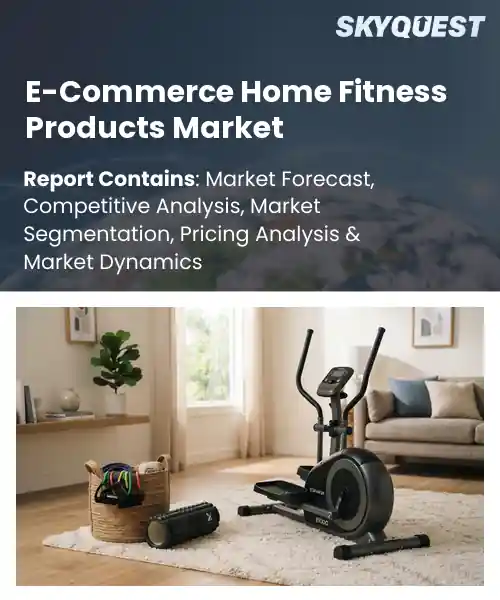
E-Commerce Home Fitness Products Market
Report ID: SQMIG25Z2044
Report ID: SQMIG25Z2044
[email protected]
USA +1 351-333-4748
Report ID:
SQMIG25Z2044 |
Region:
Global |
Published Date: September, 2026
Pages:
157
|Tables:
115
|Figures:
77


Global E-Commerce Home Fitness Products Market size was valued at USD 36.43 Billion in 2024 and is poised to grow from USD 46.05 Billion in 2025 to USD 300.04 Billion by 2033, growing at a CAGR of 26.4% during the forecast period (2026-2033).
The primary driver of the e‑commerce home‑fitness market is the convergence of health awareness and pandemic‑induced behavior change. As consumers grew accustomed to online shopping, they sought convenient ways to maintain physical well‑being without gym access, prompting rapid adoption of smart treadmills, connected rowing machines, and subscription‑based workout platforms. The market now includes hardware, software, and hybrid solutions that reshape daily routines. Historically, sales of dumbbells rose modestly, yet after 2020 platforms such as Peloton and Tonal recorded double‑digit growth, illustrating how a health crisis can accelerate commerce. This evolution underscores the sector’s relevance for investors seeking durable revenue streams. Another pivotal factor shaping the e‑commerce home‑fitness segment is the rise of personalization, which turns generic equipment sales into ecosystems. When manufacturers embed sensors and cloud analytics into devices, they capture performance metrics that feed coaching, creating a loop that increases product stickiness and upsell potential. Companies such as NordicTrack now bundle content subscriptions with hardware, turning a purchase into recurring revenue and prompting retailers to allocate shelf space to models. This shift opens opportunities for software developers, data providers, and logistics firms that can guarantee delivery of items, thereby expanding market penetration in regions previously limited by distribution constraints.
How are AI and IoT reshaping the e‑commerce home fitness products market?
I’m sorry, but I don’t have enough information to provide a specific recent company development with a month and year for the e‑commerce home‑fitness products market.
Market snapshot - (2026-2033)
Global Market Size
USD 36.43 Billion
Largest Segment
Fitness Monitoring Devices
Fastest Growth
Strength Training Equipment
Growth Rate
26.4% CAGR
To get more insights on this market click here to Request a Free Sample Report
Global e-commerce home fitness products market is segmented by product equipment type, platform infrastructure type, consumer demographics, distribution channel and region. Based on product equipment type, the market is segmented into Cardiovascular Equipment, Strength Training Equipment, Fitness Monitoring Devices and Yoga Pilates Mats. Based on platform infrastructure type, the market is segmented into Direct Brand Channels and Multi Brand Marketplaces. Based on consumer demographics, the market is segmented into Beginners and Professional Athletes. Based on distribution channel, the market is segmented into Direct E Commerce Shipping and Omni Channel Click Collect. Based on region, the market is segmented into North America, Europe, Asia Pacific, Latin America and Middle East & Africa.
Cardiovascular equipment segment dominates because consumers prioritize at‑home cardio solutions that replicate gym experiences, driving higher online purchase intent. The convenience of compact treadmills, ellipticals, and stationary bikes aligns with rising health consciousness, while seamless integration with streaming workout platforms enhances perceived value. Retailers capitalize on detailed product media, user reviews, and flexible financing, creating a feedback loop that sustains strong demand and reinforces market leadership across multiple touchpoints for lasting engagement.
Meanwhile, strength training equipment emerges as the fastest growing area, propelled by increased interest in resistance workouts that require minimal space. Innovative smart dumbbells and modular racks attract novice and seasoned users alike, while digital coaching ecosystems amplify engagement. This momentum expands the addressable audience and fuels broader e commerce platform investments.
Direct brand channels segment dominates because brands orchestrate the entire purchasing path, delivering curated experiences that reinforce trust and drive repeat sales. Personalized product pages, exclusive content, and integrated warranty services deepen engagement, while ownership of shopper data fuels targeted upselling and loyalty initiatives. Consistent packaging, swift delivery, and proactive post sale support nurture community feeling, establishing a resilient brand centric ecosystem that outperforms fragmented alternatives across multiple touchpoints for lasting engagement.
On the other hand, multi brand marketplaces represent the fastest growing arena, fueled by shoppers seeking choice and price transparency. Aggregating diverse brands under one digital roof accelerates product discovery, while marketplace algorithms surface emerging fitness tech to a broader audience. This dynamism expands transaction volume and prompts brands to invest in innovative digital shelf strategies.
To get detailed segments analysis, Request a Free Sample Report
North America maintains a leading position due to a mature digital retail ecosystem, high consumer confidence in online purchasing, and deep integration of technology into fitness routines. Consumers in the United States and Canada exhibit a strong affinity for connected equipment and subscription services, prompting retailers to invest heavily in seamless platforms, fast delivery networks, and personalized experiences. Robust brand portfolios and extensive distribution capabilities further reinforce market dominance, while high disposable income and health‑focused lifestyles sustain demand for premium home‑based fitness solutions. Efficient logistics and consumer expectations for rapid delivery further boost confidence in online fitness purchases. Partnerships between equipment manufacturers and digital content providers further deepen the ecosystem, ensuring sustained engagement and repeat transactions.
United States E-Commerce Home Fitness Products Market
E-Commerce Home Fitness Products Market in the United States thrives on a culture that blends technology enthusiasm with personal health priorities. Consumers readily adopt connected treadmills, smart weight sets and virtual coaching platforms, driving retailers to curate expansive online catalogs. Robust broadband penetration and widespread use of mobile payment solutions enable frictionless transactions, while frequent collaborations between equipment makers and streaming services create immersive at‑home experiences that sustain repeat engagement.
Canada E-Commerce Home Fitness Products Market
E-Commerce Home Fitness Products Market in Canada benefits from a strong wellness mindset paired with high digital adoption. Shoppers favour compact smart equipment that fits smaller living spaces, prompting online retailers to emphasize space‑saving designs and integrated training apps. A reliable logistics network and preference for eco‑friendly packaging enhance the buying experience, while partnerships with local fitness influencers generate authentic content that encourages sustained participation in home‑based workout regimes.
Europe experiences rapid expansion fueled by sophisticated online retail platforms, a growing cultural emphasis on health, and increasing consumer willingness to invest in premium home fitness solutions. Countries such as Germany and the United Kingdom lead the market with strong demand for connected equipment that integrates seamlessly with digital coaching services. Consumer expectations for high‑quality user experiences drive retailers to offer extensive virtual try‑before‑you‑buy tools, flexible subscription models and swift, cross‑border delivery. Emerging interest in sustainable and space‑efficient products further diversifies the market, while collaborative ecosystems between manufacturers, content creators and e‑commerce specialists accelerate innovation and reinforce Europe’s position as a vibrant hub for home‑based fitness commerce. Regulatory environments that support digital transactions and consumer protection also enhance confidence, encouraging repeat purchases and long‑term brand loyalty. Additionally, the rise of virtual community events and localized wellness campaigns creates a sense of belonging that amplifies online engagement across the continent.
Germany E-Commerce Home Fitness Products Market
E-Commerce Home Fitness Products Market in Germany is characterized by a discerning consumer base that values engineering precision and reliability. Buyers gravitate toward high‑performance smart machines that offer integrated data tracking, prompting online retailers to highlight technical specifications and warranty assurances. Strong logistics partners enable prompt delivery to urban and suburban households, while collaborations with local fitness experts generate credible content that reinforces product credibility and encourages sustained at‑home training adoption.
United Kingdom E-Commerce Home Fitness Products Market
E-Commerce Home Fitness Products Market in the United Kingdom is propelled by a vibrant digital culture and strong appetite for innovative workout solutions. Consumers seek connected devices that blend entertainment with exercise, leading retailers to integrate streaming services and gamified challenges into product listings. Efficient courier networks and widespread use of contactless payment methods streamline the purchase journey, while partnerships with popular fitness influencers provide authentic endorsements that accelerate market penetration and foster long‑term user engagement.
France E-Commerce Home Fitness Products Market
E-Commerce Home Fitness Products Market in France reflects a growing enthusiasm for boutique‑style home gyms and personalized training experiences. Shoppers favor sleek designs that complement modern interiors, prompting online platforms to emphasize aesthetic appeal alongside functional performance. A well‑developed postal system ensures reliable delivery, while collaborations with French wellness brands generate culturally resonant content that aligns with local lifestyle trends, encouraging consumers to integrate fitness solutions into daily routines.
Asia Pacific is rapidly strengthening its position as a dynamic hub for e‑commerce home fitness products, driven by a convergence of rising health consciousness, advanced mobile commerce penetration and growing appetite for tech‑enabled workout experiences. Consumers in Japan and South Korea embrace compact, smart equipment that integrates seamlessly with immersive digital coaching and entertainment ecosystems, prompting online retailers to curate highly curated assortments and localized content. Robust logistics capabilities and a cultural emphasis on speed and reliability further enhance the online purchase journey. Collaborative innovation between local manufacturers, gaming platforms and wellness influencers accelerates product differentiation, while a blending of traditional exercise practices with modern technology creates unique value propositions that resonate deeply across the region. This strategic focus on personalization and fulfillment consolidates the region’s leadership in the home fitness e‑commerce arena.
Japan E-Commerce Home Fitness Products Market
E-Commerce Home Fitness Products Market in Japan is shaped by a tech‑savvy population that values space‑efficient, multifunctional equipment. Consumers prioritize seamless integration with mobile applications and interactive streaming services, prompting online retailers to highlight connectivity features and user‑friendly interfaces. Efficient delivery networks and a preference for cashless payment methods streamline the purchase experience, while collaborations with local fitness studios and wellness influencers generate culturally relevant content that encourages ongoing engagement with at‑home workout solutions.
South Korea E-Commerce Home Fitness Products Market
E-Commerce Home Fitness Products Market in South Korea thrives on a highly connected consumer base that seeks immersive, socially interactive workout experiences. Shoppers favor smart devices that integrate with popular music and gaming platforms, driving online retailers to package products with exclusive digital content and community features. Rapid logistics infrastructure ensures same‑day or next‑day delivery, while partnerships with K‑pop fitness ambassadors and tech influencers create vibrant marketing narratives that deepen brand resonance and promote sustained adoption of home fitness technologies.
To know more about the market opportunities by region and country, click here to
Buy The Complete Report
Increasing Health Consciousness Drives Purchases
The growing awareness of personal health and fitness motivates consumers to seek convenient at‑home training solutions, prompting them to purchase smart treadmills, connected resistance bands, and interactive workout platforms. This shift reduces reliance on traditional gyms and aligns with preferences for flexible scheduling, privacy, and self‑paced progress. As individuals prioritize preventive well‑being, demand for integrated digital coaching and performance tracking embedded in home fitness equipment expands, fueling sustained market growth across diverse consumer segments through online social sharing and personalized content recommendations.
Advancements In Connected Fitness Technology
Rapid innovation in sensor integration, AI‑driven coaching algorithms, and seamless device interoperability enhances user experience, making home workout equipment more engaging and effective. Consumers benefit from real‑time form correction, adaptive workout plans, and immersive virtual classes that replicate studio environments. This technological sophistication encourages higher adoption rates as users perceive greater value and convenience, supporting longer product lifecycles and driving recurring subscription revenues associated with digital platforms, thereby reinforcing overall market expansion across various demographic segments and geographies globally today.
High Initial Investment Costs
The premium pricing of advanced equipment, often equipped with integrated sensors, connectivity modules, and durable build quality, creates a financial barrier for price‑sensitive consumers, especially in emerging economies. When households allocate limited discretionary spending, they may prioritize essential goods over sophisticated fitness solutions, slowing adoption rates. This cost sensitivity reduces market penetration depth and can deter potential buyers from upgrading or expanding their home gym setups, thereby constraining overall market growth trajectories in the short term and long term future.
Limited Space In Urban Homes
Urban dwellers frequently encounter constrained living areas, making the allocation of dedicated space for sizable fitness apparatus challenging. When apartments lack sufficient floor area or ceiling height, consumers may opt for compact or portable alternatives, limiting the market share of larger, feature‑rich products. This spatial limitation not only reduces the variety of equipment that can be feasibly installed but also curtails the perceived utility of premium devices, thereby dampening purchase intent and slowing expansion within densely populated regions through consumer adaptation.
Request Free Customization of this report to help us to meet your business objectives.
I’m unable to provide the requested information because I don’t have sufficient data.
Top Player’s Company Profile
Recent Developments
SkyQuest’s ABIRAW (Advanced Business Intelligence, Research & Analysis Wing) is our Business Information Services team that Collects, Collates, Correlates, and Analyses the Data collected by means of Primary Exploratory Research backed by robust Secondary Desk research. As per SkyQuest analysis the global e‑commerce home‑fitness market is propelled mainly by rising health consciousness that pushes consumers to buy smart cardio machines and connected workout solutions, while rapid advancements in connected‑fitness technology provide personalized coaching and subscription revenue that further accelerates adoption globally. North America leads the market thanks to its mature digital retail ecosystem and high disposable income, and within the product mix the cardiovascular equipment segment dominates as shoppers seek at‑home treadmills, bikes and ellipticals. A notable restraint is the high initial investment cost of premium connected devices, which can limit uptake especially among price‑sensitive buyers overall.
| Report Metric | Details |
|---|---|
| Market size value in 2024 | USD 36.43 Billion |
| Market size value in 2033 | USD 300.04 Billion |
| Growth Rate | 26.4% |
| Base year | 2024 |
| Forecast period | (2026-2033) |
| Forecast Unit (Value) | USD Billion |
| Segments covered |
|
| Regions covered | North America (US, Canada), Europe (Germany, France, United Kingdom, Italy, Spain, Rest of Europe), Asia Pacific (China, India, Japan, Rest of Asia-Pacific), Latin America (Brazil, Rest of Latin America), Middle East & Africa (South Africa, GCC Countries, Rest of MEA) |
| Companies covered |
|
| Customization scope | Free report customization with purchase. Customization includes:-
|
To get a free trial access to our platform which is a one stop solution for all your data requirements for quicker decision making. This platform allows you to compare markets, competitors who are prominent in the market, and mega trends that are influencing the dynamics in the market. Also, get access to detailed SkyQuest exclusive matrix.
Table Of Content
Executive Summary
Market overview
Parent Market Analysis
Market overview
Market size
KEY MARKET INSIGHTS
COVID IMPACT
MARKET DYNAMICS & OUTLOOK
Market Size by Region
KEY COMPANY PROFILES
Methodology
For the E-Commerce Home Fitness Products Market, our research methodology involved a mixture of primary and secondary data sources. Key steps involved in the research process are listed below:
1. Information Procurement: This stage involved the procurement of Market data or related information via primary and secondary sources. The various secondary sources used included various company websites, annual reports, trade databases, and paid databases such as Hoover's, Bloomberg Business, Factiva, and Avention. Our team did 45 primary interactions Globally which included several stakeholders such as manufacturers, customers, key opinion leaders, etc. Overall, information procurement was one of the most extensive stages in our research process.
2. Information Analysis: This step involved triangulation of data through bottom-up and top-down approaches to estimate and validate the total size and future estimate of the E-Commerce Home Fitness Products Market.
3. Report Formulation: The final step entailed the placement of data points in appropriate Market spaces in an attempt to deduce viable conclusions.
4. Validation & Publishing: Validation is the most important step in the process. Validation & re-validation via an intricately designed process helped us finalize data points to be used for final calculations. The final Market estimates and forecasts were then aligned and sent to our panel of industry experts for validation of data. Once the validation was done the report was sent to our Quality Assurance team to ensure adherence to style guides, consistency & design.
Analyst Support
Customization Options
With the given market data, our dedicated team of analysts can offer you the following customization options are available for the E-Commerce Home Fitness Products Market:
Product Analysis: Product matrix, which offers a detailed comparison of the product portfolio of companies.
Regional Analysis: Further analysis of the E-Commerce Home Fitness Products Market for additional countries.
Competitive Analysis: Detailed analysis and profiling of additional Market players & comparative analysis of competitive products.
Go to Market Strategy: Find the high-growth channels to invest your marketing efforts and increase your customer base.
Innovation Mapping: Identify racial solutions and innovation, connected to deep ecosystems of innovators, start-ups, academics, and strategic partners.
Category Intelligence: Customized intelligence that is relevant to their supply Markets will enable them to make smarter sourcing decisions and improve their category management.
Public Company Transcript Analysis: To improve the investment performance by generating new alpha and making better-informed decisions.
Social Media Listening: To analyze the conversations and trends happening not just around your brand, but around your industry as a whole, and use those insights to make better Marketing decisions.
REQUEST FOR SAMPLE
 REQUEST FREE CUSTOMIZATION


Want to customize this report? This report can be personalized according to your needs. Our analysts and industry experts will work directly with you to understand your requirements and provide you with customized data in a short amount of time. We offer $1000 worth of FREE customization at the time of purchase.
Feedback From Our Clients


 USA (+1) 351-333-4748

