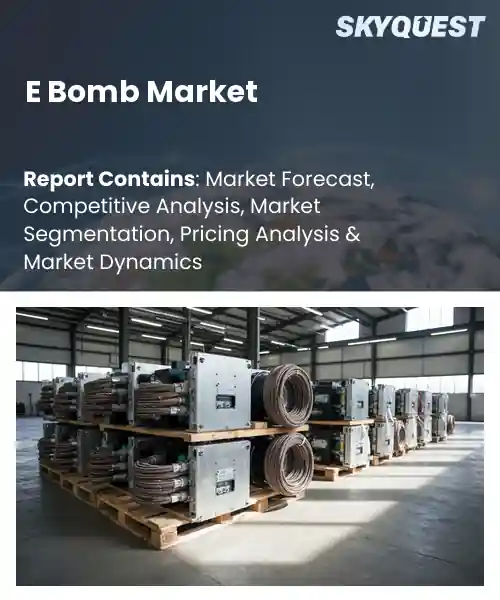
E Bomb Market
Report ID: SQMIG20A2575
Report ID: SQMIG20A2575
[email protected]
USA +1 351-333-4748
Report ID:
SQMIG20A2575 |
Region:
Global |
Published Date: March, 2026
Pages:
157
|Tables:
172
|Figures:
79


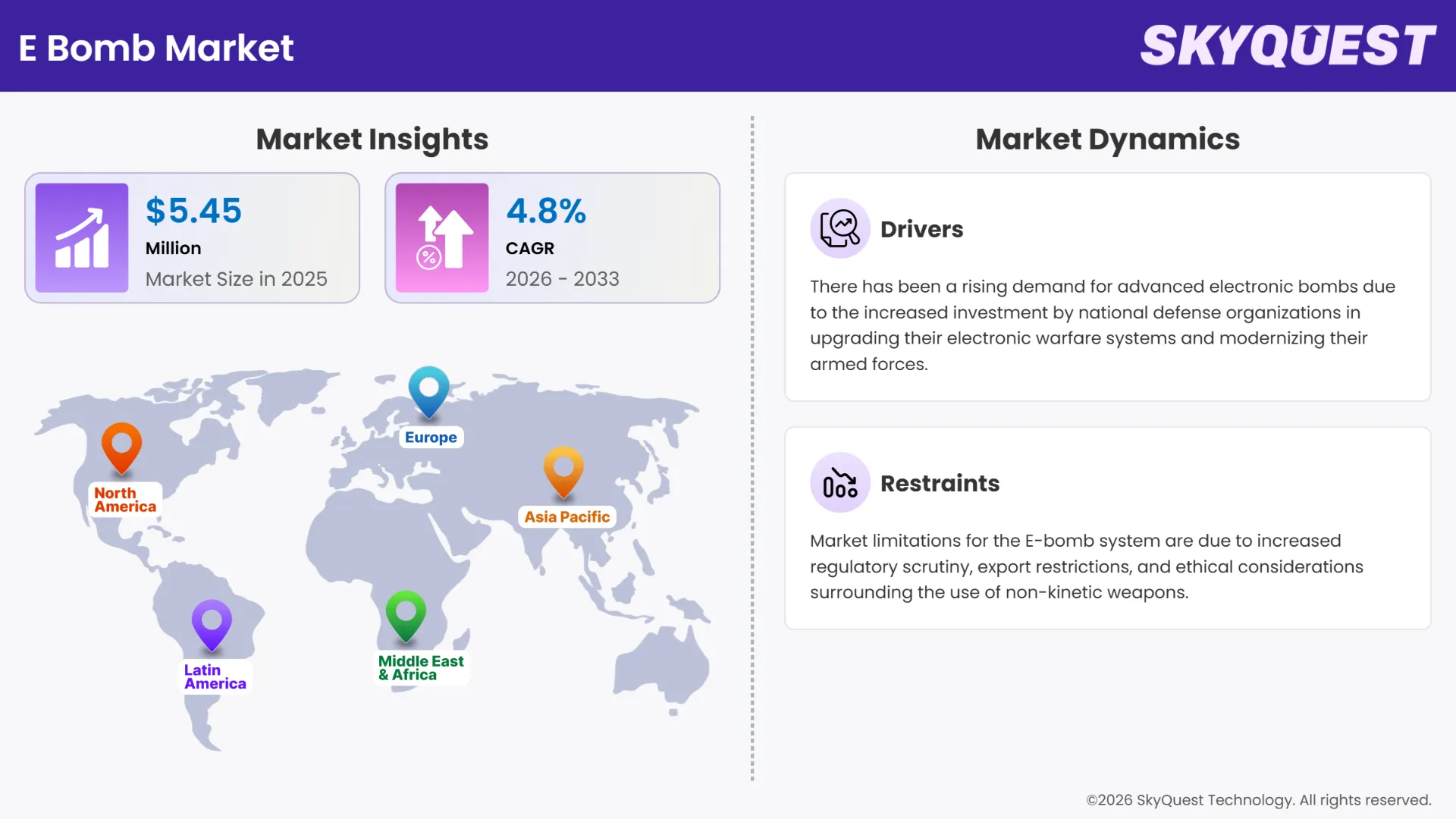
Global E Bomb Market size was valued at USD 5.20 Million in 2024 and is poised to grow from USD 5.45 Million in 2025 to USD 7.93 Million by 2033, growing at a CAGR of 4.8% during the forecast period (2026-2033).
Key Takeaways: Market Trends & Insights
The e bomb market is driven by the increasing demand for non-kinetic capabilities by militaries and security firms, which has transitioned electromagnetic disruption from research to formal procurement streams. Systems, testing services, and protective technologies that can degrade or resist electronic systems make up this market because many modern command, communication, power grids, and civilian services rely heavily on electrics that are very susceptible to disruption.
Over the past two decades, since the increase of geopolitical tensions and asymmetric threats, to take advantage of defense budgets. Expanding procurement continues with growing defense budgets and new electronic warfare and electronic-resilience-focused procurement policies. Therefore, creating innovation from vendors and allowing new vendors to enter the market.
Vendors invest in scalable product lines, hardened hardware, and simulation services that conform to the required certifiable standards because militaries and infrastructure operators need systems to degrade the adversary's electronics while maintaining civilian functions.
How is AI Transforming the E Bomb Market?
The e bomb market has undergone an evolution in recent years as the application of AI has transitioned BLUNT electromagnetic effects to sophisticated Electronic Warfare (EW) precision weapons. Some of the key component areas related to this transition are intelligent sensors, automated target identification, adaptive waveform generation, and integrated command & control systems (C2). Driven by the growing demand for counter-drone and spectrum dominance capability, as well as competition between established defence companies (the ‘legacy primes’) and agile tech start-ups, the e bomb market has recently transitioned from developing experimental prototypes. A few examples of advanced modular e-bombs/ EW weapons being developed today are autonomous jamming pods; Dynamic Spectrum Deconfliction (DSD); and predictive maintenance for high-power RF (radio frequency) sources.
In February 2026, BAE Systems demonstrated modular airborne electromagnetic attack capabilities during US Air Force readiness testing. By integrating both AI-enabled signal classification and adaptive waveform control into the Airborne Direct Action (ADA) approach, these systems improve operator workload and provide faster and more agile weapon targeting.
To get more insights on this market click here to Request a Free Sample Report
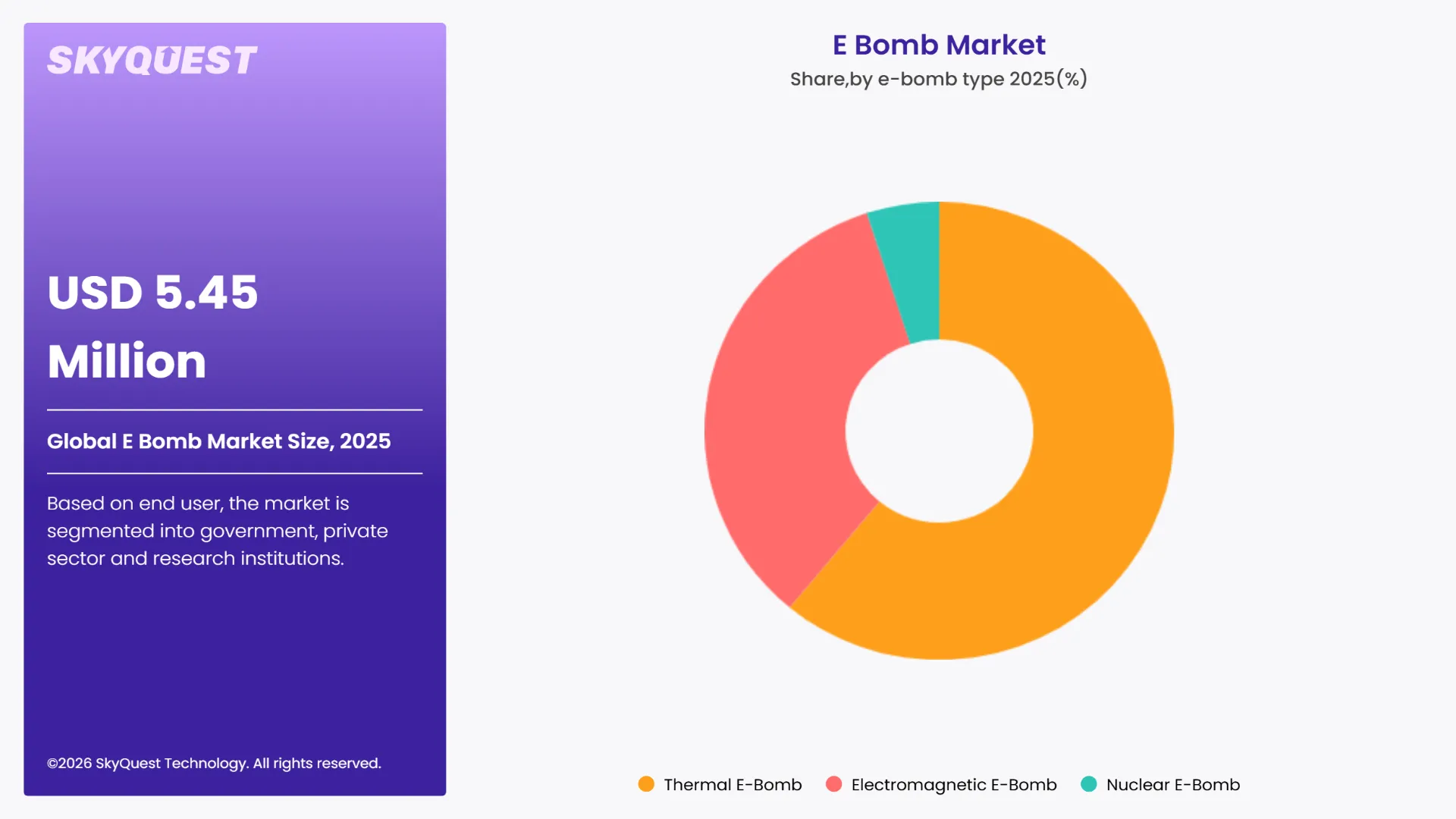
Global e bomb market is segmented into e bomb type, usage, platform, by range, end user, application and region. Based on e bomb type, the market is segmented into thermal e bomb, electromagnetic e bomb and nuclear e bomb. Based on usage, the market is segmented into offensive, defensive and countermeasure. Based on platform, the market is segmented into airborne (Missiles, UAVs, Aircraft), ground-based systems and naval platforms. based on by range, the market is segmented into tactical (short range) and strategic (long range / wide area impact).
Based on end user, the market is segmented into government, private sector and research institutions. Based on application, the market is segmented into military operations, civil defense and scientific research. Based on region, the market is segmented into North America, Europe, Asia Pacific, Latin America and Middle East & Africa.
As per e bomb market outlook, the electromagnetic segment of the e-bomb is the largest because its non-kinetic nature allows it to disable sensitive electronics and buyers are looking to purchase systems that can provide rapid and reversible effects with controlled footprints. In addition to this, buyers are looking for systems that can integrate into existing electronic warfare suites, are based on mature guidance and targeting concepts, and have minimized collateral damage risks. This drives procurement towards platforms and manufacturers that can prove their system interoperability and predictability across mission sets.
Although the e bomb market growth rate of the thermal E-bomb segment is growing faster than the electromagnetic e-bomb segments due to advances in directed energy materials, compact thermal generators and expanding tactical applications, increased demand for precision area denial weapons and ongoing research into scalable. This is creating new opportunities for newer E-bomb manufacturers, dual use applications and integration into expeditionary and small unit platforms.
As per e bomb market forecast, UAVs segment dominates because their operational flexibility, endurance, and lower deployment risk make them preferred carriers for electronic effect payloads. As a result, buyers are purchasing platforms that enable them to accomplish prolonged surveillance, loitering at a precise point and remote activation of payloads, thus minimizing both their own exposure and collateral damage by investing in modular payload interfacing.
As per e bomb market analysis, missiles are growing at a rapid rate due to increased demand for the use of standoff capabilities to deliver electronic effects and for delivering them rapidly. Additionally, improvements in miniaturized payloads and seeker integration make it easier to retrofit existing strike inventories with new strike capabilities that can be utilized for fulfilling long range time sensitive missions, as well as providing opportunities for the development of new payload combinations.
To get detailed segments analysis, Request a Free Sample Report
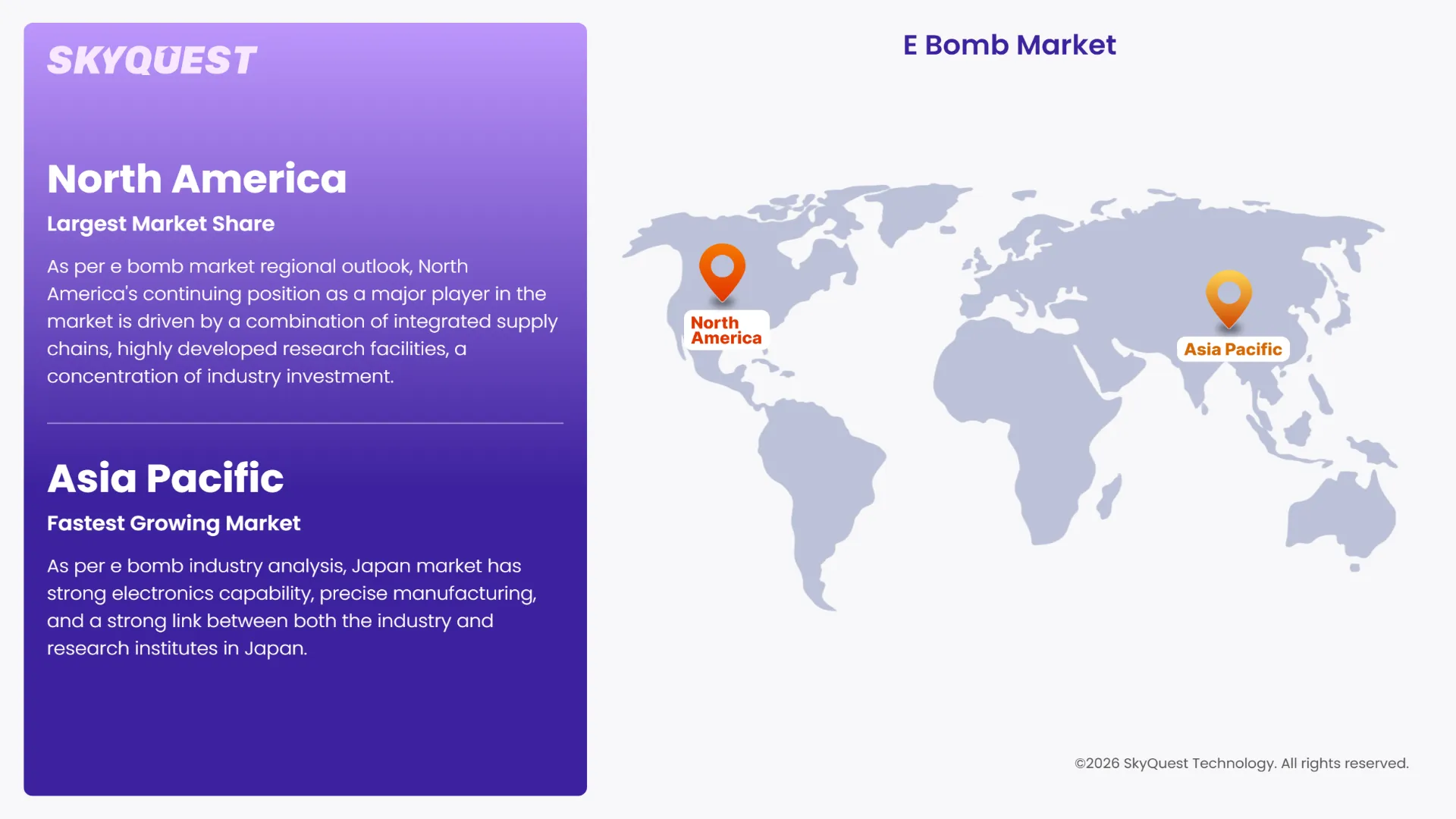
As per e bomb market regional outlook, North America's continuing position as a major player in the market is driven by a combination of integrated supply chains, highly developed research facilities, a concentration of industry investment. Collaborative working relationships between manufacturers, defense contractors, and technology partners, and a mature regulatory framework that provides consistent quality and buyer confidence.
In the United States, the e bomb market trends is characterized by leading manufacturers, a sophisticated testing infrastructure, and well-established procurement channels; all of which provide for the advanced deployment of e-bomb technologies. Cooperative relationships amongst the private sector, defense institutions and their partners in government have significantly accelerated the development of customized capability sets. A mature supply network and aftermarket end-user support base provide for rapid fielding of E-Bomb systems within the United States. Furthermore, a focus on interoperability, standardization, and commercialization will ensure that e-bomb systems developed within the United States will meet or exceed all performance and reliability standards for all applications.
Within Canada, the proximity of Canadian suppliers to the United States, combined with a highly skilled labor force, and robust research partnership programs, presents a unique opportunity for the continued development of niche capabilities to support e-bomb technology. Co-operative partnerships between manufacturers and universities provide an avenue for the validation of e-bomb components and the development of innovative processes and procedures. The focus on flexible procurement and interoperability will ensure that e-bomb systems developed for Canada will meet or exceed regional operational requirements.
As per e bomb market regional forecast, Asia Pacific is growing quickly because of many things coming together these includes strong industrial capabilities; investments into technology; and active procurement policies which facilitate development in-country. The manufacturers/system integrators based in the regions of Asia Pacific benefit from having large numbers of suppliers (dense ecosystems) supporting their activity; low manufacturing costs due to scale; and low barriers to commercial work. The cooperation between public research institutes and private companies has allowed companies to adapt advanced technologies to their spatial/temporal conditions at an accelerated pace.
As per e bomb industry analysis, Japan market has strong electronics capability, precise manufacturing, and a strong link between both the industry and research institutes in Japan. With a focus on miniaturization, reliability, and systems integration, the solutions being developed for the market meet the stringent operational requirements of their customers. The established supply chain within Japan, together with the practices in place to ensure the control of quality assurance, provides assurance in the components being manufactured as well as assurance in how they will be tested.
The South Korean e bomb market benefits from a strong base of electronics and defence, an agile approach to the role of the system integrators within this framework, and government policies focused on developing capabilities quickly. In addition, there are several strengths within South Korea’s capabilities associated with the use of advanced sensors and power systems and their use to develop tailored, robust, solutions for both maritime and terrestrial operations. The established supply chain and testing centres provide the necessary support for efficient validation and deployment of solutions. In partnership with their global partners, South Korean companies are aggressively pursuing the transfer of technology while working important elements such as quality, interoperability and lifecycle sustainment into their domestic companies.
The European Union is aiming to build its e bomb market share using complementary industrial strengths (e.g., competitive advantages), decentralized research and development programme initiatives (e.g., coordinating funding through national partners), and enhanced collaboration between national suppliers to create competitive and interoperable solutions. By investing in advanced manufacturing, integrated systems, and disciplined testing procedures, European suppliers will provide reliable products to meet operational standards.
An increased focus on cross-border partnerships and joint procurement initiatives will align supplier requirements; thus, eliminating duplication of effort, providing enhanced services, and allowing European companies to compete more effectively on both an international and regional basis. By focusing on modular design features, lifecycle support, and common standardized practices and requirements, European companies will also provide increased exportability and long-term sustainment.
The Germany e bomb market is characterized by the effective use of sophisticated and precise engineering, manufacturing techniques, and a highly developed and integrated supplier base that supports the design and manufacture of high-quality components and systems. Close ties exist between industrial organizations and research institutions (e.g., government agencies) that have developed rigorous testing and compliance requirements between themselves. Sophisticated companies that have developed a significant level of systems integration and lifecycle support are offering their customers integrated solutions that are tailored to complex operational requirements. Suppliers in Germany also leverage their manufacturing capabilities to produce reliable and interoperable E Bomb solutions for their regional and international customer base.
The e bomb market in the United Kingdom is based on strong capabilities in both systems integration and experience in defense as well as a large network of specialist suppliers. The focus of the market is on modular architectures, rigorous testing, and interoperability to meet the complex requirements of operations. The close collaboration between industry and research centres accelerates innovation and component validation. Flexible methods of procurement and partnerships across sectors allow for custom-fit solutions to be provided for both maritime and land applications, while a focus on lifecycle management increases the readiness of products through the increased potential for exports.
E bomb market growth in France has strong capabilities in the defense industry and experience with systems integration and works closely with research centres for product development. The French marketplace is focused on rigorous testing, certification and interoperability in complex operational environments. Supplier clusters and specialized firms provide innovative components and collaborate via national programs to maximize coordination and export readiness. Focus on lifecycle sustainment, modular design, and cross-sector collaboration provides the French companies involved in the e bomb market with the foundation to deliver high-quality, adaptable solutions to key regional partners.
To know more about the market opportunities by region and country, click here to
Buy The Complete Report
Rising Defense Modernization Efforts
Technological Advancements with Directed Energy
Regulatory and Ethical Concerns
Technical Integration and Compatibility Issues
Request Free Customization of this report to help us to meet your business objectives.
The global e bomb industry competitive environment is stimulating M&A activity focused on specific capabilities. It is also fostering collaboration by establishing partnerships between platforms as well as fast-paced innovation in directed energy applications. Examples of competitive actions include Anduril's acquisition of propulsion and autonomy capabilities will support the integration of these components; Epirus teaming with General Dynamics for mobile counter-unmanned aerial systems (UAS); and Helsing's acquisition of an aircraft manufacturer that will enable AI-enabled electronic warfare to be embedded in the platforms.
SkyQuest’s ABIRAW (Advanced Business Intelligence, Research & Analysis Wing) is our Business Information Services team that Collects, Collates, Correlates, and Analyses the Data collected by means of Primary Exploratory Research backed by robust Secondary Desk research.
As per SkyQuest analysis, one key driver is the strategic demand for non-kinetic capabilities as militaries prioritize electronic disruption, and a second driver is rapid advances in directed energy and AI-enabled precision electronic warfare that turn blunt effects into targeted tools. One restraint is regulatory and ethical concerns including export controls that slow procurement and fielding. Dominating region is North America, supported by integrated supply chains, testing infrastructure and strong public–private partnerships, while the dominating segment is electromagnetic e‑bombs because of their reversible, controllable effects and interoperability with existing electronic warfare suites. Vendors are moving to modular, scalable designs to match diverse operational needs.
| Report Metric | Details |
|---|---|
| Market size value in 2024 | USD 5.20 Million |
| Market size value in 2033 | USD 7.93 Million |
| Growth Rate | 4.8% |
| Base year | 2024 |
| Forecast period | 2026-2033 |
| Forecast Unit (Value) | USD Million |
| Segments covered |
|
| Regions covered | North America (US, Canada), Europe (Germany, France, United Kingdom, Italy, Spain, Rest of Europe), Asia Pacific (China, India, Japan, Rest of Asia-Pacific), Latin America (Brazil, Rest of Latin America), Middle East & Africa (South Africa, GCC Countries, Rest of MEA) |
| Companies covered |
|
| Customization scope | Free report customization with purchase. Customization includes:-
|
To get a free trial access to our platform which is a one stop solution for all your data requirements for quicker decision making. This platform allows you to compare markets, competitors who are prominent in the market, and mega trends that are influencing the dynamics in the market. Also, get access to detailed SkyQuest exclusive matrix.
Table Of Content
Executive Summary
Market overview
Parent Market Analysis
Market overview
Market size
KEY MARKET INSIGHTS
COVID IMPACT
MARKET DYNAMICS & OUTLOOK
Market Size by Region
KEY COMPANY PROFILES
Methodology
For the E Bomb Market, our research methodology involved a mixture of primary and secondary data sources. Key steps involved in the research process are listed below:
1. Information Procurement: This stage involved the procurement of Market data or related information via primary and secondary sources. The various secondary sources used included various company websites, annual reports, trade databases, and paid databases such as Hoover's, Bloomberg Business, Factiva, and Avention. Our team did 45 primary interactions Globally which included several stakeholders such as manufacturers, customers, key opinion leaders, etc. Overall, information procurement was one of the most extensive stages in our research process.
2. Information Analysis: This step involved triangulation of data through bottom-up and top-down approaches to estimate and validate the total size and future estimate of the E Bomb Market.
3. Report Formulation: The final step entailed the placement of data points in appropriate Market spaces in an attempt to deduce viable conclusions.
4. Validation & Publishing: Validation is the most important step in the process. Validation & re-validation via an intricately designed process helped us finalize data points to be used for final calculations. The final Market estimates and forecasts were then aligned and sent to our panel of industry experts for validation of data. Once the validation was done the report was sent to our Quality Assurance team to ensure adherence to style guides, consistency & design.
Analyst Support
Customization Options
With the given market data, our dedicated team of analysts can offer you the following customization options are available for the E Bomb Market:
Product Analysis: Product matrix, which offers a detailed comparison of the product portfolio of companies.
Regional Analysis: Further analysis of the E Bomb Market for additional countries.
Competitive Analysis: Detailed analysis and profiling of additional Market players & comparative analysis of competitive products.
Go to Market Strategy: Find the high-growth channels to invest your marketing efforts and increase your customer base.
Innovation Mapping: Identify racial solutions and innovation, connected to deep ecosystems of innovators, start-ups, academics, and strategic partners.
Category Intelligence: Customized intelligence that is relevant to their supply Markets will enable them to make smarter sourcing decisions and improve their category management.
Public Company Transcript Analysis: To improve the investment performance by generating new alpha and making better-informed decisions.
Social Media Listening: To analyze the conversations and trends happening not just around your brand, but around your industry as a whole, and use those insights to make better Marketing decisions.
REQUEST FOR SAMPLE
 REQUEST FREE CUSTOMIZATION
Global E Bomb Market size was valued at USD 5.2 Million in 2024 and is poised to grow from USD 5.45 Million in 2025 to USD 7.93 Million by 2033, growing at a CAGR of 4.8% during the forecast period (2026-2033).
Competitive pressure in the global E Bomb market is driving targeted M&A, platform partnerships, and rapid directed-energy innovation as militaries prioritise counter-electronics capabilities. Notable competitive moves include Anduril’s acquisitions to integrate propulsion and autonomy, Epirus teaming with General Dynamics on mobile counter-UAS systems, and Helsing acquiring an aircraft manufacturer to embed AI-driven electronic warfare into platforms. 'Northrop Grumman', 'Raytheon Technologies', 'Lockheed Martin', 'BAE Systems', 'Thales Group', 'Leonardo S.p.A.', 'General Dynamics', 'L3Harris Technologies, Inc.', 'Textron Inc.', 'The Boeing Company', 'Rheinmetall AG', 'Hensoldt', 'Denel SOC Ltd.', 'Airbus Defence and Space', 'Saab AB', 'Rockwell Collins', 'Huntington Ingalls Industries', 'Elbit Systems', 'Kratos Defense & Security Solutions', 'KBR, Inc.'
Investment by national defense establishments in modernizing armed forces and upgrading electronic warfare capabilities has increased demand for advanced E bomb systems. Military planners prioritize non-kinetic, scalable options that can neutralize adversary electronics while minimizing collateral damage, which encourages procurement and development. Integration into layered defense architectures and interoperability requirements drive vendors to innovate and offer tailored solutions. This strategic emphasis elevates procurement visibility, stimulates supplier capacity expansion, and supports long-term research collaborations that cumulatively expand the commercial and defense market for E bomb technologies.
Modular Design Adoption: The industry is shifting toward modular architectures that allow rapid reconfiguration, field upgrades and payload integration across missions. This trend reduces time to market for customized offerings, supports scalable manufacturing and enables service driven revenue through upgrades, spare modules, repairs. Suppliers emphasize common interfaces and plug and play subsystems to respond to diverse customer requirements and extend product lifecycles. The modular approach enhances collaboration across OEMs and system integrators, creating opportunities for value propositions and aftermarket services.
North America dominates the electromagnetic bomb market due to strong defense R&D, advanced military technology, high defense spending, presence of key contractors, and continuous innovation in electronic warfare systems.


Want to customize this report? This report can be personalized according to your needs. Our analysts and industry experts will work directly with you to understand your requirements and provide you with customized data in a short amount of time. We offer $1000 worth of FREE customization at the time of purchase.
Feedback From Our Clients


 USA (+1) 351-333-4748

