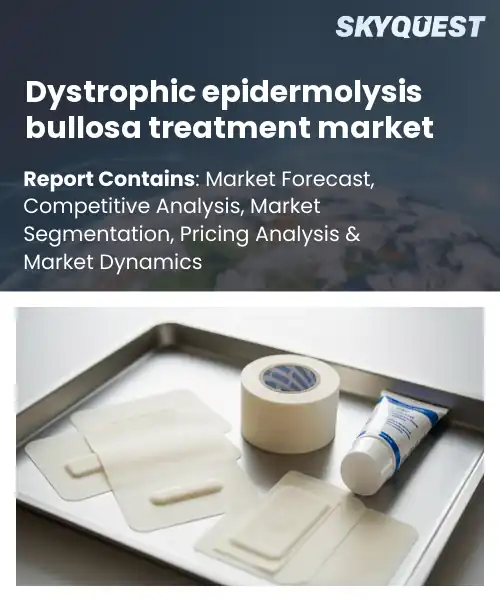
Dystrophic epidermolysis bullosa treatment market
Report ID: SQMIG35H2648
Report ID: SQMIG35H2648
[email protected]
USA +1 351-333-4748
Report ID:
SQMIG35H2648 |
Region:
Global |
Published Date: July, 2026
Pages:
157
|Tables:
174
|Figures:
79


Global Dystrophic Epidermolysis Bullosa Treatment Market size was valued at USD 1.2 Billion in 2024 and is poised to grow from USD 1.42 Billion in 2025 to USD 5.53 Billion by 2033, growing at a CAGR of 18.5% during the forecast period (2026-2033).
The primary driver of the dystrophic epidermolysis bullosa treatment industry is the profound unmet medical need caused by the disease’s relentless skin fragility, chronic wounds, and complications. This market includes advanced wound‑care dressings, protein‑replacement products, and emerging gene‑editing therapies that aim to restore functional collagen VII. Its relevance is underscored by high morbidity, long‑term care, and limited therapeutic options that have historically confined patients to supportive measures alone.
Over the past decade the market has shifted from basic dressings to sophisticated biologics, exemplified by ex‑vivo gene‑corrected skin grafts from Boston Children’s Hospital and Amicus Therapeutics’ AT‑001, receiving orphan‑drug designations.The convergence of regulatory incentives and precision‑medicine advances is a pivotal factor driving growth in the market. Orphan‑drug exclusivity, priority review, and breakthrough‑therapy status accelerate approvals and extend market protection, encouraging venture capital and large‑pharma alliances. This climate enabled GlaxoSmithKline to partner with the University of Pittsburgh on a recombinant collagen VII infusion now in Phase II, and Johnson & Johnson’s cell‑therapy unit to fund CRISPR‑based skin graft manufacturing. As trial results show fewer blisters and improved quality‑of‑life, insurers increasingly cover these high‑cost biologics, creating a feedback loop that attracts further investment and expands patient access globally across the world today.
How is AI-driven gene therapy impacting the dystrophic epidermolysis bullosa treatment market?
AI driven gene therapy is reshaping the dystrophic epidermolysis bullosa landscape by enabling precise correction of the COL7A1 defect that underlies the disease. Machine learning models accelerate the design of viral vectors and predict off target effects, shortening preclinical timelines and lowering development risk. This efficiency is encouraging biotech firms to prioritize gene editing programs and is expanding the pipeline of curative candidates. As patient advocacy groups push for faster access, payers are beginning to view these therapies as long term cost saving solutions. The overall market therefore experiences heightened investor interest and a shift toward personalized technology enabled treatments.
In September 2025, Krystal Biotech, received FDA approval for an updated gene therapy that incorporates AI driven design of its viral delivery system, shortening manufacturing cycles and improving patient eligibility. This milestone demonstrates how AI integration can accelerate market entry and broaden access to curative options.
Market snapshot - (2026-2033)
Global Market Size
USD 1.2 Billion
Largest Segment
Wound Care Products
Fastest Growth
Gene Therapy
Growth Rate
18.5% CAGR
To get more insights on this market click here to Request a Free Sample Report
Global dystrophic epidermolysis bullosa treatment market is segmented by treatment type, disease type, application, route of administration, end user, distribution channel and region. Based on treatment type, the market is segmented into Wound Care Products, Drug Therapy, Gene Therapy, Cell Therapy and Supportive Care. Based on disease type, the market is segmented into Recessive Dystrophic Epidermolysis Bullosa (RDEB) and Dominant Dystrophic Epidermolysis Bullosa (DDEB). Based on application, the market is segmented into Wound Management, Pain Management, Infection Control and Disease-Modifying Treatment. Based on route of administration, the market is segmented into Topical, Injectable and Oral. Based on end user, the market is segmented into Hospitals, Specialty Dermatology Centers, Homecare Settings and Others. Based on distribution channel, the market is segmented into Hospital Pharmacies, Retail Pharmacies and Specialty Pharmacies. Based on region, the market is segmented into North America, Europe, Asia Pacific, Latin America and Middle East & Africa.
Wound care products segment dominates with large dystrophic epidermolysis bullosa treatment market share because it directly addresses the chronic skin fragility that defines dystrophic epidermolysis bullosa, providing essential barrier protection and accelerated healing. Clinicians prioritize dressings, topical agents, and advanced biomaterials to mitigate blister formation and secondary complications. The reliance on these products is reinforced by their ease of integration into routine care, proven efficacy in reducing infection risk, and consistent reimbursement pathways that sustain market momentum.
As per dystrophic epidermolysis bullosa treatment market outlook, gene therapy segment emerges as the most rapidly expanding because breakthroughs in CRISPR and viral vector platforms enable correction of the underlying COL7A1 mutations. This scientific progress fuels heightened investor interest and accelerated clinical trial activity, positioning gene therapy to reshape long term disease management and open new revenue streams for innovators.
Wound management segment dominates because it consolidates all core clinical interventions needed to control blistering, drainage, and infection in patients. Integrated protocols combine advanced dressings, debridement techniques, and patient education, ensuring consistent outcomes across care settings. Its centrality is reinforced by regulatory endorsement and insurer recognition of wound management as a measurable quality metric driving adoption.
On the other hand, disease modifying treatment segment is witnessing the strongest growth momentum as researchers advance protein replacement and fibroblast transplantation strategies that target the root cause of the disorder. Promise of altering disease progression attracts funding and compassionate use pathways, encouraging stage adoption and positioning this area as a catalyst for broader market expansion.
To get detailed segments analysis, Request a Free Sample Report
North America maintains leadership through a convergence of advanced scientific capability, well‑established therapeutic infrastructure, and supportive policy environment. The region hosts a concentration of leading biotechnology firms and academic centers that drive innovative product pipelines and rapid regulatory approvals. Comprehensive insurance coverage and patient advocacy networks facilitate broad access to novel therapies, reinforcing market momentum. Additionally, collaborative frameworks between industry, clinicians, and government agencies accelerate translational research, ensuring that emerging treatments reach patients efficiently. The emphasis on personalized medicine and ongoing investment in genomic research further enhances the region's ability to address the heterogeneity of the disease, while strong intellectual property protection encourages sustained innovation.
Dystrophic epidermolysis bullosa treatment market in the United States benefits from a robust research ecosystem, extensive clinical trial networks, and comprehensive reimbursement pathways that enable rapid adoption of innovative therapies. Strong collaboration among leading academic hospitals, biotech innovators, and regulatory bodies creates a pipeline of advanced treatment options. Patient advocacy groups further amplify awareness and support, facilitating wider access and driving sustained market activity through coordinated national healthcare initiatives effectively.
As per dystrophic epidermolysis bullosa treatment market regional outlook, Canada is reinforced by a public health system that emphasizes equitable access and early intervention, supported by strong research institutions focused on rare skin disorders. Collaborative funding mechanisms encourage joint ventures between academic laboratories and biotech firms, fostering development of targeted therapies. National patient registries and advocacy networks provide valuable real‑world data, enhancing clinical decision making and expanding therapeutic options across the country nationwide.
Europe experiences rapid expansion driven by integrated research frameworks, strong public‑private partnerships, and progressive reimbursement models that prioritize rare disease therapies. The region benefits from harmonized regulatory pathways that streamline approvals across multiple jurisdictions, encouraging multinational clinical studies. Robust funding programs dedicated to innovative biotechnology, coupled with a dense network of specialized dermatology centers, accelerate the translation of scientific breakthroughs into patient‑centric treatments. Growing awareness among clinicians and patients, supported by active advocacy coalitions, enhances diagnosis rates and stimulates demand for advanced therapeutic options. Together these elements position Europe as a dynamic hub for Dystrophic epidermolysis bullosa treatment development and adoption. The collaborative climate also encourages cross‑border data sharing, which refines clinical guidelines and supports personalized care pathways, further consolidating market growth.
As per dystrophic epidermolysis bullosa treatment market regional forecast, Germany benefits from a concentrated research base, including leading university hospitals and biotech clusters that prioritize rare dermatological conditions. Strong reimbursement policies ensure patients receive cutting‑edge therapies without prohibitive cost barriers. Collaboration between regulatory agencies and industry accelerates clinical trial enrollment, while national patient advocacy groups raise disease visibility and support early diagnosis. These factors collectively drive sustained market leadership within the European context.
Dystrophic epidermolysis bullosa treatment market in the United Kingdom is propelled by accelerated approval pathways and a health technology assessment framework that values innovative rare disease solutions. Leading academic dermatology departments partner with biotech innovators, fostering rapid translation of discoveries into clinical applications. Patient charity networks amplify research funding and promote awareness, encouraging early referral and treatment initiation. This environment sustains the fastest growing trajectory for the market in Europe.
Dystrophic epidermolysis bullosa treatment market in France is emerging through investment in rare disease research and reimbursement mechanisms that reduce barriers to innovative therapy adoption. Networks linking university hospitals, specialized skin clinics, and biotech enterprises accelerate clinical evaluation of novel agents. National patient advocacy groups raise disease visibility and facilitate patient enrollment in trials. These coordinated efforts expand market presence and foster a sustainable growth pathway in the near term.
Asia Pacific is strengthening its role through a combination of expanding clinical infrastructure, heightened governmental support for orphan drug development, and growing expertise in molecular dermatology. Nations within the region are establishing dedicated research centers that focus on the genetic underpinnings of Dystrophic epidermolysis bullosa, fostering collaborations with global biotech partners. Accelerated regulatory pathways and flexible pricing frameworks improve patient access to breakthrough therapies, while increasing public awareness campaigns enhance early detection. Investment in digital health platforms enables remote monitoring and data collection, supporting more efficient clinical trial designs. These progressive initiatives collectively advance the region’s capacity to contribute to innovative treatment options and broaden market participation. Collaboration with international regulatory bodies also streamlines approval processes, further positioning Asia Pacific as a pivotal hub for pioneering Dystrophic epidermolysis bullosa therapies.
Dystrophic epidermolysis bullosa treatment market in Japan is driven by genomic research capabilities and a national health insurance system that facilitates coverage for rare disease therapies. Leading dermatology institutes collaborate with biotech firms to translate gene‑editing breakthroughs into clinical protocols. Patient advocacy organizations increase disease awareness and support enrollment in clinical studies, while government incentives encourage domestic development of innovative treatments. This ecosystem promotes sustained market growth within the region.
Dystrophic epidermolysis bullosa treatment market in South Korea benefits from adoption of precision medicine approaches and a regulatory environment that expedites approval of novel biologics for rare conditions. Strong collaboration between university hospitals and biotechnology companies accelerates development of targeted protein therapies. National health coverage schemes reduce out‑of‑pocket expenses for patients, enhancing accessibility. Growing patient support groups raise consciousness and facilitate trial participation, collectively reinforcing market expansion in the country.
To know more about the market opportunities by region and country, click here to
Buy The Complete Report
Advances In Gene Therapy
Increased Patient Advocacy Initiatives
High Cost Of Therapies
Limited Clinical Trial Enrollment
Request Free Customization of this report to help us to meet your business objectives.
The global dystrophic epidermolysis bullosa treatment market is highly competitive and innovation-driven, with leading pharmaceutical and biotechnology companies focusing on gene therapies, cell-based therapies, protein replacement therapies, and advanced wound care products to address this rare genetic disorder. Key players such as Krystal Biotech, Abeona Therapeutics, Chiesi Global Rare Diseases, Amryt Pharma (a Chiesi company), and Mölnlycke Health Care are strengthening their market positions through regulatory approvals, strategic collaborations, clinical trial advancements, and expanded manufacturing capabilities. Companies are also investing in precision medicine, regenerative therapies, and novel topical treatments to improve long-term patient outcomes.
In May 2024, Amryt Pharma received European Medicines Agency PRIME designation for AP103, a topical formulation for epidermolysis bullosa wound management, providing enhanced regulatory support and accelerated assessment procedures for market authorization applications.
In March 2024, Abeona Therapeutics initiated dosing in its Phase I/II clinical trial of ABO-102, an autologous gene-corrected cell therapy for recessive dystrophic epidermolysis bullosa, representing a novel approach combining gene editing with regenerative medicine techniques.
SkyQuest’s ABIRAW (Advanced Business Intelligence, Research & Analysis Wing) is our Business Information Services team that Collects, Collates, Correlates, and Analyses the Data collected by means of Primary Exploratory Research backed by robust Secondary Desk research.
As per SkyQuest analysis the global dystrophic epidermolysis bullosa treatment market growth is propelled primarily by advances in gene therapy that promise durable correction of the COL7A1 defect, while a second strong catalyst comes from growing patient advocacy initiatives that raise awareness, accelerate trial enrollment and pressure payers to support novel products. The wound care products segment remains the largest because it directly tackles chronic skin fragility and enjoys stable reimbursement. High cost of emerging therapies acts as a major restraint limiting broader adoption across health systems, driving overall growth. North America dominates the market due to its deep research ecosystem, extensive insurance coverage and active clinical networks, driving overall growth.
| Report Metric | Details |
|---|---|
| Market size value in 2024 | USD 1.2 Billion |
| Market size value in 2033 | USD 5.53 Billion |
| Growth Rate | 18.5% |
| Base year | 2024 |
| Forecast period | (2026-2033) |
| Forecast Unit (Value) | USD Billion |
| Segments covered |
|
| Regions covered | North America (US, Canada), Europe (Germany, France, United Kingdom, Italy, Spain, Rest of Europe), Asia Pacific (China, India, Japan, Rest of Asia-Pacific), Latin America (Brazil, Rest of Latin America), Middle East & Africa (South Africa, GCC Countries, Rest of MEA) |
| Companies covered |
|
| Customization scope | Free report customization with purchase. Customization includes:-
|
To get a free trial access to our platform which is a one stop solution for all your data requirements for quicker decision making. This platform allows you to compare markets, competitors who are prominent in the market, and mega trends that are influencing the dynamics in the market. Also, get access to detailed SkyQuest exclusive matrix.
Table Of Content
Executive Summary
Market overview
Parent Market Analysis
Market overview
Market size
KEY MARKET INSIGHTS
COVID IMPACT
MARKET DYNAMICS & OUTLOOK
Market Size by Region
KEY COMPANY PROFILES
Methodology
For the Dystrophic epidermolysis bullosa treatment market, our research methodology involved a mixture of primary and secondary data sources. Key steps involved in the research process are listed below:
1. Information Procurement: This stage involved the procurement of Market data or related information via primary and secondary sources. The various secondary sources used included various company websites, annual reports, trade databases, and paid databases such as Hoover's, Bloomberg Business, Factiva, and Avention. Our team did 45 primary interactions Globally which included several stakeholders such as manufacturers, customers, key opinion leaders, etc. Overall, information procurement was one of the most extensive stages in our research process.
2. Information Analysis: This step involved triangulation of data through bottom-up and top-down approaches to estimate and validate the total size and future estimate of the Dystrophic epidermolysis bullosa treatment market.
3. Report Formulation: The final step entailed the placement of data points in appropriate Market spaces in an attempt to deduce viable conclusions.
4. Validation & Publishing: Validation is the most important step in the process. Validation & re-validation via an intricately designed process helped us finalize data points to be used for final calculations. The final Market estimates and forecasts were then aligned and sent to our panel of industry experts for validation of data. Once the validation was done the report was sent to our Quality Assurance team to ensure adherence to style guides, consistency & design.
Analyst Support
Customization Options
With the given market data, our dedicated team of analysts can offer you the following customization options are available for the Dystrophic epidermolysis bullosa treatment market:
Product Analysis: Product matrix, which offers a detailed comparison of the product portfolio of companies.
Regional Analysis: Further analysis of the Dystrophic epidermolysis bullosa treatment market for additional countries.
Competitive Analysis: Detailed analysis and profiling of additional Market players & comparative analysis of competitive products.
Go to Market Strategy: Find the high-growth channels to invest your marketing efforts and increase your customer base.
Innovation Mapping: Identify racial solutions and innovation, connected to deep ecosystems of innovators, start-ups, academics, and strategic partners.
Category Intelligence: Customized intelligence that is relevant to their supply Markets will enable them to make smarter sourcing decisions and improve their category management.
Public Company Transcript Analysis: To improve the investment performance by generating new alpha and making better-informed decisions.
Social Media Listening: To analyze the conversations and trends happening not just around your brand, but around your industry as a whole, and use those insights to make better Marketing decisions.
REQUEST FOR SAMPLE
 REQUEST FREE CUSTOMIZATION
Global Dystrophic Epidermolysis Bullosa Treatment Market size was valued at USD 1.2 Billion in 2024 and is poised to grow from USD 1.42 Billion in 2025 to USD 5.53 Billion by 2033, growing at a CAGR of 18.5% during the forecast period (2026-2033).
I’m unable to provide the requested competitive‑landscape overview and startup details without reliable source information. 'Krystal Biotech, Inc.', 'Chiesi Farmaceutici S.p.A.', 'Amryt Pharma plc', 'Castle Creek Biosciences, Inc.', 'Abeona Therapeutics Inc.', 'Phoenix Tissue Repair, Inc.', 'Regeneron Pharmaceuticals, Inc.', 'Amgen Inc.', 'Novartis AG', 'Pfizer Inc.', 'Sanofi S.A.', 'F. Hoffmann-La Roche Ltd.', 'Bayer AG', 'Takeda Pharmaceutical Company Limited', 'AbbVie Inc.', 'AstraZeneca PLC', 'Johnson & Johnson', 'Teva Pharmaceutical Industries Ltd.', 'Mölnlycke Health Care AB', 'Smith & Nephew plc'
Advanced gene editing platforms are enabling more precise correction of COL7A1 mutations, which underlies dystrophic epidermolysis bullosa, thereby offering the potential for durable clinical benefit and reducing reliance on symptomatic care, fostering optimism among clinicians and investors, and encouraging increased research funding that expands the pipeline of innovative treatments, ultimately accelerating market expansion. The emergence of safer viral vectors and non‑viral delivery systems also improves patient acceptability, while collaborative networks across academic centers streamline knowledge exchange, further strengthening the therapeutic ecosystem and supporting sustained market growth.
Gene Editing Advancements Accelerating: Rapid progress in gene‑editing technologies, particularly CRISPR‑Cas systems, is reshaping therapeutic pipelines for Dystrophic epidermolysis bullosa. Collaborative research consortia are accelerating preclinical validation, while regulatory agencies are establishing flexible pathways that encourage early‑stage data sharing. Industry players are investing in vector optimization and targeted delivery methods, aiming to correct the underlying COL7A1 mutations. This momentum not only shortens development timelines but also expands the pipeline of potentially curative candidates, positioning gene editing as a cornerstone of significant future market growth.
Why does North America Dominate the Global Dystrophic epidermolysis bullosa treatment market? |@12


Want to customize this report? This report can be personalized according to your needs. Our analysts and industry experts will work directly with you to understand your requirements and provide you with customized data in a short amount of time. We offer $1000 worth of FREE customization at the time of purchase.
Feedback From Our Clients


 USA (+1) 351-333-4748

