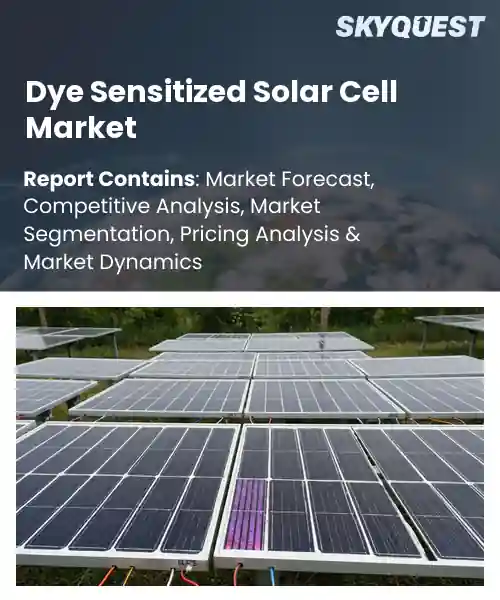
Dye Sensitized Solar Cell Market
Report ID: SQMIG55F2101
Report ID: SQMIG55F2101
[email protected]
USA +1 351-333-4748
Report ID:
SQMIG55F2101 |
Region:
Global |
Published Date: June, 2026
Pages:
157
|Tables:
146
|Figures:
78


Global Dye Sensitized Solar Cell Market size was valued at USD 175.0 Million in 2024 and is poised to grow from USD 197.75 Million in 2025 to USD 525.71 Million by 2033, growing at a CAGR of 13.0% during the forecast period (2026-2033).
The dye-sensitized solar cell market seems to revolve around low-cost modules that take in light and turn it into electricity via dye-coated electrodes, and it matters a lot because this setup makes possible uses that are awkward for silicon panels, like indoor energy harvesting, and also building-integrated photovoltaics.
One of the major factors driving the dye-sensitized solar cell market growth is the strong low light performance. That ends up pulling demand from indoor and IoT use cases, because dye sensitized devices can still provide useful power under diffuse artificial lighting, while silicon usually does worse. So manufacturers who aim at smart shelf sensors and building automation see shorter return times, which makes pilots and early deployments feel more attractive to run, to validate the economics. meanwhile, tweaks in electrolyte chemistry and encapsulation, like better barrier strategies, reduce degradation, which stretches module lifetime and lowers total cost of ownership. As a result, architects start to specify semi-transparent façades and even wearable power concepts. On top of that, scalable printing techniques, plus less dependence on silicon supply chains, open space for commercialization in emerging markets. that’s where investors and policymakers tend to lean in, supporting pathways that are actually practical.
AI optimizes efficiency in the dye-sensitized solar cell industry by speeding up materials discovery and by tightening manufacturing controls, like double checking everything. Machine learning can estimate dye and electrolyte behavior from molecular characteristics, so teams can rank candidates and focus on the better ones without doing endless bench work. at the same time, computational device models help decide layer thickness and interface structure, which cuts down how many experimental runs are needed. In manufacturing, AI systems watch roll to roll coating and use online imaging to spot defects sooner, which improves yield. Predictive analytics also accelerates lifetime testing and helps tailor the cells for indoor and building integrated deployments, where DSSC strengths show up more clearly. Together, these approaches are moving DSSCs toward more dependable commercial use.
Market snapshot - (2026-2033)
Global Market Size
USD 175.0 Million
Largest Segment
Rigid DSSCs
Fastest Growth
Flexible DSSCs
Growth Rate
13.0% CAGR
To get more insights on this market click here to Request a Free Sample Report
The Global Dye-Sensitized Solar Cell Market is segmented based on product type, material type, technology/cell type, application, end-use industry, and region. Based on product type, the market is segmented into rigid DSSCs and flexible DSSCs. Based on material type, the market is segmented into titanium dioxide (TiO₂), zinc oxide (ZnO), tin oxide (SnO₂), and niobium oxide (Nb₂O₅). Based on technology/cell type, the market is segmented into liquid electrolyte DSSCs and solid-state DSSCs. Based on application, the market is segmented into building-integrated photovoltaics (BIPV/BAPV), portable charging devices, embedded electronics, and automotive integration. Based on end-use industry, the market is segmented into Energy & Utilities, Construction, Consumer Electronics, Automotive, and Agriculture. Based on region, the market is segmented into North America, Europe, Asia Pacific, Latin America, and the Middle East & Africa.
As per the dye-sensitized solar cell market analysis, the Rigid DSSCs segment dominated the market because their structural steadiness and module level track record give people more confidence for long term setups. With a rigid form, encapsulation feels more straightforward and it slots into glass and framing systems without much fuss, so the whole integration is smoother. That lines up with known manufacturing routines and also makes quality control a bit easier. As a result, buyers and developers tend to lean toward rigid panels when durability and dependable output matter, and that pushes more investment plus supplier attention toward better efficiency and more standardized production.
On the other hand, Flexible DSSCs are getting the most noticeable growth momentum, largely due to conformability , low mass and their fit for portable or even wearable scenarios. Recent advances in flexible substrates and printable fabrication (like roll-friendly processing) allow dye sensitized layers to be incorporated into textiles and curved surfaces. This opens up more consumer oriented uses and also smaller niche markets, and it nudges companies to invest in scalable roll to roll manufacturing so they can catch the rising application demand earlier.
According to the dye-sensitized solar cell market forecast, the Titanium Dioxide (TiO₂) segment leads because of its handy electronic characteristics, chemical robustness, and the fact that nanoparticle-based formulations are already well developed. There are established synthesis routes and material handling practices that generally produce high surface area films, so dye loading improves, and electron movement stays efficient. That also helps curb recombination, which is a big deal for overall performance. Plus, there’s industry familiarity, supply chain readiness, and compatibility with common electrolytes, so it keeps getting picked for commercial devices and then fine tuned over time.
However, the Zinc Oxide (ZnO) category is predicted to achieve the largest dye-sensitized solar cell market share because its nanostructures can be tuned and it often shows higher electron mobility, which supports stronger charge transport. Also , its compatibility with low-temperature printable processes helps it get into flexible substrate platforms, so adoption increases in wearables and portable devices. That keeps research energy focused and supports pilot manufacturing, aiming to turn what works in the lab into offerings that are actually ready for the market.
To get detailed segments analysis, Request a Free Sample Report
As per the dye-sensitized solar cell market regional forecast, Asia Pacific dominance shows how manufacturing scale, concentrated research power, and these linked industry “ecosystems” all meet at once. In the region, material suppliers, device manufacturers, and consumer electronics integrators sit close together, so the end to end value chains feel more efficient, less friction, and more like a smooth circuit. Supportive industrial policies and demo initiatives also act a bit like lowering the entry ramps, so early adoption feels less scary and the practical use cases get shown in real settings. Cost competitive production and resilient local supply chains pull in longer term funding, and they also make it easier to iterate from prototype to production without waiting forever. Add in the tight back and forth between universities and corporations, and offer material improvements plus device optimization moving faster than usual. And because many plants are export oriented, global distribution gets easier, which then helps diffusion. Taken together, it makes the region a primary hub for technological advancement and commercial development in this space.
Japan Dye Sensitized Solar Cell Market
The Dye Sensitized Solar Cell sector in Japan benefits from concentrated research institutes, advanced manufacturing capabilities, and collaboration between industry and academia, like a steady loop of idea to fabrication to refinement. The emphasis on material innovation and device integration supports niche applications in portable electronics and building-integrated solutions, not just one broad use case. Local supply chain sophistication plus a skilled workforce enables rapid prototyping, plus quality control that stays consistent. Private sector investment and pilot deployments reinforce market readiness and create pathways for wider adoption across different end use segments.
South Korea Dye Sensitized Solar Cell Market
In South Korea, the Dye Sensitized Solar Cell Market leverages strengths in advanced materials research, manufacturing scale, and strong linkages with consumer electronics clusters. Integration know how and a focus on high quality help develop flexible modules and special installations that fit real product constraints. Public and private collaboration accelerates commercialization through programs and supply chain coordination, sometimes faster than expected. Active industrial partners back scale up and cross sector integration, so the market can serve domestic demand and also reach international diffusion pathways.
The European dye-sensitized solar cell market penetration is driven by cohesive policy frameworks that basically prioritize sustainability, along with a renovation market that is hungry for energy efficient solutions. There is also strong research collaboration across borders, which helps technology move and adapt. People want aesthetic integration and adaptive building technologies, so that creates demand for dyes sensitized formats that blend design with performance. Industrial clusters and specialty manufacturers support higher quality production and customization, especially for local building codes and architectural preferences. Funding mechanisms and demonstration programs reduce commercialization friction and attract private investment. Cross country networks help with knowledge sharing, plus standardization efforts, and then the active engagement from utilities, construction firms, and technology incubators speeds up deployment. All of that together makes a fertile setup for fast market growth and a wider range of application segments.
Germany Dye Sensitized Solar Cell Market
The Dye Sensitized Solar Cell Market in Germany benefits from established renewable energy frameworks, strong engineering capabilities, and a mature supply chain. The emphasis on integration with building technologies and energy efficiency pushes demand for innovative cell formats. Research institutions and partners collaborate to refine materials and processes, aiming for reliable performance over time. A manufacturing base and high quality standards support pilot production and commercial validation, which encourages adoption among retrofit projects and new construction stakeholders.
United Kingdom Dye Sensitized Solar Cell Market
The Dye Sensitized Solar Cell Market in United Kingdom is propelled by innovation ecosystems, plus targeted support for clean technology deployment. Incubators and research centers speed the translation of lab progress into prototypes, and they keep momentum. Market momentum also benefits from initiatives that prioritize building integrated photovoltaics and portable energy solutions, which boosts demand for adaptive cell formats. Collaboration between utilities, start ups, and construction firms enables demonstration projects that validate performance and makes broader adoption more likely in different applications.
France Dye Sensitized Solar Cell Market
The Dye Sensitized Solar Cell Market in France is emerging through focused research and design applications that stress aesthetics and integration. Architectural firms and specialty manufacturers show interest, which supports adoption in façade and retrofit projects where appearance and light transmission matter, at least a lot. Public research labs and private innovators collaborate to adapt materials for local climatic conditions and regulatory needs. Early pilots and partnerships are building experience, while also demonstrating the pathways to a stronger market presence.
North America is pulling stronger into the picture by funneling concentrated research funding , plus using diversified application plans, and also pushing more commercialization work out the door. In practice, academic hubs and private innovators often team up to carry material science breakthroughs into device blueprints that can actually scale for portable power, building integration, and off grid use. Venture money and corporate funding back pilot manufacturing, along with demonstration efforts, to prove output metrics and also check supply chain readiness. There’s also a clear emphasis on standards work and interoperability with existing energy infrastructure, which helps everything slot into wider energy portfolios. Strategic partnerships between tech firms, utilities , and construction stakeholders speed up field deployments, while manufacturing initiatives try to lock in localized production capability. Taken together, these moves help shape a more resilient and more inventive market stance for dye sensitized technologies across the region.
United States Dye Sensitized Solar Cell Market
The United States ' dye-sensitized solar cell market moves forward because of strong research institutions, lots of entrepreneurial energy, and active commercialization pathways. University-led research, combined with private sector development, builds a steady pipeline of materials and device innovations. Corporate and venture investment allows pilot production and demonstration, especially across building-integrated setups and portable applications. Working with utilities and construction firms supports practical validation, then helps with real market entry. The focus on smart energy system integration, as well as niche commercial uses, keeps widening routes toward broader deployment.
Canada Dye Sensitized Solar Cell Market
In Canada, the dye-sensitized solar cell market is advancing through targeted research initiatives, a noticeable emphasis on sustainable building solutions, and ongoing collaboration with industrial partners. Interest in off-grid and remote applications fits well with regional needs for flexible energy technologies. Public research laboratories collaborate with niche manufacturers to tune materials for local environmental conditions, and pilot projects then show feasibility in retrofit work and specialty installations. Partnerships with indigenous communities and regional stakeholders also matter, because they support more inclusive deployment approaches and help build local capacity for broader market engagement, even when scale is still being negotiated.
To know more about the market opportunities by region and country, click here to
Buy The Complete Report
Improved Material Stability And Efficiency
Low Cost And Versatile Integration
Limited Commercial Scale Manufacturing
Environmental And Stability Concerns
Request Free Customization of this report to help us to meet your business objectives.
The current setup for the Dye-sensitized Solar Cells market (DSSC) is, moderately fractured,in a way that a mix of new pioneers, smaller specialist shops and some bigger tech groups all sit side by side. This is different from the classic photovoltaic arenas where huge manufacturing giants usually call the shots. In DSSC, many companies tend to focus on particular areas, like building-integrated photovoltaics (BIPV), compact portable electronics, or even decorative lighting. Due to that split, competition feels more like a contest for novelty and strategic alliances, rather than just raw production. Over time, as the sector keeps moving from pilot to real commercialization, there’s also been a slow trend toward consolidation, where larger players buy, or at least team up with smaller inventors, so they can speed up technical progress and widen their production ability.
Top Player’s Company Profile
Recent Developments in the Dye Sensitized Solar Cell Market
SkyQuest’s ABIRAW (Advanced Business Intelligence, Research & Analysis Wing) is our Business Information Services team that Collects, Collates, Correlates, and Analyses the Data collected by means of Primary Exploratory Research backed by robust Secondary Desk research.
As per SkyQuest analysis, improved material stability and efficiency is a key driver, it boosts trust in dye sensitized solar cell lifetimes and supports wider take up across building integrated and portable applications. Another driver is low cost and versatile integration, plus decent performance under low light, which pulls in indoor and IoT related markets. But limited commercial scale manufacturing is still a major restraint. It causes variability, slows down standardization, and delays cost reductions, sometimes for a long time. Asia Pacific still leads the market, mainly due to manufacturing scale, concentrated research, and a relatively cohesive industry ecosystem. Meanwhile the rigid DSSCs segment stays dominant because structural stability is easier to manage, and encapsulation is comparatively simpler, though flexible formats continue to accelerate niche growth and commercialization pathways.
| Report Metric | Details |
|---|---|
| Market size value in 2024 | USD 175.0 Million |
| Market size value in 2033 | USD 525.71 Million |
| Growth Rate | 13.0% |
| Base year | 2024 |
| Forecast period | (2026-2033) |
| Forecast Unit (Value) | USD Million |
| Segments covered |
|
| Regions covered | North America (US, Canada), Europe (Germany, France, United Kingdom, Italy, Spain, Rest of Europe), Asia Pacific (China, India, Japan, Rest of Asia-Pacific), Latin America (Brazil, Rest of Latin America), Middle East & Africa (South Africa, GCC Countries, Rest of MEA) |
| Companies covered |
|
| Customization scope | Free report customization with purchase. Customization includes:-
|
To get a free trial access to our platform which is a one stop solution for all your data requirements for quicker decision making. This platform allows you to compare markets, competitors who are prominent in the market, and mega trends that are influencing the dynamics in the market. Also, get access to detailed SkyQuest exclusive matrix.
Table Of Content
Executive Summary
Market overview
Parent Market Analysis
Market overview
Market size
KEY MARKET INSIGHTS
COVID IMPACT
MARKET DYNAMICS & OUTLOOK
Market Size by Region
KEY COMPANY PROFILES
Methodology
For the Dye Sensitized Solar Cell Market, our research methodology involved a mixture of primary and secondary data sources. Key steps involved in the research process are listed below:
1. Information Procurement: This stage involved the procurement of Market data or related information via primary and secondary sources. The various secondary sources used included various company websites, annual reports, trade databases, and paid databases such as Hoover's, Bloomberg Business, Factiva, and Avention. Our team did 45 primary interactions Globally which included several stakeholders such as manufacturers, customers, key opinion leaders, etc. Overall, information procurement was one of the most extensive stages in our research process.
2. Information Analysis: This step involved triangulation of data through bottom-up and top-down approaches to estimate and validate the total size and future estimate of the Dye Sensitized Solar Cell Market.
3. Report Formulation: The final step entailed the placement of data points in appropriate Market spaces in an attempt to deduce viable conclusions.
4. Validation & Publishing: Validation is the most important step in the process. Validation & re-validation via an intricately designed process helped us finalize data points to be used for final calculations. The final Market estimates and forecasts were then aligned and sent to our panel of industry experts for validation of data. Once the validation was done the report was sent to our Quality Assurance team to ensure adherence to style guides, consistency & design.
Analyst Support
Customization Options
With the given market data, our dedicated team of analysts can offer you the following customization options are available for the Dye Sensitized Solar Cell Market:
Product Analysis: Product matrix, which offers a detailed comparison of the product portfolio of companies.
Regional Analysis: Further analysis of the Dye Sensitized Solar Cell Market for additional countries.
Competitive Analysis: Detailed analysis and profiling of additional Market players & comparative analysis of competitive products.
Go to Market Strategy: Find the high-growth channels to invest your marketing efforts and increase your customer base.
Innovation Mapping: Identify racial solutions and innovation, connected to deep ecosystems of innovators, start-ups, academics, and strategic partners.
Category Intelligence: Customized intelligence that is relevant to their supply Markets will enable them to make smarter sourcing decisions and improve their category management.
Public Company Transcript Analysis: To improve the investment performance by generating new alpha and making better-informed decisions.
Social Media Listening: To analyze the conversations and trends happening not just around your brand, but around your industry as a whole, and use those insights to make better Marketing decisions.
REQUEST FOR SAMPLE
 REQUEST FREE CUSTOMIZATION
Global Dye Sensitized Solar Cell Market size was valued at USD 175.0 Million in 2024 and is poised to grow from USD 197.75 Million in 2025 to USD 525.71 Million by 2033, growing at a CAGR of 13.0% during the forecast period (2026-2033).
I cannot find two verified, dye sensitized solar cell startups that were founded in 2019 or later. Do you want me to instead include established commercial players founded earlier, research consortia and spinouts active since 2019, or related transparent and indoor PV startups founded 2019 or later? Reply with established players, research consortia, or related startups. 'Exeger Sweden AB', 'G24 Power Ltd.', 'Solaronix SA', 'Dyenamo AB', 'Peccell Technologies Inc.', 'Fujikura Ltd.', 'Sharp Corporation', 'Ricoh Company Ltd.', 'Everlight Chemical Industrial Co.', 'Merck KGaA', 'Sony Corporation', 'Toshiba Corporation', 'Fujifilm Holdings Corporation', 'Nissha Co., Ltd.', 'Oxford Photovoltaics', '3GSolar Photovoltaics Ltd.', 'CSIRO', 'Solaris Nanosciences', 'National Institute for Materials Science (NIMS)', 'Dyesol (Greatcell Energy)'
Enhanced dye and semiconductor formulations have increased operational stability and photon to electron conversion efficiency, which encourages broader adoption in varied applications. This improvement reduces device degradation concerns and extends functional lifetime perceptions among manufacturers and end users, making DSSCs more attractive relative to alternative photovoltaic technologies. As confidence in material performance grows, investment in scale up and integration into building materials and portable electronics becomes more justifiable, supporting market expansion by lowering perceived technical risk and enabling clearer pathways from laboratory innovation to commercial deployment.
Architectural Integration For Buildings: Dye sensitized solar cells' thin, semi-transparent and color-tunable formats enable seamless integration into façades, windows and shading elements, offering architects aesthetic and functional freedom. Their lightweight construction and compatibility with flexible substrates facilitate retrofitting and new construction without major structural changes. This trend is fostering collaborations between photovoltaic suppliers, glazing manufacturers and real estate developers to create value-added building envelopes, unlock energy-as-a-service contracts and differentiate properties on sustainability and design, expanding commercial adoption in urban development projects and regulatory alignment.
Why does Asia Pacific Dominate the Global Dye Sensitized Solar Cell Market? |@12


Want to customize this report? This report can be personalized according to your needs. Our analysts and industry experts will work directly with you to understand your requirements and provide you with customized data in a short amount of time. We offer $1000 worth of FREE customization at the time of purchase.
Feedback From Our Clients


 USA (+1) 351-333-4748

