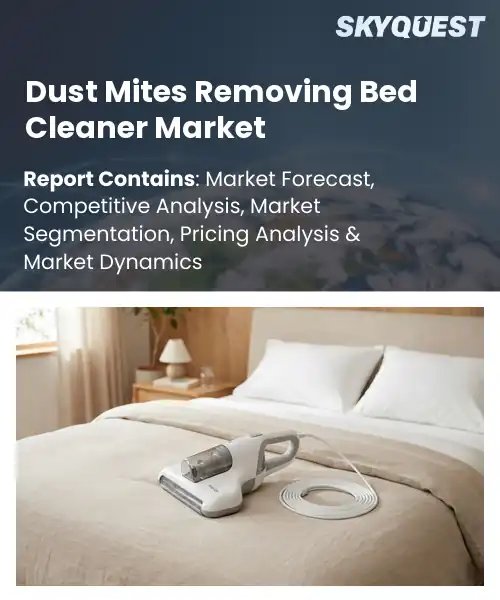
Dust Mites Removing Bed Cleaner Market
Report ID: SQMIG25H2207
Report ID: SQMIG25H2207
[email protected]
USA +1 351-333-4748
Report ID:
SQMIG25H2207 |
Region:
Global |
Published Date: August, 2026
Pages:
157
|Tables:
115
|Figures:
77


Global Dust Mites Removing Bed Cleaner Market size was valued at USD 2.18 Billion in 2024 and is poised to grow from USD 2.33 Billion in 2025 to USD 3.95 Billion by 2033, growing at a CAGR of 6.8% during the forecast period (2026-2033).
The primary driver of dust‑mites removing bed cleaner market is awareness of indoor allergen exposure and its consequences. As allergy prevalence and asthma rates climb in regions, shoppers increasingly view bedding hygiene as a measure rather than a cosmetic task. Historically market was limited to detergents, but 2010s saw introduction of enzyme‑based sprays and steam systems marketed for mite eradication. Brands such as AllerEase and MattressPro leveraged studies to demonstrate reductions in allergen counts, prompting retailers to allocate shelf space and e‑commerce platforms to mite‑control lines. This evolution reflects a shift from routine cleaning to maintenance of healthy sleeping environments.
Building on the heightened focus on sleeping environments, the next key factor propelling market expansion is the integration of smart‑home technology that enables monitoring and targeted treatment of dust‑mite infestations. Sensors embedded in mattresses can quantify humidity and particle counts, triggering automatic activation of UV‑LED or ultrasonic cleaners that neutralize mites without chemical residues. This capability appeals to tech‑savvy homeowners and healthcare facilities seeking hygiene protocols, fostering partnerships between appliance manufacturers and biotech firms. Consequently, distribution channels broaden to include subscription services for filter replacement and software updates, creating recurring revenue streams and accelerating adoption across residential and hospitality sectors.
How is AI-driven automation influencing the dust mite removal bed cleaner market?
AI‑driven automation is reshaping how dust mite removal bed cleaners operate by embedding sensors, machine‑learning algorithms, and autonomous navigation into traditionally manual devices. These smart cleaners can detect mite‑infested zones, adjust suction power, and schedule cleaning cycles without user input. The integration of AI also enables real‑time data analytics, allowing manufacturers to refine product performance and offer predictive maintenance alerts. Consumers benefit from faster, more thorough cleaning while reducing exposure to allergens. As households seek healthier sleep environments, the convergence of AI with vacuum technology is becoming a key differentiator that fuels product innovation and market expansion.
OpenPR April 2026, introduced an AI‑enabled anti‑mite bed cleaner that automatically maps mattress surfaces and optimizes cleaning pathways, showcasing how automation boosts efficiency and supports market growth.
Market snapshot - (2026-2033)
Global Market Size
USD 2.18 Billion
Largest Segment
Vacuum-Based Bed Cleaners
Fastest Growth
Hybrid Bed Cleaners
Growth Rate
6.8% CAGR
To get more insights on this market click here to Request a Free Sample Report
Global dust mites removing bed cleaner market is segmented by product type, power source, distribution channel, end user and region. Based on product type, the market is segmented into Vacuum-Based Bed Cleaners, UV Bed Cleaners, Steam Bed Cleaners and Hybrid Bed Cleaners. Based on power source, the market is segmented into Corded and Cordless. Based on distribution channel, the market is segmented into Online Retail and Offline Retail. Based on end user, the market is segmented into Residential and Commercial. Based on region, the market is segmented into North America, Europe, Asia Pacific, Latin America and Middle East & Africa.
UV Bed Cleaners segment dominates because its ability to eradicate dust mites through germicidal radiation aligns with heightened consumer hygiene expectations. The non chemical approach appeals to allergy sensitive users, eliminating the need for detergents that can damage fabrics. Integrated safety sensors and automatic cycle controls further enhance user confidence, driving preference for UV solutions over mechanical alternatives. Consequently, manufacturers prioritize UV technology, reinforcing its leadership in the dust mites removing bed cleaner market.
However, Steam Bed Cleaners segment is witnessing the strongest growth momentum as consumers seek rapid thermal eradication without chemical residues. Advances in low temperature steam technology enable safe use on mattresses and pillows, widening adoption in allergy prone households. This innovation fuels expanding demand, positioning steam solutions as a catalyst for future market expansion.
Cordless segment leads because it offers unparalleled mobility, allowing users to clean beds without being tethered to an outlet. This freedom aligns with contemporary lifestyles that value convenience and quick, on demand hygiene routines. Battery advancements now deliver sufficient runtime for complete mattress cycles, while ergonomic designs reduce fatigue. Such user centric benefits encourage preference for cordless cleaners, cementing their preeminence in the dust mites removing bed cleaner market.
Meanwhile, Corded segment emerges as a high growth area because uninterrupted power enables stronger suction for deep mite removal. Continuous energy removes battery life concerns, attracting commercial operators and heavy use households. This reliability drives broader adoption, accelerating market expansion and opening opportunities for firms emphasizing durable corded designs.
To get detailed segments analysis, Request a Free Sample Report
North America leads the global Dust Mites Removing Bed Cleaner market because of a mature consumer base that places high value on household hygiene and health. Retail networks are highly developed, offering extensive shelf presence and rapid product turnover. Innovation ecosystems foster continuous formulation improvements and eco‑friendly packaging, resonating with environmentally conscious buyers. Regulatory frameworks encourage transparent labeling and safety standards, building trust among end users. Strong purchasing power enables adoption of premium cleaning solutions, while digital commerce channels amplify reach and convenience. Collaborative partnerships between manufacturers and professional cleaning services further reinforce market depth, ensuring that North American consumers have consistent access to advanced dust mite mitigation products. The region also benefits from robust research institutions that continuously evaluate allergen control efficacy, driving consumer confidence. Additionally, widespread awareness campaigns by health organizations reinforce the importance of regular mattress sanitation, further stimulating demand for specialized cleaners.
Dust Mites Removing Bed Cleaner Market in United States benefits from a highly educated consumer base that actively seeks out allergen‑free living environments. Retail chains and online platforms provide extensive product visibility, while strong brand loyalty encourages repeat purchases. Health advocacy groups regularly highlight the risks of dust mite exposure, prompting households to adopt preventive cleaning routines. Manufacturers respond with innovative formulations that address specific regional preferences, reinforcing market resilience.
Dust Mites Removing Bed Cleaner Market in Canada is shaped by a strong emphasis on indoor health standards and a proactive regulatory environment. Consumers value natural and hypoallergenic solutions, driving manufacturers to prioritize eco‑friendly ingredients. Distribution networks span large geographic areas, ensuring product accessibility even in remote communities. Collaborative initiatives between health agencies and retailers raise public awareness, encouraging routine mattress care and sustaining demand for cleaning agents and products.
Europe experiences rapid expansion of the Dust Mites Removing Bed Cleaner market due to heightened consumer awareness of indoor allergen risks and strong regulatory emphasis on indoor air quality. National health agencies actively promote preventive cleaning practices, encouraging households to adopt specialized mattress treatments. Retail environments across the continent combine premium boutique stores with expansive online platforms, providing broad product exposure. Innovation hubs in key economies generate eco‑conscious formulations that align with sustainability goals, resonating with environmentally minded shoppers. Collaborative campaigns between dermatology experts and manufacturers reinforce the health benefits of regular dust mite control, further stimulating demand. The region’s cultural emphasis on well‑being and clean living spaces creates a fertile landscape for continued market growth. Additionally, cross‑border trade agreements facilitate the swift introduction of innovative products, while consumer education programs highlight the link between dust mite control and respiratory comfort, reinforcing purchase decisions.
Dust Mites Removing Bed Cleaner Market in Germany benefits from a robust consumer focus on health and a well‑established network of specialty retailers. Stringent indoor hygiene guidelines encourage households to incorporate regular mattress sanitation into cleaning routines. Manufacturers invest heavily in research collaborations with local universities, delivering high‑efficacy formulations that meet precise regulatory standards. The prevalence of eco‑friendly preferences drives the adoption of biodegradable ingredients, reinforcing market momentum, sustained growth.
Dust Mites Removing Bed Cleaner Market in United Kingdom experiences the fastest growth as consumers increasingly prioritize allergen‑free sleeping environments. Retail channels blend traditional high‑street outlets with dynamic e‑commerce platforms, expanding product reach. Public health campaigns emphasize the connection between dust mite exposure and respiratory discomfort, prompting proactive cleaning habits. Manufacturers respond with product launches that feature natural actives, aligning with the market’s demand for convenience and sustainability in households.
Dust Mites Removing Bed Cleaner Market in France is emerging as consumers become more conscious of indoor allergen impacts on well‑being. Boutique pharmacies and online health stores serve as primary distribution channels, offering curated product selections. Educational initiatives by consumer groups highlight the benefits of regular mattress care, encouraging trial adoption. Local manufacturers focus on gentle, fragrance‑free formulations that align with the French preference for subtlety, fostering gradual market acceptance.
Asia Pacific is strengthening its position in the Dust Mites Removing Bed Cleaner market through a confluence of rising urban living standards and growing awareness of indoor health concerns. Rapidly expanding middle‑class populations place greater emphasis on clean sleeping environments, prompting demand for specialized cleaning solutions. Manufacturers leverage advanced research facilities in the region to develop high‑performance, culturally tailored products that address local climate and bedding habits. Distribution channels blend traditional retail networks with burgeoning e‑commerce platforms, ensuring broad accessibility. Government initiatives promoting hygiene in residential settings further encourage routine mattress care. The synergy of consumer aspiration, technological innovation, and supportive policy frameworks fuels a robust upward trajectory for the market across the region. Additionally, regional trade exhibitions showcase the latest advancements, fostering collaboration between manufacturers and distributors. This collective momentum accelerates product adoption and reinforces the region’s competitive edge in the global landscape.
Dust Mites Removing Bed Cleaner Market in Japan benefits from a culture that values household hygiene and advanced technology adoption. Retail outlets ranging from specialty stores to vending solutions provide diverse purchase options. Consumer education programs emphasize the link between dust mite control and sleep quality, driving regular product use. Local manufacturers focus on engineered formulas that incorporate traditional ingredients, aligning with consumer preferences for efficacy combined with natural heritage.
Dust Mites Removing Bed Cleaner Market in South Korea is propelled by a tech‑savvy population that embraces home solutions for health maintenance. Integrated retail experiences combine physical stores with digital platforms, facilitating seamless product discovery. Public health campaigns stress the importance of dust mite mitigation for respiratory comfort, influencing household cleaning routines. Domestic manufacturers prioritize product development cycles, delivering fragrance‑light formulations that resonate with consumer expectations for efficiency and subtlety.
To know more about the market opportunities by region and country, click here to
Buy The Complete Report
Increasing Consumer Health Awareness
Technological Advancements In Cleaning Formulations
High Cost Of Specialized Products
Limited Consumer Knowledge Of Efficacy
Request Free Customization of this report to help us to meet your business objectives.
The competitive landscape is shaped by established vacuum manufacturers accelerating product lines through acquisitions of UV‑sterilization technology firms and strategic alliances with allergen‑testing labs, driving differentiation in dust‑mite removal performance. Companies are integrating smart sensor analytics and robot navigation to enhance bed‑cleaning efficacy, while expanding distribution via home‑care retail partners to capture rising consumer hygiene demand.
Top Player’s Company Profile
SkyQuest’s ABIRAW (Advanced Business Intelligence, Research & Analysis Wing) is our Business Information Services team that Collects, Collates, Correlates, and Analyses the Data collected by means of Primary Exploratory Research backed by robust Secondary Desk research.
As per SkyQuest analysis, the global dust‑mites removing bed cleaner market is being propelled primarily by rising consumer health awareness, which is prompting households to seek dedicated solutions for indoor allergen control. A second catalyst is the rapid rollout of advanced cleaning technologies such as AI‑driven mapping, UV sterilization and smart‑home integration that boost efficacy and convenience. The market is led by North America, where mature retail networks and strong purchasing power sustain adoption. Within product types, UV bed cleaners dominate because their chemical‑free germicidal approach aligns with hygiene expectations. However, the premium pricing of specialised cleaners acts as a restraint, limiting uptake among cost‑sensitive buyers.
| Report Metric | Details |
|---|---|
| Market size value in 2024 | USD 2.18 Billion |
| Market size value in 2033 | USD 3.95 Billion |
| Growth Rate | 6.8% |
| Base year | 2024 |
| Forecast period | (2026-2033) |
| Forecast Unit (Value) | USD Billion |
| Segments covered |
|
| Regions covered | North America (US, Canada), Europe (Germany, France, United Kingdom, Italy, Spain, Rest of Europe), Asia Pacific (China, India, Japan, Rest of Asia-Pacific), Latin America (Brazil, Rest of Latin America), Middle East & Africa (South Africa, GCC Countries, Rest of MEA) |
| Companies covered |
|
| Customization scope | Free report customization with purchase. Customization includes:-
|
To get a free trial access to our platform which is a one stop solution for all your data requirements for quicker decision making. This platform allows you to compare markets, competitors who are prominent in the market, and mega trends that are influencing the dynamics in the market. Also, get access to detailed SkyQuest exclusive matrix.
Table Of Content
Executive Summary
Market overview
Parent Market Analysis
Market overview
Market size
KEY MARKET INSIGHTS
COVID IMPACT
MARKET DYNAMICS & OUTLOOK
Market Size by Region
KEY COMPANY PROFILES
Methodology
For the Dust Mites Removing Bed Cleaner Market, our research methodology involved a mixture of primary and secondary data sources. Key steps involved in the research process are listed below:
1. Information Procurement: This stage involved the procurement of Market data or related information via primary and secondary sources. The various secondary sources used included various company websites, annual reports, trade databases, and paid databases such as Hoover's, Bloomberg Business, Factiva, and Avention. Our team did 45 primary interactions Globally which included several stakeholders such as manufacturers, customers, key opinion leaders, etc. Overall, information procurement was one of the most extensive stages in our research process.
2. Information Analysis: This step involved triangulation of data through bottom-up and top-down approaches to estimate and validate the total size and future estimate of the Dust Mites Removing Bed Cleaner Market.
3. Report Formulation: The final step entailed the placement of data points in appropriate Market spaces in an attempt to deduce viable conclusions.
4. Validation & Publishing: Validation is the most important step in the process. Validation & re-validation via an intricately designed process helped us finalize data points to be used for final calculations. The final Market estimates and forecasts were then aligned and sent to our panel of industry experts for validation of data. Once the validation was done the report was sent to our Quality Assurance team to ensure adherence to style guides, consistency & design.
Analyst Support
Customization Options
With the given market data, our dedicated team of analysts can offer you the following customization options are available for the Dust Mites Removing Bed Cleaner Market:
Product Analysis: Product matrix, which offers a detailed comparison of the product portfolio of companies.
Regional Analysis: Further analysis of the Dust Mites Removing Bed Cleaner Market for additional countries.
Competitive Analysis: Detailed analysis and profiling of additional Market players & comparative analysis of competitive products.
Go to Market Strategy: Find the high-growth channels to invest your marketing efforts and increase your customer base.
Innovation Mapping: Identify racial solutions and innovation, connected to deep ecosystems of innovators, start-ups, academics, and strategic partners.
Category Intelligence: Customized intelligence that is relevant to their supply Markets will enable them to make smarter sourcing decisions and improve their category management.
Public Company Transcript Analysis: To improve the investment performance by generating new alpha and making better-informed decisions.
Social Media Listening: To analyze the conversations and trends happening not just around your brand, but around your industry as a whole, and use those insights to make better Marketing decisions.
REQUEST FOR SAMPLE
 REQUEST FREE CUSTOMIZATION
Global Dust Mites Removing Bed Cleaner Market size was valued at USD 2.18 Billion in 2024 and is poised to grow from USD 2.33 Billion in 2025 to USD 3.95 Billion by 2033, growing at a CAGR of 6.8% during the forecast period (2026-2033).
The competitive landscape is shaped by established vacuum manufacturers accelerating product lines through acquisitions of UV‑sterilization technology firms and strategic alliances with allergen‑testing labs, driving differentiation in dust‑mite removal performance. Companies are integrating smart sensor analytics and robot navigation to enhance bed‑cleaning efficacy, while expanding distribution via home‑care retail partners to capture rising consumer hygiene demand. 'Dyson Limited', 'Koninklijke Philips N.V.', 'Panasonic Holdings Corporation', 'LG Electronics Inc.', 'Samsung Electronics Co., Ltd.', 'SharkNinja, Inc.', 'BISSELL Inc.', 'Tineco Intelligent Technology Co., Ltd.', 'Dreame Technology Co., Ltd.', 'Roborock Technology Co., Ltd.', 'Miele & Cie. KG', 'SEB S.A.', 'ECOVACS Robotics Co., Ltd.', 'Haier Smart Home Co., Ltd.', 'Deerma Technology Co., Ltd.', 'Techtronic Industries Company Limited', 'Alfred Kärcher SE & Co. KG', 'Eureka Forbes Limited', 'IRIS Ohyama Inc.', 'Xiaomi Corporation'
Consumers are becoming more conscious of indoor allergens and the health impacts of dust mite exposure, prompting a shift towards preventive hygiene solutions. This heightened awareness drives demand for specialized bed cleaners that effectively eliminate dust mites, as households prioritize environments that support respiratory health and comfort. Consequently, manufacturers experience stronger market pull, encouraging product innovation and broader distribution channels, which together reinforce growth momentum for the dust mite removing bed cleaner segment and prompting retailers to expand shelf space for these products.
Smart Home Cleaning Automation: The increasing adoption of smart‑home ecosystems is driving demand for automated dust‑mite cleaning solutions. Connected bedroom sensors can now monitor humidity, temperature and allergen concentrations, triggering timed releases of cleaners through dispensers. Consumers appreciate the hands‑free convenience and consistent protection, while manufacturers leverage data analytics to refine formulations and usage schedules. This convergence of IoT technology with hygiene products is reshaping purchasing decisions, encouraging brands to embed connectivity features and positioning automated cleaners as essential components of modern, health‑focused living spaces.
Why does North America Dominate the Global Dust Mites Removing Bed Cleaner Market? |@12


Want to customize this report? This report can be personalized according to your needs. Our analysts and industry experts will work directly with you to understand your requirements and provide you with customized data in a short amount of time. We offer $1000 worth of FREE customization at the time of purchase.
Feedback From Our Clients


 USA (+1) 351-333-4748

