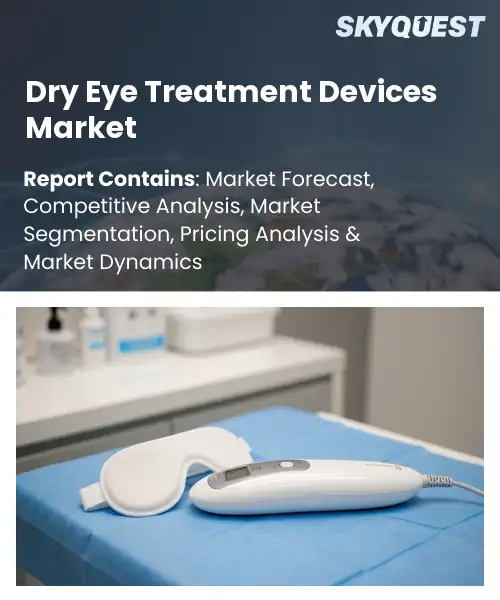
Dry Eye Treatment Devices Market
Report ID: SQMIG35A3459
Report ID: SQMIG35A3459
[email protected]
USA +1 351-333-4748
Report ID:
SQMIG35A3459 |
Region:
Global |
Published Date: May, 2026
Pages:
157
|Tables:
156
|Figures:
78


Global Dry Eye Treatment Devices Market size was valued at USD 289.7 Million in 2024 and is poised to grow from USD 311.72 Million in 2025 to USD 560.09 Million by 2033, growing at a CAGR of 7.6% during the forecast period (2026-2033).
The major factor behind the global dry eye treatment devices market growth is the steadily increasing prevalence of dry eye disease, which is pushed by demographic aging and lifestyle shifts that people ignore until it becomes uncomfortable. This space includes diagnostic instruments and therapeutic devices that go from tear film analyzers and meibomian gland thermal pulsation systems to intense pulsed light platforms and minimally invasive occlusive implants.
Moreover, tech advancement is the major factor. It speeds up the global market because improved diagnostics and better therapeutic impact make clinicians trust the process more, and that usually increases patient demand too. With tear osmolarity testing and high resolution meibography, clinicians can sort disease more precisely, and then they can justify in clinic approaches like thermal pulsation and intense pulsed light, which can deliver relief longer than topical drops. When hospitals keep reporting better outcomes payors tend to respond with reimbursement, and that lowers adoption hurdles. After that, investment follows , and firms start scaling portable devices, subscription style care models, and integrated diagnostic treatment bundles that are used across ophthalmology and optometry practices as well as telemedicine world wide.
AI is boosting diagnostic accuracy by blending multiple inputs, like meibography and tear film imaging along with patient symptom profiles, then running those through machine learning-driven analysis. These tools aim to standardize how images are interpreted, which can reduce clinician variability and expose subtle disease patterns that support subtype-specific care. Some vendors are also putting AI into point-of-care devices to speed up triage and help personalize therapy choices, which tends to raise clinician confidence and makes adoption easier in a market that still really values repeatable outcomes and efficient workflows.
Market snapshot - (2026-2033)
Global Market Size
USD 289.7 Million
Largest Segment
Thermal Pulsation Devices
Fastest Growth
Combination Therapy Devices (IPL + MGX / Heat + Expression)
Growth Rate
7.6% CAGR
To get more insights on this market click here to Request a Free Sample Report
The global dry eye treatment devices market is segmented by technology, application, portability, end user, distribution channel and region. Based on technology, the market is segmented into Thermal Pulsation Devices, Intense Pulsed Light (IPL) Devices, Broadband Light (BBL) Devices, Meibomian Gland Expression (MGX) Systems, Combination Therapy Devices (IPL + MGX / Heat + Expression), Low-Level Light Therapy (LLLT) Devices, Radiofrequency (RF) Devices, Neurostimulation Devices, Punctal Occlusion Devices, Eyelid Debridement & Blepharitis Treatment Devices and Others. Based on application, the market is segmented into Meibomian Gland Dysfunction (MGD) Treatment, Evaporative Dry Eye Treatment, Aqueous Deficient Dry Eye Treatment, Blepharitis-Associated Dry Eye Management and Ocular Surface Inflammation Management. Based on portability, the market is segmented into Standalone Clinical Systems, Handheld/Portable Devices and Home-Use Devices. Based on end user, the market is segmented into Hospitals, Ophthalmology Clinics, Optometry Clinics, Ambulatory Surgical Centers (ASCs) and Home Care Settings. Based on distribution channel, the market is segmented into Direct Sales, Distributors & Dealers and Online Sales Channels. Based on region, the market is segmented into North America, Europe, Asia Pacific, Latin America and Middle East & Africa.
As per the dry eye treatment devices market analysis, the Intense Pulsed Light (IPL) Devices segment dominates because clinicians like the multifaceted mechanism that helps meibomian gland performance, lowers periocular inflammation, and stabilizes the tear film. This strong clinical adoption comes from repeatable office-based protocols, a steadily growing evidence base showing symptom relief, and device refinements that make outcomes safer and more effective. All of that, basically, supports practitioner preference and helps IPL slot into standard dry eye therapeutic pathways. Moreover, manufacturers invest in clinician training and marketing, which locks in the market leadership.
However, Thermal Pulsation Devices are expanding the fastest, due to simplified office-based treatment workflows that deliver gland heating and expression in one single visit. Clinician preference keeps tilting toward time-efficient treatments, ongoing device innovation improves patient comfort, and payer recognition is also widening. Those things together accelerate adoption and open up meaningful future possibilities across clinical practices.
According to the dry eye treatment devices market forecast, the Meibomian Gland Dysfunction (MGD) Treatment segment is the place everything leads, because MGD is the primary mechanistic target for device interventions that help restore gland function and also improve tear film stability. Device developers and clinicians tend to put attention on approaches that unblock the glands, reduce tear evaporation, and bring lipid layer integrity back into shape again. this direction tightens up the whole loop, research and development, clinical validation, and even purchasing, all centered on MGD focused solutions, so it remains the central application area for device based therapy adoption. additionally, patient demand for minimally invasive options keeps pushing that market direction further forward.
However, the Ocular Surface Inflammation Management category is predicted to achieve the largest dry eye treatment devices market share, as device-driven anti-inflammatory modalities and adjunctive therapies start gaining real clinical traction. Recognition of inflammatory drivers keeps increasing, investment in more targeted technologies follows, and there are growing opportunities to pair device therapy with pharmacologic strategies. This combination encourages broader adoption, expands indications, and also unlocks new pathways for treatment innovation and revenue generation.
To get detailed segments analysis, Request a Free Sample Report
As per the dry eye treatment devices market regional forecast, North America dominates the market, mostly because the healthcare setup is advanced, there are a lot of ophthalmic excellence centers clustered together, and patients are more aware these days, which pushes demand for both diagnostic and therapeutic technologies. Then there’s this mature rules and payback environment that basically helps companies commercialize new devices, and meanwhile, a dense web of specialist clinics and academic groups helps those devices get adopted early, with feedback loops that keep improving things. Moreover, the region has a lot of well-known device manufacturers around, and ongoing collaboration between industry players and clinical stakeholders, and the capital market mood is supportive too so product development and market penetration move faster. On top of that, distribution and service coverage is comprehensive so access stays wide across different care settings. Ongoing R and D funding, including upgrades in minimally invasive procedures and diagnostic imaging, keeps competitiveness up. And when digital health platforms plus teleophthalmology get integrated into actual workflows it expands reach and helps with management, while cross sector partnerships make commercialization go further.
United States Dry Eye Treatment Devices Market
The Dry Eye Treatment Devices sector in the United States benefits from having more medical device companies concentrated there, and advanced clinical infrastructure and a really high level of clinician familiarity with new therapies. Strong private investment and collaborative research circles speed up innovation, and also help polish products. Specialty ophthalmology centers are widely available, with more integrated care routes, so adoption can happen fast. Payer frameworks, alongside specialist training, helps keep things sustainable. Overall market movement leans heavily toward technology differentiation , outpatient solutions, and tools that bring more patient engagement into the picture.
Canada Dry Eye Treatment Devices Market
The Dry Eye Treatment Devices industry in Canada shows integration between public healthcare and specialty eye care services, so patients can actually access care , and advanced therapies get clinical uptake. There are supportive regulatory pathways , and collaboration with academic centers keeps adoption moving for novel diagnostics and treatment options. Local distributors , and clinical networks also help rollout beyond the big cities, but there’s still focus on patient education and multidisciplinary management , which strengthens care pathways and improves device utilization, and includes regional training.
The rapid expansion of the dry eye treatment devices market in Europe is driven by an overlap between recognition of clinical need, higher clinician adoption, and the presence of regional innovation ecosystems that actually work. Harmonized regulatory frameworks , and collaborative research programs across member countries make cross border product testing, and knowledge transfer easier, while the growing focus on patient quality of life boosts interest in diagnostic and therapeutic solutions. Europe also has a mature medical technology industry, specialist societies that stay active, and more private care choices, which together support commercial scaling. Payers are also shifting mechanisms to highlight value based interventions, so manufacturers feel pushed to show clinical differentiation, and cost effectiveness. When digital care pathways and teleophthalmology get embedded too, underserved areas get reached faster, and overall market momentum improves. Local market segmentation , and clinician education campaigns that target specific groups , also tend to catalyze uptake.
Germany Dry Eye Treatment Devices Market
The Dry Eye Treatment Devices Market in Germany is helped by a strong medtech manufacturing base, extensive hospital networks, and a concentration of academic ophthalmology centers that can support clinical evaluation and help refine products. Professional societies , and clinical guidelines push evidence based adoption, while established distribution plus service infrastructure keeps market access realistic. There’s heavy emphasis on quality and engineering excellence , which encourages device innovation. Industry clinical research collaborations reinforce leadership across care settings, and international outreach also supports it.
United Kingdom Dry Eye Treatment Devices Market
The Dry Eye Treatment Devices Market in United Kingdom tends to show private sector adoption, strong clinical networks, and a regulatory and commercialization environment that feels agile enough to support uptake. There is some start up activity and sector partnerships that keep innovation moving, while telemedicine integration and growth of specialist clinics expand patient access. Collaborative initiatives between hospitals and industry support evidence building, and clinician education combined with patient engagement programs underpin broader use across outpatient and community channels.
France Dry Eye Treatment Devices Market
The Dry Eye Treatment Devices Market in France is evolving due to stronger clinical research activity, growing engagement from ophthalmology centers of excellence, and increased adoption inside public hospitals. There is emphasis on clinical validation and alignment with national care pathways, so new diagnostics and therapies get integrated in a cautious, structured way. Regional distributors , and training initiatives help dissemination beyond urban areas, while collaborations between industry and academic hospitals support evidence generation and adaptation to local clinical practice patterns.
Asia Pacific is strengthening its stance in the dry eye treatment devices market, via a blend of more clinical capacity, higher domestic manufacturing know-how, and tighter cooperation with global medtech companies. In the whole region, regulatory authorities are gradually syncing up with international benchmarks, so the entry process for newer devices is a bit smoother. There is also more money going into specialty eye care centers, training ophthalmic specialists, and widening outpatient services. All of that makes adoption easier. At the local level, firms are tweaking device layouts for regional practice habits, and for different cost sensitivities too. Meanwhile digital health solutions and teleophthalmology are reaching further for diagnosis, widening the net. Strategic arrangements, that mix international know-how with local distribution pathways, speed up market maturity and help build a more varied worldwide supply footprint. Private sector capital and an emphasis on outcome driven care support uptake, and regional centers of excellence keep generating evidence that backs reimbursement. Taken together, these shifts lift the region’s contribution to global innovation and the supply of dry eye treatment technologies.
Japan Dry Eye Treatment Devices Market
The dry eye treatment devices market in Japan rests on advanced research strength, solid manufacturing competence, and well established ophthalmology practice networks, which help clinical evaluation and iterative refinement. Device suppliers that work closely with academic groups support innovation in imaging as well as less intrusive therapy approaches. By concentrating on quality, regulatory discipline, and active market surveillance, clinician and patient trust grows. And then distribution channels, plus specialist training, make sure these options show up in both major cities and smaller care settings.
South Korea Dry Eye Treatment Devices Market
In South Korea, the dry eye treatment devices market is fueled by a lively medtech ecosystem, electronics capability, and manufacturing capacity, so devices can be developed quickly and localized without too much delay. Clinician involvement is high, hospital systems are integrated, and digital health tools help roll out solutions across different clinical environments. Public and private funding is also encouraging new ideas. Export focus and collaborations with international firms broaden the market, and they also push product development that matches regional requirements.
To know more about the market opportunities by region and country, click here to
Buy The Complete Report
Rising Prevalence Of Dry Eye
Advances In Therapeutic Technologies
High Cost Of Advanced Devices
Regulatory Approval Challenges
Request Free Customization of this report to help us to meet your business objectives.
In the global dry eye treatment devices market, the competitive dynamics changes around consolidation, regulation driven product differences and fast moving tech updates. Lately, there is a pattern where companies use deals, alliances, and energy based innovations to grab a bit more clinical traction plus distribution leverage. For example, Bausch + Lomb buying Trukera Medical, Sight Sciences pulling in big growth capital to scale TearCare, and Lumenis getting FDA De Novo for an IPL device all point in that same direction, like acquisitions and partnerships plus energy delivery advances are the way to win.
Top Player’s Company Profile
Recent Developments in the Dry Eye Treatment Devices Market
SkyQuest’s ABIRAW (Advanced Business Intelligence, Research & Analysis Wing) is our Business Information Services team that Collects, Collates, Correlates, and Analyses the Data collected by means of Primary Exploratory Research backed by robust Secondary Desk research.
As per SkyQuest analysis, one key factor is the rising prevalence of dry eye disease, which grows the patient pool and increases clinical demand, and a second factor is technological progress , and AI-enabled diagnostics that make disease stratification and therapy selection more accurate. On the flip side, one restraint is that advanced devices can be pricey , so adoption gets limited in smaller practices and in markets where buyers are more cost-sensitive. North America is still the leading region , largely because of better infrastructure, reimbursement backing , and more concentrated specialist networks. Meanwhile, Intense Pulsed Light devices are the leading segment, mainly because there is strong clinical evidence and office- based protocols that can be repeated consistently. Altogether, these dynamics tend to support ongoing clinical uptake and continued product refinement.
| Report Metric | Details |
|---|---|
| Market size value in 2024 | USD 289.7 Million |
| Market size value in 2033 | USD 560.09 Million |
| Growth Rate | 7.6% |
| Base year | 2024 |
| Forecast period | (2026-2033) |
| Forecast Unit (Value) | USD Million |
| Segments covered |
|
| Regions covered | North America (US, Canada), Europe (Germany, France, United Kingdom, Italy, Spain, Rest of Europe), Asia Pacific (China, India, Japan, Rest of Asia-Pacific), Latin America (Brazil, Rest of Latin America), Middle East & Africa (South Africa, GCC Countries, Rest of MEA) |
| Companies covered |
|
| Customization scope | Free report customization with purchase. Customization includes:-
|
To get a free trial access to our platform which is a one stop solution for all your data requirements for quicker decision making. This platform allows you to compare markets, competitors who are prominent in the market, and mega trends that are influencing the dynamics in the market. Also, get access to detailed SkyQuest exclusive matrix.
Table Of Content
Executive Summary
Market overview
Parent Market Analysis
Market overview
Market size
KEY MARKET INSIGHTS
COVID IMPACT
MARKET DYNAMICS & OUTLOOK
Market Size by Region
KEY COMPANY PROFILES
Methodology
For the Dry Eye Treatment Devices Market, our research methodology involved a mixture of primary and secondary data sources. Key steps involved in the research process are listed below:
1. Information Procurement: This stage involved the procurement of Market data or related information via primary and secondary sources. The various secondary sources used included various company websites, annual reports, trade databases, and paid databases such as Hoover's, Bloomberg Business, Factiva, and Avention. Our team did 45 primary interactions Globally which included several stakeholders such as manufacturers, customers, key opinion leaders, etc. Overall, information procurement was one of the most extensive stages in our research process.
2. Information Analysis: This step involved triangulation of data through bottom-up and top-down approaches to estimate and validate the total size and future estimate of the Dry Eye Treatment Devices Market.
3. Report Formulation: The final step entailed the placement of data points in appropriate Market spaces in an attempt to deduce viable conclusions.
4. Validation & Publishing: Validation is the most important step in the process. Validation & re-validation via an intricately designed process helped us finalize data points to be used for final calculations. The final Market estimates and forecasts were then aligned and sent to our panel of industry experts for validation of data. Once the validation was done the report was sent to our Quality Assurance team to ensure adherence to style guides, consistency & design.
Analyst Support
Customization Options
With the given market data, our dedicated team of analysts can offer you the following customization options are available for the Dry Eye Treatment Devices Market:
Product Analysis: Product matrix, which offers a detailed comparison of the product portfolio of companies.
Regional Analysis: Further analysis of the Dry Eye Treatment Devices Market for additional countries.
Competitive Analysis: Detailed analysis and profiling of additional Market players & comparative analysis of competitive products.
Go to Market Strategy: Find the high-growth channels to invest your marketing efforts and increase your customer base.
Innovation Mapping: Identify racial solutions and innovation, connected to deep ecosystems of innovators, start-ups, academics, and strategic partners.
Category Intelligence: Customized intelligence that is relevant to their supply Markets will enable them to make smarter sourcing decisions and improve their category management.
Public Company Transcript Analysis: To improve the investment performance by generating new alpha and making better-informed decisions.
Social Media Listening: To analyze the conversations and trends happening not just around your brand, but around your industry as a whole, and use those insights to make better Marketing decisions.
REQUEST FOR SAMPLE
 REQUEST FREE CUSTOMIZATION
Global Dry Eye Treatment Devices Market size was valued at USD 289.7 Million in 2024 and is poised to grow from USD 311.72 Million in 2025 to USD 560.09 Million by 2033, growing at a CAGR of 7.6% during the forecast period (2026-2033).
Competitive dynamics in the global dry eye treatment devices market center on consolidation, regulatory driven product differentiation, and rapid technology innovation. Recent M&A such as Bausch + Lomb acquiring Trukera Medical, major growth capital rounds enabling Sight Sciences to scale TearCare, and Lumenis securing FDA De Novo for an IPL device illustrate firms using acquisitions, strategic partnerships, and energy based technology advances to secure clinical and distribution advantages. 'Lumenis Be Ltd.', 'Johnson & Johnson Vision Care, Inc.', 'Alcon Inc.', 'Bausch + Lomb Corporation', 'Sight Sciences, Inc.', 'TearScience, Inc.', 'ESW Vision Ltd.', 'Nidek Co., Ltd.', 'Topcon Corporation', 'Carl Zeiss Meditec AG', 'AbbVie Inc.', 'Quantel Medical SAS', 'Optima Medical Ltd.', 'IRIDEX Corporation', 'Eyevance Pharmaceuticals LLC', 'Aequus Pharmaceuticals Inc.', 'OCuSOFT Inc.', 'MiBo Medical Group', 'NuSight Medical Ltd.', 'Bruder Healthcare Company LLC'
Rising prevalence of dry eye increases demand for diagnostic and therapeutic devices by expanding the patient pool seeking clinical intervention and long term management. As more individuals experience symptoms that impair daily activities, healthcare providers prioritize identification and treatment pathways, prompting clinics to adopt specialized equipment. This broader recognition drives investment in device procurement and encourages manufacturers to innovate user friendly solutions. The resulting market responsiveness stimulates product development cycles and commercialization efforts, reinforcing availability and awareness and thereby sustaining a growth ecosystem centered on meeting increasing clinical needs.
Telehealth Enabled Care Models: The integration of remote consultations and connected at-home diagnostic tools is reshaping patient access and continuity of care for dry eye management. Clinicians can triage symptoms, adjust device usage remotely, and monitor adherence through digital platforms, enabling proactive interventions and personalized follow-up. This model supports adoption of home-use therapeutic devices, reduces barriers to specialist input, and encourages collaborative care pathways between optometrists and ophthalmologists, ultimately improving convenience and long-term disease management outcomes for diverse patient populations.
Why does North America Dominate the Global Dry Eye Treatment Devices Market? |@12


Want to customize this report? This report can be personalized according to your needs. Our analysts and industry experts will work directly with you to understand your requirements and provide you with customized data in a short amount of time. We offer $1000 worth of FREE customization at the time of purchase.
Feedback From Our Clients


 USA (+1) 351-333-4748

