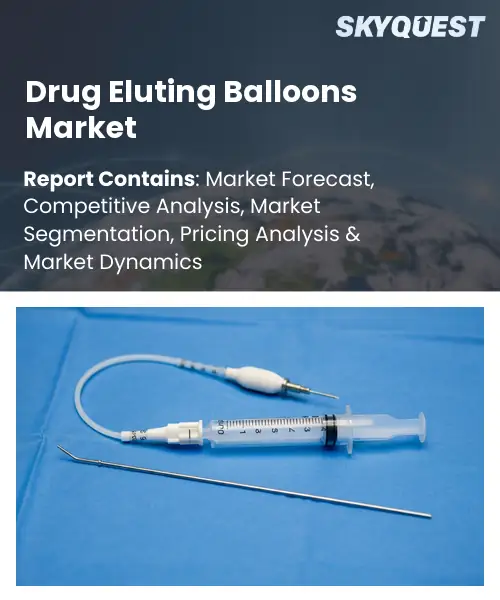
Drug Eluting Balloons Market
Report ID: SQMIG35A3791
Report ID: SQMIG35A3791
[email protected]
USA +1 351-333-4748
Report ID:
SQMIG35A3791 |
Region:
Global |
Published Date: June, 2026
Pages:
157
|Tables:
113
|Figures:
77


Global Drug Eluting Balloons Market size was valued at USD 853.75 Million in 2024 and is poised to grow from USD 922.65 Million in 2025 to USD 1716.63 Million by 2033, growing at a CAGR of 8.07% during the forecast period (2026-2033).
The global drug-eluting balloons market growth is mostly pushed by this clinical need to curb restenosis after angioplasty, and it started as a side option then became more of a deliberate companion to stents. So drug eluting balloons are basically angioplasty balloons made to release antiproliferative compounds, like paclitaxel or sirolimus, straight onto the vessel wall while the artery is being dilated, and they matter a lot because they can handle tough situations such as in-stent restenosis, plus small vessel disease, without leaving behind a permanent implant.
Moreover, a major factor shaping the drug eluting balloons market outlook is the steady build up of credible clinical data and more attractive health economics, and that stuff really affects how clinicians decide, and how payers write their policies. Once randomized trials and registries keep pointing to reduced late lumen loss plus fewer repeat revascularizations, interventional teams become more comfortable reaching for drug eluting balloons especially for in-stent restenosis, and femoropopliteal lesions, and then payers follow with reimbursement extensions. That, in turn , gives device makers a reason to justify capital spending and ramp up production. Also coating science has improved, and newer sirolimus formulations help restore confidence after earlier arguments, which quickly turns into new procurement deals, more manufacturing scale, and faster adoption across developed and also emerging markets globally
AI is improving clinical outcomes there by helping with more careful lesion assessment, better patient selection, real time procedural support, and overall device fine tuning. One key part is AI interpretation of intravascular imaging and computational estimates of coronary flow, plus predictive models that try to forecast restenosis risk and how the vessel may respond to localized drug delivery. Right now, the direction is toward deeper integration of these tools into everyday interventional steps, so operators can select balloon sizing, set an inflation approach, and decide on follow up plans with more consistency. The market context also supports drug eluting balloons as an implant free choice, and more trials plus registries are reflecting AI-assisted decision-making.
Market snapshot - (2026-2033)
Global Market Size
USD 853.75 Million
Largest Segment
Peripheral Artery Disease
Fastest Growth
Coronary Artery Disease
Growth Rate
8.07% CAGR
To get more insights on this market click here to Request a Free Sample Report
The global drug eluting balloons market is segmented by application indication, coating drug derivative, end-user, distribution channel and region. Based on application indication, the market is segmented into Peripheral Artery Disease and Coronary Artery Disease. Based on coating drug derivative, the market is segmented into Paclitaxel Eluting Balloons and Sirolimus Eluting Balloons. Based on end-user, the market is segmented into Hospitals & Cardiac Centers and Ambulatory Surgical Centers. Based on distribution channel, the market is segmented into Direct and Indirect. Based on region, the market is segmented into North America, Europe, Asia Pacific, Latin America and Middle East & Africa.
As per the drug eluting balloons market analysis, the Peripheral Artery Disease segment dominates here because clinicians keep asking for durable peripheral revascularization, so device buyers tend to pick technologies that can lower restenosis, and also help with limb salvage. In practice, many doctors seem to prefer balloons that spread antiproliferative agents over long lesion lengths, without putting in a scaffold. That matters because it can make the case feel less complicated, and it helps preserve vessel physiology, as a bonus. Put that clinical fit together with repeated device tweaking and payer acceptance, and offer a long lasting bias toward peripheral uses, plus steady purchasing in interventional routines.
Still, Coronary Artery Disease is showing up as the fastest growing piece, and it’s mainly tied to the growing attention on treating in stent restenosis, along with certain de novo coronary lesions. Since balloon based drug delivery is getting more traction there, adoption keeps rising. On top of that, procedural tuning keeps improving workflow, and clinical evidence is backing coronary use. As a result, interventional cardiologists are starting to use these balloons more widely, so it opens other treatment pathways. That also builds a real chance for future cath lab uptake.
According to the drug eluting balloons market forecast, the Sirolimus Eluting Balloons segment leads because the drug’s behavior tends to support more even arterial healing, and it can deliver a longer lasting antiproliferative effect with less local toxicity. This is also relevant because it helps address some earlier safety concerns that were tied to other coatings. Device teams and clinicians seem drawn to sirolimus chemistry since it tends to be vessel compatible, and it may offer longer term patency. That combination pulls investment toward better delivery systems, and it keeps positioning these balloons as the preferred choice when lesions get complicated.
Meanwhile, Paclitaxel Eluting Balloons are gaining the fastest growth traction, mostly because there’s already strong clinical familiarity. There’s also broad hands on procedural experience, and ongoing formulation improvements that keep clinician confidence high. Add manufacturer support on top of that, plus iterative coating technologies, and the market uptake stays firm. With indications expanding, demand continues, so these devices can support near term commercial growth, and they can create small but meaningful stepping stones for adoption in different interventional settings.
To get detailed segments analysis, Request a Free Sample Report
As per the drug eluting balloons market regional forecast, North America is dominating , because the whole setup is connected , like clinical research , technology development and that supportive reimbursement stuff all work together. There is a bunch of leading medical device makers and advanced healthcare providers in one place, and that makes it easier for new endovascular therapies to actually get adopted. Also , the clinical trials seem robust and the regulatory routes are efficient , so improved balloon designs and drug formulations can hit the market quicker. In the real world , clinicians know what theyre doing and hospitals have the infrastructure , so complex peripheral and coronary interventions where these devices are used can move forward smoothly. There are these ecosystems that keep repeating , industry , academic centers and clinical opinion leaders, all pushing product refinement and more evidence creation. And then distribution networks plus payer systems, help access in acute care and outpatient settings, so market leadership stays strong , along with continuous innovation momentum. On top of that , investment in device manufacturing , plus targeted training programs for interventional specialists, improves procedural results and builds clinician confidence. Patient awareness and referral patterns in tertiary centers, locks in uptake and ongoing prominence.
United States Drug Eluting Balloons Market
The Drug Eluting Balloons sector in the United States is being led by concentrated research activity and clinical adoption inside complicated endovascular procedures . There are strong partnerships between device makers interventional specialists, and academic centers, and that helps iterative improvements happen in balloon technologies plus drug coatings. Reimbursement mechanisms and high procedure volumes in tertiary hospitals back commercialization and training. There’s also focused clinician education , and robust distribution channels, making it easier to spread innovations across treatment settings, which keeps demand steady and differentiation clear.
Canada Drug Eluting Balloons Market
The Drug Eluting Balloons industry in Canada is basically defined by concentrated adoption in specialized cardiac and vascular centers, and there are collaborative procurement pathways that make access more likely for innovative devices. Close cooperation between clinicians provincial health authorities and industry supports programs and postmarket evidence generation. The emphasis stays on clinician training and regional referral networks, which improves procedural capability. Established distributors, plus a focus on real world outcomes, helps adoption happen across hospitals and community facilities , which supports market maturity over time.
Europe is seeing rapid drug eluting balloons market penetration due to concentrated clinical know how, harmonized regulatory pathways, and coordinated attempts to standardize interventional care across different national systems. Strong hospital networks and specialized vascular centers make balloon technologies for complex peripheral and coronary indications easier to adopt. Device manufacturers invest in localized clinical programs and in real world evidence generation, which increases clinician confidence and also helps with payer acceptance. Comparative procurement practices and collaborative purchasing initiatives in several countries create openings for broader device uptake. And then there’s guideline endorsement from leading cardiology societies , plus more attention on minimally invasive treatments, so clinicians lean toward drug eluting balloon options. Cross border collaboration among academic centers and industry partnerships also speeds up technology diffusion and market depth. Finally, clinician training programs and outcome monitoring initiatives, align with reimbursement to create a space that supports sustained clinical adoption and ongoing innovation.
Germany Drug Eluting Balloons Market
The Drug Eluting Balloons Market in Germany is tied closely to a medical technology industry and extensive clinical networks. Equipped hospitals and specialized vascular centers allow routine use of advanced balloon platforms. There’s close collaboration between manufacturers and clinical research sites, which leads to strong evidence generation that supports payer acceptance. Established procurement channels , plus emphasis on quality improvement, encourages device adoption. Training for clinicians , along with local manufacturing capability, keeps Germany positioned for leadership and deeper market penetration.
United Kingdom Drug Eluting Balloons Market
The Drug Eluting Balloons Market in the United Kingdom stands out with faster adoption fueled by focused clinical initiatives and attempts to expand minimally invasive vascular therapies. Strong connections between academic centers and industry help trials and localized evidence generation , while national procurement programs and hospital networks assist scaling up. There’s clear emphasis on clinician education, comparative outcome assessment, and streamlined adoption pathways, so new balloon technologies can be integrated across acute care and specialist centers.
France Drug Eluting Balloons Market
The Drug Eluting Balloons Market in France is getting momentum through targeted introduction in specialized vascular units , with coordinated evaluation programs. Collaboration between clinical networks and industry supports the use of these devices, and helps build evidence that informs payer decisions. National health authorities and hospital groups are also exploring procurement models that push uptake of innovative devices. Continued focus on clinician training, outcome monitoring, and manufacturing partnerships helps gradual expansion eventually across tertiary hospitals and regional centers.
Asia Pacific is strengthening its position, via localized innovation, expanded clinical capacities, and also by growing collaboration with international device manufacturers. In the leading markets, people are pushing for more regulatory clarity, then investing in clinician training—plus specialized centers, that can handle complex endovascular procedures. Meanwhile local companies are improving device design and coating technologies, and they’re partnering with global firms to speed up commercialization. There is a clear emphasis on generating region specific clinical proof, which bumps payer and physician confidence. As hospital infrastructure gets better and referral networks widen, patients get broader access to advanced vascular treatments. Cross border clinical partnerships and targeted educational programs, they help cultivate a skilled clinician base , and that supports long term market penetration, and the idea that Asia Pacific is becoming a major source of both innovation and demand. Regional investment drives, along with public private collaborations, also help with scalability and local manufacturing, so it’s all moving together in a steady way.
Japan Drug Eluting Balloons Market
The Drug Eluting Balloons Market in Japan benefits from strong medical R and D and a fairly mature device industry, which is pushing improvements in balloon design and drug delivery. High standards in hospital care and specialized cardiovascular centers make it easier for adoption for complicated interventions. Collaboration between industry and academic groups fosters region based clinical evidence creation and device refinement. With regulatory clarity and focused clinician training programs, balloon technologies get evaluated and then incorporated into routine practice, across multiple treatment centers.
South Korea Drug Eluting Balloons Market
In South Korea, the Drug Eluting Balloons Market is shaped by agile device development and close industry–hospital collaboration, that tends to accelerate clinical adoption. Strong manufacturing know how and precision engineering skills support quality device production and customization as well. Government initiatives, together with private investment, encourage clinical research partnerships and actual deployments in tertiary hospitals. There’s also a heavy focus on clinician training, outcome monitoring, and export oriented commercialization approaches, which improves both domestic uptake and international competitiveness for balloon technologies.
To know more about the market opportunities by region and country, click here to
Buy The Complete Report
Rising Clinical Preference For DCBs
Innovations In Balloon Coating Technology
High Procedure Costs Hamper Uptake
Limited Long Term Clinical Evidence
Request Free Customization of this report to help us to meet your business objectives.
In the global drug eluting balloons market the competitive landscape moves because of consolidation, strategic alliances , and a lot of platform differentiation that leans on new drug carriers and delivery mechanisms. Lately there have been a few very tangible moves , like Teleflex wrapping up the acquisition of BIOTRONIK’s vascular intervention business, Philips taking up Vesper Medical, and partnership styled models such as Cardiovascular Systems funding Chansu Vascular to push everolimus DCBs forward. At the same time sirolimus approaches and nanoparticle delivery tweaks are raising the stakes in a noticeable way, like the bar keeps shifting.
Top Player’s Company Profile
Recent Developments in the Drug Eluting Balloons Market
SkyQuest’s ABIRAW (Advanced Business Intelligence, Research & Analysis Wing) is our Business Information Services team that Collects, Collates, Correlates, and Analyses the Data collected by means of Primary Exploratory Research backed by robust Secondary Desk research.
As per SkyQuest analysis, the global drug eluting balloons market is mostly driven by the clinical need to cut restenosis after angioplasty, which frames DCBs as implant free alternatives for both complicated coronary and peripheral lesions. Still, there are two things that hold things back, high procedure costs and reimbursement that stays limited, these act as a restraint for wider uptake. North America is leading, mainly because strong clinical research pipelines, active device development, and reimbursement frameworks that are already in place. Peripheral Artery Disease is the biggest application segment, largely due to demand for durable peripheral revascularization. Another meaningful driver is the continuous innovation in balloon coating technologies, which improves drug transfer, safety, and clinician confidence—so expanded indications become more feasible and adoption tends to rise.
| Report Metric | Details |
|---|---|
| Market size value in 2024 | USD 853.75 Million |
| Market size value in 2033 | USD 1716.63 Million |
| Growth Rate | 8.07% |
| Base year | 2024 |
| Forecast period | (2026-2033) |
| Forecast Unit (Value) | USD Million |
| Segments covered |
|
| Regions covered | North America (US, Canada), Europe (Germany, France, United Kingdom, Italy, Spain, Rest of Europe), Asia Pacific (China, India, Japan, Rest of Asia-Pacific), Latin America (Brazil, Rest of Latin America), Middle East & Africa (South Africa, GCC Countries, Rest of MEA) |
| Companies covered |
|
| Customization scope | Free report customization with purchase. Customization includes:-
|
To get a free trial access to our platform which is a one stop solution for all your data requirements for quicker decision making. This platform allows you to compare markets, competitors who are prominent in the market, and mega trends that are influencing the dynamics in the market. Also, get access to detailed SkyQuest exclusive matrix.
Table Of Content
Executive Summary
Market overview
Parent Market Analysis
Market overview
Market size
KEY MARKET INSIGHTS
COVID IMPACT
MARKET DYNAMICS & OUTLOOK
Market Size by Region
KEY COMPANY PROFILES
Methodology
For the Drug Eluting Balloons Market, our research methodology involved a mixture of primary and secondary data sources. Key steps involved in the research process are listed below:
1. Information Procurement: This stage involved the procurement of Market data or related information via primary and secondary sources. The various secondary sources used included various company websites, annual reports, trade databases, and paid databases such as Hoover's, Bloomberg Business, Factiva, and Avention. Our team did 45 primary interactions Globally which included several stakeholders such as manufacturers, customers, key opinion leaders, etc. Overall, information procurement was one of the most extensive stages in our research process.
2. Information Analysis: This step involved triangulation of data through bottom-up and top-down approaches to estimate and validate the total size and future estimate of the Drug Eluting Balloons Market.
3. Report Formulation: The final step entailed the placement of data points in appropriate Market spaces in an attempt to deduce viable conclusions.
4. Validation & Publishing: Validation is the most important step in the process. Validation & re-validation via an intricately designed process helped us finalize data points to be used for final calculations. The final Market estimates and forecasts were then aligned and sent to our panel of industry experts for validation of data. Once the validation was done the report was sent to our Quality Assurance team to ensure adherence to style guides, consistency & design.
Analyst Support
Customization Options
With the given market data, our dedicated team of analysts can offer you the following customization options are available for the Drug Eluting Balloons Market:
Product Analysis: Product matrix, which offers a detailed comparison of the product portfolio of companies.
Regional Analysis: Further analysis of the Drug Eluting Balloons Market for additional countries.
Competitive Analysis: Detailed analysis and profiling of additional Market players & comparative analysis of competitive products.
Go to Market Strategy: Find the high-growth channels to invest your marketing efforts and increase your customer base.
Innovation Mapping: Identify racial solutions and innovation, connected to deep ecosystems of innovators, start-ups, academics, and strategic partners.
Category Intelligence: Customized intelligence that is relevant to their supply Markets will enable them to make smarter sourcing decisions and improve their category management.
Public Company Transcript Analysis: To improve the investment performance by generating new alpha and making better-informed decisions.
Social Media Listening: To analyze the conversations and trends happening not just around your brand, but around your industry as a whole, and use those insights to make better Marketing decisions.
REQUEST FOR SAMPLE
 REQUEST FREE CUSTOMIZATION
Global Drug Eluting Balloons Market size was valued at USD 853.75 Million in 2024 and is poised to grow from USD 922.65 Million in 2025 to USD 1716.63 Million by 2033, growing at a CAGR of 8.07% during the forecast period (2026-2033).
Competitive landscape in the global drug eluting balloons market is driven by consolidation, strategic partnerships, and platform differentiation focused on novel drug carriers and delivery mechanisms. Recent concrete moves include Teleflex completing the acquisition of BIOTRONIK’s vascular intervention business, Philips acquiring Vesper Medical, and partnership models such as Cardiovascular Systems funding Chansu Vascular to advance everolimus DCBs, while sirolimus and nanoparticle delivery innovations raise competitive stakes. 'Medtronic', 'Boston Scientific Corporation', 'B. Braun SE', 'BD', 'Cook Medical', 'Stryker Corporation', 'Terumo Corporation', 'Asahi Intecc', 'MicroPort Scientific Corporation', 'Lepu Medical Technology', 'Acrostak', 'Biotronik', 'Cardionovum', 'Concept Medical', 'Eurocor Tech', 'Hexacath', 'Minvasys', 'OrbusNeich', 'Surmodics', 'Teleflex'
Advancements in clinical outcomes and growing clinician confidence have led to increased preference for drug eluting balloons in specific vascular interventions. Physicians perceive DCBs as offering targeted antiproliferative delivery without leaving a permanent implant, which simplifies future treatment options and aligns with minimally invasive care objectives. This shift in clinical practice encourages higher adoption rates as interventionalists prioritize durable vessel patency and reduced device related complications, and it supports broader integration of DCBs into treatment algorithms, training programs, and hospital procurement decisions.
Broader Peripheral Vessel Adoption: Adoption of drug eluting balloons in peripheral vascular applications is expanding as clinicians seek targeted vessel preserving therapies that reduce repeat interventions. Manufacturers are developing device profiles and delivery systems tailored to diverse lesion anatomies while hospitals adopt protocols and training to integrate these tools into peripheral intervention suites. This shift enhances procedural flexibility across arterial beds, encourages cross specialty collaboration, and stimulates investment in indication specific clinical programs and commercial support aimed at improving patient access and consistency overall.
Why does North America Dominate the Global Drug Eluting Balloons Market? |@12


Want to customize this report? This report can be personalized according to your needs. Our analysts and industry experts will work directly with you to understand your requirements and provide you with customized data in a short amount of time. We offer $1000 worth of FREE customization at the time of purchase.
Feedback From Our Clients


 USA (+1) 351-333-4748

