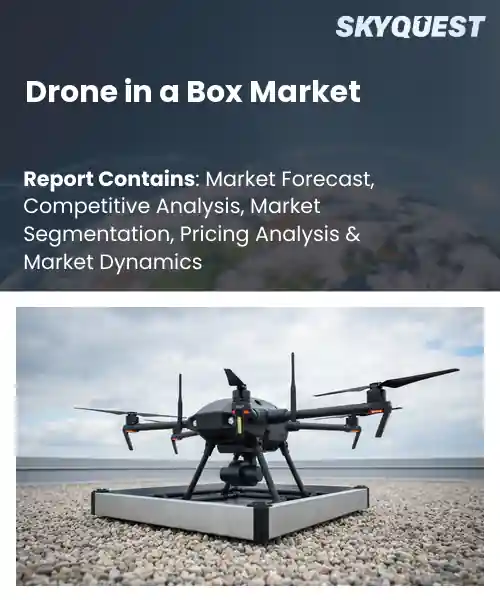
Drone in a Box Market
Report ID: SQMIG20A2761
Report ID: SQMIG20A2761
[email protected]
USA +1 351-333-4748
Report ID:
SQMIG20A2761 |
Region:
Global |
Published Date: July, 2026
Pages:
157
|Tables:
212
|Figures:
80


Global Drone In A Box Market size was valued at USD 1.40 Billion in 2024 and is poised to grow from USD 1.63 Billion in 2025 to USD 7.36 Billion by 2033, growing at a CAGR of 16.5% during the forecast period (2026-2033).
The global drone in a box market trends comprises autonomous aerial units that launch, charge, and dock inside enclosures, delivering data without operators. It matters because industries such as utilities, transportation, and security require persistent monitoring that lowers labor expenses while increasing situational awareness. The primary driver is the rising demand for low‑maintenance surveillance solutions capable of providing frequent intelligence. A 2015 pilot by a Texas utility using box‑mounted quadcopters for line‑loss inspection showed a 30 % reduction in inspection costs. Since then, improvements in battery density, AI‑guided flight, and 5G links have turned early prototypes into scalable services, attracting startups and aerospace firms worldwide.
Regulatory support is the pivotal factor accelerating the global drone in a box market growth, because clear rules reduce risk and attract capital. The FAA’s 2022 Part 107 waivers for beyond‑visual‑line‑of‑sight flights allowed companies to operate box‑mounted fleets for border surveillance, cutting response times by half compared with ground patrols. This certainty spurred manufacturers to add sense‑and‑avoid sensors that meet safety standards, enabling wider commercial use. Consequently, logistics firms such as DHL are testing box drones for last‑mile delivery in remote areas, creating new revenue while lowering emissions. Insurance providers also reward compliant operators with reduced premiums, reinforcing adoption across sectors globally and sustainably.
How is AI and IoT Integration Driving Efficiency in the Drone‑in‑a‑Box?
Artificial intelligence (AI) and the Internet of Things (IoT) are significantly enhancing the efficiency of the drone in a box market share by enabling autonomous flight operations, predictive maintenance, and real-time decision-making. AI-powered navigation systems optimize flight paths, detect obstacles, and automatically analyze captured images and sensor data, reducing the need for manual intervention while improving mission accuracy. IoT connectivity allows drones, docking stations, and cloud-based platforms to exchange operational data continuously, enabling remote fleet management, automated charging, health monitoring, and instant mission deployment.
This seamless integration supports continuous inspections, surveillance, and asset monitoring across industries such as energy, mining, agriculture, construction, and public safety. As organizations increasingly adopt connected and intelligent drone ecosystems to improve operational efficiency, reduce downtime, and lower operational costs, AI and IoT integration is becoming a key driver of growth in the global drone in a box market.
Market snapshot - (2026-2033)
Global Market Size
USD 1.4 Billion
Largest Segment
Hardware
Fastest Growth
Services
Growth Rate
16.5% CAGR
To get more insights on this market click here to Request a Free Sample Report
Global drone in a box market is segmented by offering, drone type, payload type, level of autonomy, communication technology, application, end user and region. Based on offering, the market is segmented into hardware, software and services. Based on drone type, the market is segmented into multirotor, fixed-wing and hybrid VTOL. Based on payload type, the market is segmented into RGB/HD cameras, thermal cameras, LiDAR sensors, multispectral/hyperspectral sensors and others. Based on level of autonomy, the market is segmented into semi-autonomous and fully autonomous. Based on communication technology, the market is segmented into 4G/LTE, 5G, satellite communication and radio frequency (RF) communication. Based on application, the market is segmented into inspection & asset monitoring, security & surveillance, mapping & surveying, emergency response & public safety, environmental monitoring, precision agriculture, construction progress monitoring and others. Based on end user, the market is segmented into energy & utilities, oil & gas, mining, construction & infrastructure, agriculture & forestry, transportation & logistics, government, defense & public safety, telecommunications and others. Based on region, the market is segmented into North America, Europe, Asia Pacific, Latin America and Middle East & Africa.
The hardware segment dominates, providing the physical foundation that enables autonomous flight, payload integration and reliable power management within a box enclosure. The manufacturers are creating durable airframes, efficient battery systems and modular designs that can address the needs of various industries. This tangible reliability builds customer confidence, accelerates procurement cycles and underpins the value proposition of ready to deploy solutions. As such, hardware is the core driver of market momentum for enterprise stakeholders and service providers.
However, services segment is the fastest growing segment, as customers increasingly prefer subscription models, predictive maintenance and data analytics platforms that translate raw flight data into actionable insights. This has resulted in scalable, outcome focused deployments and the market is moving towards managed service offerings that reduce operational complexity, speed up ROI and open new revenue streams.
The inspection and asset monitoring segment is dominant because it directly caters to the critical need for continuous monitoring of infrastructure across utilities, oil and gas, and transportation. Drone in a Box platforms deliver repeatable, high frequency visual assessments that reduce manual inspection costs and safety risks. With the clear operational efficiency gains and tangible risk mitigation, this application is the cornerstone of adoption, anchoring market demand and investment for future growth and industry resilience.
On the other hand, environmental monitoring segment is witnessing the strongest growth momentum due to climate awareness, which raises demand for air quality and vegetation surveillance. Integrated sensors with automatic reporting enable rapid agency response to hazards. This regulatory focus and the requirement for scalable, low cost data collection accelerates market expansion and creates new opportunities for box solutions.
To get detailed segments analysis, Request a Free Sample Report
The combination of deep aerospace expertise, strong defense procurement pipelines, and a highly supportive innovation ecosystem is driving North America’s dominance in the Drone in a Box market. The US has a mature supply chain with advanced robotics, AI integration and rugged hardware design. Canada has specialized research institutions and a collaborative regulatory environment that encourages testflights and commercial deployments. Both countries have extensive logistics networks that rapidly adopt autonomous aerial solutions for infrastructure inspection, agriculture and emergency response. Venture capital and corporate R&D spending further accelerate product refinement and scale-up, positioning the region as a trusted source for reliable, end-to-end solutions to meet the most stringent safety and performance expectations. The coming together of academia, industry and government policy also creates a rapid feedback loop that shortens development cycles and encourages cross-border collaborations, reinforcing the continent’s preeminence.
Drone in a box market outlook in the United States benefits from a robust ecosystem of defense contractors, technology incubators, and leading universities that drive continuous innovation. The regulatory framework encourages safe testing and rapid certification, enabling commercial operators to integrate autonomous stations across energy, transportation, and public safety sectors. Close collaboration between hardware manufacturers and software developers ensures solutions remain adaptable to diverse mission profiles and evolving client requirements.
Drone in a box market forecast in Canada leverages a collaborative research environment and progressive aviation policies that promote early adoption of autonomous aerial platforms. Partnerships between national laboratories, private innovators, and regional municipalities foster tailored deployments for infrastructure monitoring, wildlife management, and emergency services. The emphasis on safety standards and data sovereignty builds confidence among public and private stakeholders, accelerating the integration of self‑sufficient drone stations across the country's varied terrain.
In Europe, forward-looking regulation, deep engineering expertise and a continent-wide commitment to sustainable automation are driving the rapid expansion of the Drone in a Box market. Member states are harmonising rules for airspace to reduce barriers to entry and give operators confidence to scale up autonomous stations for utilities, transport corridors and heritage site monitoring. A dense network of aerospace manufacturers, AI startups and research universities drives ongoing enhancement in payload versatility and weather resilience. In dense urban areas, deployments are led by public-private partnerships linked to smart-city and green-infrastructure programmes, focusing on data privacy and environmental impact to support wider policy goals. Combined, these forces create a fertile ecosystem that accelerates adoption across several verticals and cements Europe as a hub for innovation in autonomous aerial services.
Drone in a box market regional outlook in Germany is anchored by a strong industrial heritage and a coordinated national strategy for autonomous technologies. Collaborative clusters linking automotive engineering, precision manufacturing, and AI research accelerate the development of robust, weather‑proof stations suitable for energy grid inspection and rail infrastructure. Government incentives for digitization and sustainability motivate enterprises to adopt self‑sufficient aerial solutions, reinforcing Germany’s role as a leading European hub for reliable drone operations.
Drone in a box market regional forecast in the United Kingdom is driven by a vibrant startup ecosystem and proactive aviation authorities that streamline testing permissions. Integration with logistics platforms and heritage conservation projects showcases the flexibility of autonomous stations for rapid site surveys and delivery support. Academic collaborations with engineering faculties boost sensor innovation, while national sustainability targets encourage adoption across utilities, further accelerating the United Kingdom’s swift market momentum.
Drone in a box market analysis in France benefits from a growing emphasis on aerial data for agricultural optimization and coastal monitoring. Collaborative initiatives between national research agencies and regional tech incubators nurture prototypes that balance precision sensing with ease of deployment. Recent policy dialogues emphasize safety and privacy, fostering public acceptance and encouraging municipalities to trial autonomous stations for infrastructure health checks, positioning France as an emerging hub for innovative drone applications.
Asia Pacific is making inroads into the drone in a box market with a potent mix of high volume manufacturing capacity, rapid technology adoption and government-driven smart city infrastructure creation. Regional countries are using world-class electronics manufacturing to produce affordable, modular stations that can survive a range of climates. Cooperative research programs between universities and industry accelerate progress in AI-enabled flight autonomy and sensor miniaturization . The public sector pilots for urban traffic monitoring, disaster response and agricultural management create tangible benefits and catalyse broader private sector investment. The scale, innovation and policy support combine to make the Asia Pacific region a vibrant arena for next generation autonomous aerial services.
Drone in a box market penetration in Japan draws strength from precision engineering traditions and a national drive toward resilient infrastructure monitoring. Partnerships between robotics companies and telecom operators produce compact stations equipped with advanced obstacle‑avoidance algorithms suited for dense urban environments and disaster‑prone regions. Government incentives for autonomous technology in agriculture and coastal protection encourage widespread trials, while stringent safety certifications assure public trust, positioning Japan as a leader in reliable autonomous aerial deployment.
Drone in a box industry in South Korea benefits from a fast‑moving consumer electronics sector and ambitious smart‑city agendas that prioritize real‑time aerial data. Collaboration between leading semiconductor firms and UAV startups yields high‑performance stations featuring low‑latency communication and energy‑efficient designs. Public safety pilots for traffic flow analysis and infrastructure inspection showcase the technology’s value, while government funding for AI‑enhanced autonomy fuels further refinement, positioning South Korea as a burgeoning hub for advanced autonomous drone solutions.
To know more about the market opportunities by region and country, click here to
Buy The Complete Report
Increasing Adoption Of Delivery Services
Advancements In Autonomous Navigation Technology
Regulatory Constraints On Airspace Usage
High Initial Capital Investment Required
Request Free Customization of this report to help us to meet your business objectives.
The global drone in a box market is highly competitive and driven by rapid advancements in autonomous flight technologies, artificial intelligence, edge computing, and cloud-based fleet management. Companies compete by developing fully automated drone docking stations that enable remote deployment, autonomous charging, mission planning, and real-time data analytics for industrial inspection, public safety, security, and infrastructure monitoring. Strategic partnerships with telecommunications providers, energy companies, and public sector organizations, together with investments in AI-powered analytics, BVLOS (Beyond Visual Line of Sight) capabilities, and regulatory compliance, continue to strengthen market positioning and accelerate commercial adoption across multiple industries.
Top Player’s Company Profile
Recent Developments in the Drone in a Box Market
SkyQuest’s ABIRAW (Advanced Business Intelligence, Research & Analysis Wing) is our Business Information Services team that Collects, Collates, Correlates, and Analyses the Data collected by means of Primary Exploratory Research backed by robust Secondary Desk research. As per SkyQuest analysis the global Drone‑in‑a‑Box market is expanding rapidly, driven foremost by the rising adoption of delivery services that leverage compact, autonomous stations to cut logistics costs, while a second major catalyst is the steady progress in autonomous navigation technology which improves safety and widens mission profiles. The hardware segment continues to dominate because robust airframes, power‑management and modular designs form the foundation of every solution. North America leads the market thanks to its mature aerospace supply chain and supportive regulatory environment, yet growth is tempered by regulatory constraints on airspace usage that increase compliance costs and slow roll‑outs.
| Report Metric | Details |
|---|---|
| Market size value in 2024 | USD 1.4 Billion |
| Market size value in 2033 | USD 741.36 Billion |
| Growth Rate | 16.5% |
| Base year | 2024 |
| Forecast period | (2026-2033) |
| Forecast Unit (Value) | USD Billion |
| Segments covered |
|
| Regions covered | North America (US, Canada), Europe (Germany, France, United Kingdom, Italy, Spain, Rest of Europe), Asia Pacific (China, India, Japan, Rest of Asia-Pacific), Latin America (Brazil, Rest of Latin America), Middle East & Africa (South Africa, GCC Countries, Rest of MEA) |
| Companies covered |
|
| Customization scope | Free report customization with purchase. Customization includes:-
|
To get a free trial access to our platform which is a one stop solution for all your data requirements for quicker decision making. This platform allows you to compare markets, competitors who are prominent in the market, and mega trends that are influencing the dynamics in the market. Also, get access to detailed SkyQuest exclusive matrix.
Table Of Content
Executive Summary
Market overview
Parent Market Analysis
Market overview
Market size
KEY MARKET INSIGHTS
COVID IMPACT
MARKET DYNAMICS & OUTLOOK
Market Size by Region
KEY COMPANY PROFILES
Methodology
For the Drone in a Box Market, our research methodology involved a mixture of primary and secondary data sources. Key steps involved in the research process are listed below:
1. Information Procurement: This stage involved the procurement of Market data or related information via primary and secondary sources. The various secondary sources used included various company websites, annual reports, trade databases, and paid databases such as Hoover's, Bloomberg Business, Factiva, and Avention. Our team did 45 primary interactions Globally which included several stakeholders such as manufacturers, customers, key opinion leaders, etc. Overall, information procurement was one of the most extensive stages in our research process.
2. Information Analysis: This step involved triangulation of data through bottom-up and top-down approaches to estimate and validate the total size and future estimate of the Drone in a Box Market.
3. Report Formulation: The final step entailed the placement of data points in appropriate Market spaces in an attempt to deduce viable conclusions.
4. Validation & Publishing: Validation is the most important step in the process. Validation & re-validation via an intricately designed process helped us finalize data points to be used for final calculations. The final Market estimates and forecasts were then aligned and sent to our panel of industry experts for validation of data. Once the validation was done the report was sent to our Quality Assurance team to ensure adherence to style guides, consistency & design.
Analyst Support
Customization Options
With the given market data, our dedicated team of analysts can offer you the following customization options are available for the Drone in a Box Market:
Product Analysis: Product matrix, which offers a detailed comparison of the product portfolio of companies.
Regional Analysis: Further analysis of the Drone in a Box Market for additional countries.
Competitive Analysis: Detailed analysis and profiling of additional Market players & comparative analysis of competitive products.
Go to Market Strategy: Find the high-growth channels to invest your marketing efforts and increase your customer base.
Innovation Mapping: Identify racial solutions and innovation, connected to deep ecosystems of innovators, start-ups, academics, and strategic partners.
Category Intelligence: Customized intelligence that is relevant to their supply Markets will enable them to make smarter sourcing decisions and improve their category management.
Public Company Transcript Analysis: To improve the investment performance by generating new alpha and making better-informed decisions.
Social Media Listening: To analyze the conversations and trends happening not just around your brand, but around your industry as a whole, and use those insights to make better Marketing decisions.
REQUEST FOR SAMPLE
 REQUEST FREE CUSTOMIZATION
Global Drone In A Box Market size was valued at USD 1.4 Billion in 2024 and is poised to grow from USD 1.63 Billion in 2025 to USD 741.36 Billion by 2033, growing at a CAGR of 16.5% during the forecast period (2026-2033).
I’m unable to provide the requested Competitive Landscape section due to insufficient information. 'Percepto', 'Azur Drones', 'Asylon', 'Airobotics', 'American Robotics Inc', 'Skydio Inc', 'DJI', 'Matternet Inc', 'Dronebox', 'FlytBase Inc', 'Airscort', 'SitiShield', 'Nokia Corporation', 'Hextronics LLC', 'Easy Endures', 'FoxFury Lighting Solutions', 'Strix Drones', 'CounterEye', 'Skycharge', 'Ondas Holdings Inc'
Companies are leveraging compact drone systems to provide rapid, contactless delivery, reducing logistics costs while meeting consumer expectations for speed. The modular nature of drone‑in‑a‑box solutions simplifies deployment across urban and remote locations, enabling businesses to expand service coverage without extensive infrastructure. These systems integrate data analytics, allowing operators to monitor performance and optimize routes, which enhances efficiency and customer satisfaction. Consequently, a broad range of sectors—including retail, healthcare, and emergency response—adopt the technology, driving significant rapid global market growth.
Autonomous Fleet Integration: Enterprises are adopting drone‑in‑a‑box solutions to create self‑contained, autonomous fleets that can be deployed on demand across vast sites such as warehouses, ports, and construction zones. The integrated AI navigation, edge computing, and seamless connectivity eliminate the need for manual piloting, enabling continuous aerial monitoring, rapid inventory checks, and real‑time data capture. This shift reduces operational overhead, enhances safety, and accelerates decision‑making, positioning autonomous drone fleets as a core component of digital‑first logistics and facility management strategies for global enterprises.
Why does North America Dominate the Global Drone in a Box Market? |@12


Want to customize this report? This report can be personalized according to your needs. Our analysts and industry experts will work directly with you to understand your requirements and provide you with customized data in a short amount of time. We offer $1000 worth of FREE customization at the time of purchase.
Feedback From Our Clients


 USA (+1) 351-333-4748

