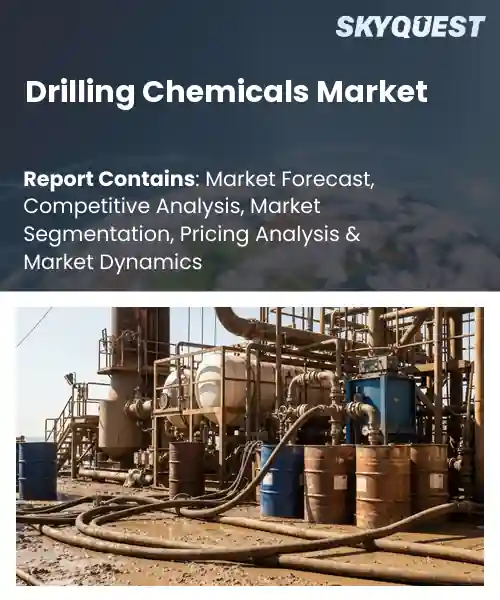
Drilling Chemicals Market
Report ID: SQMIG15E3681
Report ID: SQMIG15E3681
[email protected]
USA +1 351-333-4748
Report ID:
SQMIG15E3681 |
Region:
Global |
Published Date: June, 2026
Pages:
157
|Tables:
121
|Figures:
77


Global Drilling Chemicals Market size was valued at USD 10.5 Billion in 2024 and is poised to grow from USD 11.08 Billion in 2025 to USD 17.0 Billion by 2033, growing at a CAGR of 5.5% during the forecast period (2026-2033).
The primary driver of the drilling chemicals market is the imperative to optimize subsurface operations as energy demand and reservoir complexity increase. Drilling chemicals include additives and fluids that control pressure, condition cuttings, stabilize boreholes and protect reservoir quality, so they are central to oil and gas extraction as well as emerging geothermal and carbon storage applications. Over recent decades the market evolved from basic clay and bentonite muds to multifunctional synthetic polymers, lost circulation products and high temperature high pressure chemistries, while shale development and deepwater projects have acted as major catalysts for technological advancement and increased supplier specialization.Because reservoirs are now deeper, hotter and geologically more heterogeneous, demand for specialty drilling chemicals that deliver thermal stability, shale inhibition and fluid loss control has risen, driving market expansion. When operators use tailored polymers or micronized bridging agents they reduce nonproductive time and improve penetration rate, which lowers barrel development costs and creates demand for premium formulations. Regulatory emphasis on environmental performance causes firms to adopt biodegradable and low toxicity chemistries, opening markets for green product lines tested in North Sea and Gulf of Mexico projects, where successful field trials have translated into longstanding contracts. This stimulates supplier innovation.
How is AI improving formulation and performance optimization in the drilling chemicals market?
AI is improving formulation and performance optimization in the drilling chemicals market by enabling data driven design and real time tuning. Key aspects include predictive modeling of fluid behavior, rapid in silico screening of additive combinations and integration of lab analytics with field sensors. The current state is one of growing pilot adoption where machine learning helps tailor chemistries to specific geology and operational constraints. This reduces trial and error and shortens the time from laboratory concept to field deployment. In a market pushing for higher efficiency and lower environmental impact, AI driven prescriptive workflows are making chemical programs more consistent and responsive to changing downhole conditions.Flotek Industries March 2026, announced its XSPCT Analyzer and expanded data analytics offerings, illustrating how AI enabled real time measurement and prescriptive chemistry management accelerate formulation cycles and improve dosing and field performance across drilling programs.
Market snapshot - (2026-2033)
Global Market Size
USD 10.5 Billion
Largest Segment
Weighting Agents
Fastest Growth
Shale Stabilizers
Growth Rate
5.5% CAGR
To get more insights on this market click here to Request a Free Sample Report
Global drilling chemicals market is segmented by chemical type, fluid type, application, function and region. Based on chemical type, the market is segmented into Viscosifiers, Fluid Loss Control Additives, Shale Stabilizers, Lubricants, Weighting Agents and Others. Based on fluid type, the market is segmented into Water-Based Fluids, Oil-Based Fluids, Synthetic-Based Fluids and Others. Based on application, the market is segmented into Onshore and Offshore. Based on function, the market is segmented into Drilling, Completion & Cementing, Workover and Others. Based on region, the market is segmented into North America, Europe, Asia Pacific, Latin America and Middle East & Africa.
Viscosifiers segment dominates because viscosifiers are fundamental to controlling carrying capacity and hole cleaning in drilling operations; their role in tuning rheology across temperature and formation conditions makes them indispensable to formulators. Their ability to stabilize cuttings transport and maintain fluid properties under variable shear causes operators to prioritize them when designing drilling fluids. Demand is driven by the need for reliable rheological control across diverse formations and the compatibility of modern viscosifiers with multiple base fluids.
However, Fluid Loss Control Additives are witnessing rapid expansion as formulators seek to minimize permeability invasion and maintain wellbore integrity; advances in nanoparticle and polymer chemistries boost efficacy in tighter formations. Rising adoption of advanced additives for deep and extended reach drilling, along with regulatory preference for reduced formation damage, accelerates investment and creates downstream opportunities in tailored fluid systems.
Water-Based Fluids segment dominates because water-based systems offer operational flexibility, environmental acceptability, and compatibility with a broad suite of additives used for rheology, shale control, and fluid loss. Their adaptability to both standard and modified formulations reduces logistics complexity and enables cost effective treatment on most rigs. Operators often favor water-based systems when formulation performance meets wellbore stability and drilling efficiency objectives, sustaining steady demand among chemical suppliers and service providers.
Meanwhile, Synthetic-Based Fluids are emerging as the fastest growing area due to superior thermal stability and reduced environmental trade offs compared with older oil based systems; innovations in low toxicity synthetics expand acceptance for challenging wells. This momentum drives demand for specialized additives and bespoke formulations, unlocking high margin opportunities for chemical developers and service companies.
To get detailed segments analysis, Request a Free Sample Report
Asia Pacific commands market prominence due to a convergence of robust upstream investment, extensive offshore and onshore exploration, and a dense network of local chemical manufacturers and service providers. Strong industrial ecosystems in key markets enable rapid commercialization of tailored drilling fluid systems and specialty additives, while proximity to major drilling contractors shortens development cycles and lowers logistics complexity. Regulatory frameworks that emphasize safety and environmental performance have driven innovation toward more efficient and lower impact chemistries. Collaborative research between industry and academic institutions supports advanced formulation development and digital integration for well optimization. Cost competitiveness and flexible supply chains further reinforce the region role as a global hub for complex drilling chemical solutions. Growing demand for deeper and more complex wells sustains long term need for specialized chemistries.
Drilling Chemicals Market in Japan benefits from advanced engineering capabilities, close collaboration between oilfield service companies and chemical producers, and a focus on developing low environmental impact fluid systems. Domestic expertise in precision manufacturing supports bespoke additive formulations for complex drilling environments. A mature regulatory environment and research institutions encourage trial of innovative chemistries and digital monitoring tools that enhance performance and reduce operational risk in offshore and onshore operations.
Drilling Chemicals Market in South Korea is shaped by strong industrial chemistry capability, strategic investments by service providers, and an emphasis on environmental regulation compliance. Local producers concentrate on high performance additives and tailored drilling fluid packages for deepwater and complex geologies. Close integration of supply chain, testing facilities and consultancies accelerates deployment of innovative formulations. Industry collaboration with technology partners supports digital monitoring and efficiency improvements that lower complexity.
North America exhibits rapid market expansion driven by an integrated energy value chain, a culture of swift technology adoption, and a competitive service provider landscape that prioritizes productivity and cost efficiency. Large and diversified operators demand advanced drilling chemistries that improve penetration rates, wellbore stability and operational uptime, prompting suppliers to innovate specialty additives and multifunctional fluid systems. A strong focus on environmental permitting and community engagement motivates development of lower impact formulations and enhanced waste management practices. Established testing infrastructure and close collaboration between producers, service companies and research centers accelerate qualification and field deployment. Regional manufacturing capacity and proximity to major exploration and production basins facilitate responsive supply and customization of products.
Drilling Chemicals Market in the United States features strong demand for high performance formulations and rapid adoption of technological improvements. Suppliers prioritize multifunctional additives to reduce non productive time and optimize drilling operations. Environmental and regulatory pressures drive development of greener fluids and better waste management. Robust testing and certification capabilities enable faster field validation and scaling of innovative chemistries across a wide range of drilling environments including complex wells.
Drilling Chemicals Market in Canada combines diverse drilling activity with a strong emphasis on environmental stewardship and cold climate performance. Suppliers develop formulations for low temperature rheology, solids control and zonal isolation suited to challenging formations. Collaboration between industry and research institutions supports field validation of low impact chemistries and improved waste handling. Regional manufacturing capacity and logistics networks facilitate timely supply and tailoring of products to meet operational requirements.
Europe is strengthening its position through a clear emphasis on environmental compliance, collaborative innovation, and modernization of offshore and onshore drilling practices. Regulatory drivers motivate suppliers to reformulate products for lower environmental footprint and improved biodegradability, while industry incentives encourage substitution of legacy chemistries with more efficient alternatives. Strong engineering and service sectors in core markets drive integration of digital monitoring and advanced testing, enabling faster qualification cycles for new formulations. Cross border partnerships and investment in specialty manufacturing capacity enhance supply chain resilience. Focus on decommissioning, complex North Sea wells and mature field optimization further stimulates demand for tailored drilling chemicals and integrated fluid management solutions that balance performance with sustainability. Investment in research centers and standardization initiatives supports circular approaches to drilling waste and recycling of additives, reinforcing competitiveness.
Drilling Chemicals Market in Germany is underpinned by a strong chemicals industry, strict regulatory standards and advanced engineering expertise. Suppliers develop environmentally compatible formulations and robust testing regimes to satisfy safety and performance criteria. Close cooperation between manufacturers and research institutes fosters specialty additives for demanding subsurface conditions. Local production capacity and skilled technical workforce enable swift customization and reliable supply of tailored drilling fluids for complex European operations needs
Drilling Chemicals Market in the United Kingdom is shaped by North Sea activity, decommissioning efforts and a drive toward lower environmental impact solutions. Suppliers provide specialized fluid systems for challenging wells and sensitive marine settings. Integration of digital monitoring and analytics enhances fluid performance and reduces operational risk. Collaboration among service providers, operators and research centers speeds qualification of new chemistries and supports adoption of common standards across regional operations.
Drilling Chemicals Market in France leverages strong research capabilities, an established chemicals sector and collaboration with offshore operators. Suppliers emphasize lower impact formulations and specialty additives tailored to complex geology and strict environmental constraints. Pilot initiatives and public private partnerships enable field testing and refinement of innovative fluid systems. Focus on supply chain traceability and certification builds market confidence and supports adoption of advanced drilling chemistries across diverse operational contexts.
To know more about the market opportunities by region and country, click here to
Buy The Complete Report
Expansion In Unconventional Drilling Activity
Technological Advancements In Formulations
Stringent Environmental Regulations
Raw Material Price Volatility
Request Free Customization of this report to help us to meet your business objectives.
Competition in the global drilling chemicals market is intensifying as consolidation and operator demand for lower-environmental-impact formulations drive strategic M&A, partnerships, and technology integration. Major providers are acquiring specialty chemistry assets and striking tech collaborations to offer chemical-plus-software solutions. Notable examples include SLB’s recent digital drilling contracts deploying AI-enabled fluid optimization and Newpark’s 2025 partnership with Intelligent Mud Solutions for real-time fluid monitoring, illustrating the competitive push toward integrated service offerings.
Top Player’s Company Profile
Recent Developments
SkyQuest’s ABIRAW (Advanced Business Intelligence, Research & Analysis Wing) is our Business Information Services team that Collects, Collates, Correlates, and Analyses the Data collected by means of Primary Exploratory Research backed by robust Secondary Desk research. As per SkyQuest analysis, the global drilling chemicals market is propelled by a key driver, the need to optimize subsurface operations as reservoirs become deeper, hotter and more geologically complex, which raises demand for specialty additives. A second driver is rapid technological advancement, including AI-driven formulation optimization and digitalized fluid management that reduce trial and error and accelerate field deployment. A restraint is stringent environmental regulations that force reformulation and slow adoption of some legacy chemistries. Asia Pacific dominates the market, supported by strong upstream investment and local manufacturing. Among chemical types viscosifiers remain the dominating segment due to their essential role in rheology and hole cleaning.
| Report Metric | Details |
|---|---|
| Market size value in 2024 | USD 10.5 Billion |
| Market size value in 2033 | USD 17.0 Billion |
| Growth Rate | 5.5% |
| Base year | 2024 |
| Forecast period | (2026-2033) |
| Forecast Unit (Value) | USD Billion |
| Segments covered |
|
| Regions covered | North America (US, Canada), Europe (Germany, France, United Kingdom, Italy, Spain, Rest of Europe), Asia Pacific (China, India, Japan, Rest of Asia-Pacific), Latin America (Brazil, Rest of Latin America), Middle East & Africa (South Africa, GCC Countries, Rest of MEA) |
| Companies covered |
|
| Customization scope | Free report customization with purchase. Customization includes:-
|
To get a free trial access to our platform which is a one stop solution for all your data requirements for quicker decision making. This platform allows you to compare markets, competitors who are prominent in the market, and mega trends that are influencing the dynamics in the market. Also, get access to detailed SkyQuest exclusive matrix.
Table Of Content
Executive Summary
Market overview
Parent Market Analysis
Market overview
Market size
KEY MARKET INSIGHTS
COVID IMPACT
MARKET DYNAMICS & OUTLOOK
Market Size by Region
KEY COMPANY PROFILES
Methodology
For the Drilling Chemicals Market, our research methodology involved a mixture of primary and secondary data sources. Key steps involved in the research process are listed below:
1. Information Procurement: This stage involved the procurement of Market data or related information via primary and secondary sources. The various secondary sources used included various company websites, annual reports, trade databases, and paid databases such as Hoover's, Bloomberg Business, Factiva, and Avention. Our team did 45 primary interactions Globally which included several stakeholders such as manufacturers, customers, key opinion leaders, etc. Overall, information procurement was one of the most extensive stages in our research process.
2. Information Analysis: This step involved triangulation of data through bottom-up and top-down approaches to estimate and validate the total size and future estimate of the Drilling Chemicals Market.
3. Report Formulation: The final step entailed the placement of data points in appropriate Market spaces in an attempt to deduce viable conclusions.
4. Validation & Publishing: Validation is the most important step in the process. Validation & re-validation via an intricately designed process helped us finalize data points to be used for final calculations. The final Market estimates and forecasts were then aligned and sent to our panel of industry experts for validation of data. Once the validation was done the report was sent to our Quality Assurance team to ensure adherence to style guides, consistency & design.
Analyst Support
Customization Options
With the given market data, our dedicated team of analysts can offer you the following customization options are available for the Drilling Chemicals Market:
Product Analysis: Product matrix, which offers a detailed comparison of the product portfolio of companies.
Regional Analysis: Further analysis of the Drilling Chemicals Market for additional countries.
Competitive Analysis: Detailed analysis and profiling of additional Market players & comparative analysis of competitive products.
Go to Market Strategy: Find the high-growth channels to invest your marketing efforts and increase your customer base.
Innovation Mapping: Identify racial solutions and innovation, connected to deep ecosystems of innovators, start-ups, academics, and strategic partners.
Category Intelligence: Customized intelligence that is relevant to their supply Markets will enable them to make smarter sourcing decisions and improve their category management.
Public Company Transcript Analysis: To improve the investment performance by generating new alpha and making better-informed decisions.
Social Media Listening: To analyze the conversations and trends happening not just around your brand, but around your industry as a whole, and use those insights to make better Marketing decisions.
REQUEST FOR SAMPLE
 REQUEST FREE CUSTOMIZATION


Want to customize this report? This report can be personalized according to your needs. Our analysts and industry experts will work directly with you to understand your requirements and provide you with customized data in a short amount of time. We offer $1000 worth of FREE customization at the time of purchase.
Feedback From Our Clients


 USA (+1) 351-333-4748

