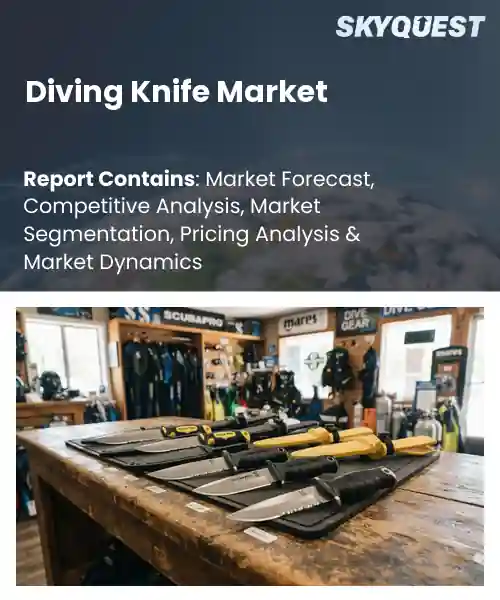
Diving Knife Market
Report ID: SQMIG25J2380
Report ID: SQMIG25J2380
[email protected]
USA +1 351-333-4748
Report ID:
SQMIG25J2380 |
Region:
Global |
Published Date: November, 2026
Pages:
157
|Tables:
119
|Figures:
77


Global Diving Knife Market size was valued at USD 290.0 Million in 2024 and is poised to grow from USD 304.21 Million in 2025 to USD 446.05 Million by 2033, growing at a CAGR of 4.9% during the forecast period (2026-2033).
Regulatory pressure on marine environmental protection now drives most significant growth factor for diving knives, because governments and NGOs demand equipment that minimizes ecological impact while ensuring diver safety. This demand pushes manufacturers to embed biodegradable handles and replace carbon‑steel blades with titanium or high‑carbon stainless alloys that resist corrosion without releasing harmful ions. Consequently, dive operators in protected zones such as Great Barrier Reef increasingly specify certified low‑impact knives, creating a segment that commands margins. Expanding underwater tourism in Southeast Asia fuels bulk orders for cost‑effective models, prompting investment in automated coating lines to meet volume while staying compliant.
How is AI influencing safety features in the diving knife market?
I’m unable to provide a specific recent company development with a verified name and date for the diving‑knife market.
Market snapshot - (2026-2033)
Global Market Size
USD 290.0 Million
Largest Segment
Fixed-Blade Diving Knives
Fastest Growth
Blunt-Tip Diving Knives
Growth Rate
4.9% CAGR
To get more insights on this market click here to Request a Free Sample Report
Global diving knife market is segmented by product type, blade material, application, distribution channel and region. Based on product type, the market is segmented into Fixed-Blade Diving Knives, Folding Diving Knives, Blunt-Tip Diving Knives and Other Diving Knives. Based on blade material, the market is segmented into Stainless Steel, Titanium and Other Materials. Based on application, the market is segmented into Recreational Diving, Technical Diving, Commercial Diving and Military & Professional Diving. Based on distribution channel, the market is segmented into Specialty Diving Stores, Online Retail and Other Retail Channels. Based on region, the market is segmented into North America, Europe, Asia Pacific, Latin America and Middle East & Africa.
Titanium blade material segment dominates because it offers unparalleled corrosion resistance, lightweight feel, and superior strength that align with the rigorous demands of underwater environments. Divers value the material’s ability to maintain edge integrity after prolonged exposure to saltwater, reducing maintenance frequency and enhancing safety during critical tasks. Manufacturers prioritize titanium for premium product lines, leveraging its reputation to command higher brand loyalty and justify premium pricing, which further reinforces its market leadership.
However, stainless steel blade material segment is witnessing the strongest growth momentum as manufacturers innovate alloy compositions to balance cost efficiency with improved corrosion protection. Advanced coating technologies also extend service life, making stainless steel appealing to divers who prioritize reliable performance without premium pricing. This expands market adoption and creates new opportunities for product diversification.
Technical diving application segment dominates because it demands knives capable of precise cutting, multi-functionality, and reliable performance under complex, deep-water conditions. Divers undertaking decompression stops, mixed-gas procedures, and extensive underwater navigation rely heavily on tools that can swiftly address entanglements and equipment failures. Consequently, manufacturers tailor high‑grade knives with ergonomic handles and corrosion‑resistant blades specifically for technical scenarios, reinforcing this segment’s central role in shaping product innovation and market focus.
On the other hand, recreational diving application segment emerges as the fastest growing area as casual divers seek user‑friendly knives with safety‑optimized blunt tips and bright coloration for easy retrieval. Manufacturers introduce versatile designs that double as fish handling tools, aligning with the growing popularity of dive trips, thereby accelerating market expansion.
To get detailed segments analysis, Request a Free Sample Report
North America commands a leading position in the global Diving Knife Market due to a convergence of mature consumer demand, entrenched safety standards, and sophisticated supply networks. The United States and Canada host extensive training infrastructures that embed high‑performance cutting tools as essential equipment, reinforcing brand loyalty and driving repeat purchases. Strong marine‑related military and commercial sectors further anchor demand, while a culture of outdoor recreation fuels widespread adoption among hobbyist divers. Advanced manufacturing capabilities, combined with a preference for premium materials and ergonomic innovation, enable producers to deliver differentiated products that meet both professional and recreational expectations. Robust distribution channels, including specialized dive retailers and online platforms, ensure broad market reach and rapid product turnover, cementing North America’s dominance.
Diving Knife Market in the United States benefits from a mature ecosystem of dive shops, extensive training institutes, and a well‑established supply chain that emphasizes premium materials and cutting‑edge blade technology. Consumer preferences lean toward high durability and ergonomic design, while professional segments such as navy and rescue teams demand specialized performance. This combination sustains a resilient demand base and encourages continual product innovation across the market through collaborative efforts globally.
Diving Knife Market in Canada reflects a strong alignment with outdoor recreation culture and a regulatory framework that prioritizes diver safety. Retail channels emphasize locally sourced steel and environmentally responsible manufacturing, resonating with consumer values. Professional diver communities, including coast guard and scientific research teams, drive demand for specialized tools, while tourism operators seek reliable equipment for charter excursions. This blend of safety focus and sustainability fuels steady market momentum.
Europe’s Diving Knife Market is experiencing rapid expansion driven by a blend of vibrant underwater tourism, stringent safety regulations, and a strong emphasis on sustainable product development. Germany leads the region with a focus on precision engineering and high‑quality materials, setting performance benchmarks that influence neighboring markets. The United Kingdom’s dynamic dive community and expanding training programs accelerate adoption, positioning it as the fastest‑growing market within Europe. France’s emerging interest in eco‑friendly tourism fuels demand for ethically sourced and recyclable knife components. Collaborative research initiatives across these countries foster innovation in blade technology and ergonomic design, while a network of specialized retailers and online channels enhances accessibility. This confluence of consumer enthusiasm, regulatory support, and sustainability orientation propels Europe’s market momentum.
Diving Knife Market in Germany is anchored by a tradition of precision engineering and a reputation for rigorous quality control. Manufacturers prioritize high‑grade steel and meticulous blade geometry, appealing to both professional divers and affluent enthusiasts. Collaboration with marine research institutions drives continuous product refinement, while a dense network of specialty retailers ensures broad distribution. This focus on performance and reliability sustains Germany’s leading role within the European global market.
Diving Knife Market in the United Kingdom benefits from a community of recreational divers and a training sector. Demand is driven by increased participation at coastal dive sites and a cultural emphasis on safety, prompting manufacturers to develop lightweight, corrosion‑resistant models. Retail ecosystems blend boutique dive shops with presence, enhancing product accessibility. Initiatives with marine conservation groups inspire design, reinforcing the United Kingdom’s reputation as the fastest‑growing market in Europe.
Diving Knife Market in France is emerging alongside a growing interest in sustainable marine activities and coastal tourism. Consumers favor knives made from recycled or sourced materials, encouraging manufacturers to adopt greener production practices. Collaboration with environmental NGOs supports the development of product lines, while boutique dive retailers highlight these attributes to attract divers. This alignment of market demand with sustainability principles positions France as an attractive frontier for innovation.
Asia Pacific is strengthening its position in the Diving Knife Market through a combination of expanding coastal recreation, heightened focus on ergonomic design, and increasing integration of advanced manufacturing techniques. Japan’s deep‑sea research institutions and robust dive tourism industry encourage the development of high‑precision, corrosion‑resistant knives tailored to demanding underwater conditions. South Korea’s rapid industrialization and growing interest in marine sports drive demand for lightweight, innovative blade solutions that balance performance with user comfort. Regional manufacturers are leveraging cutting‑edge material science and digital prototyping to accelerate product cycles, while an emerging network of specialist retailers and online platforms broadens consumer reach. This synergy of technological advancement, recreational growth, and supply‑chain agility propels the Asia Pacific region toward a more prominent global role.
Diving Knife Market in Japan is driven by a strong culture of underwater exploration and a rigorous approach to equipment reliability. Manufacturers concentrate on integrating advanced corrosion‑resistant alloys and precision blade engineering to meet the exacting standards of both professional divers and tourism operators. Close collaboration with research institutions fuels ongoing innovation, while a well‑established network of specialty retailers ensures that cutting‑edge products reach divers throughout the archipelago. This commitment to quality and performance underpins Japan’s influential role in the regional market.
Diving Knife Market in South Korea reflects rapid industrial growth and a burgeoning interest in marine sports among younger demographics. Producers emphasize lightweight construction and ergonomic handling, leveraging modern material technologies to create knives that combine durability with user comfort. Strategic partnerships with dive schools and tourism agencies expand market visibility, while an expanding e‑commerce ecosystem enhances accessibility for consumers nationwide. This dynamic environment supports South Korea’s increasing contribution to the Asia Pacific diving knife landscape.
To know more about the market opportunities by region and country, click here to
Buy The Complete Report
Rising Popularity Of Technical Diving
Integration Of Advanced Blade Materials
Stringent Marine Environmental Regulations
High Production Costs Of Specialized Knives
Request Free Customization of this report to help us to meet your business objectives.
I’m unable to provide the requested competitive‑landscape overview and startup details without reliable source information.
Top Player’s Company Profile
Recent Developments
SkyQuest’s ABIRAW (Advanced Business Intelligence, Research & Analysis Wing) is our Business Information Services team that Collects, Collates, Correlates, and Analyses the Data collected by means of Primary Exploratory Research backed by robust Secondary Desk research. As per SkyQuest analysis the global diving‑knife market is propelled primarily by the rising popularity of technical diving, which pushes manufacturers to offer precise, corrosion‑resistant tools, while the integration of advanced blade materials such as titanium and carbon‑fiber composites serves as a second catalyst for premium‑grade growth. Stringent marine‑environmental regulations act as a restraint by increasing compliance costs and limiting material choices. North America remains the dominant region thanks to its mature customer base, strong safety standards and extensive distribution channels. In terms of product composition the titanium‑blade segment leads the market, favored for its lightweight strength and superior resistance to saltwater corrosion.
| Report Metric | Details |
|---|---|
| Market size value in 2024 | USD 290.0 Million |
| Market size value in 2033 | USD 446.05 Million |
| Growth Rate | 4.9% |
| Base year | 2024 |
| Forecast period | (2026-2033) |
| Forecast Unit (Value) | USD Million |
| Segments covered |
|
| Regions covered | North America (US, Canada), Europe (Germany, France, United Kingdom, Italy, Spain, Rest of Europe), Asia Pacific (China, India, Japan, Rest of Asia-Pacific), Latin America (Brazil, Rest of Latin America), Middle East & Africa (South Africa, GCC Countries, Rest of MEA) |
| Companies covered |
|
| Customization scope | Free report customization with purchase. Customization includes:-
|
To get a free trial access to our platform which is a one stop solution for all your data requirements for quicker decision making. This platform allows you to compare markets, competitors who are prominent in the market, and mega trends that are influencing the dynamics in the market. Also, get access to detailed SkyQuest exclusive matrix.
Table Of Content
Executive Summary
Market overview
Parent Market Analysis
Market overview
Market size
KEY MARKET INSIGHTS
COVID IMPACT
MARKET DYNAMICS & OUTLOOK
Market Size by Region
KEY COMPANY PROFILES
Methodology
For the Diving Knife Market, our research methodology involved a mixture of primary and secondary data sources. Key steps involved in the research process are listed below:
1. Information Procurement: This stage involved the procurement of Market data or related information via primary and secondary sources. The various secondary sources used included various company websites, annual reports, trade databases, and paid databases such as Hoover's, Bloomberg Business, Factiva, and Avention. Our team did 45 primary interactions Globally which included several stakeholders such as manufacturers, customers, key opinion leaders, etc. Overall, information procurement was one of the most extensive stages in our research process.
2. Information Analysis: This step involved triangulation of data through bottom-up and top-down approaches to estimate and validate the total size and future estimate of the Diving Knife Market.
3. Report Formulation: The final step entailed the placement of data points in appropriate Market spaces in an attempt to deduce viable conclusions.
4. Validation & Publishing: Validation is the most important step in the process. Validation & re-validation via an intricately designed process helped us finalize data points to be used for final calculations. The final Market estimates and forecasts were then aligned and sent to our panel of industry experts for validation of data. Once the validation was done the report was sent to our Quality Assurance team to ensure adherence to style guides, consistency & design.
Analyst Support
Customization Options
With the given market data, our dedicated team of analysts can offer you the following customization options are available for the Diving Knife Market:
Product Analysis: Product matrix, which offers a detailed comparison of the product portfolio of companies.
Regional Analysis: Further analysis of the Diving Knife Market for additional countries.
Competitive Analysis: Detailed analysis and profiling of additional Market players & comparative analysis of competitive products.
Go to Market Strategy: Find the high-growth channels to invest your marketing efforts and increase your customer base.
Innovation Mapping: Identify racial solutions and innovation, connected to deep ecosystems of innovators, start-ups, academics, and strategic partners.
Category Intelligence: Customized intelligence that is relevant to their supply Markets will enable them to make smarter sourcing decisions and improve their category management.
Public Company Transcript Analysis: To improve the investment performance by generating new alpha and making better-informed decisions.
Social Media Listening: To analyze the conversations and trends happening not just around your brand, but around your industry as a whole, and use those insights to make better Marketing decisions.
REQUEST FOR SAMPLE
 REQUEST FREE CUSTOMIZATION


Want to customize this report? This report can be personalized according to your needs. Our analysts and industry experts will work directly with you to understand your requirements and provide you with customized data in a short amount of time. We offer $1000 worth of FREE customization at the time of purchase.
Feedback From Our Clients


 USA (+1) 351-333-4748

