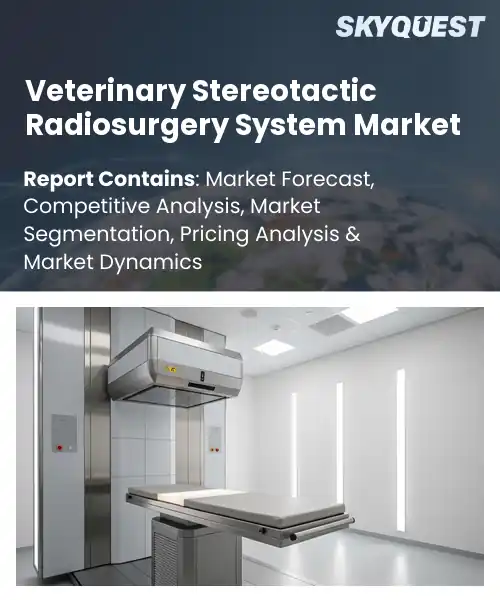
Veterinary Stereotactic Radiosurgery System Market
Report ID: SQMIG35A4013
Report ID: SQMIG35A4013
[email protected]
USA +1 351-333-4748
Report ID:
SQMIG35A4013 |
Region:
Global |
Published Date: June, 2026
Pages:
157
|Tables:
150
|Figures:
78


Global Veterinary Stereotactic Radiosurgery System Market size was valued at USD 3.9 Billion in 2024 and is poised to grow from USD 4.3 Billion in 2025 to USD 9.35 Billion by 2033, growing at a CAGR of 10.2% during the forecast period (2026-2033).
The key driver of the veterinary stereotactic radiosurgery system market is the rising incidence of cancer in companion animals, as well as the increasing willingness of pet owners to pay for advanced care. Stereotactic radiosurgery involves high doses of radiation that precisely target tumours while sparing healthy tissues. Human platforms such as the CyberKnife have been adapted for veterinary use. "The market sees its importance as it provides a less invasive option than major surgery, reduces anesthesia time and maintains quality of life for older pets and so has been adopted by specialty clinics and veterinary teaching hospitals." Adoption has progressed over the last decade from pilot case reports to standardized protocols as outcomes were reported by manufacturers and clinicians.
A major growth driver is the increasing economic accessibility driven by pet insurance expansion and reductions in size and cost of equipment, building on the clinical validation described above. As the number of oncology treatments covered by insurers increases, owners are more likely to opt for stereotactic radiosurgery. This leads to increased case volume that supports investment from private specialty practices. Similarly, compact image-guided linear accelerators and modular service models lower capital barriers, enabling community hospitals to offer single-session brain and nasal tumor treatments that reduce anesthesia and hospital stay. These dynamics offer opportunities for manufacturers to offer training, financing and outcome-based service contracts, and referral networks.
How is AI improving treatment planning in the veterinary stereotactic radiosurgery system market?
AI is changing the game in veterinary stereotactic radiosurgery treatment planning by automating image segmentation, proposing optimal beam paths and enabling adaptive plans responsive to anatomical changes. Key features include AI based auto contouring of organs at risk, dose prediction models and workflow orchestration that reduce planning variability and increase the case throughput. Today’s status is a combination of clinician supervision and AI aided planning tools designed for veterinary workflows. The market demand for accurate non invasive options is growing and vendors are embedding imaging guidance and automation to make them more accessible. Examples include auto segmentation and real time motion tracking in modern radiosurgery suites which improve on consistency.
Accuray In September 2025, the company introduced the Accuray Stellar solution with adaptive planning tools and motion tracking that use AI-driven contouring and plan evaluation. This innovation reduces planning cycles and facilitates training of clinicians, enabling wider use of veterinary stereotactic radiosurgery and improved efficiency across referral centers and specialty hospitals.
Market snapshot - (2026-2033)
Global Market Size
USD 3.9 Billion
Largest Segment
Linear Accelerator (LINAC)-Based Systems
Fastest Growth
CyberKnife Systems
Growth Rate
10.2% CAGR
To get more insights on this market click here to Request a Free Sample Report
Global veterinary stereotactic radiosurgery system market is segmented by product type, animal type, application, technology, end user and region. Based on product type, the market is segmented into Linear Accelerator (LINAC)-Based Systems, CyberKnife Systems, Gamma Knife Systems, Proton Therapy Systems and Others. Based on animal type, the market is segmented into Companion Animals, Livestock Animals and Exotic Animals. Based on application, the market is segmented into Brain Tumors, Spinal Tumors, Head & Neck Tumors, Soft Tissue Tumors and Others. Based on technology, the market is segmented into Image-Guided Radiosurgery, Robotic Radiosurgery, Frameless Radiosurgery and Others. Based on end user, the market is segmented into Veterinary Hospitals, Specialty Veterinary Clinics, Academic & Research Institutes and Others. Based on region, the market is segmented into North America, Europe, Asia Pacific, Latin America and Middle East & Africa.
The Linear Accelerator (LINAC)-Based Systems segment dominates due to the flexibility of these platforms in providing high-energy photon beams suitable for different animal sizes and tumor locations, as well as the ability to seamlessly integrate into existing radiotherapy workflows. The clinical preference is based on compatibility with commonly used imaging and planning systems, dependable beam shaping capabilities, and a knowledge base among radiation oncologists. This allows for repeatable treatment protocols and operational efficiency that support widespread use in veterinary oncology practices.
However, the CyberKnife Systems segment is emerging as the fastest growing segment owing to its robotic delivery and nonisocentric targeting that allows high conformal single-session treatments for difficult anatomies. Vendor-led training, portable treatment workflows and growing clinician confidence in non-invasive stereotactic options accelerate adoption, unlocking premium service lines and attracting referrals that speed market opportunity creation.
Image-Guided Radiosurgery segment leads because of continuous imaging during planning and delivery, which reduces positional uncertainty across different animal anatomies and increases clinician confidence in dose accuracy. Its technological maturity, interoperability with treatment planning platforms and proven ability to verify target coverage in real time, makes it the preferred choice for complex cases driving integration into routine veterinary oncology services and improving treatment outcomes through better targeting.
The segment that is witnessing the strongest growth impetus is the Frameless Radiosurgery, which is driven by the noninvasive immobilization and advanced motion management techniques that lower the duration of anesthesia and enhance the comfort of the companion animals. The adoption is driven by advancements in surface tracking, frameless fixation systems, and growing patient demand for low-risk, outpatient procedures, which allow for scalable clinical workflows and expansion of the addressable patient population for radiosurgical care.
To get detailed segments analysis, Request a Free Sample Report
North America is at the forefront, driven by a sophisticated veterinary oncology infrastructure, well-established specialty hospitals and a strong culture of early adoption of precision therapies. Clinical evidence generation and practitioner familiarity are fueled by the concentration of leading device manufacturers and collaborative networks between academic centers and private referral practices. Commercialization is aided by favorable intellectual property and regulatory clarity, while clinician confidence is boosted by comprehensive post sales services and training programs. Strong distribution and maintenance support coupled with focused service models form the base for widespread deployments across referral centers and specialty clinics, further establishing the region position as the global market leader for veterinary stereotactic radiosurgery solutions. Market leadership is achieved through robust academic programs and ongoing education efforts that develop expertise and encourage the creation of clinical evidence.
The United States Veterinary Stereotactic Radiosurgery System Market is supported by the presence of specialty veterinary hospitals, strong referral networks, advanced clinical training programs, and strong partnerships between device manufacturers and leading veterinary centers. High clinician familiarity with stereotactic techniques, access to post sales support and demand for premium pet care are driving uptake. The market drives comprehensive service packages, training, and research partnerships that encourage early adoption and ongoing use by referring practices.
The Veterinary Stereotactic Radiosurgery System Market Canada is witnessing robust demand driven by concentration of specialty clinics, collaborative provincial referral pathways and focus on high quality companion animal care. Clinical adoption is supported by training initiatives and partnerships with research institutions increasing clinical expertise in radiation oncology. Manufacturers are focusing on tailored service models, easy access to maintenance and clinician education to address geography driven logistics, ensuring systems are reaching regional referral centers and specialty hospitals serving diverse communities.
The expansion of specialty veterinary services, the growth of clinical expertise in radiation oncology and cohesive regulatory frameworks that facilitate cross border commercialization are driving rapid expansion in Europe. Strong referral networks and centralized oncology centers support adoption, and collaborative linkages among academic institutions, professional associations, and manufacturers facilitate knowledge transfer. Increased owner willingness to pursue advanced care, along with targeted training programs and reliable post sales support, improves clinician confidence. The results show a stable demand base and mature providers in Germany, dynamic private investment and accelerating uptake through consolidation in the United Kingdom, and emerging clinical research and demonstration projects in France, as evidence of market heterogeneity. Localized distribution and customized service models reduce barriers to implementation and support ongoing growth in different country markets.
Veterinary Stereotactic Radiosurgery System Market Germany has a high density of specialty clinics, established academic veterinary centers, and coordinated referral pathways that support advanced oncology treatments. Strong traditions of clinical research and the presence of manufacturers enable training and service provision to be localized. High clinician expertise and integrated hospital systems support adoption. Major teaching hospitals use systems well, through tailored selling strategies and strong maintenance networks.
The Veterinary Stereotactic Radiosurgery System Market United Kingdom is characterized by rapid private clinic investment, consolidation of referral practices and active collaboration between manufacturers and specialist clinicians. Training emphasis, post sales service and flexible financing supports adoption in urban referral centres. Increased owner demand for advanced oncology care and streamlined regulatory pathways provide incentives to trial innovative systems, and robust service networks support deployment across specialty practices and forge partnerships with universities across the country.
Veterinary Stereotactic Radiosurgery System Market France is showing emerging adoption driven by veterinary teaching hospitals and research centers exploring advanced oncology therapies. The expansion is backed by clinical partnerships, pilot projects and clinician training programs. Targeted demonstrations and localized servicing arrangements also address regional needs. A progressive uptake, driven by increasing owner awareness and reinforcing referral networks, is positioning France as an emerging contributor to regional market development and innovation.
Asia Pacific is investing in specialty veterinary care and building clinical expertise and partnerships with global and regional manufacturers to grow its market position. Key markets are investing in clinician training, demonstration projects and service infrastructure to lower implementation barriers and facilitate scalable deployment. Facilitating collaboration between academic institutions and private referral centers stimulates local evidence generation and uptake of clinical best practices. Manufacturers tailor products and service models to local needs, highlighting remote support and modular installations suitable for a range of clinical settings. Owners are demanding more sophisticated companion animal care, and improved distribution channels and focused commercialization efforts are leading to broader system roll-out and the development of regional centers of excellence, especially in technologically advanced markets.
Japan’s veterinary stereotactic radiosurgery system market has a developed clinical infrastructure, a robust base of veterinary specialists and a close interaction between manufacturers and referral centers that facilitate the adoption of the technology. Precision medicine and clinical research emphasis drives evidence generation and practitioner confidence. Manufacturers provide localized training, strong maintenance programs, customized solutions that are a fit for clinical workflows. These factors, combined with owner demands for high quality pet care, fuel adoption in referral hospitals.
The system is adopted thanks to South Korea’s strong technology base, active clinical research and collaboration between device manufacturers and veterinary centers. Strong after sales support, clinician training programs and focused demonstration projects develops practitioner confidence. The flexible service models and effective distribution are a boon to urban referral hospitals and specialized clinics, allowing integration of stereotactic radiosurgery into advanced veterinary oncology pathways and promoting wider adoption.
To know more about the market opportunities by region and country, click here to
Buy The Complete Report
Increasing Demand For Precision Treatment
Advances In Imaging and Software
High Capital Investment Requirements
Limited Trained Clinical Personnel
Request Free Customization of this report to help us to meet your business objectives.
Competitive intensity is on the rise in the global veterinary stereotactic radiosurgery system market as leading human oncology vendors and specialized medtech startups vie to adapt human grade SRS equipment and planning software for animal care. Strategic moves include Siemens Healthineers’ acquisition of Varian. Recent partnerships and launches such as OncoSoft’s veterinary product and Terapet’s imaging collaborations are shifting competition to integrated hardware software solutions.
SkyQuest’s ABIRAW (Advanced Business Intelligence, Research & Analysis Wing) is our Business Information Services team that Collects, Collates, Correlates, and Analyses the Data collected by means of Primary Exploratory Research backed by robust Secondary Desk research. As per SkyQuest analysis, a key driver is rising cancer incidence in companion animals combined with pet owners' greater willingness to pay for precision, minimally invasive options, which is pushing adoption across referral centers. A restraint is the high capital investment required for systems, facility upgrades and specialized training that limits uptake by smaller practices. The dominating region is North America, supported by advanced veterinary oncology infrastructure and strong post-sales networks, while the dominating segment is Linear Accelerator (LINAC)-based systems due to versatility and workflow compatibility. A second driver is expanding economic accessibility through pet insurance growth and smaller, modular equipment that lower barriers to purchase and operation.
| Report Metric | Details |
|---|---|
| Market size value in 2024 | USD 3.9 Billion |
| Market size value in 2033 | USD 9.35 Billion |
| Growth Rate | 10.2% |
| Base year | 2024 |
| Forecast period | (2026-2033) |
| Forecast Unit (Value) | USD Billion |
| Segments covered |
|
| Regions covered | North America (US, Canada), Europe (Germany, France, United Kingdom, Italy, Spain, Rest of Europe), Asia Pacific (China, India, Japan, Rest of Asia-Pacific), Latin America (Brazil, Rest of Latin America), Middle East & Africa (South Africa, GCC Countries, Rest of MEA) |
| Companies covered |
|
| Customization scope | Free report customization with purchase. Customization includes:-
|
To get a free trial access to our platform which is a one stop solution for all your data requirements for quicker decision making. This platform allows you to compare markets, competitors who are prominent in the market, and mega trends that are influencing the dynamics in the market. Also, get access to detailed SkyQuest exclusive matrix.
Table Of Content
Executive Summary
Market overview
Parent Market Analysis
Market overview
Market size
KEY MARKET INSIGHTS
COVID IMPACT
MARKET DYNAMICS & OUTLOOK
Market Size by Region
KEY COMPANY PROFILES
Methodology
For the Veterinary Stereotactic Radiosurgery System Market, our research methodology involved a mixture of primary and secondary data sources. Key steps involved in the research process are listed below:
1. Information Procurement: This stage involved the procurement of Market data or related information via primary and secondary sources. The various secondary sources used included various company websites, annual reports, trade databases, and paid databases such as Hoover's, Bloomberg Business, Factiva, and Avention. Our team did 45 primary interactions Globally which included several stakeholders such as manufacturers, customers, key opinion leaders, etc. Overall, information procurement was one of the most extensive stages in our research process.
2. Information Analysis: This step involved triangulation of data through bottom-up and top-down approaches to estimate and validate the total size and future estimate of the Veterinary Stereotactic Radiosurgery System Market.
3. Report Formulation: The final step entailed the placement of data points in appropriate Market spaces in an attempt to deduce viable conclusions.
4. Validation & Publishing: Validation is the most important step in the process. Validation & re-validation via an intricately designed process helped us finalize data points to be used for final calculations. The final Market estimates and forecasts were then aligned and sent to our panel of industry experts for validation of data. Once the validation was done the report was sent to our Quality Assurance team to ensure adherence to style guides, consistency & design.
Analyst Support
Customization Options
With the given market data, our dedicated team of analysts can offer you the following customization options are available for the Veterinary Stereotactic Radiosurgery System Market:
Product Analysis: Product matrix, which offers a detailed comparison of the product portfolio of companies.
Regional Analysis: Further analysis of the Veterinary Stereotactic Radiosurgery System Market for additional countries.
Competitive Analysis: Detailed analysis and profiling of additional Market players & comparative analysis of competitive products.
Go to Market Strategy: Find the high-growth channels to invest your marketing efforts and increase your customer base.
Innovation Mapping: Identify racial solutions and innovation, connected to deep ecosystems of innovators, start-ups, academics, and strategic partners.
Category Intelligence: Customized intelligence that is relevant to their supply Markets will enable them to make smarter sourcing decisions and improve their category management.
Public Company Transcript Analysis: To improve the investment performance by generating new alpha and making better-informed decisions.
Social Media Listening: To analyze the conversations and trends happening not just around your brand, but around your industry as a whole, and use those insights to make better Marketing decisions.
REQUEST FOR SAMPLE
 REQUEST FREE CUSTOMIZATION
Global Veterinary Stereotactic Radiosurgery System Market size was valued at USD 3.9 Billion in 2024 and is poised to grow from USD 4.3 Billion in 2025 to USD 9.35 Billion by 2033, growing at a CAGR of 10.2% during the forecast period (2026-2033).
Competitive intensity in the global veterinary stereotactic radiosurgery system market is rising as major human oncology vendors and specialised medtech startups compete to adapt human grade SRS equipment and planning software for animal care. Strategic moves include Siemens Healthineers acquisition of Varian. Recent partnerships and launches such as OncoSoft’s veterinary product and Terapet’s imaging collaborations are shifting competition toward integrated hardware software solutions. 'Varian Medical Systems, Inc.', 'Elekta AB', 'Accuray Incorporated', 'Brainlab AG', 'Siemens Healthineers AG', 'GE HealthCare Technologies Inc.', 'Hitachi, Ltd.', 'Mevion Medical Systems, Inc.', 'Panacea Medical Technologies Pvt. Ltd.', 'ViewRay Technologies, Inc.', 'Shenzhen Institute of Advanced Technology', 'Mitsubishi Electric Corporation', 'ZAP Surgical Systems, Inc.', 'RaySearch Laboratories AB', 'IBA Worldwide', 'Best Medical International, Inc.', 'Neusoft Medical Systems Co., Ltd.', 'Sensus Healthcare, Inc.', 'P-Cure Ltd.', 'Canon Medical Systems Corporation'
In veterinary oncology and neurosurgery, growing preference for precise, minimally invasive interventions drives adoption of stereotactic radiosurgery systems because they enable targeted tumor ablation while preserving surrounding healthy tissue. Veterinary clinicians seek technologies that improve procedural accuracy, reduce recovery times, and expand treatment options for complex cases, which in turn motivates clinics and referral centers to invest in specialized equipment. Manufacturers and distributors respond by prioritizing product availability, training, and support, reinforcing market expansion as clinical demand aligns with available advanced therapeutic solutions.
Imaging Integration Advances: Enhanced integration with advanced imaging modalities is enabling more precise lesion targeting and treatment planning in veterinary stereotactic radiosurgery systems. Seamless interoperability with CT, MRI and ultrasound, combined with improved planning software, supports multidisciplinary workflows and facilitates referrals from general practices. This trend reduces procedure time and anesthetic exposure, expands treatable indications across species, and fosters confidence among clinicians. Greater imaging synergy also drives demand for systems that can be adapted to existing clinic infrastructure and supports clinical protocol standardization.
Why does North America Dominate the Global Veterinary Stereotactic Radiosurgery System Market? |@12


Want to customize this report? This report can be personalized according to your needs. Our analysts and industry experts will work directly with you to understand your requirements and provide you with customized data in a short amount of time. We offer $1000 worth of FREE customization at the time of purchase.
Feedback From Our Clients


 USA (+1) 351-333-4748

