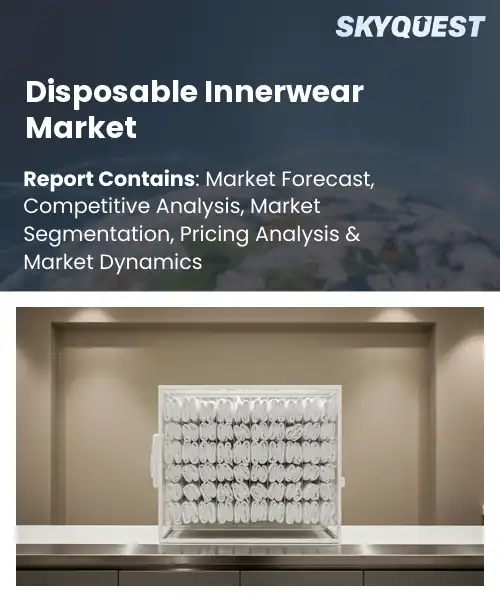
Disposable Innerwear Market
Report ID: SQMIG25K2213
Report ID: SQMIG25K2213
[email protected]
USA +1 351-333-4748
Report ID:
SQMIG25K2213 |
Region:
Global |
Published Date: July, 2026
Pages:
157
|Tables:
174
|Figures:
79


Global Disposable Innerwear Market size was valued at USD 2.1 Billion in 2024 and is poised to grow from USD 2.2 Billion in 2025 to USD 3.22 Billion by 2033, growing at a CAGR of 4.85% during the forecast period (2026-2033).
The global disposable innerwear market is centered on single-use garments for hygiene, convenience and infection control. The primary driver is increasing demand for sanitary solutions in healthcare facilities where patients and staff require quick-change products to minimize cross-contamination. The industry’s origins lie in the early 2000s, when hospitals began swapping out reusable cloth for disposable gowns and diapers, a trend that was hastened by outbreaks like SARS and COVID-19, exposing weaknesses in traditional laundering systems. Today, more and more manufacturers are expanding product lines to include biodegradable fabrics and antimicrobial finishes, both in response to environmental pressure and the global need for safer patient experiences. Another aspect fueling the market growth is the increasing acceptance of disposable innerwear by consumers for comfort during traveling, sports, and postpartum recovery.
As convenience becomes a factor in reducing laundry time, consumers are drawn to products that tout moisture-wicking performance and odor control, and retailers are responding by carrying those options along with their lines. That change is fueling investment in materials such as bamboo fibers and absorbent polymers that reduce skin irritation and increase wear time, creating a feedback loop that stimulates demand. Manufacturers are cashing in on convenience and health considerations, from airlines handing out disposable briefs to passengers, to maternity clinics handing out reusable-free panties.
How is AI-driven Automation Influencing Product Customization In The Disposable Innerwear Market?
AI powered automation is transforming the design and manufacturing of disposable innerwear. Machine-learning models generate fit profiles based on consumer feedback, body measurements and usage data. Robotic stitching and material dispensing, in production lines, adapt in real time to those profiles. This reduces overstock of generic sizes and allows for limited runs of personalized styles. Skin friendly coatings, scent, absorbency level etc., which can be offered by brands as per individual preferences. The approach also reduces the time from concept to shelf, enabling companies to respond quickly to emerging trends while controlling costs.
Kimberly Clark launched an AI platform in April 2024 that personalizes absorbency patterns to individual body shapes, drives down material waste and speeds delivery of custom packs. The launch is a demonstration of the impact of data-driven design on market growth and user experience. It also allows retailers to provide on demand inventory according to seasonal demand.
Market snapshot - 2026-2033
Global Market Size
USD 2.1 Billion
Largest Segment
Disposable Briefs
Fastest Growth
Disposable Panties
Growth Rate
4.85% CAGR
To get more insights on this market click here to Request a Free Sample Report
Global disposable innerwear market is segmented by product type, material type, end user, application, distribution channel, usage and region. Based on product type, the market is segmented into Disposable Briefs, Disposable Panties, Disposable Bras and Others. Based on material type, the market is segmented into Nonwoven Fabric, Cotton-Based Fabric, Blended Fabric and Others. Based on end user, the market is segmented into Men, Women and Children. Based on application, the market is segmented into Healthcare, Travel, Personal Care and Others. Based on distribution channel, the market is segmented into Pharmacies, Supermarkets & Hypermarkets, Online Retail and Others. Based on usage, the market is segmented into Single Use and Limited Multi-Use. Based on region, the market is segmented into North America, Europe, Asia Pacific, Latin America and Middle East & Africa.
The disposable briefs segment had the largest share, as it offers immediate comfort and hygiene for the users who require quick changes, particularly in clinical and travel scenarios. Their simple design, low cost and easy disposal fit with buyer preferences for convenience. Manufacturers rely on efficient supply chains and low inventory levels so mass production is a priority. So disposable briefs are the purchase of choice for bulk, further entrenching their market leadership across consumer and institutional channels.
Whereas, disposable bras segment is expected to be the fastest growing segment owing to increasing awareness regarding personal hygiene among women and increasing use in postsurgical care. New, breathable designs and on-trend aesthetics boost appeal beyond medical use, prompting retailers to expand their assortments and creating new revenue streams for producers.
Nonwoven fabric segment dominates because it offers excellent superior absorbivity and barrier performance while remaining lightweight and cost effective for single-use applications. The production process enables efficiently rapid scaling without complex weaving, meeting the today’s high turnover needs of healthcare facilities and travel retail. Its inherent disposability satisfies hygiene regulations, and manufacturers can incorporate antimicrobial treatments that enhance safety. These attributes solidify its position as the preferred material across most disposable innerwear offerings.
On the other hand, blended fabric segment is witnessing growth momentum because it merges the softness of cotton with the durability of synthetics, appealing to consumers seeking comfort without compromising performance. Advances in ecofriendly blending techniques attract sustainability focused buyers, prompting brands to expand lines and unlocking market opportunities.
To get detailed segments analysis, Request a Free Sample Report
The region is characterized by a confluence of cultural acceptance, brisk urbanization, and robust distribution networks stressing convenience and hygiene. In many APAC economies, consumer preferences are shifting increasingly towards single‑use solutions for both medical and lifestyle applications, with greater awareness of infection control and a fast moving retail environment. By employing advanced textile technologies and low-cost manufacturing bases, manufacturers can provide a broad range of designs to satisfy a wide variety of comfort and absorption needs. Strong e-commerce platforms and deep penetration retail channels enhance accessibility, and government health initiatives endorse disposable options in clinical settings. All these elements together form a self-reinforcing ecosystem that keeps Asia Pacific on top of the market.
Japan’s Disposable Innerwear Market thrives on a discerning consumer base that gives importance to quality, discretion and innovation. Advanced manufacturing capabilities provide high-performance fabrics that meet the market demand for comfort and reliability. Retail channels are fully integrated with convenience stores and online platforms ensuring instant availability. The cultural emphasis on cleanliness and personal care drives that acceptance of disposable solutions in the hospital and the home. Local brands’ strategic alliances with multinational players boost product diversity and keep the market buzzing.
The South Korea Disposable Innerwear Market is driven by tech-savvy population who prefers online shopping and fast-paced product turnover. Efficient supply chains and proximity to manufacturing hubs shorten lead times and foster a continuous flow of new designs. High importance on health and wellness and Government encouragement of hygienic practices drive adoption in medical and everyday environments. Innovative material blends that address climate adaptability are a market advantage, making disposable innerwear a preferred option for active lifestyles and caregiving scenarios as well.
Growing emphasis on health, evolving lifestyle patterns and stringent regulatory standards driving the use of disposable hygiene products are driving growth in Europe. Across the continent, consumers are searching for easy, single-use substitutes that match busy urban lifestyles and an increased awareness of infection risk. The manufacturers respond with eco-friendly production techniques and flexible product lines that serve both medical and personal purposes. A robust retail infrastructure, including pharmacy chains or digital marketplaces, makes products visible to a wide audience. Cross-border trade within the European Union further facilitates the expansion of both established and new brands. These dynamics together work to accelerate growth and cement Europe as a vibrant market for disposable innerwear.
Disposable Innerwear Market in Germany stands out through a robust healthcare system that endorses disposable solutions for patient comfort and infection control. The market benefits from a reputation for engineering precision, resulting in high‑quality products that meet exacting standards. Retail networks combine traditional drugstores with sophisticated e‑commerce platforms, offering broad consumer reach. An emphasis on sustainability drives manufacturers to adopt recyclable materials, resonating with environmentally conscious shoppers. Together, these elements reinforce Germany’s leading status in the European landscape.
Disposable Innerwear Market in United Kingdom experiences swift growth driven by a dynamic e‑commerce environment and a cultural shift toward convenience. Consumers prioritize discreet, easy‑to‑use products for both medical and everyday needs, fostering rapid adoption. Retailers incorporate subscription models and fast‑delivery services, reducing friction in the purchase journey. Influential health campaigns promote the benefits of disposable hygiene solutions, especially in public settings. The fusion of technological adoption and proactive consumer education fuels the market’s accelerated expansion.
Disposable Innerwear Market in France is emerging as a niche yet promising segment, supported by growing awareness of personal hygiene and comfort. French consumers exhibit a preference for premium, soft‑touch materials that align with lifestyle expectations. Boutique retailers and online platforms collaborate to introduce curated collections that emphasize design and functionality. Health initiatives encourage the use of disposable products in clinical environments, gradually extending acceptance to home care. This balanced focus on quality and convenience positions France as an emerging contributor to Europe’s broader market trajectory.
North America advances its role through a blend of consumer demand for convenience, innovative product development, and extensive distribution reach. The market benefits from a strong culture of personal care that embraces single‑use solutions for both medical and lifestyle applications. Companies invest heavily in research to create breathable, high‑absorbency fabrics that enhance comfort while addressing environmental concerns. Retail landscapes encompass large‑scale chains, specialty stores, and robust online ecosystems, ensuring widespread availability. Collaborative efforts between healthcare providers and manufacturers promote the integration of disposable innerwear into standard care protocols. These strategic initiatives collectively elevate North America’s influence within the global disposable innerwear arena.
Disposable Innerwear Market in United States expands through a vigorous retail network that emphasizes speed and convenience. Consumers value product variety that caters to diverse lifestyles, from athletic to caregiving needs. Innovation in material science yields softer, more absorbent products that align with consumer expectations for comfort. Influential health advocacy groups champion disposable options for infection prevention, reinforcing market acceptance. Integration of subscription services and omnichannel strategies further amplifies accessibility, solidifying the United States as a key driver of market growth.
Disposable Innerwear Market in Canada reflects a balance between health‑focused public policy and consumer preference for practicality. The market leverages cold‑climate textile expertise to produce warm, breathable disposable solutions suited for seasonal demands. Retail channels combine pharmacy chains with online platforms, ensuring that products reach remote and urban populations alike. Health authorities promote disposable innerwear for hospital use and home caregiving, enhancing overall market perception. This convergence of climate‑adapted innovation and supportive distribution underpins Canada’s strengthening position in the sector.
To know more about the market opportunities by region and country, click here to
Buy The Complete Report
Increasing Urban Lifestyle Demand
Rising Environmental Awareness
Higher Production Cost Pressures
Regulatory Scrutiny on Materials
Request Free Customization of this report to help us to meet your business objectives.
The competitive landscape is shaped by aggressive capital inflows and rapid product innovation, with firms leveraging sizable funding to expand disposable innerwear lines and secure market share. SKIMS’s $154 million round and Joyvié Health’s €897 k seed raise illustrate how investment drives new material technologies and distribution partnerships, intensifying rivalry among both established brands and emerging specialists.
SkyQuest’s ABIRAW (Advanced Business Intelligence, Research & Analysis Wing) is our Business Information Services team that Collects, Collates, Correlates, and Analyses the Data collected by means of Primary Exploratory Research backed by robust Secondary Desk research.
As per SkyQuest analysis, the global disposable innerwear market is propelled primarily by increasing urban‑lifestyle demand, as busy consumers seek convenient, hygienic garments for travel, sports and post‑care use, while a growing environmental awareness is acting as a second driver that pushes manufacturers toward biodegradable fabrics and eco‑friendly packaging. However, higher production‑cost pressures restrain broader adoption, especially in price‑sensitive markets. The Asia Pacific region dominates the market, benefiting from rapid urbanization, strong distribution networks and cultural acceptance of single‑use solutions. Within the product landscape, disposable briefs remain the leading segment, due to their simplicity, low cost and bulk‑procurement appeal across both healthcare and consumer channels.
| Report Metric | Details |
|---|---|
| Market size value in 2024 | USD 2.1 Billion |
| Market size value in 2033 | USD 3.22 Billion |
| Growth Rate | 4.85% |
| Base year | 2024 |
| Forecast period | 2026-2033 |
| Forecast Unit (Value) | USD Billion |
| Segments covered |
|
| Regions covered | North America (US, Canada), Europe (Germany, France, United Kingdom, Italy, Spain, Rest of Europe), Asia Pacific (China, India, Japan, Rest of Asia-Pacific), Latin America (Brazil, Rest of Latin America), Middle East & Africa (South Africa, GCC Countries, Rest of MEA) |
| Companies covered |
|
| Customization scope | Free report customization with purchase. Customization includes:-
|
To get a free trial access to our platform which is a one stop solution for all your data requirements for quicker decision making. This platform allows you to compare markets, competitors who are prominent in the market, and mega trends that are influencing the dynamics in the market. Also, get access to detailed SkyQuest exclusive matrix.
Table Of Content
Executive Summary
Market overview
Parent Market Analysis
Market overview
Market size
KEY MARKET INSIGHTS
COVID IMPACT
MARKET DYNAMICS & OUTLOOK
Market Size by Region
KEY COMPANY PROFILES
Methodology
For the Disposable Innerwear Market, our research methodology involved a mixture of primary and secondary data sources. Key steps involved in the research process are listed below:
1. Information Procurement: This stage involved the procurement of Market data or related information via primary and secondary sources. The various secondary sources used included various company websites, annual reports, trade databases, and paid databases such as Hoover's, Bloomberg Business, Factiva, and Avention. Our team did 45 primary interactions Globally which included several stakeholders such as manufacturers, customers, key opinion leaders, etc. Overall, information procurement was one of the most extensive stages in our research process.
2. Information Analysis: This step involved triangulation of data through bottom-up and top-down approaches to estimate and validate the total size and future estimate of the Disposable Innerwear Market.
3. Report Formulation: The final step entailed the placement of data points in appropriate Market spaces in an attempt to deduce viable conclusions.
4. Validation & Publishing: Validation is the most important step in the process. Validation & re-validation via an intricately designed process helped us finalize data points to be used for final calculations. The final Market estimates and forecasts were then aligned and sent to our panel of industry experts for validation of data. Once the validation was done the report was sent to our Quality Assurance team to ensure adherence to style guides, consistency & design.
Analyst Support
Customization Options
With the given market data, our dedicated team of analysts can offer you the following customization options are available for the Disposable Innerwear Market:
Product Analysis: Product matrix, which offers a detailed comparison of the product portfolio of companies.
Regional Analysis: Further analysis of the Disposable Innerwear Market for additional countries.
Competitive Analysis: Detailed analysis and profiling of additional Market players & comparative analysis of competitive products.
Go to Market Strategy: Find the high-growth channels to invest your marketing efforts and increase your customer base.
Innovation Mapping: Identify racial solutions and innovation, connected to deep ecosystems of innovators, start-ups, academics, and strategic partners.
Category Intelligence: Customized intelligence that is relevant to their supply Markets will enable them to make smarter sourcing decisions and improve their category management.
Public Company Transcript Analysis: To improve the investment performance by generating new alpha and making better-informed decisions.
Social Media Listening: To analyze the conversations and trends happening not just around your brand, but around your industry as a whole, and use those insights to make better Marketing decisions.
REQUEST FOR SAMPLE
 REQUEST FREE CUSTOMIZATION
Global Disposable Innerwear Market size was valued at USD 2.1 Billion in 2024 and is poised to grow from USD 2.2 Billion in 2025 to USD 3.22 Billion by 2033, growing at a CAGR of 4.85% during the forecast period (2026-2033).
The competitive landscape is shaped by aggressive capital inflows and rapid product innovation, with firms leveraging sizable funding to expand disposable innerwear lines and secure market share. SKIMS’s $154 million round and Joyvié Health’s €897 k seed raise illustrate how investment drives new material technologies and distribution partnerships, intensifying rivalry among both established brands and emerging specialists. 'Essity AB', 'Kimberly-Clark Corporation', 'Ontex Group NV', 'Medline Industries, LP', 'Cardinal Health, Inc.', 'Attends Healthcare Products, Inc.', 'First Quality Enterprises, Inc.', 'TZMO SA', 'Paul Hartmann AG', 'Abena A/S', 'Unicharm Corporation', 'Domtar Corporation', 'Hengan International Group Company Limited', 'Winner Medical Co., Ltd.', 'Medpride LLC', 'Dynarex Corporation', 'Caretex Co., Ltd.', 'Seni (TZMO Group)', 'Principle Business Enterprises, Inc.', 'Medtecs International Corporation Limited'
The shift toward compact living spaces and on‑the‑go activities fuels consumer preference for lightweight, disposable innerwear that offers convenience without laundering. This convenience aligns with busy urban schedules, prompting retailers to expand assortments and encouraging manufacturers to innovate packaging and sizing. As convenience becomes a core purchase criterion, brand loyalty strengthens, prompting repeated acquisitions and supporting market expansion through word‑of‑mouth recommendation and expanded distribution channels. Additionally, the perceived hygiene advantage of single‑use garments reinforces purchase intent among health‑conscious shoppers, further driving demand across diverse demographic segments.
Sustainable Materials Driving Adoption: Consumer preference for environmentally responsible products is reshaping the disposable innerwear segment, prompting manufacturers to explore biodegradable polymers, recycled fibers, and water‑based processing. Brands that transparently communicate sustainable credentials gain loyalty, while retailers expand eco‑focused assortments. Partnerships with material innovators accelerate the rollout of compostable options, and regulatory encouragement of circular solutions further reinforces market momentum. This shift not only differentiates product lines but also opens premium pricing opportunities and aligns the sector with broader sustainability agendas.
Why does Asia Pacific Dominate the Global Disposable Innerwear Market? |@12


Want to customize this report? This report can be personalized according to your needs. Our analysts and industry experts will work directly with you to understand your requirements and provide you with customized data in a short amount of time. We offer $1000 worth of FREE customization at the time of purchase.
Feedback From Our Clients


 USA (+1) 351-333-4748

