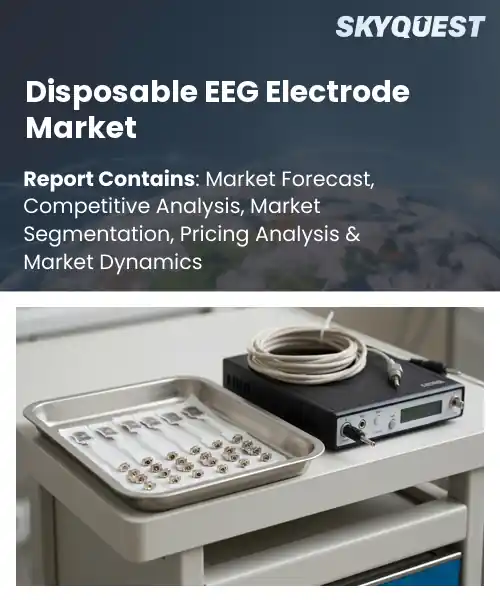
Disposable EEG Electrode Market
Report ID: SQMIG35A3505
Report ID: SQMIG35A3505
[email protected]
USA +1 351-333-4748
Report ID:
SQMIG35A3505 |
Region:
Global |
Published Date: May, 2026
Pages:
157
|Tables:
184
|Figures:
79


Global Disposable Eeg Electrode Market size was valued at USD 420.0 Million in 2024 and is poised to grow from USD 444.36 Million in 2025 to USD 697.62 Million by 2033, growing at a CAGR of 5.8% during the forecast period (2026-2033).
The disposable EEG electrode market as the segment that supplies single use sensors and consumables for electroencephalography applications in hospitals clinics centers and home monitoring. Its primary driver is the rising demand for infection control along with increasing neurological disease prevalence which has pushed clinicians and facilities to prefer disposable options to reusable alternatives. Over time the market evolved from basic adhesive electrodes toward improved hydrogel technologies and preconfigured electrode arrays that reduce setup time and motion artifact, for example neonatal monitoring systems and ambulatory EEG kits, which illustrate both clinical need and efficiency.
Because clinicians and facilities prioritize safety and workflow efficiency, manufacturers invest in performance disposable electrodes that reduce setup time and minimize contamination risk, thereby accelerating adoption across inpatient and outpatient settings. As ambulatory and home based monitoring expand, demand causes development of softer adhesives and wireless compatible electrode arrays that improve patient comfort and signal fidelity in long recordings, enabling use in epilepsy diagnosis and cognitive research. Moreover regulatory emphasis on single use devices and favorable reimbursement for remote neurodiagnostics create commercial incentives, so suppliers can scale manufacturing, pursue OEM integrations and offer bundled disposables that meet clinicians' immediate needs.
How can AI-Driven Analytics Improve Clinical Reliability Of Disposable EEG Electrodes?
AI driven analytics can improve clinical reliability of disposable EEG electrodes by detecting artifacts, monitoring electrode impedance trends, and delivering immediate feedback to technologists and device manufacturers. Key features involve automatic classification of artifacts, scoring of signal quality and incorporation into clinical workflow to facilitate faster triage. The current landscape has variability attributed to adhesive failure, movement and ambient noise; there is also increasing demand for disposable electrodes due to infection control and overall efficiency reasons. There are many emerging solutions that combine single-use electrodes with analytical methods to decrease the need for repeat recordings. A number of vendors are also developing standalone disposable biopotential product lines and analytical workflow solutions to create EEG recordings that are both consistent and clinically useful.
In March 2026, Natus launched the autoSCORE AI analysis tool which flags abnormal segments and highlights artifact prone recordings, enabling clinicians to prioritize high quality data and manufacturers to refine electrode design. This AI driven feedback loop supports broader adoption of disposable electrodes by improving diagnostic yield and operational efficiency.
Market snapshot - (2026-2033)
Global Market Size
USD 420.0 Million
Largest Segment
Pre-gelled EEG Electrodes
Fastest Growth
Dry EEG Electrodes
Growth Rate
5.8% CAGR
To get more insights on this market click here to Request a Free Sample Report
Global disposable eeg electrode market is segmented by product type, material type, application, end user, patient type, distribution channel and region. Based on product type, the market is segmented into Cup EEG Electrodes, Needle EEG Electrodes, Foam EEG Electrodes, Adhesive EEG Electrodes, Dry EEG Electrodes, Pre-gelled EEG Electrodes and Others. Based on material type, the market is segmented into Silver/Silver Chloride Electrodes, Gold Electrodes, Stainless Steel Electrodes, Polymer-based Electrodes and Others. Based on application, the market is segmented into Routine EEG Monitoring, Long-term EEG Monitoring, Sleep Disorder Diagnosis, Epilepsy Monitoring, Intraoperative Monitoring, Brain-computer Interface Applications and Others. Based on end user, the market is segmented into Hospitals, Neurology Clinics, Diagnostic Centers, Ambulatory Surgical Centers, Research Institutes and Others. Based on patient type, the market is segmented into Adult, Pediatric and Geriatric. Based on distribution channel, the market is segmented into Direct Sales, Medical Device Distributors and Online Sales. Based on region, the market is segmented into North America, Europe, Asia Pacific, Latin America and Middle East & Africa.
Adhesive EEG electrodes segment dominates because their ready to use format and reliable skin adhesion reduce setup time and minimize signal disruption, making them the default choice for routine clinical workflows. Single use hygiene profiles help to reduce the possibility of cross contamination and have consequently created interest from procurement teams associated with patient care. Furthermore, standard monitoring systems can be utilized in conjunction with, or are compatible with, these electrodes; and their predictable impedance characteristics allow technicians easy to learn how to use them. In addition to these features, single use hygiene profiles have resulted in a large amount of use adoption momentum in point-of-care locations, and solidified that these electrodes remain the leaders in disposable EEG electrodes market.
However, dry EEG electrodes are emerging as the fastest growing product choice due to advances in contact materials and user comfort that remove the need for conductive gels, enabling quicker patient turnover and suitability for ambulatory and wearable monitoring. Their alignment with mobile platforms and interest from brain computer interface developers drives investment, expanding application use cases and future procurement opportunities.
Silver/silver chloride electrodes segment dominates because their electrochemical stability and low noise characteristics deliver consistently high quality biopotential recordings that clinicians rely on for diagnostic confidence. Having established compatibility with conductive media and standardized reference behaviour, this results in reduced signal variability; making interpretations and clinical workflows simpler. High levels of acceptance of clinical use and perceived reliability will drive procurement choices and organisation preferences creating a key element in shaping performance expectations among the Disposable EEG Electrode market.
However, polymer based electrodes are emerging as the fastest growing material choice, fueled by advances in flexible conductive inks and biocompatible substrates that enable conformal contact and integration with wearable monitoring systems. Their manufacturing scalability and design adaptability attract developers focused on ambulatory monitoring and brain computer interface applications, accelerating product innovation and opening new commercial pathways within the disposable EEG electrode Market.
To get detailed segments analysis, Request a Free Sample Report
As per the global disposable EEG electrode market share, North America dominates the industry due to a confluence of health system strengths, innovation, and commercial ecosystem advantages. A mature clinical infrastructure combined with a high level of adoption of advanced monitoring technology provides for ongoing institutional demand for these products. In addition, hospitals are placing a greater emphasis on infection control, which increases the need for the use of single use products. These factors, in conjunction with an established medical device industry; active clinical research; and defined regulatory pathways, drive product development and increase the ability to rapidly develop, introduce, and distribute products. In addition, the availability of reimbursement mechanisms and the concentration of expertise in the field of neurology provide added incentive for the purchase of disposable electrodes. Furthermore, hospital systems that partner with large hospital systems and distributors provide an effective method for facilitating market access.
Disposable EEG electrode market in United States is characterized by extensive hospital networks, advanced neurology centers, and high clinical adoption of single use devices. Group-buying in a very close manner between device manufacturers and health systems speeds product trials and procurement. Focus on infection control, metrics, and an expedited supply chain maintain institutional preferences for disposable products. Active clinical research and training programs actively sustain clinician confidence, leading to a successful integration of disposable electrodes into routine neurodiagnostic workflows.
Disposable EEG electrode market in Canada combines universal healthcare frameworks with growing focus on infection control and patient safety, encouraging adoption of single use electrodes across care settings. Accreditation priorities, supply reliability and collaboration between distributors and global manufacturers also influence their purchasing decisions for hospital supplies. Additionally, having training initiatives on how to use disposable electrode protocols as well as having strong resources in neurology services will aid in embedding these protocols into both acute care and ambulatory practice.
Based on global disposable EEG electrode regional forecast, rapid expansion in Europe is driven by harmonized regulatory standards, widespread modernization of hospital equipment, and heightened emphasis on infection prevention across national healthcare systems. The use of single-use electrodes is being promoted by many centralized procurement programs and group purchasing organizations offering standardized tender submissions for the purchase of these products while guidelines for clinical practice reference more frequently disposable options for treatment of patients in both acute care settings and outpatient neurology. Additionally, the combination of established medical device manufacturers producing disposable products along with a cooperative research environment has led to many innovative products being developed specifically for different clinical care settings. Other supports such as cross-border sharing/connections exchanging knowledge and education/training of neurodiagnostic teams are fast-tracking to achieve acceptance into practice.
Disposable EEG electrode market in Germany is anchored by a strong medical technology sector, extensive hospital networks, and procurement practices that favor reliable single use solutions. Because hospitals focus on preventing infections and improving operational efficiency, the demand for disposable electrodes in both inpatient and outpatient neurology services is very strong. Manufacturers, clinical researchers, and university hospitals collaborative to improve products through research efforts. Integration of disposables into neurodiagnostic workflow systems is supported by central purchasing entities and quality assurance programs.
Disposable EEG electrode market in United Kingdom is experiencing adoption driven by dynamic procurement reforms, public private collaboration, and growing emphasis on outpatient neurology services. The focus of hospitals and clinics is to have infection control and supply chain in place with developed adhesive designs to build clinician confidence. There is also an emphasis on providing training for neurodiagnostic teams and establishing centralized purchasing programs to facilitate widespread adoption through the care continuum and at multiple locations.
Disposable EEG electrode market in France is emerging as hospitals modernize equipment and prioritize patient safety initiatives that favor single use electrodes. Regional neurology centers lead programmes evaluating disposables in diverse care settings. The collaboration of European producers and local distributors helps improve both product access and the training of clinicians. Increasingly strong advocacy from clinicians and targeted education have supported product uptake in the dressing field of all diagnostic services.
As per global disposable EEG electrode regional outlook, Asia Pacific is strengthening its position in the industry through coordinated investments in healthcare infrastructure, expansion of hospital and clinic networks, and maturation of local manufacturing capabilities. Regulatory changes that simplify device approval processes and promote partnership/cooperation with overseas manufacturers enhance both marketplace access and the ability to modify new products for specific regional patient care needs. The need to reduce opportunities for infection transmission in large urban populations and the growing demand for neurology services has created increased interest from health care institutions to work with medical device manufacturers. The ability for global medical device producers and local distributors to form strategic partnerships has strengthened the resiliency of their supply chains and increased access to medical devices within the region. Additionally, educational programs, formal partnerships with education institutions, pilot projects at both tertiary hospitals and community clinics have helped to familiarize health care providers with these products.
Disposable EEG electrode market in Japan benefits from advanced hospital infrastructure, strong medical technology firms, and emphasis on quality clinical standards that favor single use solutions. The close partnership between academic hospitals and manufacturers helps to develop better designs and gain the acceptance of clinicians. Supply chains are established, enabling reliable distribution to tertiary facilities. Training programmes and adherence to stringent infection control protocols further promote use of disposable electrodes across diagnostic and monitoring services broadly.
Disposable EEG electrode market in South Korea is supported by modernization of clinical facilities, strong manufacturing capabilities, and regulatory engagement that eases product introduction. Hospitals emphasize infection control and operational efficiency, making disposables attractive for neurodiagnostic units. Collaboration between manufacturers located in the United States and foreign technology suppliers develops electrodes and glue systems. Training programs and simplified distribution systems will give clinicians the tools they need to be more familiar and accessible in more than 3000 tertiary hospitals and/or clinics.
To know more about the market opportunities by region and country, click here to
Buy The Complete Report
Rising Neurological Disorder Diagnoses
Disposable EEG electrodes allow for streamlined diagnostic processes in clinics, allowing for faster patient turnover and reducing the potential for infection by addressing the issue of re-use. Many clinicians and healthcare administrators prefer products that allow for quick setups and reduce the burden of sterilisation, thus supporting the broader adoption of these types of solutions throughout the hospital and clinic environment. This operational convenience is in alignment with priorities to provide patient safety and improve workflow efficiency, which leads to the choice of single use solutions and consistent signal quality in the procurement decision-making process. This broader adoption of disposable EEG electrodes leads to the wider integration of these products into the routine of neurodiagnostic practice and services.
Expansion Of Ambulatory Monitoring Services
With the evolving nature of outpatient and home-based therapeutic neurophysiologic monitoring, disposable EEG electrodes will be relied upon as these products create much less of a burden regarding cleaning/re-processing and allow for the acquisition of reliable diagnostic signals by caregivers/technicians with varying degrees of training who can deploy these devices in non-traditional healthcare settings. They will also support the establishment of portable monitoring programs and provide continuity of care by reducing the equipment turnaround time and the potential for infection concerns, allowing healthcare providers and service providers to implement the use of disposable electrode kits within their monitoring protocols and remote diagnostic services, which will significantly increase the availability of their products services in the marketplace.
Environmental Sustainability Concerns
Recognition of an increase in the amount of medical wastes created, and of the resultant environmental effects; has motivated healthcare buyers to attempt to reduce their usage of single-use products. This has created a reluctance to use disposable EEG electrodes when making purchasing decisions. Organizations concerned about sustainability, and providing guidance on related best practices, encourage hospitals to consider waste reduction options and the long-term impact of the use of their products when making purchasing decisions. These organizations have been motivating hospitals and health systems to develop purchasing policies or to adopt more stringent criteria relating to product selection and purchasing practices.
Reimbursement and Cost Pressures
Cost sensitivity and reimbursement limitations drive purchasing behavior in healthcare settings and may prevent the broad adoption of single use EEG electrodes due to their higher operational costs compared to reusable EEG electrodes. If reimbursement policies do not cover the ongoing cost associated with single-use EEG electrodes, healthcare providers will typically select devices and accessories based on long-term costs or amortized costs, preferring to purchase reusable EEG electrodes. Procurement committees weigh ongoing supply costs against clinical benefits, and this cost conscious evaluation can slow procurement of disposable electrodes despite clinical convenience.
Request Free Customization of this report to help us to meet your business objectives.
Competitive landscape in the global disposable EEG electrode market outlook features incumbent medical device suppliers and agile neurotech entrants competing on infection control driven product designs, faster setup, and regulatory clearances. Firms pursue concrete strategies such as distribution agreements exemplified by Ambu, product innovation like Brain Scientific’s disposable NeuroCap, regulatory 510k pathways and targeted startup funding and prototype programs.
Top Player’s Company Profile
Recent Developments
SkyQuest’s ABIRAW (Advanced Business Intelligence, Research & Analysis Wing) is our Business Information Services team that Collects, Collates, Correlates, and Analyses the Data collected by means of Primary Exploratory Research backed by robust Secondary Desk research.
As per SkyQuest analysis, the global disposable EEG electrode industry is driven primarily by rising neurological disorder diagnoses and heightened infection control priorities, while a second driver is rapid expansion of ambulatory and home-based monitoring services that favor single-use sensors. North America is still the leading market owing to having well-established healthcare systems and a high rate of acceptance of clinical products. The use of adhesive EEG electrodes is predominant because they are easy to use and work well in a healthcare setting. Manufacturers are continuing to invest in developing new types of adhesives and polymers, creating new tools that utilize artificial intelligence to assess the quality of the signals produced by the adhesive electrodes, and developing OEM relationships in order to provide solutions that meet customers’ clinical needs while balancing costs and meeting regulatory requirements.
| Report Metric | Details |
|---|---|
| Market size value in 2024 | USD 420.0 Million |
| Market size value in 2033 | USD 697.62 Million |
| Growth Rate | 5.8% |
| Base year | 2024 |
| Forecast period | (2026-2033) |
| Forecast Unit (Value) | USD Million |
| Segments covered |
|
| Regions covered | North America (US, Canada), Europe (Germany, France, United Kingdom, Italy, Spain, Rest of Europe), Asia Pacific (China, India, Japan, Rest of Asia-Pacific), Latin America (Brazil, Rest of Latin America), Middle East & Africa (South Africa, GCC Countries, Rest of MEA) |
| Companies covered |
|
| Customization scope | Free report customization with purchase. Customization includes:-
|
To get a free trial access to our platform which is a one stop solution for all your data requirements for quicker decision making. This platform allows you to compare markets, competitors who are prominent in the market, and mega trends that are influencing the dynamics in the market. Also, get access to detailed SkyQuest exclusive matrix.
Table Of Content
Executive Summary
Market overview
Parent Market Analysis
Market overview
Market size
KEY MARKET INSIGHTS
COVID IMPACT
MARKET DYNAMICS & OUTLOOK
Market Size by Region
KEY COMPANY PROFILES
Methodology
For the Disposable EEG Electrode Market, our research methodology involved a mixture of primary and secondary data sources. Key steps involved in the research process are listed below:
1. Information Procurement: This stage involved the procurement of Market data or related information via primary and secondary sources. The various secondary sources used included various company websites, annual reports, trade databases, and paid databases such as Hoover's, Bloomberg Business, Factiva, and Avention. Our team did 45 primary interactions Globally which included several stakeholders such as manufacturers, customers, key opinion leaders, etc. Overall, information procurement was one of the most extensive stages in our research process.
2. Information Analysis: This step involved triangulation of data through bottom-up and top-down approaches to estimate and validate the total size and future estimate of the Disposable EEG Electrode Market.
3. Report Formulation: The final step entailed the placement of data points in appropriate Market spaces in an attempt to deduce viable conclusions.
4. Validation & Publishing: Validation is the most important step in the process. Validation & re-validation via an intricately designed process helped us finalize data points to be used for final calculations. The final Market estimates and forecasts were then aligned and sent to our panel of industry experts for validation of data. Once the validation was done the report was sent to our Quality Assurance team to ensure adherence to style guides, consistency & design.
Analyst Support
Customization Options
With the given market data, our dedicated team of analysts can offer you the following customization options are available for the Disposable EEG Electrode Market:
Product Analysis: Product matrix, which offers a detailed comparison of the product portfolio of companies.
Regional Analysis: Further analysis of the Disposable EEG Electrode Market for additional countries.
Competitive Analysis: Detailed analysis and profiling of additional Market players & comparative analysis of competitive products.
Go to Market Strategy: Find the high-growth channels to invest your marketing efforts and increase your customer base.
Innovation Mapping: Identify racial solutions and innovation, connected to deep ecosystems of innovators, start-ups, academics, and strategic partners.
Category Intelligence: Customized intelligence that is relevant to their supply Markets will enable them to make smarter sourcing decisions and improve their category management.
Public Company Transcript Analysis: To improve the investment performance by generating new alpha and making better-informed decisions.
Social Media Listening: To analyze the conversations and trends happening not just around your brand, but around your industry as a whole, and use those insights to make better Marketing decisions.
REQUEST FOR SAMPLE
 REQUEST FREE CUSTOMIZATION
Global Disposable Eeg Electrode Market size was valued at USD 420.0 Million in 2024 and is poised to grow from USD 444.36 Million in 2025 to USD 697.62 Million by 2033, growing at a CAGR of 5.8% during the forecast period (2026-2033).
Competitive landscape in the global disposable EEG electrode market features incumbent medical device suppliers and agile neurotech entrants competing on infection control driven product designs, faster setup, and regulatory clearances. Firms pursue concrete strategies such as distribution agreements exemplified by Ambu, product innovation like Brain Scientific’s disposable NeuroCap, regulatory 510k pathways and targeted startup funding and prototype programs. 'Natus Medical', 'Nihon Kohden', 'Compumedics', 'Ambu', 'Medtronic', '3M', 'Cardinal Health', 'Rhythmlink International', 'BIOPAC Systems', 'CONMED', 'Neuroelectrics', 'Brain Products', 'Ad-Tech Medical Instrument', 'Dymedix Diagnostics', 'Mitsar', 'Bionen Medical Devices', 'Leonhard Lang', 'G.Tec Medical Engineering', 'EMOTIV', 'Wearable Sensing'
Telehealth Platform Integration: Growing integration of telehealth services is prompting demand for disposable EEG electrodes that enable reliable home-based monitoring. Providers and device makers prioritize simple application, secure data transfer, and interoperability with remote diagnostic platforms. Emphasis on patient comfort, clinician confidence, and streamlined workflows supports broader adoption in outpatient and home care settings. Collaboration across vendors, telehealth platforms, and care networks enhances usability and operational consistency for decentralized neurological assessment, improving access and care continuity without compromising signal integrity or user experience
Why does North America Dominate the Global Disposable EEG Electrode Market? |@12


Want to customize this report? This report can be personalized according to your needs. Our analysts and industry experts will work directly with you to understand your requirements and provide you with customized data in a short amount of time. We offer $1000 worth of FREE customization at the time of purchase.
Feedback From Our Clients


 USA (+1) 351-333-4748

