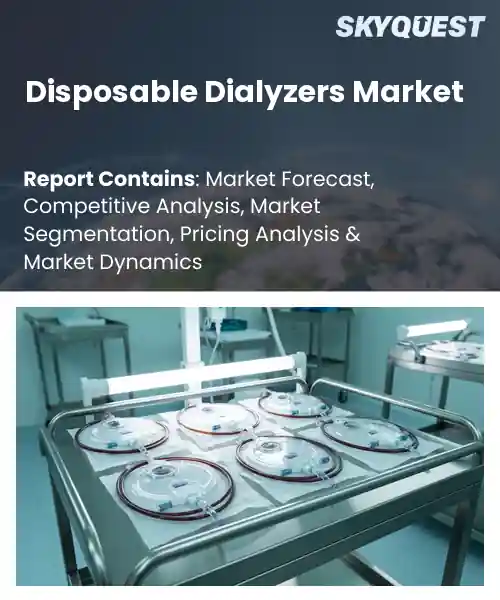
Disposable Dialyzers Market
Report ID: SQMIG35B2440
Report ID: SQMIG35B2440
[email protected]
USA +1 351-333-4748
Report ID:
SQMIG35B2440 |
Region:
Global |
Published Date: July, 2026
Pages:
157
|Tables:
142
|Figures:
78


Global Disposable Dialyzers Market size was valued at USD 4.92 Billion in 2024 and is poised to grow from USD 5.21 Billion in 2025 to USD 8.17 Billion by 2033, growing at a CAGR of 5.8% during the forecast period (2026-2033).
The global disposable dialyzer market encompasses single‑use blood‑filter devices that replace traditional reusable cartridges in hemodialysis clinics worldwide. Its importance lies in preventing cross‑contamination, reducing infection risk, and simplifying workflow for healthcare providers. The market emerged in the late 1990s when advances in polymer science enabled cost‑effective, high‑performance membranes, prompting early adopters in Europe to replace steel‑cased units.
Over the subsequent two decades, reimbursement policies in the United States and Japan incentivized patient safety, accelerating adoption rates. As a result, manufacturers have shifted R&D budgets toward single‑use designs, fueling steady annual growth of roughly 6% across the sector globally. The growth catalyst resides in the rising prevalence of end‑stage renal disease combined with home‑dialysis programs that demand sterile, plug‑and‑play solutions. As patients shift to nocturnal or peritoneal alternatives, clinics prioritize disposables to minimize time and ensure compliance with hygiene standards.
Companies such as Fresenius and Baxter have responded by launching modular dialyzers equipped with pressure sensors, enabling monitoring and reducing nursing workload. This technological edge opens export opportunities in economies where regulatory frameworks favor single‑use devices to curb hospital‑acquired infections. Consequently, investment in automation and supply‑chain resilience translates directly into higher significant overall market penetration and sustained revenue growth.
How is AI Enhancing Manufacturing Efficiency In The Disposable Dialyzers Market?
AI is reshaping disposable dialyzer manufacturing by embedding sensor networks and machine‑learning models into every stage of production. Real‑time data feeds predictive maintenance systems that anticipate equipment wear before failures occur, keeping lines running smoothly. Computer‑vision inspection stations automatically detect microscopic defects, ensuring each unit meets strict quality standards without manual checks. Advanced algorithms analyze material flow and adjust parameters on the fly, reducing waste and improving consistency. Integrated scheduling tools balance supply with fluctuating demand, shortening lead times and freeing capacity for new product introductions. Together these capabilities create a tighter, more responsive manufacturing ecosystem that supports the sector’s expanding needs.
Baxter announced in June 2019, the rollout of an AI‑enabled production line for its next‑generation disposable dialyzer, cutting cycle times and boosting yield, which directly supports market growth by delivering more reliable devices faster.
Market snapshot - (2026-2033)
Global Market Size
USD 4.92 Billion
Largest Segment
Polysulfone
Fastest Growth
Cellulose-Based
Growth Rate
5.8% CAGR
To get more insights on this market click here to Request a Free Sample Report
Global disposable dialyzers market is segmented by membrane material, flux type, application, end user, distribution channel and region. Based on membrane material, the market is segmented into Polysulfone, Polyethersulfone, Cellulose-Based and Others. Based on flux type, the market is segmented into Low-Flux Dialyzers and High-Flux Dialyzers. Based on application, the market is segmented into Hemodialysis and Hemodiafiltration. Based on end user, the market is segmented into Hospitals, Dialysis Centers and Home Healthcare. Based on distribution channel, the market is segmented into Direct Sales and Distributors. Based on region, the market is segmented into North America, Europe, Asia Pacific, Latin America and Middle East & Africa.
Polysulfone segment dominates because it offers a robust combination of biocompatibility, mechanical strength, and consistent ultrafiltration performance that aligns with clinicians’ demand for reliable disposable dialyzers. Its proven track record in minimizing clotting risk encourages widespread adoption across renal care facilities. Manufacturers prioritize polysulfone due to its ease of processing, enabling cost‑effective mass production while maintaining stringent quality standards. Consequently, it sets the benchmark for product reliability and patient safety in the market.
Meanwhile, polyethersulfone is emerging as the fastest growing sub‑category as manufacturers leverage its superior permeability and enhanced surface hydrophilicity to meet rising demand for high‑efficiency treatments. Innovations in polymer blending reduce fouling, attracting providers seeking to expand hemodiafiltration services. This momentum fuels product launches and reinforces expansion opportunities within disposable dialyzer landscape.
Hospitals segment dominates because they serve the largest patient volumes, offering integrated renal units equipped with comprehensive clinical support and centralized procurement processes that favor bulk purchasing of disposable dialyzers. The institutional emphasis on standardized protocols ensures consistent product selection, driving manufacturers to prioritize hospital‑focused product lines. Additionally, hospital budgets accommodate higher‑value offerings, reinforcing their central role in shaping market demand and supply chains. Their capability to implement advanced training programs further consolidates adoption of latest dialyzer technologies.
Conversely, home healthcare is witnessing the strongest growth as patient preferences shift toward at‑home treatment options that reduce hospital visits and improve quality of life. Portable disposable dialyzers enable clinicians to safely extend therapy beyond clinical settings, spurred by telemedicine support and reimbursement incentives. This expanding market segment drives innovation in user‑friendly designs and creates new revenue streams for manufacturers.
To get detailed segments analysis, Request a Free Sample Report
Asia Pacific commands a leading share of the global disposable dialyzers market due to a combination of advanced healthcare infrastructure, strong regulatory support for single‑use technologies, and a high prevalence of chronic kidney disease that drives consistent demand. The region benefits from well‑established manufacturing ecosystems in Japan and South Korea, which emphasize precision engineering and rapid innovation cycles. Reimbursement policies in many APAC nations favor cost‑effective disposable solutions, encouraging hospitals to adopt them over reusable alternatives. Additionally, rising patient awareness and a cultural preference for hygiene and safety reinforce market dominance. These synergistic factors create a robust ecosystem that sustains high adoption rates across the region.
Disposable Dialyzers Market in Japan is propelled by a mature dialysis network that prioritizes patient safety and operational efficiency. Japanese manufacturers leverage cutting‑edge polymer technology to produce high‑quality single‑use devices, while clinicians favor disposables for their reduced cross‑contamination risk. Favorable reimbursement frameworks and a strong emphasis on clinical outcomes further embed disposable dialyzers as the preferred choice in renal care settings across the country.
Disposable Dialyzers Market in South Korea is shaped by an aggressive adoption of innovative medical solutions and a health system that encourages the use of single‑use products. Local producers invest heavily in research to enhance membrane performance, supporting clinicians who seek reliable and sterile options. Government health policies that streamline procurement of disposables, combined with rising awareness of infection control, accelerate market penetration among dialysis centers throughout the nation.
North America experiences rapid expansion of the disposable dialyzers market thanks to a healthcare environment that values high standards of infection control, strong payer incentives for cost‑effective therapies, and an entrenched culture of clinical excellence. The United States and Canada have extensive networks of dialysis clinics that prioritize operational simplicity, making single‑use devices attractive for reducing turnaround time and maintenance burdens. Robust reimbursement mechanisms reward the adoption of disposable technologies, while ongoing clinical research underscores their safety profile. Moreover, patient advocacy groups emphasize quality of life, reinforcing demand for reliable, hassle‑free treatment options. Together, these dynamics create a fertile landscape for sustained growth of disposable dialyzers across the continent.
Disposable Dialyzers Market in United States is driven by a vast network of dialysis providers that prioritize efficiency and regulatory compliance. Healthcare payers support the cost advantages of single‑use devices, encouraging widespread procurement. Clinicians value the reduced infection risk associated with disposables, aligning with stringent safety standards. Innovation hubs foster continuous product enhancements, while patient‑focused initiatives promote adoption of technologies that simplify treatment journeys across the nation.
Disposable Dialyzers Market in Canada benefits from a public‑funded health system that emphasizes patient safety and cost containment. Provincial health authorities endorse single‑use solutions to streamline dialysis operations and minimize infection hazards. Canadian clinicians appreciate the consistency and reliability of disposables, which align with national quality guidelines. Collaborative research programs further validate clinical benefits, reinforcing confidence among providers and supporting steady market uptake throughout the country.
Europe strengthens its position in the disposable dialyzers market through coordinated regulatory frameworks, strong commitment to patient safety, and collaborative innovation across national boundaries. The European Union promotes harmonized standards that facilitate market entry for high‑quality single‑use devices, while individual countries invest in research consortia to advance membrane technology. Healthcare systems increasingly prefer disposables to reduce infection risk and simplify logistics, supported by reimbursement policies that recognize long‑term cost efficiencies. Environmental considerations also encourage manufacturers to develop more sustainable disposable solutions. Together, these strategic actions enhance market confidence, expand adoption, and reinforce Europe’s role as a key driver of global disposable dialyzers growth.
Disposable Dialyzers Market in Germany is anchored by a robust healthcare infrastructure that values precision and reliability. German manufacturers excel in engineering high‑performance membranes, while hospitals adopt disposables to meet strict infection control mandates. Reimbursement models reward cost‑effective therapies, fostering broader acceptance. Collaborative research institutions drive continual product refinement, ensuring alignment with clinical expectations. This synergy sustains strong demand for disposable dialyzers across German dialysis centers.
Disposable Dialyzers Market in United Kingdom reflects a national emphasis on clinical safety and streamlined service delivery. The NHS encourages single‑use solutions to minimize cross‑contamination and reduce procedural complexity. UK manufacturers focus on innovative material science to meet rigorous performance criteria, while clinicians adopt disposables for their consistency and ease of use. Policy frameworks that support value‑based purchasing further stimulate market penetration throughout renal care facilities.
Disposable Dialyzers Market in France benefits from a healthcare system that prioritizes patient outcomes and operational efficiency. French dialysis providers adopt disposables to align with stringent hygiene standards and to simplify device management. Domestic manufacturers collaborate with research institutes to enhance membrane technology, addressing the nuanced needs of French clinicians. Reimbursement policies that recognize long‑term cost savings encourage broader uptake, reinforcing France’s active participation in the European disposable dialyzers landscape.
To know more about the market opportunities by region and country, click here to
Buy The Complete Report
Increasing Chronic Kidney Disease Prevalence
Advancements In Membrane Technology
High Cost Of Disposable Units
Limited Reimbursement Policies In Emerging Markets
Request Free Customization of this report to help us to meet your business objectives.
The disposable dialyzers market is shaped by intense competition among established manufacturers and emerging entrants, with recent M&A activity and strategic partnerships accelerating product differentiation and geographic reach. Companies are investing in advanced membrane technologies and automated production lines, while collaborations with renal care providers aim to secure long‑term supply contracts and enhance clinical outcomes.
SkyQuest’s ABIRAW (Advanced Business Intelligence, Research & Analysis Wing) is our Business Information Services team that Collects, Collates, Correlates, and Analyses the Data collected by means of Primary Exploratory Research backed by robust Secondary Desk research.
As per SkyQuest analysis, the Disposable Dialyzers market is propelled primarily by the rising prevalence of chronic kidney disease which fuels demand for single‑use dialyzers, while breakthroughs in membrane technology—particularly high‑performance polysulfone—serve as a second catalyst by improving clearance and biocompatibility. The polysulfone membrane segment remains the clear leader, benefitting from cost‑effective mass production and strong clinician trust. Asia Pacific dominates globally due to its advanced manufacturing base, supportive reimbursement policies and a large patient pool. However, the higher price of disposable units compared with reusable alternatives restrains uptake, especially in cost‑sensitive or emerging markets, tempering overall growth. This pricing pressure pushes providers to evaluate total‑cost‑of‑ownership models and may slow replacement cycles.
| Report Metric | Details |
|---|---|
| Market size value in 2024 | USD 4.92 Billion |
| Market size value in 2033 | USD 8.17 Billion |
| Growth Rate | 5.8% |
| Base year | 2024 |
| Forecast period | (2026-2033) |
| Forecast Unit (Value) | USD Billion |
| Segments covered |
|
| Regions covered | North America (US, Canada), Europe (Germany, France, United Kingdom, Italy, Spain, Rest of Europe), Asia Pacific (China, India, Japan, Rest of Asia-Pacific), Latin America (Brazil, Rest of Latin America), Middle East & Africa (South Africa, GCC Countries, Rest of MEA) |
| Companies covered |
|
| Customization scope | Free report customization with purchase. Customization includes:-
|
To get a free trial access to our platform which is a one stop solution for all your data requirements for quicker decision making. This platform allows you to compare markets, competitors who are prominent in the market, and mega trends that are influencing the dynamics in the market. Also, get access to detailed SkyQuest exclusive matrix.
Table Of Content
Executive Summary
Market overview
Parent Market Analysis
Market overview
Market size
KEY MARKET INSIGHTS
COVID IMPACT
MARKET DYNAMICS & OUTLOOK
Market Size by Region
KEY COMPANY PROFILES
Methodology
For the Disposable Dialyzers Market, our research methodology involved a mixture of primary and secondary data sources. Key steps involved in the research process are listed below:
1. Information Procurement: This stage involved the procurement of Market data or related information via primary and secondary sources. The various secondary sources used included various company websites, annual reports, trade databases, and paid databases such as Hoover's, Bloomberg Business, Factiva, and Avention. Our team did 45 primary interactions Globally which included several stakeholders such as manufacturers, customers, key opinion leaders, etc. Overall, information procurement was one of the most extensive stages in our research process.
2. Information Analysis: This step involved triangulation of data through bottom-up and top-down approaches to estimate and validate the total size and future estimate of the Disposable Dialyzers Market.
3. Report Formulation: The final step entailed the placement of data points in appropriate Market spaces in an attempt to deduce viable conclusions.
4. Validation & Publishing: Validation is the most important step in the process. Validation & re-validation via an intricately designed process helped us finalize data points to be used for final calculations. The final Market estimates and forecasts were then aligned and sent to our panel of industry experts for validation of data. Once the validation was done the report was sent to our Quality Assurance team to ensure adherence to style guides, consistency & design.
Analyst Support
Customization Options
With the given market data, our dedicated team of analysts can offer you the following customization options are available for the Disposable Dialyzers Market:
Product Analysis: Product matrix, which offers a detailed comparison of the product portfolio of companies.
Regional Analysis: Further analysis of the Disposable Dialyzers Market for additional countries.
Competitive Analysis: Detailed analysis and profiling of additional Market players & comparative analysis of competitive products.
Go to Market Strategy: Find the high-growth channels to invest your marketing efforts and increase your customer base.
Innovation Mapping: Identify racial solutions and innovation, connected to deep ecosystems of innovators, start-ups, academics, and strategic partners.
Category Intelligence: Customized intelligence that is relevant to their supply Markets will enable them to make smarter sourcing decisions and improve their category management.
Public Company Transcript Analysis: To improve the investment performance by generating new alpha and making better-informed decisions.
Social Media Listening: To analyze the conversations and trends happening not just around your brand, but around your industry as a whole, and use those insights to make better Marketing decisions.
REQUEST FOR SAMPLE
 REQUEST FREE CUSTOMIZATION
Global Disposable Dialyzers Market size was valued at USD 4.92 Billion in 2024 and is poised to grow from USD 5.21 Billion in 2025 to USD 8.17 Billion by 2033, growing at a CAGR of 5.8% during the forecast period (2026-2033).
The disposable dialyzers market is shaped by intense competition among established manufacturers and emerging entrants, with recent M&A activity and strategic partnerships accelerating product differentiation and geographic reach. Companies are investing in advanced membrane technologies and automated production lines, while collaborations with renal care providers aim to secure long‑term supply contracts and enhance clinical outcomes. 'Fresenius Medical Care AG', 'Baxter International Inc.', 'Nipro Corporation', 'Asahi Kasei Corporation', 'B. Braun SE', 'Toray Industries, Inc.', 'Nikkiso Co., Ltd.', 'Medtronic plc', 'WEGO Holding Company Limited', 'Allmed Medical Products Co., Ltd.', 'Farmasol', 'Medica S.p.A.', 'SWS Hemodialysis Care Co., Ltd.', 'JMS Co., Ltd.', 'Kawasumi Laboratories, Inc.', 'Bain Medical Equipment (Guangzhou) Co., Ltd.', 'Sichuan Nigale Biomedical Co., Ltd.', 'Dialife SA', 'Bellco S.r.l.', 'SWS Medical Group'
The global rise in chronic kidney disease prevalence drives demand for renal replacement therapies, prompting healthcare providers to expand dialysis facilities and increase treatment sessions. Because disposable dialyzers reduce cross‑contamination risk and simplify inventory management, clinicians favor them for both in‑center and home‑based therapies. This shift accelerates procurement volumes, encourages manufacturers to broaden product portfolios, and sustains a positive growth trajectory for the disposable dialyzer market. Furthermore, patient awareness campaigns highlight the benefits of sterile, single‑use devices, reinforcing clinical preferences and supporting sustained market expansion.
Home Dialysis Adoption Surge: The shift toward care is encouraging acceptance of home‑based dialysis, prompting manufacturers to design disposable dialyzers that are lightweight, easy to set up, and require minimal training. Clinicians stress convenience and reduced infection risk, while payers value lower facility overhead. Companies therefore launch kits with priming and disposal features, allowing patients to safely conduct treatments outside clinical settings and expanding market reach into residential environments. This trend also supports continuity of care during pandemics and aligns with monitoring platforms globally.
Why does Asia Pacific Dominate the Global Disposable Dialyzers Market? |@12


Want to customize this report? This report can be personalized according to your needs. Our analysts and industry experts will work directly with you to understand your requirements and provide you with customized data in a short amount of time. We offer $1000 worth of FREE customization at the time of purchase.
Feedback From Our Clients


 USA (+1) 351-333-4748

