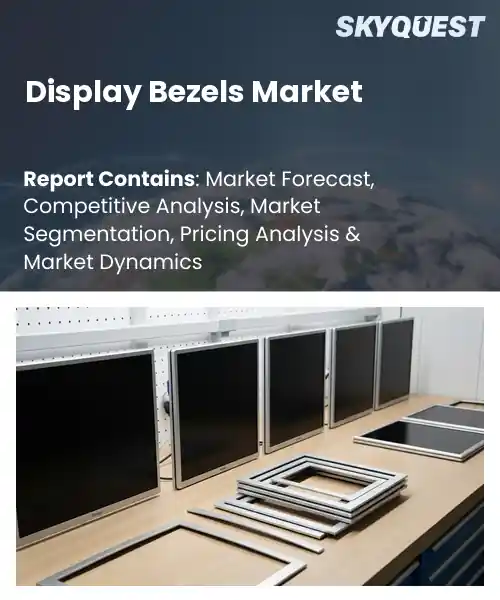
Display Bezels Market
Report ID: SQMIG45K2373
Report ID: SQMIG45K2373
[email protected]
USA +1 351-333-4748
Report ID:
SQMIG45K2373 |
Region:
Global |
Published Date: July, 2026
Pages:
157
|Tables:
149
|Figures:
78


Global Display Bezels Market size was valued at USD 2.14 Billion in 2024 and is poised to grow from USD 2.26 Billion in 2025 to USD 3.5 Billion by 2033, growing at a CAGR of 5.6% during the forecast period (2026-2033).
The global display bezels market consists of the design, manufacture and supply of frame components that surround LCD, OLED, and micro-LED panels in smartphones, televisions, laptops and automotive heads-up displays. Its importance lies in protecting fragile substrates and also in determining aesthetic appeal, device thickness and user experience. In the past, the demand from consumers for thinner devices resulted in smaller bezels, which then prompted manufacturers to look into aluminum and polymer solutions. For instance, the 2017 iPhone X ditched the top bezel for a display that goes edge to edge, starting a trend of notch-free designs around the industry. This has transformed bezels from a key component to a strategic differentiator driving component demand.
Material innovation, such as lightweight composites and recyclable aluminum alloys, is driving the display-bezels market, enabling thinner frames and meeting stringent environmental regulations. In automotive applications, the trend toward curved, high-resolution dashboards is an example of cause and effect: carbon-fiber-reinforced polymers replace steel, reducing bezel mass by approximately 30% and lowering energy use in the vehicle. The adoption of 8‐K TVs and AR headsets also drives the need for ultra‐precise, low‐expansion bezels, creating an opportunity for vendors that are strong in precision machining with an environmentally responsible sourcing approach. Thus companies investing in scalable green-manufacturing enjoy cost benefits, regulatory approval and market share, accelerating overall market growth.
How is AI-driven Automation Influencing Design Trends In The Global Display Bezel Market?
AI-driven automation is transforming bezel design with rapid generative modeling, material optimization, and real-time error detection. “Today, designers input performance criteria into algorithms that recommend ultra thin frames and still maintain structural integrity. The technology cuts down on prototype cycles so manufacturers can experiment with new curvature and edge to edge glass. Consumers want immersive experiences without borders, and AI tools can help find the balance between aesthetic ambitions and manufacturing tolerances. This combination of intelligent design and manufacturing efficiency is speeding the transition to thinner lighter bezels in everything from laptops and monitors to large format displays. Furthermore, it supports sustainability by not wasting materials and enabling recyclable frame structures.
Market snapshot - (2026-2033)
Global Market Size
USD 2.14 Billion
Largest Segment
Plastic Bezels
Fastest Growth
Glass Bezels
Growth Rate
5.6% CAGR
To get more insights on this market click here to Request a Free Sample Report
Global display bezels market is segmented by product type, application, manufacturing process, end user, distribution channel and region. Based on product type, the market is segmented into Plastic Bezels, Metal Bezels, Glass Bezels and Others. Based on application, the market is segmented into Televisions, Monitors, Smartphones, Automotive Displays and Others. Based on manufacturing process, the market is segmented into Injection Molding, CNC Machining, Die Casting and Others. Based on end user, the market is segmented into Consumer Electronics OEMs, Automotive OEMs, Industrial Display Manufacturers and Others. Based on distribution channel, the market is segmented into OEM Supply, Component Distributors and Others. Based on region, the market is segmented into North America, Europe, Asia Pacific, Latin America and Middle East & Africa.
The plastic bezels segment is expected to dominate the market share. Manufacturers prefer plastic bezels because of its light weight, easy molding and cost efficiency which is in line with high volume consumer electronics production. Material flexibility enables rapid color matching and surface finishes that fulfill aesthetic demands and facilitate supply chains. Plastic also offers the advantage of being impact resistant, which is a plus point for designers and further reinforces its choice for large-scale TV and monitor assemblies, thus maintaining its leadership in the display bezels market.
However, the glass Bezels segment is witnessing the strongest growth momentum as premium devices require higher visual clarity and a sleek premium feel that glass offers. Increasing durability and reduced weight of the thin glass processing is attracting manufacturers of high end smartphones and luxury TVs fuelling the rapid market growth.
The televisions segment is dominant, with a surge in home entertainment and large screen adoption driving massive volume requirements for bezel components. Producers stress the importance of cost effective, aesthetically consistent solutions to meet consumer expectations for slim profiles and vivid picture framing. Economies of scale exist in the current TV bezels supply chain, enabling manufacturers to optimize material use and simplify the assembly process, thus helping to maintain television’s leading position in the display bezels market.
Meanwhile, the automotive displays segment is emerging as the key high growth area with vehicle manufacturers integrating larger, high resolution screens for infotainment clusters. The adoption of electric vehicles is opening up market opportunities, and the introduction of improved bezel designs that meet safety standards and look sleek is fueling the demand.
To get detailed segments analysis, Request a Free Sample Report
Asia Pacific has a convergence of highly advanced manufacturing capabilities, deep engineering talent pools, and a cultural emphasis on cutting‑edge consumer electronics. The region benefits from a tightly integrated supply chain where component suppliers, panel manufacturers, and device assemblers operate in close proximity, driving rapid innovation cycles and cost efficiencies. Strong design sensibility and early adoption of new form factors further fuel demand, while substantial investment in research and development nurtures next‑generation bezel technologies. This ecosystem of technical expertise, agile production, and market responsiveness creates a robust foundation that consistently places Asia Pacific at the forefront of the global display bezels landscape.
Display Bezels Market in Japan is shaped by a legacy of precision engineering and a relentless pursuit of quality. Domestic manufacturers leverage sophisticated fabrication techniques and a strong tradition of electronics excellence to produce bezels that meet exacting standards. Collaboration between component suppliers and leading device makers accelerates the rollout of refined designs, while a culture that values aesthetic harmony supports the integration of sleek, thin bezels across premium devices.
Display Bezels Market in South Korea thrives on the presence of world‑leading panel producers and a synergistic relationship with the semiconductor sector. Continuous investment in advanced materials and manufacturing automation enables the creation of ultra‑thin, high‑performance bezels. Innovation is further propelled by a vibrant start‑up environment and close partnerships between technology conglomerates, fostering rapid adoption of new bezel solutions in both consumer and industrial applications.
Europe’s expansion is propelled by stringent design standards, a strong focus on sustainability, and a deep integration of display technologies within automotive, industrial, and premium consumer segments. The region’s robust research ecosystems and collaborative innovation hubs encourage the development of lightweight, recyclable bezel materials. Cross‑border trade within the single market facilitates efficient distribution, while leading design schools nurture talent that emphasizes both functionality and visual elegance. These elements collectively stimulate a vibrant market environment that accelerates the uptake of sophisticated bezel solutions across diverse European industries.
Display Bezels Market in Germany is heavily influenced by its powerful automotive and industrial sectors, which demand high‑precision, durable bezels for advanced instrument clusters and machinery interfaces. Engineering excellence and a dense network of specialized component suppliers enable swift customization and integration. The German emphasis on reliability and performance ensures that bezel designs meet rigorous safety and quality benchmarks, reinforcing the country’s reputation as a leading source of technically refined display solutions.
Display Bezels Market in the United Kingdom is experiencing swift growth driven by a dynamic creative industry, vibrant media production, and a thriving technology start‑up scene. Designers and manufacturers collaborate closely to introduce innovative bezel aesthetics that cater to rapidly changing consumer preferences. The UK’s strong focus on user‑centred design and rapid prototyping shortens time‑to‑market, while strategic partnerships with global device brands amplify the reach of home‑grown bezel innovations.
Display Bezels Market in France is emerging through the convergence of luxury fashion, high‑end consumer electronics, and design‑forward thinking. French designers prioritize elegance and tactile experience, influencing bezel aesthetics that blend artistry with functionality. Collaboration between boutique manufacturers and established electronics firms fosters niche market offerings, while supportive cultural policies encourage experimentation with sustainable materials, positioning France as a growing hub for refined bezel solutions.
North America reinforces its role through a combination of large‑scale consumer demand, leading technology firms, and a vigorous ecosystem of design and engineering talent. The region benefits from deep investment in advanced manufacturing processes that enable precision‑crafted, ultra‑thin bezels for smartphones, wearables, and immersive display systems. Integration of artificial intelligence and IoT drives functional bezel innovations, while strong distribution networks ensure rapid market penetration. Collaborative partnerships between hardware manufacturers, material scientists, and software developers create an environment where design excellence and technological advancement coalesce, further elevating North America’s market influence.
Display Bezels Market in the United States is characterized by expansive consumer electronics consumption and the presence of global technology pioneers that set industry benchmarks. R&D centers focus on pushing the limits of bezel thinness, durability, and multifunctionality, often integrating advanced sensors and connectivity features. The domestic supply chain benefits from a mature component ecosystem, enabling swift scaling and iterative design improvements that resonate with a market eager for cutting‑edge device aesthetics.
Display Bezels Market in Canada is bolstered by a strong design talent pool and a policy environment that encourages sustainable manufacturing practices. Emphasis on eco‑friendly materials and responsible sourcing aligns with consumer preferences for greener products. Collaborative clusters linking universities, research institutes, and niche manufacturers foster innovative bezel concepts tailored for specialized applications, positioning Canada as an emerging contributor to the broader North American display bezel landscape.
To know more about the market opportunities by region and country, click here to
Buy The Complete Report
Increasing Demand for Slim Designs
Advancements In Flexible Materials
High Production Costs Remain
Complex Supply Chain Dependencies
Request Free Customization of this report to help us to meet your business objectives.
The global display bezels market is shaped by intense rivalry among major OEMs and specialized component suppliers, driving rapid product differentiation and cost efficiencies. Recent strategic moves include a leading display manufacturer acquiring a niche bezel‑technology firm to integrate ultra‑thin frames, while another key player formed a joint venture with a precision‑machining company to accelerate next‑generation bezel designs.
SkyQuest’s ABIRAW (Advanced Business Intelligence, Research & Analysis Wing) is our Business Information Services team that Collects, Collates, Correlates, and Analyses the Data collected by means of Primary Exploratory Research backed by robust Secondary Desk research.
As per SkyQuest analysis, the market is propelled by the increasing demand for slim designs, which pushes manufacturers toward ultra‑thin bezel solutions, while advancements in flexible materials serve as a second driver expanding design possibilities for foldable and curved displays. The primary restraint is high production costs linked to precision manufacturing and specialized materials, limiting adoption in price‑sensitive segments. Asia‑Pacific dominates the market due to its integrated supply chain and strong consumer electronics base, and plastic bezels remain the leading segment due to their cost‑effectiveness and ease of molding.
| Report Metric | Details |
|---|---|
| Market size value in 2024 | USD 2.14 Billion |
| Market size value in 2033 | USD 3.5 Billion |
| Growth Rate | 5.6% |
| Base year | 2024 |
| Forecast period | (2026-2033) |
| Forecast Unit (Value) | USD Billion |
| Segments covered |
|
| Regions covered | North America (US, Canada), Europe (Germany, France, United Kingdom, Italy, Spain, Rest of Europe), Asia Pacific (China, India, Japan, Rest of Asia-Pacific), Latin America (Brazil, Rest of Latin America), Middle East & Africa (South Africa, GCC Countries, Rest of MEA) |
| Companies covered |
|
| Customization scope | Free report customization with purchase. Customization includes:-
|
To get a free trial access to our platform which is a one stop solution for all your data requirements for quicker decision making. This platform allows you to compare markets, competitors who are prominent in the market, and mega trends that are influencing the dynamics in the market. Also, get access to detailed SkyQuest exclusive matrix.
Table Of Content
Executive Summary
Market overview
Parent Market Analysis
Market overview
Market size
KEY MARKET INSIGHTS
COVID IMPACT
MARKET DYNAMICS & OUTLOOK
Market Size by Region
KEY COMPANY PROFILES
Methodology
For the Display Bezels Market, our research methodology involved a mixture of primary and secondary data sources. Key steps involved in the research process are listed below:
1. Information Procurement: This stage involved the procurement of Market data or related information via primary and secondary sources. The various secondary sources used included various company websites, annual reports, trade databases, and paid databases such as Hoover's, Bloomberg Business, Factiva, and Avention. Our team did 45 primary interactions Globally which included several stakeholders such as manufacturers, customers, key opinion leaders, etc. Overall, information procurement was one of the most extensive stages in our research process.
2. Information Analysis: This step involved triangulation of data through bottom-up and top-down approaches to estimate and validate the total size and future estimate of the Display Bezels Market.
3. Report Formulation: The final step entailed the placement of data points in appropriate Market spaces in an attempt to deduce viable conclusions.
4. Validation & Publishing: Validation is the most important step in the process. Validation & re-validation via an intricately designed process helped us finalize data points to be used for final calculations. The final Market estimates and forecasts were then aligned and sent to our panel of industry experts for validation of data. Once the validation was done the report was sent to our Quality Assurance team to ensure adherence to style guides, consistency & design.
Analyst Support
Customization Options
With the given market data, our dedicated team of analysts can offer you the following customization options are available for the Display Bezels Market:
Product Analysis: Product matrix, which offers a detailed comparison of the product portfolio of companies.
Regional Analysis: Further analysis of the Display Bezels Market for additional countries.
Competitive Analysis: Detailed analysis and profiling of additional Market players & comparative analysis of competitive products.
Go to Market Strategy: Find the high-growth channels to invest your marketing efforts and increase your customer base.
Innovation Mapping: Identify racial solutions and innovation, connected to deep ecosystems of innovators, start-ups, academics, and strategic partners.
Category Intelligence: Customized intelligence that is relevant to their supply Markets will enable them to make smarter sourcing decisions and improve their category management.
Public Company Transcript Analysis: To improve the investment performance by generating new alpha and making better-informed decisions.
Social Media Listening: To analyze the conversations and trends happening not just around your brand, but around your industry as a whole, and use those insights to make better Marketing decisions.
REQUEST FOR SAMPLE
 REQUEST FREE CUSTOMIZATION
Global Display Bezels Market size was valued at USD 2.14 Billion in 2024 and is poised to grow from USD 2.26 Billion in 2025 to USD 3.5 Billion by 2033, growing at a CAGR of 5.6% during the forecast period (2026-2033).
The global display bezels market is shaped by intense rivalry among major OEMs and specialized component suppliers, driving rapid product differentiation and cost efficiencies. Recent strategic moves include a leading display manufacturer acquiring a niche bezel‑technology firm to integrate ultra‑thin frames, while another key player formed a joint venture with a precision‑machining company to accelerate next‑generation bezel designs. 'Samsung Display Co., Ltd.', 'LG Display Co., Ltd.', 'BOE Technology Group Co., Ltd.', 'AUO Corporation', 'Innolux Corporation', 'Sharp Corporation', 'Japan Display Inc.', 'Tianma Microelectronics Co., Ltd.', 'HKC Corporation Limited', 'Visionox Technology Inc.', 'CSOT (TCL China Star Optoelectronics Technology Co., Ltd.)', 'EverDisplay Optronics (Shanghai) Co., Ltd.', 'HannStar Display Corporation', 'Raydium Semiconductor Corporation', 'BenQ Materials Corporation', 'Corning Incorporated', 'AGC Inc.', 'Schott AG', 'GIS (General Interface Solution Holding Ltd.)', 'Radiant Opto-Electronics Corporation'
Consumers are favoring thinner display frames, prompting manufacturers to develop ultra‑slim bezel solutions that enhance visual appeal while maintaining structural integrity, thereby stimulating demand across consumer electronics, automotive dashboards, and wearable devices; this preference encourages investment in precision engineering, material innovation, and streamlined assembly processes, creating a cycle of product differentiation that reinforces market expansion and drives continuous refinement of bezel technologies. As brands seek to differentiate their offerings, aesthetic advantage of minimal bezels becomes a marketing attribute, accelerating cycles and reinforcing consumer expectations for visual experiences.
Immersive Edge‑To‑Edge Design Push: The market is witnessing a rapid shift toward bezel‑free or ultra‑thin bezel displays, driven by consumer demand for seamless visual experiences across smartphones, tablets, and large‑format TVs. Manufacturers are investing in advanced optical bonding, laser‑cut precision frames, and proprietary edge‑lighting technologies to minimize visible borders while preserving structural integrity. This design emphasis not only elevates aesthetic appeal but also supports higher screen‑to‑body ratios, enabling richer content consumption and fostering new use cases such as foldable and rollable form factors for future applications.
Why does Asia Pacific Dominate the Global Display Bezels Market? |@12


Want to customize this report? This report can be personalized according to your needs. Our analysts and industry experts will work directly with you to understand your requirements and provide you with customized data in a short amount of time. We offer $1000 worth of FREE customization at the time of purchase.
Feedback From Our Clients


 USA (+1) 351-333-4748

