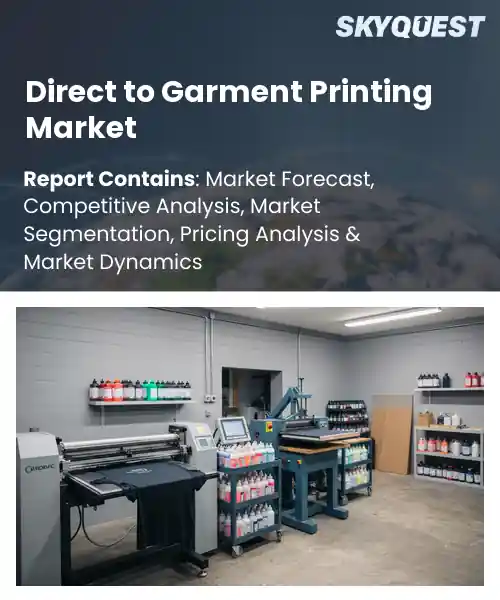
Direct to Garment Printing Market
Report ID: SQMIG20I3248
Report ID: SQMIG20I3248
[email protected]
USA +1 351-333-4748
Report ID:
SQMIG20I3248 |
Region:
Global |
Published Date: July, 2026
Pages:
157
|Tables:
144
|Figures:
78


Global Direct To Garment Printing Market size was valued at USD 2.2 Billion in 2024 and is poised to grow from USD 2.5 Billion in 2025 to USD 6.88 Billion by 2033, growing at a CAGR of 13.5% during the forecast period (2026-2033).
The factor pushing the Direct‑to‑Garment (DTG) printing market growth ahead is mostly how digital ink‑jet tech keeps getting better and more mature. It basically takes fabric surfaces and makes them feel like blank canvases, no screens, no plates, just direct printing.
From there, the main growth nudge for DTG seems tied to a growing appetite for personalized apparel, especially as e‑commerce platforms lean harder into customization. When someone uploads an image and gets the garment within days, conversion tends to climb, while waste drops down. That alone makes manufacturers want equipment that can churn out a hundred shirts per hour, or at least something close to it. For example, one online retailer in Japan uses a DTG workflow for niche pop‑culture themes, and that turned a once-small segment into a $10 million revenue stream. That fit between retail chains and what consumers want helps DTG keep expanding, into corporate branding and also into activewear, everywhere.
AI improves DTG printing by doing things in the background like automatically aligning colors, fine-tuning ink flow and forecasting print problems before they show up. The machine-learning systems learn from every job so results stay steady, and less material gets wasted. IoT then adds the connective tissue by linking printers to a cloud dashboard, where sensors keep tracking things like temperature humidity and nozzle condition in real time. With that data, predictive maintenance becomes possible, meaning operators can swap parts early, before a failure interrupts the whole production run. On top of it, workflow software can arrange jobs around machine availability and even fabric stock. That smooths the line, and it also cuts idle time. In short, AI and IoT shift DTG from a more manual routine into something responsive and data-driven that can scale with demand.
Market snapshot - (2026-2033)
Global Market Size
USD 2.2 Billion
Largest Segment
Pigment Inks
Fastest Growth
Others
Growth Rate
13.5% CAGR
To get more insights on this market click here to Request a Free Sample Report
The global direct-to-garment printing market is segmented by ink type, substrate type, end-use industry, sales channel, distribution channel and region. Based on ink type, the market is segmented into Pigment Inks, Reactive Inks, Acid Inks and Others. Based on substrate type, the market is segmented into Cotton Fabrics, Polyester & Blends, Silk & Rayon and Others. Based on end-use industry, the market is segmented into Clothing & Apparel Industry, Home Textiles & Decor and Advertising & Promotional Media. Based on sales channel, the market is segmented into Online and Offline. Based on distribution channel, the market is segmented into Direct and Indirect. Based on region, the market is segmented into North America, Europe, Asia Pacific, Latin America and Middle East & Africa.
As per the direct-to-garment printing market analysis, the pigment inks segment is dominant due to its superior colorfastness and washing resistance, making it the preferred choice for manufacturers who seek durable prints. The chemistry of the pigment particles provides opacity on both light and dark fabrics, cutting down on the number of passes. This reliability corresponds to the high-volume production needs of the direct-to-garment printing market, supporting consistent quality and reducing waste and leading the way.
However, the fastest-growing area is the reactive inks segment, because it can form covalent bonds with fiber polymers, resulting in vibrant colours and excellent wash durability on cotton and blended textiles. “Low-temperature curing innovations continue to expand its application and attract designers looking for vibrant, sustainable colors, which further fuels market growth and new product opportunities.
According to the direct-to-garment printing market forecast, the Clothing & apparel segment dominates volume of print orders driven by fast fashion cycles and consumer demand for customized garments. Brands use direct-to-garment tech to quickly prototype and produce small runs, limiting inventory risk. This high turnover ensures a constant demand for printing equipment and consumables, keeping the sector the leader in market activity.
Whereas the home textiles & decor segment is predicted to have the largest direct-to-garment printing market share, as interior designers are increasingly adopting printed fabrics for upholstery, curtains, and bedding to create a unique visual experience. Consumer interest grows as ink durability on fibers improves, extending product lives. The growing area of application opens new market opportunities and contributes to the overall growth of the sector.
To get detailed segments analysis, Request a Free Sample Report
As per the direct-to-garment printing market regional forecast, North America leads the market by mixing a lot of technical know how, big manufacturing muscle, and a culture that likes fast, almost instant product personalization. The region also has a fairly mature apparel ecosystem that ties design sourcing and distribution together, so custom garments can be turned around quickly. There’s consistent spending on digital printing equipment and software, so innovation keeps moving, and at the same time a tuned logistics network helps deliveries stay dependable. People keep wanting unique, on demand clothing, which pulls demand up, plus a friendly regulatory environment seems to make it easier for brands to adopt newer printing approaches. And because major equipment makers are around, access to advanced machinery is basically “ready to go”. On top of that, a workforce that’s skilled in both graphic design and textile engineering helps projects move faster. There’s also a noticeable shift toward sustainable inks and low waste processes, which fits wider environmental aims and makes the market even more attractive.
United States Direct to Garment Printing Market
The Direct to Garment Printing sector in the United States does well, largely due to a fashion scene that prizes individuality and quick, rotating trend cycles. Tech incubators and venture capital groups push progress in printing hardware along with software, keeping the momentum alive. Retailers and independent designers use the systems to shorten time to market, while consumer preference for personalized apparel keeps interest high. The whole ecosystem gets extra lift from commerce platforms that blend design tools with on demand production, which feels like a smoother workflow end to end.
Canada Direct to Garment Printing Market
The Direct to Garment Printing industry in Canada is strengthened by an innovation environment that mixes academic research with practical, commercial use. Government programs back textile initiatives, so manufacturers tend to adopt eco friendly inks and workflows that produce less waste. Retail chains and boutique label owners often like limited runs, because it avoids extra inventory sitting around, and it matches what consumers want from sourced apparel. Also, trade ties help provide access to equipment as well as know-how, so adoption doesn’t stall.
The European Direct to Garment Printing market is moving forward because the region has a deep fashion legacy that values craft, but also embraces technological innovation. Designers across Europe use digital printing to blend artistic expression with rapid prototyping, and this can reduce waste while also shortening development cycles. In several key countries, textile clusters create an easy pipeline to quality fabrics and trained labor, which supports bespoke production even when scale is needed. Environmental rules push low impact inks and more efficient processes, so sustainability and market growth basically line up. On top of that, joint research programs between universities and equipment manufacturers help improve print fidelity and compatibility with materials. Consumers still want personalized apparel, and e commerce ecosystems make discovery easier, which boosts demand. Altogether, Europe has this mix of heritage with cutting edge tooling, so it stays relevant inside the global value chain.
Germany Direct to Garment Printing Market
The Direct to Garment Printing market in Germany is grounded in engineering talent and a tight network of textile manufacturers. Germany’s focus on precision, and quality, supports high resolution printing on a variety of fabrics. Meanwhile, environmental standards help drive eco friendly inks into routine use. There are also collaborative efforts between research institutions and equipment companies, and those projects aim at faster production and better color fidelity. This combination of technical discipline and sustainability keeps Germany as a major European hub for these services.
United Kingdom Direct to Garment Printing Market
The Direct to Garment Printing market penetration in the United Kingdom is expanding, mostly because the sector has a strong base and the digital infrastructure is improving. Fashion brands as well as independent designers rely on agile printing capabilities to meet consumer demand for customized apparel, not just standard runs. Government incentives that encourage innovation speed up adoption of print technologies, and the e commerce environment supports smoother, modern workflows. With design talent plus technological agility in place, the United Kingdom acts like a fairly strong growth engine within Europe.
France Direct to Garment Printing Market
The Direct to Garment Printing market in France keeps growing because designers want more sustainable, personalized ways to produce garments. Networks that connect fashion schools with technology startups encourage experiments with ink formulations, plus new fabric treatments. Consumers show interest in locally produced, custom clothing, and that motivation pushes retailers to adopt on demand printing capabilities. With supportive cultural policies and investment in creative industries, France ends up with a fertile setting for growth, so it can become a meaningful contributor to Europe’s wider printing landscape.
Asia Pacific keeps pushing harder in the Direct to Garment Printing market, merging advanced automation with a real cultural pull toward fashion trial and error. In Japan, there is that careful tradition of craftsmanship that blends in with high‑precision equipment manufacturers so the result is clean, sharp print quality across many types of textiles. South Korea, on the other hand moves fast, smart manufacturing plus strong digital design know how means development cycles feel quicker, and on demand output tends to be more cost‑effective. Both places also ride on government programs that back eco‑friendly inks and resource‑efficient workflows, so growth and environmental responsibility walk together. Then there’s the rising middle class, they want clothing that feels personal , which expands demand even more. Add collaborative ecosystems, universities , startups , and established brands all trading know how, and technology transfer happens quicker. Altogether those forces make Asia Pacific look like a competitive hub for fresh thinking in garment printing.
Japan Direct to Garment Printing Market
The Direct to Garment Printing Market in Japan works well because precision engineering meets those experimental fashion instincts. The country’s well known machinery makers provide dependable, high‑resolution printers, and they can handle a broad lineup of fabrics. When design institutes team up with tech firms , ink formulations get improved , and that helps color vibrancy stay strong while environmental impact drops a bit. Also shoppers like limited drops and custom pieces, so retailers increasingly lean into on‑demand production, which keeps reinforcing Japan’s quality first image in garment printing.
South Korea Direct to Garment Printing Market
The direct-to-garment printing market in South Korea is powered by a mix of manufacturing focus and a consumer base that stays hungry for new styles. The electronics sector contributes print heads and software, which supports rapid output, and makes it easier to stay responsive. Government support helps subsidize research on sustainable inks as well as waste‑reduction methods, tying industry momentum to ecological targets. Retailers and streetwear brands adopt on‑demand printing to cut lead times, and also to lower inventory exposure, this helps keep South Korea positioned firmly inside the regional picture.
To know more about the market opportunities by region and country, click here to
Buy The Complete Report
Growing Demand for Custom Apparel
Adoption of On‑Demand Printing Technology
Rising Cost of Ink Materials
Environmental Regulations on Textile Waste
Request Free Customization of this report to help us to meet your business objectives.
The competitive landscape in the worldwide direct-to-garment printing space is get shaped by fast technology blending, a string of strategic acquisitions here and there, and partnership arrangements that speed up product innovation while also pushing distribution channels outward. This can be seen in recent moves too: one major printer company bought a digital workflow platform, and at the same time a bigger textile manufacturer teamed up, in a joint venture with an AI design startup, to push on-demand customization. That whole mix intensifies the rivalry a bit and it tends to nudge market consolidation as well.
Top Player’s Company Profile
Recent Developments in the Direct to Garment Printing Market
SkyQuest’s ABIRAW (Advanced Business Intelligence, Research & Analysis Wing) is our Business Information Services team that Collects, Collates, Correlates, and Analyses the Data collected by means of Primary Exploratory Research backed by robust Secondary Desk research.
As per SkyQuest analysis, the quick rise of personalized apparel demand is the main thing pushing the global direct to garment printing market, and it makes brands invest in fast, on demand printers. Another driver is the growth of AI plus IoT technologies, which handle color management automatically and also enable predictive upkeep, so productivity goes up and waste goes down too. Pigment ink still stays out in front, since its color fastness and opacity support high volume runs. North America leads overall, because it has a mature clothing ecosystem, a strong tech foundation, and consumers who like personalization. Still, rising costs for ink materials are squeezing profit margins, and that could slow expansion for manufacturers who are more sensitive to pricing.
| Report Metric | Details |
|---|---|
| Market size value in 2024 | USD 2.2 Billion |
| Market size value in 2033 | USD 6.88 Billion |
| Growth Rate | 13.5% |
| Base year | 2024 |
| Forecast period | (2026-2033) |
| Forecast Unit (Value) | USD Billion |
| Segments covered |
|
| Regions covered | North America (US, Canada), Europe (Germany, France, United Kingdom, Italy, Spain, Rest of Europe), Asia Pacific (China, India, Japan, Rest of Asia-Pacific), Latin America (Brazil, Rest of Latin America), Middle East & Africa (South Africa, GCC Countries, Rest of MEA) |
| Companies covered |
|
| Customization scope | Free report customization with purchase. Customization includes:-
|
To get a free trial access to our platform which is a one stop solution for all your data requirements for quicker decision making. This platform allows you to compare markets, competitors who are prominent in the market, and mega trends that are influencing the dynamics in the market. Also, get access to detailed SkyQuest exclusive matrix.
Table Of Content
Executive Summary
Market overview
Parent Market Analysis
Market overview
Market size
KEY MARKET INSIGHTS
COVID IMPACT
MARKET DYNAMICS & OUTLOOK
Market Size by Region
KEY COMPANY PROFILES
Methodology
For the Direct to Garment Printing Market, our research methodology involved a mixture of primary and secondary data sources. Key steps involved in the research process are listed below:
1. Information Procurement: This stage involved the procurement of Market data or related information via primary and secondary sources. The various secondary sources used included various company websites, annual reports, trade databases, and paid databases such as Hoover's, Bloomberg Business, Factiva, and Avention. Our team did 45 primary interactions Globally which included several stakeholders such as manufacturers, customers, key opinion leaders, etc. Overall, information procurement was one of the most extensive stages in our research process.
2. Information Analysis: This step involved triangulation of data through bottom-up and top-down approaches to estimate and validate the total size and future estimate of the Direct to Garment Printing Market.
3. Report Formulation: The final step entailed the placement of data points in appropriate Market spaces in an attempt to deduce viable conclusions.
4. Validation & Publishing: Validation is the most important step in the process. Validation & re-validation via an intricately designed process helped us finalize data points to be used for final calculations. The final Market estimates and forecasts were then aligned and sent to our panel of industry experts for validation of data. Once the validation was done the report was sent to our Quality Assurance team to ensure adherence to style guides, consistency & design.
Analyst Support
Customization Options
With the given market data, our dedicated team of analysts can offer you the following customization options are available for the Direct to Garment Printing Market:
Product Analysis: Product matrix, which offers a detailed comparison of the product portfolio of companies.
Regional Analysis: Further analysis of the Direct to Garment Printing Market for additional countries.
Competitive Analysis: Detailed analysis and profiling of additional Market players & comparative analysis of competitive products.
Go to Market Strategy: Find the high-growth channels to invest your marketing efforts and increase your customer base.
Innovation Mapping: Identify racial solutions and innovation, connected to deep ecosystems of innovators, start-ups, academics, and strategic partners.
Category Intelligence: Customized intelligence that is relevant to their supply Markets will enable them to make smarter sourcing decisions and improve their category management.
Public Company Transcript Analysis: To improve the investment performance by generating new alpha and making better-informed decisions.
Social Media Listening: To analyze the conversations and trends happening not just around your brand, but around your industry as a whole, and use those insights to make better Marketing decisions.
REQUEST FOR SAMPLE
 REQUEST FREE CUSTOMIZATION
Global Direct To Garment Printing Market size was valued at USD 2.2 Billion in 2024 and is poised to grow from USD 2.5 Billion in 2025 to USD 6.88 Billion by 2033, growing at a CAGR of 13.5% during the forecast period (2026-2033).
The competitive landscape of the global direct‑to‑garment printing market is shaped by rapid technology integration, strategic acquisitions, and partnership deals that accelerate product innovation and expand distribution networks; recent examples include a major printer’s acquisition of a digital workflow platform and a leading textile manufacturer’s joint venture with an AI‑driven design startup to offer on‑demand customization, intensifying rivalry and driving market consolidation. 'Seiko Epson Corporation', 'Brother Industries', 'Mimaki Engineering', 'Ricoh Company', 'Kornit Digital', 'Roland DG Corporation', 'Mutoh Holdings', 'Fujifilm Holdings', 'Canon', 'Konica Minolta', 'Kyocera Corporation', 'Panasonic Holdings', 'Toshiba Corporation', 'Sharp Corporation', 'HP Inc', 'Xerox Holdings Corporation', 'Aeoon Technologies', 'Polyprint', 'Anajet', 'dtg Digital'
Businesses are responding to consumer preference for unique, personalized garments, prompting retailers to expand direct‑to‑garment capabilities. This shift encourages investment in digital printers that can quickly produce short runs without extensive setup, fostering faster product cycles and reducing excess inventory. As brands leverage these options to differentiate offerings, demand for high‑quality, on‑demand printing services rises, driving market expansion. The ability to customize designs at scale also opens new revenue streams across fashion, sportswear, and promotional segments, reinforcing growth momentum through innovative strategies.
Sustainable Fiber Integration: The industry is increasingly adopting eco‑friendly fibers such as organic cotton, Tencel, and recycled polyester in DTG workflows. Manufacturers are reconfiguring supply chains to source these materials, emphasizing low‑impact processing and closed‑loop water systems. This shift not only aligns with consumer demand for greener apparel but also reduces reliance on conventional cotton, enhancing brand credibility and opening new market segments focused on ethical fashion. Companies that embed sustainability into material selection gain competitive advantage through differentiated product storytelling.
Why does North America Dominate the Global Direct to Garment Printing Market? |@12


Want to customize this report? This report can be personalized according to your needs. Our analysts and industry experts will work directly with you to understand your requirements and provide you with customized data in a short amount of time. We offer $1000 worth of FREE customization at the time of purchase.
Feedback From Our Clients


 USA (+1) 351-333-4748

