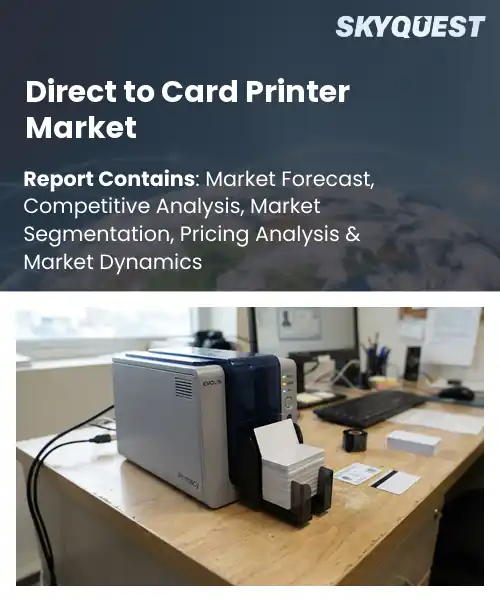
Direct to Card Printer Market
Report ID: SQMIG45I2516
Report ID: SQMIG45I2516
[email protected]
USA +1 351-333-4748
Report ID:
SQMIG45I2516 |
Region:
Global |
Published Date: September, 2026
Pages:
157
|Tables:
145
|Figures:
78


Global Direct To Card Printer Market size was valued at USD 1.68 Billion in 2024 and is poised to grow from USD 1.8 Billion in 2025 to USD 3.15 Billion by 2033, growing at a CAGR of 7.2% during the forecast period (2026-2033).
Direct‑to‑card printing applies ink or dye‑sublimation directly onto a plastic card, eliminating pre‑printed stock and enabling on‑demand personalization. The market matters because it shortens supply chains, reduces inventory costs, and supports rapid issuance of secure credentials such as payment cards, employee IDs, and travel passes. Its evolution began with bulk offset presses in the 1990s, moved to ribbon‑based batch printers in the early 2000s, and accelerated after 2015 when high‑resolution dye‑sublimation engines added integrated security features. A primary driver of this shift is global and secure digital transformation, which demands instant, customized card issuance for remote workforces and contactless payments. The surge in demand for contactless identification and fintech services fuels the market’s next expansion phase, as organizations seek printers that can embed chips, holograms, and biometric data in a single pass. This requirement creates opportunities for manufacturers to integrate IoT connectivity, allowing monitoring of print queues and security updates. For example, a university deploying a campus card system can instantly re‑issue lost IDs with updated access rights, while a bank can produce EMV‑compliant payment cards on site, reducing shipping delays and fraud exposure. Consequently, vendors that combine high‑resolution imaging with secure element embedding are positioned to capture the segment.
How is AI enhancing personalization and security in the direct‑to‑card printer market?
AI is reshaping the direct‑to‑card printer market by embedding intelligent algorithms that tailor each card’s design and security features to the end‑user. Personalization engines analyze user preferences, corporate branding guidelines, and contextual data to automatically generate graphics, layouts, and variable data such as names or access codes, reducing manual design time and errors. At the same time, AI‑driven verification tools examine image quality, color consistency, and encoding accuracy in real time, flagging defects before they become costly reprints. Machine‑learning models also detect anomalies in printing patterns that could indicate tampering or counterfeit attempts, enhancing the overall security posture of issued cards. Together, these capabilities streamline production, improve user experience, and strengthen fraud resistance, positioning the technology as a key growth driver in a market that demands both speed and reliability.In June 2024, Entrust released an AI‑enhanced card‑issuing solution, demonstrating how predictive analytics and real‑time image validation can accelerate personalization while tightening security controls, thereby supporting broader market adoption.
Market snapshot - (2026-2033)
Global Market Size
USD 1.68 Billion
Largest Segment
Single-Sided Printers
Fastest Growth
Retransfer Card Printers
Growth Rate
7.2% CAGR
To get more insights on this market click here to Request a Free Sample Report
Global direct to card printer market is segmented by printer type, printing technology, application, end user, connectivity and region. Based on printer type, the market is segmented into Single-Sided Printers, Dual-Sided Printers and Retransfer Card Printers. Based on printing technology, the market is segmented into Dye Sublimation and Thermal Transfer. Based on application, the market is segmented into ID Cards, Access Control Cards, Financial Cards and Membership Cards. Based on end user, the market is segmented into Government, BFSI, Education and Healthcare. Based on connectivity, the market is segmented into USB, Ethernet and Wi-Fi. Based on region, the market is segmented into North America, Europe, Asia Pacific, Latin America and Middle East & Africa.
Single-Sided Printers segment dominates because it offers a straightforward workflow that aligns with the majority of low to medium volume card issuance operations. Its simplicity reduces maintenance complexity and lowers total cost of ownership, making it attractive to organizations seeking reliable, fast printing without the need for intricate handling. This ease of integration with existing IT infrastructures accelerates adoption across diverse sectors, reinforcing its leading position in the market and supporting rapid deployment cycles.
However, Dual-Sided Printers are witnessing the strongest growth momentum as organizations prioritize secure, multi layered card formats for high security applications. The ability to embed additional data on the reverse side drives demand in sectors requiring enhanced authentication, prompting manufacturers to innovate faster printing speeds and advanced media handling, thereby expanding market opportunities.
Dye Sublimation segment leads because it delivers superior image fidelity and color vibrancy essential for high quality identity and membership cards. The process transfers pigment in a fluid state, creating durable, tamper resistant prints that resist fading, which aligns with regulatory demands for long lasting credentials. Its ability to reproduce complex graphics and photographs without additional layers simplifies production workflows, fostering broader acceptance across industries that value visual precision and enhancing brand consistency.
Meanwhile, Thermal Transfer is emerging as the key high growth area because it provides strong resilience to wear and environmental conditions, suiting financial and access control cards that face frequent handling. Its ability to embed magnetic stripes and secure chips on a single substrate expands multifunctional card solutions, accelerating adoption across security focused sectors.
To get detailed segments analysis, Request a Free Sample Report
North America leads the Direct to Card Printer market due to a combination of mature financial ecosystems, extensive demand for secure card personalization, and a high density of technology‑focused enterprises. The region benefits from a sophisticated supply chain that integrates printer manufacturers with software developers, enabling rapid deployment of advanced printing solutions. Strong regulatory frameworks around data protection and card security drive continuous investment in high‑performance, customizable printers. Moreover, the presence of major card issuers and a culture of early technology adoption creates a feedback loop that encourages innovation, reinforces market depth, and sustains competitive advantage across the continent. Collaboration between fintech startups and established printing firms further accelerates product differentiation, while robust distribution networks ensure rapid service delivery to both large enterprises and niche market segments. The convergence of these factors consolidates North America’s position as the benchmark for reliability and performance in direct to card printing technology.
Direct to Card Printer Market in the United States thrives on an ecosystem of major card issuers, financial institutions, and technology innovators. Emphasis on stringent security standards drives adoption of high‑resolution, encoded printing solutions that are seamlessly integrated with digital workflows. The market benefits from a strong focus on research and development, enabling rapid incorporation of new authentication features, while a robust distribution channel guarantees timely service and support for diverse client bases.
Direct to Card Printer Market in Canada is shaped by an environment between governmental agencies, fintech firms, and printer manufacturers. Strong emphasis on data protection and compliance encourages the deployment of secure, customizable printing solutions that meet the needs of both public sector card programs and private financial services. The market leverages a supply chain and focuses on scalable options, ensuring that small and medium enterprises can adopt advanced card personalization technology with confidence.
Europe’s Direct to Card Printer market is experiencing rapid expansion driven by a convergence of regulatory harmonization, heightened security expectations, and a strong focus on sustainable production. Unified data‑privacy directives encourage issuers to adopt advanced printing solutions that embed encryption and personalization directly onto cards, reducing reliance on external processing. The region’s commitment to eco‑friendly manufacturing prompts manufacturers to develop low‑waste, energy‑efficient printers, aligning with corporate responsibility goals. Collaborative networks between technology providers, financial institutions, and governmental bodies foster continuous innovation, while the prevalence of multi‑national card programs stimulates demand for adaptable, high‑throughput solutions capable of serving diverse market segments across borders. In addition, the adoption of unified European card standards simplifies cross‑border interoperability, allowing printers to be deployed across multiple jurisdictions with minimal reconfiguration. This environment, combined with growing investment in digital identity initiatives, propels the market toward broader integration of printing technology within comprehensive security ecosystems.
Direct to Card Printer Market in Germany benefits from a reputation for precision engineering and a robust financial services sector. The demand for highly secure, high‑resolution printing aligns with the country’s stringent data‑protection regulations, prompting issuers to adopt sophisticated, integrated solutions. Collaborative initiatives between printer manufacturers and technology firms drive continuous innovation, while a focus on sustainability encourages the development of energy‑efficient equipment that meets both performance and environmental standards.
Direct to Card Printer Market in the United Kingdom experiences accelerated growth driven by a fintech ecosystem and a regulatory environment. The market places strong emphasis on rapid deployment of secure printing capabilities to support digital identity services and contactless payment solutions. Partnerships between printer suppliers and software innovators foster tailored solutions that address compliance needs, while an increasing focus on operational efficiency encourages the adoption of high‑throughput, low‑maintenance equipment across diverse industry sectors.
Direct to Card Printer Market in France is emerging as a segment supported by growing demand for personalized secure cards in both public and private sectors. The market benefits from increasing adoption of contactless payment technologies and initiatives to modernize citizen identification programs. Collaboration between local printer manufacturers and European tech alliances promotes development of environmentally conscious printing solutions, positioning France as a notable contributor to the broader European market evolution.
Asia Pacific is strengthening its position in the Direct to Card Printer market through a synergy of rapid digital payment adoption, expansive manufacturing capabilities, and proactive government policies that encourage secure card issuance. The region’s large and diverse consumer base fuels demand for contactless and personalized card solutions, prompting manufacturers to scale production while integrating advanced security features. Strategic investments in research and development across Japan and South Korea foster innovation in high‑speed, low‑maintenance printers, aligning with the region’s emphasis on operational efficiency. Moreover, collaborative ecosystems linking fintech startups, financial institutions, and technology providers accelerate the rollout of next‑generation card printing solutions, reinforcing Asia Pacific’s role as a pivotal growth engine for the global market. Increasing focus on sustainability also drives manufacturers to develop greener printing technologies, aligning with regional environmental objectives and enhancing market appeal.
Direct to Card Printer Market in Japan leverages the country’s electronics expertise and a focus on precision manufacturing. Financial institutions prioritize high‑security printing solutions that integrate with digital identity platforms. Collaboration between domestic printer producers and software innovators accelerates the introduction of energy‑efficient, high‑throughput equipment, while a focus on quality assurance ensures reliability across card issuance programs. Government initiatives support secure card technology adoption, reinforcing Japan’s reputation as a leader in high‑quality printing solutions.
Direct to Card Printer Market in South Korea thrives on a strong technology manufacturing base and a financial sector that values secure card solutions. The market emphasizes integration of encoding methods with printers to meet demand for contactless and personalized cards. Partnerships between local printer companies and fintech innovators accelerate rollout of energy‑saving, equipment, while regulatory support ensures compliance with stringent security standards, positioning South Korea as a competitive hub for card printing technology.
To know more about the market opportunities by region and country, click here to
Buy The Complete Report
Growing Demand for Personalized Cards
Adopting Integrated Security Features
High Initial Investment Costs
Complex Regulatory Compliance Requirements
Request Free Customization of this report to help us to meet your business objectives.
The direct‑to‑card printer market is shaped by intense rivalry among established OEMs such as Zebra Technologies, Evolis and HID Global, each leveraging M&A, strategic alliances and rapid technology upgrades to capture enterprise and government contracts. Recent driver is the demand for secure, on‑demand card issuance, prompting firms to integrate NFC encoding, cloud‑based management and AI‑enhanced print quality.
Top Player’s Company Profile
Recent Developments
SkyQuest’s ABIRAW (Advanced Business Intelligence, Research & Analysis Wing) is our Business Information Services team that Collects, Collates, Correlates, and Analyses the Data collected by means of Primary Exploratory Research backed by robust Secondary Desk research. As per SkyQuest analysis the global direct‑to‑card printer market is projected to reach $3.15 billion by 2033, driven primarily by the growing demand for personalized cards that require flexible on‑demand printing platforms. A second major catalyst is the adoption of integrated security features such as holograms and biometric encoding, which push issuers toward sophisticated printers. High initial investment costs remain a notable restraint, limiting adoption among smaller organizations. North America dominates the market thanks to its mature financial ecosystem and early‑technology adoption, while single‑sided printers hold the largest share of the printer‑type segment due to their simplicity and low total cost of ownership.
| Report Metric | Details |
|---|---|
| Market size value in 2024 | USD 1.68 Billion |
| Market size value in 2033 | USD 3.15 Billion |
| Growth Rate | 7.2% |
| Base year | 2024 |
| Forecast period | (2026-2033) |
| Forecast Unit (Value) | USD Billion |
| Segments covered |
|
| Regions covered | North America (US, Canada), Europe (Germany, France, United Kingdom, Italy, Spain, Rest of Europe), Asia Pacific (China, India, Japan, Rest of Asia-Pacific), Latin America (Brazil, Rest of Latin America), Middle East & Africa (South Africa, GCC Countries, Rest of MEA) |
| Companies covered |
|
| Customization scope | Free report customization with purchase. Customization includes:-
|
To get a free trial access to our platform which is a one stop solution for all your data requirements for quicker decision making. This platform allows you to compare markets, competitors who are prominent in the market, and mega trends that are influencing the dynamics in the market. Also, get access to detailed SkyQuest exclusive matrix.
Table Of Content
Executive Summary
Market overview
Parent Market Analysis
Market overview
Market size
KEY MARKET INSIGHTS
COVID IMPACT
MARKET DYNAMICS & OUTLOOK
Market Size by Region
KEY COMPANY PROFILES
Methodology
For the Direct to Card Printer Market, our research methodology involved a mixture of primary and secondary data sources. Key steps involved in the research process are listed below:
1. Information Procurement: This stage involved the procurement of Market data or related information via primary and secondary sources. The various secondary sources used included various company websites, annual reports, trade databases, and paid databases such as Hoover's, Bloomberg Business, Factiva, and Avention. Our team did 45 primary interactions Globally which included several stakeholders such as manufacturers, customers, key opinion leaders, etc. Overall, information procurement was one of the most extensive stages in our research process.
2. Information Analysis: This step involved triangulation of data through bottom-up and top-down approaches to estimate and validate the total size and future estimate of the Direct to Card Printer Market.
3. Report Formulation: The final step entailed the placement of data points in appropriate Market spaces in an attempt to deduce viable conclusions.
4. Validation & Publishing: Validation is the most important step in the process. Validation & re-validation via an intricately designed process helped us finalize data points to be used for final calculations. The final Market estimates and forecasts were then aligned and sent to our panel of industry experts for validation of data. Once the validation was done the report was sent to our Quality Assurance team to ensure adherence to style guides, consistency & design.
Analyst Support
Customization Options
With the given market data, our dedicated team of analysts can offer you the following customization options are available for the Direct to Card Printer Market:
Product Analysis: Product matrix, which offers a detailed comparison of the product portfolio of companies.
Regional Analysis: Further analysis of the Direct to Card Printer Market for additional countries.
Competitive Analysis: Detailed analysis and profiling of additional Market players & comparative analysis of competitive products.
Go to Market Strategy: Find the high-growth channels to invest your marketing efforts and increase your customer base.
Innovation Mapping: Identify racial solutions and innovation, connected to deep ecosystems of innovators, start-ups, academics, and strategic partners.
Category Intelligence: Customized intelligence that is relevant to their supply Markets will enable them to make smarter sourcing decisions and improve their category management.
Public Company Transcript Analysis: To improve the investment performance by generating new alpha and making better-informed decisions.
Social Media Listening: To analyze the conversations and trends happening not just around your brand, but around your industry as a whole, and use those insights to make better Marketing decisions.
REQUEST FOR SAMPLE
 REQUEST FREE CUSTOMIZATION


Want to customize this report? This report can be personalized according to your needs. Our analysts and industry experts will work directly with you to understand your requirements and provide you with customized data in a short amount of time. We offer $1000 worth of FREE customization at the time of purchase.
Feedback From Our Clients


 USA (+1) 351-333-4748

