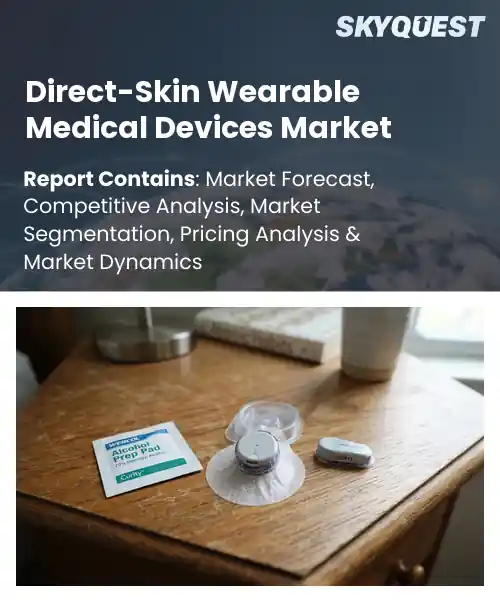
Direct-Skin Wearable Medical Devices Market
Report ID: SQMIG35A4489
Report ID: SQMIG35A4489
[email protected]
USA +1 351-333-4748
Report ID:
SQMIG35A4489 |
Region:
Global |
Published Date: September, 2026
Pages:
157
|Tables:
124
|Figures:
77


Global Direct-Skin Wearable Medical Devices Market size was valued at USD 1.61 Billion in 2024 and is poised to grow from USD 1.72 Billion in 2025 to USD 2.9 Billion by 2033, growing at a CAGR of 6.75% during the forecast period (2026-2033).
Direct‑skin wearable medical devices are adhesive, ultra‑thin sensors that adhere directly to the epidermis to capture physiological signals such as glucose, ECG, or temperature in real time. The market has expanded rapidly because the primary driver continuous health monitoring demand has been amplified by aging populations and the rise of chronic disease management. Early prototypes in the 2010s, like glucose‑monitoring patches from Dexcom, demonstrated feasibility and sparked investor interest, leading to an influx of startups and major tech firms. By integrating data streams into telehealth platforms, these devices reduce hospital visits and empower patients, establishing a new paradigm for preventive care globally. The next critical factor shaping global expansion is regulatory harmonization coupled with advances in flexible electronics, which together lower entry barriers and stimulate commercial deployment. When agencies such as the FDA and EU’s MDCG issue guidance on biocompatibility and data security, manufacturers can accelerate certification, allowing hospitals to adopt skin‑attached cardiac monitors for post‑operative patients. This regulatory clarity drives investment in manufacturing lines that produce roll‑to‑roll printed sensors, reducing unit costs and enabling markets in emerging economies to benefit. Consequently, wider insurer reimbursement and the surge in remote‑patient‑monitoring programs create a feedback loop that fuels research, iteration, and market penetration.
How is AI-driven analytics enhancing performance of direct-skin wearable medical devices?
AI‑driven analytics is reshaping direct‑skin wearables by turning raw biosignals into actionable insights in real time. Machine‑learning models filter noise, detect patterns, and predict health events from continuous streams of temperature, electrophysiology, and biochemical data. This capability enables devices to adjust sampling rates, personalize alerts, and extend battery life, making them more reliable for long‑term monitoring. The market is seeing a shift from simple threshold‑based alerts to predictive health management, attracting interest from clinicians seeking early‑intervention tools and from consumers wanting proactive wellness feedback. As data pipelines mature, integration with cloud platforms and electronic health records further amplifies the value of these wearables, driving broader adoption across chronic disease management and remote patient monitoring.I do not have a specific recent development with a company name and month/year to cite.
Market snapshot - (2026-2033)
Global Market Size
USD 1.61 Billion
Largest Segment
Wearable Sensors
Fastest Growth
Wearable Drug Delivery Devices
Growth Rate
6.75% CAGR
To get more insights on this market click here to Request a Free Sample Report
Global direct-skin wearable medical devices market is segmented by device type, measurement parameter, application, end user and region. Based on device type, the market is segmented into Wearable Sensors, Wearable Drug Delivery Devices, Wearable Monitoring Devices, Wearable Therapeutic Devices and Others. Based on measurement parameter, the market is segmented into Vital Signs, Glucose, ECG, Temperature and Others. Based on application, the market is segmented into Patient Monitoring, Chronic Disease Management, Drug Delivery, Rehabilitation and Others. Based on end user, the market is segmented into Hospitals, Homecare Settings, Ambulatory Care Centers and Others. Based on region, the market is segmented into North America, Europe, Asia Pacific, Latin America and Middle East & Africa.
Wearable Sensors segment dominates because it provides seamless, continuous data capture directly from the skin, enabling real‑time health insights without invasive procedures. Its integration with flexible electronics and low‑power communication modules meets clinicians’ demand for immediate monitoring, while patients appreciate comfort and unobtrusive design. This confluence of technological maturity and user acceptance fuels its leading position in the market and drives sustained investment from device manufacturers and healthcare providers.
However, Wearable Therapeutic Devices segment emerges as the fastest growing because advances in bio‑feedback and actuation technologies enable personalized treatment directly on the skin. Clinical trials demonstrating accelerated wound healing and pain management are spurring adoption, while reimbursement pathways are evolving, creating new revenue streams that accelerate market expansion and innovation.
Glucose segment dominates because it addresses a critical, lifelong monitoring need for diabetics through painless, skin‑conformable sensors that replace traditional finger‑stick methods. The technology’s proven clinical accuracy combined with integrated data platforms simplifies disease management, prompting widespread endorsement by endocrinologists and patients alike. Its ability to feed actionable insights into therapeutic decisions reinforces its central role, anchoring the market’s growth trajectory and drives continuous innovation in sensor chemistry and adhesive designs.
On the other hand, ECG segment is witnessing the strongest growth as emerging algorithms translate raw cardiac signals into predictive health scores. Integration with AI‑driven analytics and tele‑cardiology platforms expands clinical utility beyond arrhythmia detection, attracting cardiology practices seeking remote monitoring solutions, thereby propelling market expansion and opening new service models.
To get detailed segments analysis, Request a Free Sample Report
North America leads through a confluence of advanced clinical research environments, extensive investment in digital health innovation, and well‑established reimbursement pathways that encourage adoption of sophisticated wearable solutions. The region benefits from a mature regulatory framework that provides clear guidance for product approval while supporting rapid iteration. Strong collaborations between academic institutions, technology firms, and healthcare providers accelerate product development cycles. Moreover, a tech‑savvy consumer base and high awareness of preventive health drive demand, reinforcing the market’s depth and resilience.
Direct‑Skin Wearable Medical Devices Market in the United States thrives on deep integration of cutting‑edge sensor technologies with a robust venture capital ecosystem that fuels startups and scale‑ups. Close ties between leading research hospitals and industry accelerate clinical validation, while an extensive network of health insurers offers pathways for coverage. A culture of early adoption among both clinicians and patients further propels market momentum, establishing the United States as a benchmark for innovation and market penetration.
Direct‑Skin Wearable Medical Devices Market in Canada benefits from a collaborative health‑tech community supported by public research funding and a proactive regulatory agency that emphasizes safety and efficacy. Strong partnerships between provincial health systems and technology incubators facilitate real‑world testing and adoption. Emphasis on universal health coverage encourages equitable access, while a highly educated population embraces wearable health monitoring as part of routine care, reinforcing Canada’s role as a forward‑looking market within the region.
Europe’s expansion is propelled by a harmonized regulatory landscape that streamlines cross‑border product launch, coupled with a strategic emphasis on preventive medicine across public health agendas. Robust public‑private partnerships stimulate R&D, while strong manufacturing capabilities in key hubs ensure supply chain resilience. Consumer confidence is bolstered by rigorous data‑privacy standards, fostering trust in continuous health monitoring. Additionally, coordinated reimbursement initiatives and national health strategies encourage integration of wearable diagnostics into routine clinical pathways, positioning Europe as a dynamic growth engine.
Direct‑Skin Wearable Medical Devices Market in Germany is anchored by a world‑class engineering tradition and a dense network of medical research institutes that drive product excellence. Close collaboration between industry and the federal health ministry accelerates pilot programs within hospitals, ensuring clinical relevance. A strong emphasis on precision health and a well‑structured reimbursement framework facilitate adoption, while Germany’s export‑oriented manufacturing sector reinforces its status as a dominant force in the European market.
Direct‑Skin Wearable Medical Devices Market in the United Kingdom experiences rapid expansion through vibrant digital‑health ecosystems centered around leading universities and fintech‑focused innovation hubs. Proactive health‑policy initiatives encourage integration of wearable data into national health records, enhancing clinical utility. Collaborative funding mechanisms between the National Health Service and private investors accelerate the translation of prototypes into market‑ready solutions. This ecosystemic support underpins the United Kingdom’s position as the fastest‑growing market within Europe.
Direct‑Skin Wearable Medical Devices Market in France is emerging as a distinct niche driven by national strategies that prioritize telemedicine and remote patient monitoring. Close ties between public research agencies and biotech startups foster innovative sensor designs tailored to chronic disease management. Health insurance reforms that gradually incorporate wearable data into reimbursement pathways stimulate early adoption. This supportive environment positions France as an emerging contributor to Europe’s overall market momentum.
Asia Pacific advances its role by leveraging rapid technological adoption, extensive manufacturing expertise, and government‑backed health‑innovation agendas. High mobile penetration and a culturally attuned focus on personal health create fertile ground for wearable integration into daily life. Strategic public‑sector initiatives aim to address aging demographics and chronic disease burdens through scalable monitoring solutions. Collaborative ecosystems that unite tech giants, medical device firms, and regional research institutions accelerate product localization, while flexible regulatory pathways encourage timely market entry, collectively enhancing the region’s global presence.
Direct‑Skin Wearable Medical Devices Market in Japan benefits from a strong tradition of precision engineering and a health system that emphasizes early detection and continuous monitoring. Close cooperation between the Ministry of Health and leading electronics manufacturers drives the development of ultra‑thin, high‑accuracy sensors. Public health campaigns promote adoption among an aging population keen on maintaining independence, while integration with national health data platforms ensures clinical relevance and sustainability of market growth.
Direct‑Skin Wearable Medical Devices Market in South Korea thrives on a dynamic convergence of biotech innovation and a digitally connected populace. Government incentives accelerate R&D in flexible electronics, while major conglomerates invest heavily in wearable health platforms. Strong emphasis on real‑time health analytics aligns with national objectives to improve chronic disease outcomes. Rapid consumer acceptance, supported by widespread smartphone usage, reinforces South Korea’s emerging stature as a pivotal player in the Asia Pacific arena.
To know more about the market opportunities by region and country, click here to
Buy The Complete Report
Rising Chronic Disease Monitoring
Advancements In Flexible Sensor Technology
Stringent Regulatory Approval Processes
Data Privacy And Security Concerns
Request Free Customization of this report to help us to meet your business objectives.
The market is shaped by intense rivalry as incumbents pursue strategic M&A, such as Alphabet’s 2021 acquisition of Fitbit to integrate advanced skin‑contact sensors, while forming partnerships like Abbott collaborating with Medtronic on integrated glucose monitoring platforms; these moves accelerate technology diffusion and pressure newcomers to innovate rapidly.
Top Player’s Company Profile
Recent Developments
SkyQuest’s ABIRAW (Advanced Business Intelligence, Research & Analysis Wing) is our Business Information Services team that Collects, Collates, Correlates, and Analyses the Data collected by means of Primary Exploratory Research backed by robust Secondary Desk research. As per SkyQuest analysis the global direct‑skin wearable medical devices market is projected to grow at a 6.75 percent CAGR to 2029 driven primarily by the rising need for chronic disease monitoring which pushes patients and clinicians toward continuous non‑invasive skin‑attached sensors. A second driver is rapid progress in flexible sensor technology that improves comfort and multi‑parameter capture accelerating adoption across care settings. The dominant region remains North America where strong reimbursement, tech‑savvy users and clear regulatory pathways support uptake while wearable sensors constitute the leading segment by volume. However, stringent regulatory approval processes act as a restraint extending time‑to‑market and increasing development costs.
| Report Metric | Details |
|---|---|
| Market size value in 2024 | USD 1.61 Billion |
| Market size value in 2033 | USD 2.9 Billion |
| Growth Rate | 6.75% |
| Base year | 2024 |
| Forecast period | (2026-2033) |
| Forecast Unit (Value) | USD Billion |
| Segments covered |
|
| Regions covered | North America (US, Canada), Europe (Germany, France, United Kingdom, Italy, Spain, Rest of Europe), Asia Pacific (China, India, Japan, Rest of Asia-Pacific), Latin America (Brazil, Rest of Latin America), Middle East & Africa (South Africa, GCC Countries, Rest of MEA) |
| Companies covered |
|
| Customization scope | Free report customization with purchase. Customization includes:-
|
To get a free trial access to our platform which is a one stop solution for all your data requirements for quicker decision making. This platform allows you to compare markets, competitors who are prominent in the market, and mega trends that are influencing the dynamics in the market. Also, get access to detailed SkyQuest exclusive matrix.
Table Of Content
Executive Summary
Market overview
Parent Market Analysis
Market overview
Market size
KEY MARKET INSIGHTS
COVID IMPACT
MARKET DYNAMICS & OUTLOOK
Market Size by Region
KEY COMPANY PROFILES
Methodology
For the Direct-Skin Wearable Medical Devices Market, our research methodology involved a mixture of primary and secondary data sources. Key steps involved in the research process are listed below:
1. Information Procurement: This stage involved the procurement of Market data or related information via primary and secondary sources. The various secondary sources used included various company websites, annual reports, trade databases, and paid databases such as Hoover's, Bloomberg Business, Factiva, and Avention. Our team did 45 primary interactions Globally which included several stakeholders such as manufacturers, customers, key opinion leaders, etc. Overall, information procurement was one of the most extensive stages in our research process.
2. Information Analysis: This step involved triangulation of data through bottom-up and top-down approaches to estimate and validate the total size and future estimate of the Direct-Skin Wearable Medical Devices Market.
3. Report Formulation: The final step entailed the placement of data points in appropriate Market spaces in an attempt to deduce viable conclusions.
4. Validation & Publishing: Validation is the most important step in the process. Validation & re-validation via an intricately designed process helped us finalize data points to be used for final calculations. The final Market estimates and forecasts were then aligned and sent to our panel of industry experts for validation of data. Once the validation was done the report was sent to our Quality Assurance team to ensure adherence to style guides, consistency & design.
Analyst Support
Customization Options
With the given market data, our dedicated team of analysts can offer you the following customization options are available for the Direct-Skin Wearable Medical Devices Market:
Product Analysis: Product matrix, which offers a detailed comparison of the product portfolio of companies.
Regional Analysis: Further analysis of the Direct-Skin Wearable Medical Devices Market for additional countries.
Competitive Analysis: Detailed analysis and profiling of additional Market players & comparative analysis of competitive products.
Go to Market Strategy: Find the high-growth channels to invest your marketing efforts and increase your customer base.
Innovation Mapping: Identify racial solutions and innovation, connected to deep ecosystems of innovators, start-ups, academics, and strategic partners.
Category Intelligence: Customized intelligence that is relevant to their supply Markets will enable them to make smarter sourcing decisions and improve their category management.
Public Company Transcript Analysis: To improve the investment performance by generating new alpha and making better-informed decisions.
Social Media Listening: To analyze the conversations and trends happening not just around your brand, but around your industry as a whole, and use those insights to make better Marketing decisions.
REQUEST FOR SAMPLE
 REQUEST FREE CUSTOMIZATION


Want to customize this report? This report can be personalized according to your needs. Our analysts and industry experts will work directly with you to understand your requirements and provide you with customized data in a short amount of time. We offer $1000 worth of FREE customization at the time of purchase.
Feedback From Our Clients


 USA (+1) 351-333-4748

