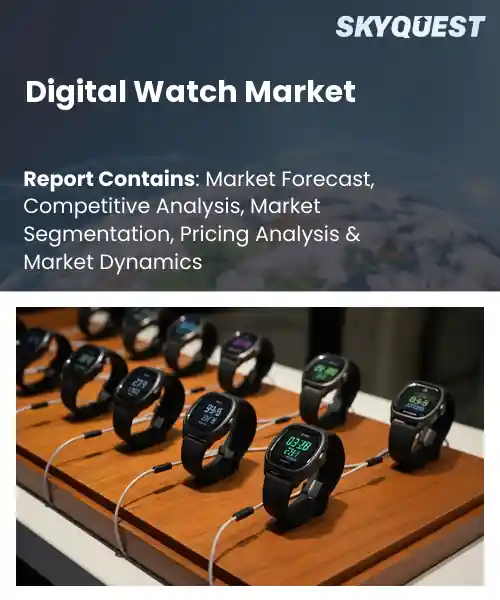
Digital Watch Market
Report ID: SQMIG25K2212
Report ID: SQMIG25K2212
[email protected]
USA +1 351-333-4748
Report ID:
SQMIG25K2212 |
Region:
Global |
Published Date: July, 2026
Pages:
157
|Tables:
144
|Figures:
78


Global Digital Watch Market size was valued at USD 8.52 Billion in 2024 and is poised to grow from USD 9.06 Billion in 2025 to USD 14.85 Billion by 2033, growing at a CAGR of 6.32% during the forecast period (2026-2033).
The digital watch industry centers on timekeeping devices that use electronic displays and embedded processors to deliver features beyond analog watches. Its primary driver has been rapid miniaturization and low-cost electronics, which lowered unit costs and enabled feature-rich designs for consumers. This market matters because it sits at the intersection of fashion, utility and personal data, influencing daily routines and ecosystems alike. Over time the market evolved from simple LCD modules in Casio models to smartwatches that pair with smartphones for notifications and health metrics, and examples such as Garmin and Xiaomi illustrate diversification across premium and budget segments globally.
As a result demand grew for continuous heart-rate monitoring, GPS tracking and smartphone pairing, opening opportunities for healthcare providers to use devices for remote patient monitoring and for insurers to reward healthy behaviors. Companies like Garmin and Fitbit illustrate these dynamics through athlete training analytics and population activity tracking, while Xiaomi’s low-cost offerings demonstrate scalability in emerging markets. Consequently manufacturers that prioritize secure data platforms and subscription services can transform one-time sales into recurring revenue streams and expand global reach.
How is AI enhancing health monitoring in the digital watch market?
AI is reshaping health monitoring in digital watches through smarter sensing and analysis. Key aspects include continuous sensor fusion from heart rate and motion sensors, on device algorithms that detect anomalies, and cloud models that personalize insights. Today manufacturers use these tools to move from raw metrics to actionable alerts and coaching. Consumers now expect proactive prompts and longer term trend feedback. Competition among traditional watchmakers and tech firms has driven rapid feature rollouts. Examples include mainstream smartwatches using machine learning for refined activity detection and firmware updates that add advanced health functions, making devices more clinically relevant and user friendly.
Google in May 2026, the company launched the Google Health app and the Fitbit Air wearable with an AI powered health coach that integrates wearable data and medical records. This innovation strengthens market growth by improving user retention and by automating personalized guidance so monitoring becomes more actionable and efficient.
Market snapshot - (2026-2033)
Global Market Size
USD 8.52 Billion
Largest Segment
Smartwatches
Fastest Growth
Smartwatches
Growth Rate
6.32% CAGR
To get more insights on this market click here to Request a Free Sample Report
Global digital watch market is segmented by type, connectivity, end-user, distribution, price and region. Based on type, the market is segmented into Smartwatches, Traditional Digital Watches and Hybrid Smart Watches. Based on connectivity, the market is segmented into Bluetooth, Cellular and Wi-Fi. Based on end-user, the market is segmented into Adults, Children and Sports/Fitness. Based on distribution, the market is segmented into Online Retail, Electronics Stores and Brand Stores. Based on price, the market is segmented into Budget (Below $100), Mid-Range ($100-$500) and Premium (Above $500). Based on region, the market is segmented into North America, Europe, Asia Pacific, Latin America and Middle East & Africa.
Smartwatches segment dominates with large digital watch market share because their deep software and sensor integration transforms timepieces into multifunctional platforms, enabling health monitoring, notifications, payments and app ecosystems that redefine user expectations. Manufacturers leverage ongoing firmware updates and partner ecosystems to sustain engagement, while OEMs invest in UI and third party apps to differentiate products. The result is sustained consumer preference for devices offering continuous connectivity and evolving capabilities, driving product portfolios and marketing toward smartwatch first strategies.
As per digital watch market outlook, hybrid smart watches are emerging as the most rapidly expanding area due to their blend of classic analog aesthetics with selective smart functions, offering longer battery life and fashion appeal. This convergence attracts style conscious buyers and mid market brands, expanding addressable audiences, enabling collaborations with fashion labels and creating new distribution and monetization opportunities.
Cellular segment dominates because untethered voice and data capabilities transform watches into independent communication devices, unlocking standalone use cases for safety, on the go connectivity and subscription services. Carriers and device makers capitalize on embedded SIM technology to offer persistent connectivity and premium service plans, which drives higher device valuation and fosters ecosystems for app developers and service providers, reinforcing demand for watches that operate independently of smartphones.
As per digital watch market forecast, bluetooth is emerging as the fastest growing area because its low power requirements and ubiquity enable seamless tethering with smartphones and accessories while keeping costs and complexity down. Widespread compatibility with health sensors and audio peripherals accelerates accessory ecosystems, broadening functionality for budget and mid range offerings and creating easier paths for manufacturers to scale features and aftermarket services.
To get detailed segments analysis, Request a Free Sample Report
Asia Pacific dominance is driven by concentrated technological leadership, integrated consumer electronics ecosystems, and widespread adoption of wearable technology across urban and emerging markets. Robust electronics manufacturing hubs and strong collaborations between device makers and telecommunications providers enable rapid innovation cycles and localized feature adaptation. High consumer familiarity with advanced mobile applications and emphasis on health and fitness monitoring support sustained demand for multifunctional timepieces. Proximity to component suppliers and design centers reduces time to market and fosters competitive pricing, while diverse consumer segments encourage feature differentiation and niche product development. Strategic partnerships between original equipment manufacturers and brands further reinforce regional influence and export orientation. Supportive regulatory frameworks for device certification and expanding service ecosystems such as repair, customization, and app marketplaces enhance consumer confidence and long term retention.
As per digital watch market regional outlook, Japan benefits from a discerning consumer base that values precision engineering, refined user interfaces, and premium craftsmanship. Local manufacturers emphasize quality materials, seamless integration with mobile ecosystems, and distinctive design language that appeals to both domestic buyers and niche international customers. Strong retailer networks and authorized service centers support product longevity, while collaborative ventures between traditional watchmakers and technology firms drive sophisticated hybrid models and retail.
As per digital watch market regional forecast, South Korea is characterized by strong consumer adoption of connected devices and collaboration between device brands and carriers. Emphasis on advanced display technologies, compact sensors, and localized software features enhances user engagement. Skilled industrial design studios and agile manufacturers enable product refreshes. Vibrant online channels and tech savvy early adopters support experimentation, while urban lifestyle trends encourage integration of health monitoring and payment functions into wearables.
North America expansion is propelled by skilled consumer affinity for connected experiences, deep integration with smartphone platforms, and a mature retail ecosystem that supports rapid product discovery. Strong app developer communities and health providers encouraging remote monitoring contribute to perceived utility beyond timekeeping. Diverse distribution channels, including sophisticated ecommerce platforms and experiential brick and mortar stores, facilitate broad market reach and premium positioning. Emphasis on user privacy frameworks and interoperability standards enhances trust in wearable solutions. Brand differentiation through software ecosystems, health partnerships, and fashionable design drives adoption among professional and lifestyle oriented segments, while service and warranty infrastructures sustain long term customer relationships. Corporate wellness programs, institutional procurement for workforce monitoring, and collaboration between academic research centers and industry advance functionality and enterprise adoption.
As per digital watch industry analysis, United States reflects strong consumer demand for multifunctional wearables that integrate fitness tracking and payments. Strong technology ecosystems and leading app marketplaces foster rapid innovation and third party service integrations. Corporate procurement and wellness program adoption support enterprise use cases, while premium retail channels and mainstream online platforms enable wide visibility. Emphasis on data privacy, customer support networks, and accessory ecosystems reinforces brand loyalty and purchases.
Canada benefits from a consumer base that values health monitoring and outdoor activity features. Local carriers and retailers collaborate with global brands to adapt service plans and distribution. Emphasis on cross border compatibility and bilingual user experiences influences product design. Growing interest from corporate wellness initiatives and specialty outdoor retailers supports niche segments, while strong after sales service networks enhance long term ownership confidence and trust.
Europe strengthens its position through a combination of precision engineering heritage, strong luxury and fashion sectors, and emphasis on data protection and interoperability standards that appeal to privacy conscious consumers. Established watchmaking expertise blends with tech innovation to create refined hybrid offerings and premium digital timepieces. Cross border trade frameworks and a dense network of specialized retailers and boutique showrooms facilitate curated customer experiences. Collaborative initiatives between manufacturers, healthcare providers, and research institutions advance certified health monitoring features. Focus on sustainable materials, repairability, and after sales services reinforces brand value and supports mid to high end market segments seeking durability and provenance. Vibrant design schools and incubators nurture wearable startups, while targeted investment channels and trade shows provide platforms for collaboration and international scaling. Regional regulatory alignment and certification paths help manufacturers introduce interoperable devices across multiple markets, supporting cohesive brand strategies and consumer trust.
Germany draws on engineering excellence and a resilient supplier base to deliver robust hardware and precise sensors. Design prioritizes functional aesthetics, rigorous quality control, and long term reliability for technical users. Collaboration with component specialists supports tailored solutions for industrial and clinical use. Strong retail partnerships and service networks build consumer confidence, while robust data security practices appeal to enterprise buyers and extended warranty support programs.
United Kingdom benefits from a vibrant fashion and tech scene that prioritizes design led devices and lifestyle integration. Brands collaborate with fintech and health service providers to embed payments and certified health features. Strong direct to consumer channels and boutique retail experiences enable curated launches and brand storytelling. Emphasis on after sales services, user privacy assurances, and modular accessory ecosystems supports premium positioning and consumer engagement.
France is shaped by a strong culture of luxury and design, resulting in elegantly styled wearables that combine fashion and function. Local designers work with technology partners to craft intuitive interfaces and refined materials that resonate with style conscious consumers. Boutique retail and online channels create aspirational positioning, while partnerships with healthcare networks and research institutions support validated wellness features and clinical credibility for health models.
To know more about the market opportunities by region and country, click here to
Buy The Complete Report
Growing Consumer Demand For Wearables
Advances In Sensor and Connectivity
Data Privacy and Security Concerns
Limited Battery Life and Device Size
Request Free Customization of this report to help us to meet your business objectives.
Competitive intensity in the global digital watch industry is driven by platform consolidation, chipset-led differentiation and ecosystem plays that shape consumer lock in; concrete examples include Google completing the acquisition of Fitbit, the Google Samsung collaboration to unify Wear OS and Samsung software, and chipset vendors like Qualcomm shipping new low power wearable platforms to enable richer features and longer battery life.
SkyQuest’s ABIRAW (Advanced Business Intelligence, Research & Analysis Wing) is our Business Information Services team that Collects, Collates, Correlates, and Analyses the Data collected by means of Primary Exploratory Research backed by robust Secondary Desk research.
As per SkyQuest analysis, growing consumer demand for wearables is the key driver fueling market expansion, while data privacy and security concerns act as a significant restraint on adoption. Asia Pacific is the dominating region due to strong manufacturing ecosystems and rapid consumer uptake, and smartwatches are the dominating segment because their integrated sensors and app ecosystems create ongoing value. A second driver is advances in sensor miniaturization and connectivity that enable richer health and location features without sacrificing wearability. Overall the market is shifting toward multifunctional, connected timepieces where manufacturers that address privacy, battery life and service models will capture the most durable growth.
| Report Metric | Details |
|---|---|
| Market size value in 2024 | USD 8.52 Billion |
| Market size value in 2033 | USD 14.85 Billion |
| Growth Rate | 6.32% |
| Base year | 2024 |
| Forecast period | (2026-2033) |
| Forecast Unit (Value) | USD Billion |
| Segments covered |
|
| Regions covered | North America (US, Canada), Europe (Germany, France, United Kingdom, Italy, Spain, Rest of Europe), Asia Pacific (China, India, Japan, Rest of Asia-Pacific), Latin America (Brazil, Rest of Latin America), Middle East & Africa (South Africa, GCC Countries, Rest of MEA) |
| Companies covered |
|
| Customization scope | Free report customization with purchase. Customization includes:-
|
To get a free trial access to our platform which is a one stop solution for all your data requirements for quicker decision making. This platform allows you to compare markets, competitors who are prominent in the market, and mega trends that are influencing the dynamics in the market. Also, get access to detailed SkyQuest exclusive matrix.
Table Of Content
Executive Summary
Market overview
Parent Market Analysis
Market overview
Market size
KEY MARKET INSIGHTS
COVID IMPACT
MARKET DYNAMICS & OUTLOOK
Market Size by Region
KEY COMPANY PROFILES
Methodology
For the Digital Watch Market, our research methodology involved a mixture of primary and secondary data sources. Key steps involved in the research process are listed below:
1. Information Procurement: This stage involved the procurement of Market data or related information via primary and secondary sources. The various secondary sources used included various company websites, annual reports, trade databases, and paid databases such as Hoover's, Bloomberg Business, Factiva, and Avention. Our team did 45 primary interactions Globally which included several stakeholders such as manufacturers, customers, key opinion leaders, etc. Overall, information procurement was one of the most extensive stages in our research process.
2. Information Analysis: This step involved triangulation of data through bottom-up and top-down approaches to estimate and validate the total size and future estimate of the Digital Watch Market.
3. Report Formulation: The final step entailed the placement of data points in appropriate Market spaces in an attempt to deduce viable conclusions.
4. Validation & Publishing: Validation is the most important step in the process. Validation & re-validation via an intricately designed process helped us finalize data points to be used for final calculations. The final Market estimates and forecasts were then aligned and sent to our panel of industry experts for validation of data. Once the validation was done the report was sent to our Quality Assurance team to ensure adherence to style guides, consistency & design.
Analyst Support
Customization Options
With the given market data, our dedicated team of analysts can offer you the following customization options are available for the Digital Watch Market:
Product Analysis: Product matrix, which offers a detailed comparison of the product portfolio of companies.
Regional Analysis: Further analysis of the Digital Watch Market for additional countries.
Competitive Analysis: Detailed analysis and profiling of additional Market players & comparative analysis of competitive products.
Go to Market Strategy: Find the high-growth channels to invest your marketing efforts and increase your customer base.
Innovation Mapping: Identify racial solutions and innovation, connected to deep ecosystems of innovators, start-ups, academics, and strategic partners.
Category Intelligence: Customized intelligence that is relevant to their supply Markets will enable them to make smarter sourcing decisions and improve their category management.
Public Company Transcript Analysis: To improve the investment performance by generating new alpha and making better-informed decisions.
Social Media Listening: To analyze the conversations and trends happening not just around your brand, but around your industry as a whole, and use those insights to make better Marketing decisions.
REQUEST FOR SAMPLE
 REQUEST FREE CUSTOMIZATION
Global Digital Watch Market size was valued at USD 8.52 Billion in 2024 and is poised to grow from USD 9.06 Billion in 2025 to USD 14.85 Billion by 2033, growing at a CAGR of 6.32% during the forecast period (2026-2033).
Competitive intensity in the global digital watch market is driven by platform consolidation, chipset-led differentiation and ecosystem plays that shape consumer lock in; concrete examples include Google completing the acquisition of Fitbit, the Google Samsung collaboration to unify Wear OS and Samsung software, and chipset vendors like Qualcomm shipping new low power wearable platforms to enable richer features and longer battery life. 'Apple Inc. (Apple Watch)', 'Samsung Electronics (Galaxy Watch)', 'Garmin Ltd.', 'Fitbit (Google)', 'Huawei Technologies', 'Casio Computer Co.', 'Fossil Group', 'Amazfit (Zepp Health)', 'Polar Electro', 'Suunto Oy (Amer Sports)', 'Michael Kors (Capri Holdings)', 'TAG Heuer (LVMH)', 'Citizen Watch', 'Seiko Group', 'Timex Group', 'HONOR (Huawei spin-off)', 'Xiaomi Corporation', 'Noise (Go Noise)', 'Boat Lifestyle (Imagine Marketing)', 'Fastrack (Titan)'
Growing consumer interest in convenient health monitoring, activity tracking and seamless connectivity encourages broader adoption of digital watches, directly expanding the user base and stimulating product innovation. As more individuals perceive tangible lifestyle benefits and integration with everyday devices, manufacturers prioritize new features and interoperable platforms. This consumer-driven focus attracts developers and service providers to create complementary applications and services, strengthening ecosystems and increasing perceived value. The resulting positive feedback loop accelerates market acceptance and supports diversified offerings across price points and regions.
Integrated Health Sensor Fusion: Manufacturers are emphasizing seamless integration of multimodal health sensors to deliver more comprehensive wellness insights and clinical grade signals. This trend enables continuous remote monitoring, richer user personalization, and improved interoperability with healthcare platforms, fostering partnerships across medical and broader consumer ecosystems. Enhanced sensor fusion improves reliability of activity, biometric and sleep metrics while supporting developer ecosystems that create condition specific applications. Market players prioritize form factor adaptations and data harmonization to accelerate adoption among clinical stakeholders and everyday users.
Why does Asia Pacific Dominate the Global Digital Watch Market? |@12


Want to customize this report? This report can be personalized according to your needs. Our analysts and industry experts will work directly with you to understand your requirements and provide you with customized data in a short amount of time. We offer $1000 worth of FREE customization at the time of purchase.
Feedback From Our Clients


 USA (+1) 351-333-4748

