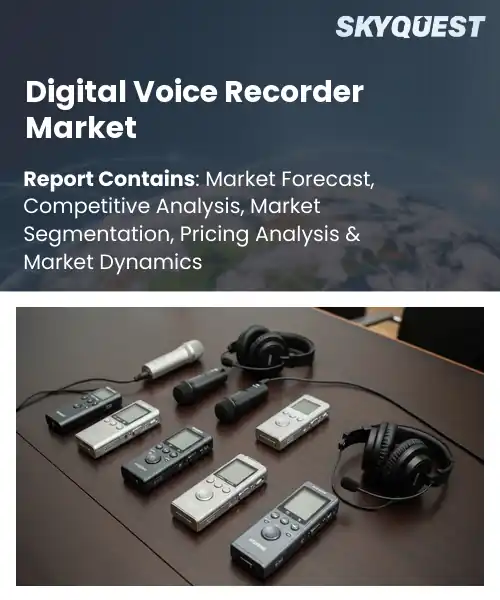
Digital Voice Recorder Market
Report ID: SQMIG25E2277
Report ID: SQMIG25E2277
[email protected]
USA +1 351-333-4748
Report ID:
SQMIG25E2277 |
Region:
Global |
Published Date: July, 2026
Pages:
157
|Tables:
181
|Figures:
79


Global Digital Voice Recorder Market size was valued at USD 2.2 Billion in 2024 and is poised to grow from USD 2.43 Billion in 2025 to USD 5.4 Billion by 2033, growing at a CAGR of 10.5% during the forecast period (2026-2033).
Portable devices capable of recording, storing, and playing back high-quality audio for the professional community (i.e., journalists, lawyers, teachers, etc.) make up the global market for digital voice recorders. The demand for high-quality, searchable data has created a need for these products to have a significant impact on the way that parties involved in a legal dispute and the media view the integrity of the data being created and used. The digital voice recorder market was first dominated by large, cumbersome, tape-based voice recorders prior to the introduction of solid-state memory and compression algorithms in the early part of the 21st century, allowing for smaller and less expensive handheld recording devices to be purchased. Because of this technological advancement, voice recording products were regularly used in various professional settings such as in the field for news reporting, in the court room for court reporters and transcribers, and by teachers to record their classroom lectures, thereby establishing a solid foundation for continued, significant growth globally.
With the advent of the latest generation of digital voice recorders, a new wave of growth will occur as voice recording technology converges with artificial intelligence (AI) technology to provide a new level of service and value to advertisers and end-users alike. AI-powered software programs, such as those embedded in the firmware of digital voice recorders, enable users to create valuable content quickly and efficiently. This will allow users to receive keyword alerts while conducting interviews or when recording videos, thereby shortening the amount of time that it takes to produce the final product and providing the opportunity for users to make real-time decisions regarding the use of the content as it relates to news investigative journalism and law enforcement.
Additionally, the increasing number of people creating content in other languages creates an increased demand for digital voice recorders that support the automatic detection of the language being used during a multinational conference setting. These capabilities open revenue streams through premium software subscriptions and create integration opportunities with cloud‑based collaboration platforms, accelerating market penetration across enterprise and consumer segments in the near future.
How is AI-driven Noise Cancellation Influencing The Digital Voice Recorder Market?
AI Based Noise Cancellation is transforming the way digital voice recorders are utilized as it gives you clearer recordings in environments where background noise would otherwise impact them. Manufacturing Companies are using machine learning models that can isolate speech from background sounds in real time so the user will not have to manually edit recordings and they can also use recorders outside of a studio environment for things like field interviews and lectures, as well as remote working from home. As users look for devices to provide portability along with studio quality audio, the demand has increased for digital voice recorders with intelligent filtering capabilities.
The market has accordingly begun to move toward encouraging products with AI market their capabilities as major differentiators of the product. Companies like podcasters, journalists, and educators desire to have audio that is immediately usable and ready for distribution. The Zoom H5 was identified as one of the top digital recorders available on the market in June 2026 and it's ability to deliver high quality audio, coupled with new and emerging AI noise cancelling technologies is representative of how AI will drive the future of the digital voice recorder to provide professional and non professional users with the ability to deliver quality audio.
Market snapshot - (2026-2033)
Global Market Size
USD 2.2 Billion
Largest Segment
Handheld Digital Voice Recorders
Fastest Growth
Wearable Digital Voice Recorders
Growth Rate
10.5% CAGR
To get more insights on this market click here to Request a Free Sample Report
Global digital voice recorder market is segmented by product type, storage capacity, application, connectivity, end user, distribution channel and region. Based on product type, the market is segmented into Handheld Digital Voice Recorders, Wearable Digital Voice Recorders, Pen Digital Voice Recorders, Smart Digital Voice Recorders and Others. Based on storage capacity, the market is segmented into Below 8 GB, 8–32 GB and Above 32 GB. Based on application, the market is segmented into Business & Meetings, Education & Lectures, Journalism & Media, Legal & Law Enforcement, Personal Use and Others. Based on connectivity, the market is segmented into USB, Bluetooth, Wi-Fi and Others. Based on end user, the market is segmented into Individuals, Enterprises, Educational Institutions, Government & Law Enforcement, Healthcare and Others. Based on distribution channel, the market is segmented into Online Retail, Consumer Electronics Stores, Office Supply Stores and Others. Based on region, the market is segmented into North America, Europe, Asia Pacific, Latin America and Middle East & Africa.
The Business & Meetings category will be the most influential because organizations want reliable recording devices to capture all discussions, decisions, and any action items that arise during meetings (board meetings) and telephone calls (long distance). Organizations have a heightened demand for clear recordings that are easy to search, which aligns with the increase in compliance regulations and knowledge management initiatives. Companies will be looking to standardize the use of handheld and smart recorders across their organization. Continued improvements in security/encryption features, integration into collaborative technologies, and the ease of indexing for users continue to enhance the importance of this category to maintain present market momentum and profitability overall.
On the other hand, Education & Lectures is experiencing the most growth in the Digital Audio Recording Market. The emergence of hybrid learning, increased use of recorded classroom materials, and the need for accurate note-taking devices are driving students and educators to record lectures and other materials in addition to driving innovation into features that enhance recorded voice quality. This has created an opportunity for vendors to enter the marketplace with new and existing products.
The Handheld Digital Voice Recorder (HDVR), with their intuitive, easy-to-use physical controls along with their long battery lives and very easy to navigate file management systems, are now the default recording solution for meeting documentation and field interviews. In addition, manufacturers continue to improve HDVR microphone arrays and firmware, which builds trust and supports the segments continued dominance within the Digital Voice Recorder (DVR) market.
While the HDVRs will remain the dominant segment of the DVR market, the Smart Digital Voice Recorder (SDVR) will continue to be the fastest-growing segment of the DVR market. The rise of AI-powered transcription, cloud syncing, and voice-activated controls are beginning to attract innovative tech-savvy customers and create new use cases for content creation and remote collaboration, which will accelerate innovation, drive market growth, and create new revenue streams.
To get detailed segments analysis, Request a Free Sample Report
North America is at the forefront of advanced technological innovation combined with significant commercial demand, and a well-distributed product base. Businesses and schools use high-quality recording technology for effective compliance training and academic research resulting in an ongoing demand for these products. Moreover, there is an established level of integrated digital voice solutions with a broader range of productivity systems within North America that encourage the implementation of seamless workflows. Continuous improvements to the functionality of recording devices are often the result of collaborative efforts between hardware manufacturers and software developers through innovation hubs. This collaboration further solidifies North America's place as the leader in the global market.
In the U.S., the demand for digital voice recording devices is directly impacted by the emphasis on a culture of productivity, along with their various uses in recording content in the legal, medical, and media sectors. These dual uses have resulted in a strong preference for using smaller, higher quality recording devices that also provide a high level of security and compatibility with cloud-based platforms. Academic institutions utilize digital voice recorders to document their ongoing research as well as to aid language development, thereby creating a continuous level of demand. In addition, the active cooperation of technology companies that manufacture digital voice recorders will lead to a steady supply of new features to improve and maintain the supply of products in the market so that they are able to respond to the needs of customers as they continue to evolve.
Canada's digital voice recorder market has been developed based on its emphasis on high-quality, multilingual recording. Businesses and federal agencies use digital dictation devices to record voice notes for compliance purposes and to keep records of internal and external communication with others. The relationship between North America's manufacturing supply chain and the market allows time-sensitive delivery of the newest innovations in recording technology. Furthermore, cooperation between local distributors and global manufacturers increases availability of products in the marketplace, and thus, continues to grow at a steady pace as professional users and educators adopt digital dictation technology.
Europe's growth will be driven by greater concern with preserving data integrity and facilitating cooperation among countries, as well as by ensuring that environmental impact is minimized. Digital recording devices provide businesses in Europe with reliable tools for maintaining compliance with laws regarding data privacy and for facilitating multilingual communication. Academic and research institutions in Europe continue to invest in the use of advanced recording devices for recording scientific research and conducting language studies. The integration of recording devices into enterprise-level software systems will enhance the productivity of users of signed language. The emphasis being placed on utilizing environmentally sustainable products is pushing businesses to switch to using energy-efficient products. Standardization initiatives among European businesses further promote market growth by creating an environment conducive to adopting intensely innovative products.
Digital Voice Recorder Market in Germany benefits from a reputation for engineering excellence and a robust demand for precision tools in engineering, legal, and academic fields. Companies value seamless integration with enterprise resource planning systems, while research institutions rely on high‑fidelity recorders for experimental documentation. A strong emphasis on data protection aligns with regulatory expectations, encouraging investment in secure devices. Collaboration between domestic manufacturers and international technology partners accelerates feature enhancements, sustaining a vibrant market landscape.
Digital Voice Recorder Market in the United Kingdom experiences swift growth driven by a dynamic media sector and a proactive regulatory environment. Professionals across journalism, legal services, and higher education increasingly adopt compact recording solutions to streamline workflow and ensure compliance. The market is energized by a focus on interoperability with cloud‑based collaboration tools, facilitating real‑time access to recorded content. Innovation hubs foster rapid development of user‑centric features, reinforcing the United Kingdom’s position as a fast‑moving segment within the European arena.
Digital Voice Recorder Market in France is emerging as a focal point for creative industries and educational initiatives. Growing awareness of the benefits of digital documentation encourages adoption among literary professionals, researchers, and language educators. Emphasis on user‑friendly interfaces and multilingual support resonates with the country’s diverse cultural landscape. Partnerships between local distributors and global manufacturers improve market accessibility, while a commitment to sustainability drives interest in eco‑conscious device designs, nurturing steady expansion within the French market.
Asia Pacific advances its role through a blend of rapid technological uptake, expanding professional sectors, and a culturally attuned approach to communication. Enterprises across the region integrate recording solutions to enhance productivity and meet evolving compliance standards. Educational institutions leverage these tools for language acquisition and research documentation, aligning with regional priorities on skill development. Local manufacturers focus on cost‑effective yet feature‑rich devices, catering to both high‑volume markets and niche professional users. Growing interconnectivity with regional digital ecosystems accelerates adoption, positioning Asia Pacific as an increasingly influential contributor to the global digital voice recorder landscape.
Digital Voice Recorder Market in Japan reflects a deep appreciation for precision and reliability, resonating with the nation’s meticulous business culture. Professionals in journalism, legal affairs, and academia favor compact devices that deliver superior audio clarity and seamless integration with mobile platforms. Emphasis on ergonomic design and long battery life aligns with user expectations for portability and endurance. Collaborative ventures between domestic technology firms and global innovators foster continuous improvement, reinforcing Japan’s reputation as a hub for high‑quality recording solutions.
Digital Voice Recorder Market in South Korea is characterized by a strong orientation toward cutting‑edge innovation and seamless connectivity. Fast‑paced corporate environments and vibrant creative sectors drive demand for devices that merge advanced audio capture with real‑time data synchronization. Emphasis on sleek design and intuitive user experiences resonates with tech‑savvy consumers. Close alignment between hardware producers and software developers accelerates the rollout of integrated solutions, supporting South Korea’s ascent as a dynamic participant in the digital voice recorder ecosystem.
To know more about the market opportunities by region and country, click here to
Buy The Complete Report
Increasing Demand For Remote Recording
Integration With Cloud Storage Solutions
High Cost Of Advanced Devices
Privacy Concerns Over Recorded Data
Request Free Customization of this report to help us to meet your business objectives.
The competitive landscape is shaped by intense rivalry among established recorder manufacturers and emerging AI‑focused entrants, driving rapid feature upgrades such as integrated speech‑to‑text, cloud sync and advanced noise‑cancellation. Recent M&A activity has seen a major hardware player acquire a niche AI startup to embed transcription capabilities, while strategic partnerships between recorder brands and software platforms are accelerating ecosystem integration and expanding market reach.
SkyQuest’s ABIRAW (Advanced Business Intelligence, Research & Analysis Wing) is our Business Information Services team that Collects, Collates, Correlates, and Analyses the Data collected by means of Primary Exploratory Research backed by robust Secondary Desk research.
As per SkyQuest analysis, the market is propelled by increasing demand for remote recording which fuels adoption across professional fields, while the high cost of advanced devices restrains price‑sensitive users, especially in emerging economies. North America dominates the landscape due to early technology uptake and strong distribution networks, and handheld digital voice recorders remain the leading segment due to their reliability and ease of use. A second driver comes from seamless integration with cloud storage, enabling instant backup and collaborative workflows that further accelerate growth. AI‑driven noise cancellation also enhances appeal by delivering studio‑grade clarity in field settings, opening new opportunities in media and law‑enforcement.
| Report Metric | Details |
|---|---|
| Market size value in 2024 | USD 2.2 Billion |
| Market size value in 2033 | USD 5.4 Billion |
| Growth Rate | 10.5% |
| Base year | 2024 |
| Forecast period | (2026-2033) |
| Forecast Unit (Value) | USD Billion |
| Segments covered |
|
| Regions covered | North America (US, Canada), Europe (Germany, France, United Kingdom, Italy, Spain, Rest of Europe), Asia Pacific (China, India, Japan, Rest of Asia-Pacific), Latin America (Brazil, Rest of Latin America), Middle East & Africa (South Africa, GCC Countries, Rest of MEA) |
| Companies covered |
|
| Customization scope | Free report customization with purchase. Customization includes:-
|
To get a free trial access to our platform which is a one stop solution for all your data requirements for quicker decision making. This platform allows you to compare markets, competitors who are prominent in the market, and mega trends that are influencing the dynamics in the market. Also, get access to detailed SkyQuest exclusive matrix.
Table Of Content
Executive Summary
Market overview
Parent Market Analysis
Market overview
Market size
KEY MARKET INSIGHTS
COVID IMPACT
MARKET DYNAMICS & OUTLOOK
Market Size by Region
KEY COMPANY PROFILES
Methodology
For the Digital Voice Recorder Market, our research methodology involved a mixture of primary and secondary data sources. Key steps involved in the research process are listed below:
1. Information Procurement: This stage involved the procurement of Market data or related information via primary and secondary sources. The various secondary sources used included various company websites, annual reports, trade databases, and paid databases such as Hoover's, Bloomberg Business, Factiva, and Avention. Our team did 45 primary interactions Globally which included several stakeholders such as manufacturers, customers, key opinion leaders, etc. Overall, information procurement was one of the most extensive stages in our research process.
2. Information Analysis: This step involved triangulation of data through bottom-up and top-down approaches to estimate and validate the total size and future estimate of the Digital Voice Recorder Market.
3. Report Formulation: The final step entailed the placement of data points in appropriate Market spaces in an attempt to deduce viable conclusions.
4. Validation & Publishing: Validation is the most important step in the process. Validation & re-validation via an intricately designed process helped us finalize data points to be used for final calculations. The final Market estimates and forecasts were then aligned and sent to our panel of industry experts for validation of data. Once the validation was done the report was sent to our Quality Assurance team to ensure adherence to style guides, consistency & design.
Analyst Support
Customization Options
With the given market data, our dedicated team of analysts can offer you the following customization options are available for the Digital Voice Recorder Market:
Product Analysis: Product matrix, which offers a detailed comparison of the product portfolio of companies.
Regional Analysis: Further analysis of the Digital Voice Recorder Market for additional countries.
Competitive Analysis: Detailed analysis and profiling of additional Market players & comparative analysis of competitive products.
Go to Market Strategy: Find the high-growth channels to invest your marketing efforts and increase your customer base.
Innovation Mapping: Identify racial solutions and innovation, connected to deep ecosystems of innovators, start-ups, academics, and strategic partners.
Category Intelligence: Customized intelligence that is relevant to their supply Markets will enable them to make smarter sourcing decisions and improve their category management.
Public Company Transcript Analysis: To improve the investment performance by generating new alpha and making better-informed decisions.
Social Media Listening: To analyze the conversations and trends happening not just around your brand, but around your industry as a whole, and use those insights to make better Marketing decisions.
REQUEST FOR SAMPLE
 REQUEST FREE CUSTOMIZATION
Global Digital Voice Recorder Market size was valued at USD 2.2 Billion in 2024 and is poised to grow from USD 2.43 Billion in 2025 to USD 5.4 Billion by 2033, growing at a CAGR of 10.5% during the forecast period (2026-2033).
The competitive landscape is shaped by intense rivalry among established recorder manufacturers and emerging AI‑focused entrants, driving rapid feature upgrades such as integrated speech‑to‑text, cloud sync and advanced noise‑cancellation. Recent M&A activity has seen a major hardware player acquire a niche AI startup to embed transcription capabilities, while strategic partnerships between recorder brands and software platforms are accelerating ecosystem integration and expanding market reach. 'Sony Group Corporation', 'OM Digital Solutions Corporation', 'Zoom Corporation', 'TASCAM (TEAC Corporation)', 'Philips Speech Processing Solutions GmbH', 'Grundig Business Systems GmbH', 'Shenzhen JWD Digital Technology Co., Ltd.', 'PLAUD Inc.', 'Aiworth Technologies Co., Ltd.', 'EVIDA Technology Co., Ltd.', 'Shenzhen Hnsat Industrial Co., Ltd.', 'Panasonic Holdings Corporation', 'Ricatech B.V.', 'Aigo Digital Technology Co., Ltd.', 'QFX, Inc.', 'CENIX Inc.', 'Fujitsu Limited', 'Roland Corporation', 'Shenzhen Benjie Technology Co., Ltd.', 'iFLYTEK Co., Ltd.'
Remote work and field reporting have intensified the need for portable audio capture, prompting professionals to adopt digital voice recorders for reliable documentation. These devices enable hands‑free operation, high‑quality sound capture, and seamless transcription, which supports productivity across sectors such as journalism, law, and education. As organizations prioritize efficient information gathering, the perceived value of dedicated recorders rises, encouraging manufacturers to expand feature sets and distribution channels, thereby reinforcing market expansion through heightened consumer interest and sustained purchasing activity globally.
Voice Ai Integration: The rise of artificial‑intelligence driven transcription and voice‑command capabilities is reshaping recorder functionality. Manufacturers embed real‑time speech‑to‑text engines, language translation, and contextual tagging directly into devices. Users benefit from instant searchable notes, hands‑free operation, and seamless synchronization with collaborative platforms. This shift accelerates adoption across professional sectors such as legal, healthcare, and media, where rapid content capture and analysis are critical. Consequently, product roadmaps prioritize AI‑centric firmware and cloud connectivity, driving differentiation through intelligent user experiences for modern workflows worldwide.
Why does North America Dominate the Global Digital Voice Recorder Market? |@12


Want to customize this report? This report can be personalized according to your needs. Our analysts and industry experts will work directly with you to understand your requirements and provide you with customized data in a short amount of time. We offer $1000 worth of FREE customization at the time of purchase.
Feedback From Our Clients


 USA (+1) 351-333-4748

