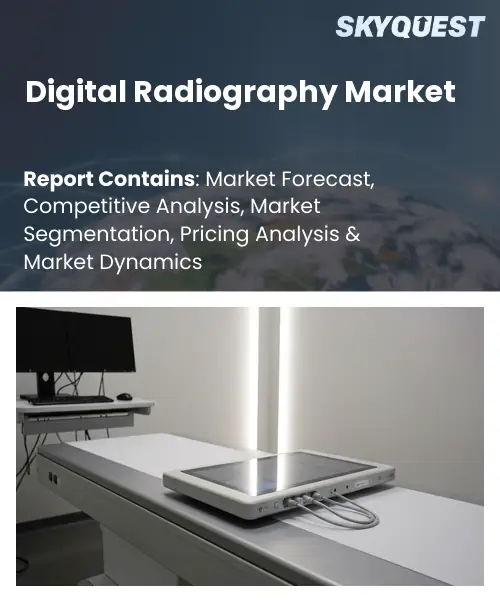
Digital Radiography Market
Report ID: SQMIG35A3576
Report ID: SQMIG35A3576
[email protected]
USA +1 351-333-4748
Report ID:
SQMIG35A3576 |
Region:
Global |
Published Date: May, 2026
Pages:
157
|Tables:
117
|Figures:
77


Global Digital Radiography Market size was valued at USD 1.6 Billion in 2024 and is poised to grow from USD 1.66 Billion in 2025 to USD 2.2 Billion by 2033, growing at a CAGR of 3.6% during the forecast period (2026-2033).
The driver of the digital radiography market is the shift from analog film systems to digital imaging platforms that deliver higher throughput and diagnostic clarity. Flat-panel detectors, digital X-ray machines, image management systems, and computer software utilized in hospitals, clinics, and in diagnostic centers are all classified as digital radiography. Digital radiography has been important for expediting a patients workflow, reducing repeat rates, facilitating the sharing of images, thus improving outcomes for patients while also decreasing costs. The progression from film-based methods, to electronic-based methods, to direct digital detectors has been one of the many advancements to be made within this industry.
Building on this technological transition, a key growth factor is rising demand for diagnostic imaging driven by aging populations and increasing chronic disease prevalence, which forces healthcare providers to invest in digital radiography solutions to manage higher patient volumes. Vendors are integrating portable wireless detectors that allow for quick bedside chest X-ray scans in an ICU setting and an alternate diagnostic strategy in rural locations. Positive reimbursement policies as well as governmental digital health initiatives have encouraged hospitals to purchase integrated PACS (Picture Archiving and Communication Systems) and AI-enabled analytics systems in order to shorten the time needed to make an accurate diagnosis.
How is AI Improving Diagnostic Accuracy and Workflow Efficiency in the Digital Radiography Market?
The addition of AI technologies to the practice of digital radiography has augmented diagnostic accuracy, improved workflow efficiencies, provided clearer images, and automated the detection of difficult to see findings. Three important AI capabilities are as follows: AI reconstruction provides improved detail for clinicians; computer aided detection reduces variability in interpretation between radiologists; integrated decision support prioritizes urgent exams for, and by, reviewing physicians. Vendors are embedding these tools into acquisition consoles and PACS so radiographers and radiologists can work more consistently and with greater confidence. Real world instances include advanced mammography reconstruction, automated density assessment, and vendor neutral AI that routes suspicious studies to specialty review, improving day to day throughput and diagnostic reliability.
In April 2026, GE HealthCare expanded its collaboration with DeepHealth to integrate an AI powered Breast Suite with the Pristina mammography system, supporting earlier detection and prioritized worklists that speed interpretation and help scale high quality screening programs.
Market snapshot - (2026-2033)
Global Market Size
USD 1.6 Billion
Largest Segment
Static Digital Radiography Systems
Fastest Growth
Dynamic Digital Radiography Systems
Growth Rate
3.6% CAGR
To get more insights on this market click here to Request a Free Sample Report
Global digital radiography market is segmented by product type, device configuration, technology, end-user and region. Based on product type, the market is segmented into Dynamic Digital Radiography Systems, Static Digital Radiography Systems, Retrofit Systems and Others. Based on device configuration, the market is segmented into Fixed Digital Radiography Systems and Portable Digital Radiography Systems. Based on technology, the market is segmented into Direct Digital Radiography and Computed Radiography. Based on end-user, the market is segmented into Hospitals, Diagnostic Centers, Specialty Clinics and Others. Based on region, the market is segmented into North America, Europe, Asia Pacific, Latin America and Middle East & Africa.
Dynamic digital radiography systems segment dominates because these systems capture continuous radiographic sequences that reveal functional and motion-related pathology, enabling clinicians to make more confident diagnoses and plan interventions without additional imaging. Real-time imaging will allow fewer repeat imaging sessions, which enables quicker patient processing time. The integration of Picture Archiving and Image Processing will enable efficiency through workflow. The manufacturers are focused on conducting R&D and building relationships with vendors to maximize dynamic capabilities, which will ultimately support the institution's procurement processes and clinical user preference.
However, static digital radiography systems are emerging as the most rapidly expanding area due to cost-effective installation, familiar workflow compatibility, and broad diagnostic utility. Integration into existing suites, vendor emphasis on detector upgrades, and demand from practices seeking reliable replacements accelerate uptake and open new service and upgrade opportunities.
Direct digital radiography segment leads because flat-panel detectors and direct capture architectures produce immediate high-fidelity images that streamline interpretation and reduce time to diagnosis. By integrating seamlessly with Picture Archiving and Communication System as well as the hospital information management system, unnecessary scanning is removed. This will yield higher volume and lower operational burdens for the physician’s practice. The clinician will likely choose to procure digital radiography detectors from a vendor that utilizes higher contrast and spatial resolution by implementing new technology into their workflow.
However, computed radiography is emerging as the most rapidly expanding technology area due to lower entry costs, ability to retrofit existing film setups, and reliability for routine imaging. Vendors offering cost-effective detectors and service models enable facilities to modernize incrementally, fueling sustained adoption among budget-constrained providers and creating aftermarket upgrade opportunities.
To get detailed segments analysis, Request a Free Sample Report
North America commands the global digital radiography market through a convergence of advanced clinical infrastructure, robust funding for healthcare modernization, and a highly developed ecosystem for medical technology adoption. Increasing the number of hospitals with specialized imaging is making it possible for many new types of detectors and integrated imaging to come together. The supportive regulatory and reimbursement system is helping fast-track the integration of these technologies into clinical use, and the relationship between manufacturers and research organizations continues to improve these technologies. With a strong service and distribution network, ensuring high equipment uptime and lifecycle management of the technology, and a continued focus on increasing the efficiency of workflow and accuracy of diagnosis are providing further incentive for hospitals to move from analog to more smart radiography technologies.
Digital radiography market in United States exhibits a highly mature adoption environment characterized by extensive clinical research collaboration, rapid incorporation of advanced detectors and software, and a strong service and distribution network. Providers of the healthcare industry are prioritizing imaging throughput, quality of images, and interoperability with patient electronic health record systems thus generating an increasing demand for all-encompassing solutions. The continued emphasis on specialty imaging centers, outpatient networks and academic medical centers will keep their initial adoption of technologies improving workflow efficiencies high.
Digital radiography market in Canada reflects a focus on improving access to high-quality imaging across diverse geographies, with investment in portable and wireless detector technologies and teleimaging workflows. Government funded hospitals are moving towards more standardised imaging protocols and centralised purchasing in their efforts to upgrading from film to digital based images for X-ray and other modalities. The collaboration of regional health authorities with the vendors of their chosen equipment will lead to long term contracts for service and training of staff, facilitating the modernisation of their radiology fleets and providing a more consistent level of diagnostic capability in both urban and rural communities.
Europe is experiencing rapid expansion in digital radiography driven by coordinated digital health agendas, strong clinical demand for consistent diagnostic quality, and proactive adoption by major healthcare providers. Network of radiology centers and national health care providers will provide standardized procurement of a large scale digital image system which will allow implementation of a national solution for digital images. Emphasis on data privacy compliance, interoperability and integration with health information exchanges also drive suppliers to provide modular configurable solutions to suit different clinical environments. Local manufacturing and collaboration with academia allow suppliers to address the regional adaptation of the Detector and software technology, while flexible financing and service models will help to overcome the fragmentation of procurement.
Digital radiography market in Germany benefits from a concentrated base of advanced hospitals, strong technical capabilities, and a procurement ecosystem that favors high quality imaging solutions. In particular, in areas diagnosed from imaging techniques, the use of advanced detection devices and image processing software are two key aspects to achieving high standards of clinical information systems. Local manufacturing and collaborative research between medical centers and industry support product adaptation to clinical workflows, while service excellence sustains long term equipment utilization.
Digital radiography market in United Kingdom is characterized by dynamic adoption driven by policy focus on digital transformation, expanding outpatient imaging services, and private provider investment. Innovative financing and flexible procurement allow for rapidly replacing obsolete technologies. Process integration through interoperability and data governance enables integrated care processes. Vendor partnerships with clinical networks and targeted training foster faster deployment of portable detectors and workflow software, improving access to diagnostic imaging.
Digital radiography market in France is emerging through modernization of public hospitals, stronger regional purchasing initiatives, and interest in cost effective imaging workflows. National focus on standardized clinical protocols and interoperability encourages suppliers to offer configurable solutions for diverse facility types. Collaborative agreements between locally based producers of imaging systems and health-related institutions allow for custom designed and developed detectors and software applications, while the introduction of tele-imaging and mobile radiography pilot sites increases access to these technologies in remote areas and supports the continued acceptance of digital replacements.
Asia Pacific is strengthening its position in digital radiography through strategic healthcare modernization, expanding local manufacturing capabilities, and targeted adoption of scalable imaging solutions across urban and emerging markets. New, expanding private hospital chains and diagnostic imaging groups are focused on both operational efficiency and quality of images. As such, there is an increasing demand for competitive cost detectors and cloud-enabled workflow software designed to operate on a variety of infrastructures. The introduction of collaborative relationships across borders, along with technology transfer and skills development initiatives, has increased service networks and support after the sale. The increased focus on portable or point-of-care solutions and teleimagery will also allow for greater clinical access and will assist in speeding the transition of healthcare providers from traditional analog system.
Digital radiography market in Japan centers on high technology integration, strong domestic manufacturing, and a clinical focus on image precision and workflow automation. Healthcare providers prefer compact detectors, high-performance systems (in terms of speed) and advanced imaging processing software to fit their hospital IT environments. Vendors who partner with research hospitals benefit from an ongoing iterative process of improving hardware, analytics, service after the sale, and training programs, all of which promote long-term clinical performance and technology adoption.
Digital radiography market in South Korea is propelled by technology adoption, strong electronics manufacturing expertise, and integration of AI enabled imaging tools. Hospitals and diagnostic centers prioritize compact high efficiency detectors and advanced analytics to support faster clinical decision making. The collaboration environment built by tech companies and institutions of higher learning creates an environment of specialized software/hardware creation through enhanced supply chain support through SaaS models and a fast-paced service model in the installation stage to move to deployment to urban based hospitals and outpatient ,expanding body.
To know more about the market opportunities by region and country, click here to
Buy The Complete Report
Rising Adoption Of Digital Radiography
Advancements In Detector Technology
High Initial Capital Expenditure
Regulatory And Reimbursement Challenges
Request Free Customization of this report to help us to meet your business objectives.
Competition in global digital radiography is intensifying as incumbents and new entrants pursue consolidation, AI integration, and channel partnerships. Recent moves include large imaging OEMs expanding through acquisitions and tie-ups with AI vendors, while well‑funded imaging AI firms scale via strategic partnerships and international office openings, pushing rapid product innovation and shifts in distribution and clinical adoption.
Top Player’s Company Profile
Recent Developments
SkyQuest’s ABIRAW (Advanced Business Intelligence, Research & Analysis Wing) is our Business Information Services team that Collects, Collates, Correlates, and Analyses the Data collected by means of Primary Exploratory Research backed by robust Secondary Desk research.
As per SkyQuest analysis, the global digital radiography market is primarily driven by the shift from analog film to digital imaging platforms that deliver higher throughput and diagnostic clarity, with a secondary driver being rising demand for diagnostic imaging from aging populations and the growing chronic disease burden. Growth is supported by detector improvements and AI-enabled workflows, yet high initial capital expenditure remains a key restraint that slows adoption among smaller providers. North America continues to dominate the market thanks to advanced clinical infrastructure and supportive reimbursement, while the Dynamic Digital Radiography Systems segment leads demand due to its real-time functional imaging and strong workflow efficiencies.
| Report Metric | Details |
|---|---|
| Market size value in 2024 | USD 1.6 Billion |
| Market size value in 2033 | USD 2.2 Billion |
| Growth Rate | 3.6% |
| Base year | 2024 |
| Forecast period | (2026-2033) |
| Forecast Unit (Value) | USD Billion |
| Segments covered |
|
| Regions covered | North America (US, Canada), Europe (Germany, France, United Kingdom, Italy, Spain, Rest of Europe), Asia Pacific (China, India, Japan, Rest of Asia-Pacific), Latin America (Brazil, Rest of Latin America), Middle East & Africa (South Africa, GCC Countries, Rest of MEA) |
| Companies covered |
|
| Customization scope | Free report customization with purchase. Customization includes:-
|
To get a free trial access to our platform which is a one stop solution for all your data requirements for quicker decision making. This platform allows you to compare markets, competitors who are prominent in the market, and mega trends that are influencing the dynamics in the market. Also, get access to detailed SkyQuest exclusive matrix.
Table Of Content
Executive Summary
Market overview
Parent Market Analysis
Market overview
Market size
KEY MARKET INSIGHTS
COVID IMPACT
MARKET DYNAMICS & OUTLOOK
Market Size by Region
KEY COMPANY PROFILES
Methodology
For the Digital Radiography Market, our research methodology involved a mixture of primary and secondary data sources. Key steps involved in the research process are listed below:
1. Information Procurement: This stage involved the procurement of Market data or related information via primary and secondary sources. The various secondary sources used included various company websites, annual reports, trade databases, and paid databases such as Hoover's, Bloomberg Business, Factiva, and Avention. Our team did 45 primary interactions Globally which included several stakeholders such as manufacturers, customers, key opinion leaders, etc. Overall, information procurement was one of the most extensive stages in our research process.
2. Information Analysis: This step involved triangulation of data through bottom-up and top-down approaches to estimate and validate the total size and future estimate of the Digital Radiography Market.
3. Report Formulation: The final step entailed the placement of data points in appropriate Market spaces in an attempt to deduce viable conclusions.
4. Validation & Publishing: Validation is the most important step in the process. Validation & re-validation via an intricately designed process helped us finalize data points to be used for final calculations. The final Market estimates and forecasts were then aligned and sent to our panel of industry experts for validation of data. Once the validation was done the report was sent to our Quality Assurance team to ensure adherence to style guides, consistency & design.
Analyst Support
Customization Options
With the given market data, our dedicated team of analysts can offer you the following customization options are available for the Digital Radiography Market:
Product Analysis: Product matrix, which offers a detailed comparison of the product portfolio of companies.
Regional Analysis: Further analysis of the Digital Radiography Market for additional countries.
Competitive Analysis: Detailed analysis and profiling of additional Market players & comparative analysis of competitive products.
Go to Market Strategy: Find the high-growth channels to invest your marketing efforts and increase your customer base.
Innovation Mapping: Identify racial solutions and innovation, connected to deep ecosystems of innovators, start-ups, academics, and strategic partners.
Category Intelligence: Customized intelligence that is relevant to their supply Markets will enable them to make smarter sourcing decisions and improve their category management.
Public Company Transcript Analysis: To improve the investment performance by generating new alpha and making better-informed decisions.
Social Media Listening: To analyze the conversations and trends happening not just around your brand, but around your industry as a whole, and use those insights to make better Marketing decisions.
REQUEST FOR SAMPLE
 REQUEST FREE CUSTOMIZATION
Global Digital Radiography Market size was valued at USD 1.6 Billion in 2024 and is poised to grow from USD 1.66 Billion in 2025 to USD 2.2 Billion by 2033, growing at a CAGR of 3.6% during the forecast period (2026-2033).
Competition in global digital radiography is intensifying as incumbents and new entrants pursue consolidation, AI integration, and channel partnerships. Recent moves include large imaging OEMs expanding through acquisitions and tie-ups with AI vendors, while well‑funded imaging AI firms scale via strategic partnerships and international office openings, pushing rapid product innovation and shifts in distribution and clinical adoption. 'General Electric', 'Siemens Energy', 'Fujifilm Holdings', 'Philips', 'Canon', 'Carestream Health', 'Agfa-Gevaert Group', 'Konica Minolta', 'Varex Imaging', 'Shimadzu Corporation', 'Hologic', 'Dentsply Sirona', 'Planmeca Oy', 'Midmark Corporation', 'Acteon Group', 'Teledyne Technologies', 'Vieworks', 'Rayence', 'Trixell', 'Dexela'
Digital radiography adoption enhances diagnostic workflows and operational efficiency by providing faster image acquisition, clarity improvements, and smoother integration with hospital information systems and picture archiving systems. Clinicians benefit from more reliable imaging that reduces the need for repeat examinations and supports quicker clinical decisions, which in turn encourages procurement and deployment. Vendors respond by expanding product portfolios and support services, creating a reinforcing cycle where usability, interoperability, and perceived clinical value drive further uptake across hospitals, outpatient centers, and diagnostic networks.
Ai-Assisted Interpretation: AI integration into digital radiography workflows is accelerating diagnostic efficiency and image interpretation quality by enabling automated image enhancement, prioritization and decision support. Vendors are embedding machine learning algorithms within image acquisition and reporting pipelines to reduce variability, support less experienced operators, and streamline radiologist workloads. This trend fosters tighter interoperability with PACS and enterprise systems, encourages vendor partnerships with software developers, and shifts clinical practice toward proactive triage and standardized reporting, ultimately improving throughput and value across care settings.
Why does North America Dominate the Global Digital Radiography Market? |@12


Want to customize this report? This report can be personalized according to your needs. Our analysts and industry experts will work directly with you to understand your requirements and provide you with customized data in a short amount of time. We offer $1000 worth of FREE customization at the time of purchase.
Feedback From Our Clients


 USA (+1) 351-333-4748

