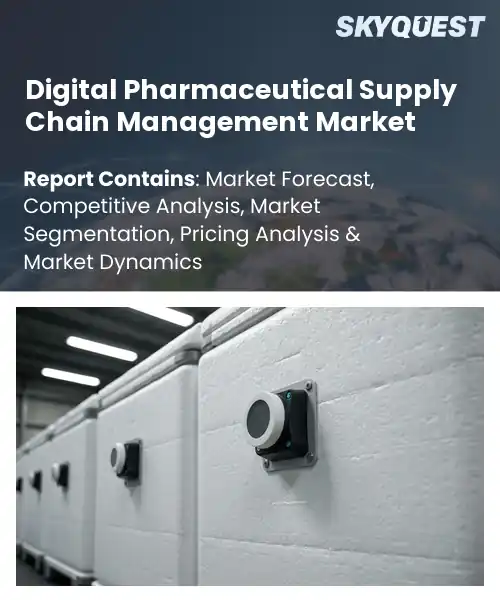
Digital Pharmaceutical Supply Chain Management Market
Report ID: SQMIG35G2416
Report ID: SQMIG35G2416
[email protected]
USA +1 351-333-4748
Report ID:
SQMIG35G2416 |
Region:
Global |
Published Date: May, 2026
Pages:
157
|Tables:
180
|Figures:
79


Global Digital Pharmaceutical Supply Chain Management Market size was valued at USD 4.90 Billion in 2024 and is poised to grow from USD 5.48 Billion in 2025 to USD 13.37 Billion by 2033, growing at a CAGR of 11.8% during the forecast period (2026-2033).
Digital pharmaceutical supply chain management market growth can be defined as the management of inventory, manufacturing, logistics (both cold and regular), and regulatory compliance throughout a network of suppliers and stakeholders, using software applications, sensors, analytics and blockchain technology. Traceability and integrity of drug products is very important because of the complexity of global sourcing, demonstrated by drug shortages and vaccine cold chain failures during pandemics, creating an urgent need for traceability. In addition to the fact that lapses in efficacy result in harm to patients, expensive recalls and regulatory penalties that reduce trust and revenue, this is also why we need to see investments made to ensure visibility into the supply chain for drug products. There has been an evolution from basic ERP systems that use barcode scanning to integrated IoT monitoring systems that utilize cloud based analytics as well as blockchains by global companies that manufacture and distribute products worldwide.
As regulations increase and patient safety expectations require the need for transparency, pharmaceutical companies are increasingly adopting serialization (the process of giving each drugs unit a unique identifier), track and trace and real-time monitoring technologies in order to mitigate the risks associated with counterfeiting and enable the ability to conduct accurate recalls. Examples of regulations that force the use of serialization are the Drug Supply Chain Security Act (DSCSA) and the European Union Falsified Medicines Directive, as well as the use of continuous temperature measurement tools during the COVID-19 vaccination campaign ensured that the vaccine was not spoiled and remained effective. Investments in these technologies will enable the use of predictive analytics and inventory optimization systems, which will in turn result in fewer stock-outs, less waste and reduced time to market for those biologic products that need to be kept at precise temperatures during the shipping process. As a result, those vendors providing integrated supply chain networks, AI predictive analytics and blockchain-enabled provenance will be well positioned to take advantage of increased opportunities.
How is Blockchain Enhancing Traceability in the Digital Pharmaceutical Supply Chain?
Blockchain has the potential to create verifiable provenance for the Digital pharmaceutical supply chain management market trends. This is accomplished through the use of an immutable ledger to capture all custody events associated with a product. In regards to verifiable provenance, three key points stand out: product history can be tamper resistant and interoperable; different product batches will have their own digital identities and therefore, actors will have their own respective digital identities; and lastly, the use of sensors for temperature and location compliance.
As the industry progresses, it will soon realise that with the increasing demands from regulators and manufacturers for stronger serialization and recall capabilities; that the state of infrastructure for pharmaceuticals is constantly evolving due to pilots and commercial deployments. Market forces resulting from safety concerns and counterfeiting issues are driving collaboration between pharmaceutical companies and technology providers. A number of industry initiatives and vendor solutions showcase how the establishment of shared ledgers creates an environment for improved auditability related to the reconciliation of manual processes.
In May of 2026 Tmall Health announced the establishment of a Health Supplement Safety Alliance that is tasked with implementing blockchain-based traceability from start-to-finish for health supplement products; this noteworthy development highlights that verifying product information via a ledger can expedite the regulatory review process and increase the efficiency of validating the authenticity of products. Both of which will help drive increased market growth and operational resilience.
Market snapshot - (2026-2033)
Global Market Size
USD 4.9 Billion
Largest Segment
Software
Fastest Growth
Software
Growth Rate
11.8% CAGR
To get more insights on this market click here to Request a Free Sample Report
Global digital pharmaceutical supply chain management market is segmented by component, deployment type, application, technology, end user, supply chain stage and region. Based on component, the market is segmented into software, hardware and services. Based on deployment type, the market is segmented into cloud-based, on-premise and hybrid. Based on application, the market is segmented into inventory management, warehouse management, cold chain monitoring, track & trace solutions, order & distribution management and others. Based on technology, the market is segmented into IoT, blockchain, AI & analytics, RFID & barcode systems and cloud computing. Based on end user, the market is segmented into pharmaceutical manufacturers, distributors & wholesalers, hospitals & pharmacies, contract manufacturing organizations (CMOs) and others. Based on supply chain stage, the market is segmented into procurement, manufacturing, warehousing, distribution and retail & dispensing. Based on region, the market is segmented into North America, Europe, Asia Pacific, Latin America and Middle East & Africa.
With the availability of pervasive sensor networks and connectivity, the Internet of Things (IoT) segment is the predominant technology solution for monitoring temperature, location, and other conditions across the pharmaceutical supply chain. This allows manufacturers, distributors, and third-party logistics providers to have an accurate understanding of their products in real time, enabling them to intervene proactively to safeguard product integrity. Through the use of real-time telemetry data, manufacturers and distributors can automate alerts, maintain appropriate regulatory records, and more closely coordinate their suppliers. The result is a reduction in spoilage and compliance risk. In addition, by integrating the IoT with cloud platforms and logistics systems, manufacturers and distributors create the data foundation upon which process optimization will occur and build trust among stakeholders.
However, AI and analytics are also growing quickly as more manufacturers and distributors leverage advanced algorithms to extract actionable insights from the diverse data available across their supply chains, which will enable those manufacturers and distributors to perform demand forecasting, anomaly detection, and automated decision support. As more manufacturers and distributors adopt AI and analytics, coupled with investments in predictive models and regulatory reporting tools, efficiencies will be enhanced and new service opportunities will be created based on analytics.
The track & trace solutions space is the largest of the three segments due to the requirement for serialization to be compliant with anti-counterfeiting regulations, as well as expectations from regulators to have both provenance and unit level visibility throughout the pharmaceutical supply chain. Traceability systems that can effectively execute recalls, validate the origin of products at each stage of the supply chain and verify the authenticity of products during each transfer between locations also mitigate the risk of diversion and damage to the brand. Integrating with manufacturing execution systems and distribution platforms also creates a seamless connection between compliance and operational processes, driving adoption on a larger scale by manufacturers and supply chain partners.
At the same time, there has also been increased growth in the cold chain monitoring space as new temperature sensitive biologics have increased the demand for continuous monitoring of environmental conditions and stricter requirements about how these products must be stored. The ability to improve the accuracy and reliability of sensor technology, as well as the development of automated workflows to respond when products exceed acceptable temperature limits, have allowed companies to expand their use of cold chain monitoring solutions across warehousing and transport, opening up new opportunities for specialized monitoring solutions and value-added services.
To get detailed segments analysis, Request a Free Sample Report
North America is the leading region due to its integrated healthcare system, digital maturity among stakeholders, and concentration of major pharmaceutical and technology companies that impact the adoption of end-to-end supply chain solutions. Strong regulatory frameworks focusing on product safety and traceability incentivize investment in serialization, track & trace, and data interoperability solutions. The deployment of modern technologies such as cloud-based platforms, analytics, and automation is accelerated by strong partnerships between technology vendors, logistics providers, and life science companies. Mature payer and provider ecosystems create a demand for transparency and reliability in products and services; a skilled workforce and available capital enable ongoing innovation. Investment in cybersecurity and data governance supports stakeholder confidence and improves the ability to collaborate across borders.
Digital pharmaceutical supply chain management market share in United States is influenced by the large number of pharmaceutical HQs, tech innovators, and logistics companies that are utilizing digital solutions to move product through their distribution networks. Due to the need for on-time delivery, safety, serialization, and visibility, companies are adopting enterprise-wide digital supply chains. Through collaborative programs and vendor partnerships, companies are able to deploy their digital supply chains faster than they could on their own. Finally, the availability of mature IT infrastructure and resources allow for the integration of analytics and automated systems, as well as the use of secure cloud-based platforms; this helps organizations improve traceability and response time to customer demands throughout their supply chain.
Digital pharmaceutical supply chain management market outlook in Canada include partnerships between vendors and numerous regulatory compliance efforts to enhance patient safety. The different types of supply chain providers are looking for Modular/Scalable solutions to meet their specific needs and overcome existing logistical challenges such as temperature controlled distribution and the number of service providers to deliver products at a given location. Expanding the trade between Canada and other countries will develop a more seamless supply chain by partnering to share platforms. The increased need for expertise, partnerships with technology vendors, and a belief in the importance of developing the capabilities to trace, analyse and resiliently supply products will help progress the evolution of the traceability, analytics and resilient supply chain processes.
Europe experiences robust growth driven by harmonizing regulatory initiatives focusing on safety, traceability, and supply continuity across nations. Such an environment fosters investments in interoperable digital platforms. This is fuelled by the visiability from end to end across cold chains with an immediate requirement from an existing base of manufacturing companies skillfully matched with colourful investments from innovative biopharma firms. Collaborative networks between distributors, regulators, and technology vendors encourage them to exchange Standardized Data and run jointly sponsored pilots. An inordinate focus on patient safety, sustainability, and supply resilience is leading to greater deployment of analytics, serialization, and connected logistics. Strong vendor ecosystems and a quality labor force keep siphoning through scalable implementations and build the fast track from country to scientific collaboration in sharing best practices and solutions across the region. Regional funding mechanisms and industry consortia catalyse adoption and dissemination of knowledge.
Digital pharmaceutical supply chain management market forecast in Germany is driven by a strong manufacturing base, advanced automation, and vendor ecosystems that provide industrial solutions. Collaboration among manufacturers, technology providers, and logistics firms advances serialization, traceability, and process efficiency. High quality and compliance standards encourage adoption of validated digital systems, while a skilled technical workforce and focus on operational excellence support integration of analytics and automation across production and distribution networks.
Digital pharmaceutical supply chain management market regional outlook in United Kingdom has seen a lot of progress with new ways to improve operations and engage customers. The adoption of new technologies has been driven by several factors such as modernized systems that offer greater interoperability, enhanced patient safety and efficient distribution methods. The market also has been positively impacted by cloud-based platforms and advanced analytical tools as well as connected logistics tools that can provide access to data across different parts of the supply chain. The presence of vendor partnerships with healthcare providers, technology companies and regulatory bodies has created opportunities for the adoption of new technologies in the digital pharmaceutical supply chain management space while also supporting companies' digital transformation objectives and the modernization of supply chain operations.
Digital pharmaceutical supply chain management market regional forecast in France has a positive growing through investments in digital initiatives, supportive legislation, and partnerships between the biotech and logistics communities. Cloud platforms, traceability solutions, and cold chain optimization solutions are the primary focus of provider's technology investments that will ultimately result in improved service to the manufacturing base that exists within the region. The development of public-private partnerships and pilot programs has helped mid-sized businesses adopt digital technologies, while a continuing commitment to quality standards and workforce training has supported the integration of analytics and automated processes and the overall goal of establishing more resilient supply chains.
Asia Pacific is strengthening its position through rapid technology adoption among manufacturers and logistics operators, targeted investments in cold chain and serialization capabilities, and growing partnerships with global technology providers. Regional players are focusing on localized solutions that address diverse infrastructure and regulatory environments while leveraging mobile connectivity and cloud platforms to improve visibility and responsiveness. Public and private stakeholders are prioritizing resilience, temperature controlled logistics, and data driven decision making. Increased skills development, emerging vendor ecosystems, and cross border trade integration support scalable deployments and adaptation of best practices from leading markets, contributing to more robust and interconnected regional pharmaceutical supply chains. National initiatives and industry consortia promote harmonized standards and workforce training, while investments in advanced analytics and AI enable predictive planning and risk mitigation across distribution networks.
Digital pharmaceutical supply chain management market analysis in Japan has a solid base because of precision manufacturing, stringent quality control, and advanced automation, which support digital solutions. Domestic suppliers and integrators also provide reliable bases for serialization, temperature monitoring, and process control. Manufacturers, logistics providers, and researchers collaborate to foster robotic and analytical adoption. Regulatory compliance and discipline create an incentive for implementing secure cloud platforms and predictive maintenance throughout the distribution and production networks.
Digital pharmaceutical supply chain management industry in South Korea is driven by a strong technology sector and local expertise in electronics along with public support for digital health. The local solutions for temperature monitoring (monitoring of temps and serial numbers) and serialization align with the rapid logistics capabilities of South Korea. Close cooperation between technology companies, pharmaceutical manufacturers, and logistics companies and support for the adoption of analytics, AI, and automation will ultimately drive digital health adoption. The interoperability and deployment focus will enable better traceability and resiliency in supply chain channels of distribution and reliability.
To know more about the market opportunities by region and country, click here to
Buy The Complete Report
Increasing Need For Traceability
Adoption Of Advanced Analytics
High Implementation Complexity
Data Security and Privacy Concerns
Request Free Customization of this report to help us to meet your business objectives.
Competitive intensity in the global digital pharmaceutical supply chain market is being driven by regulatory serialization and buyer demand for end to end visibility, prompting consolidation through acquisitions, logistics agreements and platform innovation. Examples include Antares Vision Group acquiring rfXcel to combine track and trace software, Maersk’s cold chain agreement with Novo Nordisk, and Sonoco ThermoSafe’s PharmaPortal built with IBM blockchain to improve temperature controlled traceability.
Top Player’s Company Profile
Recent Developments in the Digital Pharmaceutical Supply Chain Management Market
SkyQuest’s ABIRAW (Advanced Business Intelligence, Research & Analysis Wing) is our Business Information Services team that Collects, Collates, Correlates, and Analyses the Data collected by means of Primary Exploratory Research backed by robust Secondary Desk research.
As per SkyQuest analysis, the global digital pharmaceutical supply chain management industry is experiencing major growth with increasing requirements for medicine tracking to protect patients and to stop counterfeit medicines. The use of advanced analytical tools for predicting consumer demand, i.e., demand forecasting, and reducing waste serves as another major driver to market growth. The inability for pharmaceutical companies to handle the technical issues related to their legacy systems and the need for all parties involved with the movement of medicines to coordinate with each other, however, continues to present a significant challenge to overall growth in the market. North America is the dominant region in the global pharmaceutical supply chain market because of its developed healthcare system and the strong regulatory pressures placed on pharmaceutical companies. The IoT market is the largest segment due to the use of ubiquitous sensor networks to continuously monitor the temperature and location of medicines stored in a cold-chain environment and their ability to meet the serialization requirements associated with them.
| Report Metric | Details |
|---|---|
| Market size value in 2024 | USD 4.9 Billion |
| Market size value in 2033 | USD 13.37 Billion |
| Growth Rate | 11.8% |
| Base year | 2024 |
| Forecast period | (2026-2033) |
| Forecast Unit (Value) | USD Billion |
| Segments covered |
|
| Regions covered | North America (US, Canada), Europe (Germany, France, United Kingdom, Italy, Spain, Rest of Europe), Asia Pacific (China, India, Japan, Rest of Asia-Pacific), Latin America (Brazil, Rest of Latin America), Middle East & Africa (South Africa, GCC Countries, Rest of MEA) |
| Companies covered |
|
| Customization scope | Free report customization with purchase. Customization includes:-
|
To get a free trial access to our platform which is a one stop solution for all your data requirements for quicker decision making. This platform allows you to compare markets, competitors who are prominent in the market, and mega trends that are influencing the dynamics in the market. Also, get access to detailed SkyQuest exclusive matrix.
Table Of Content
Executive Summary
Market overview
Parent Market Analysis
Market overview
Market size
KEY MARKET INSIGHTS
COVID IMPACT
MARKET DYNAMICS & OUTLOOK
Market Size by Region
KEY COMPANY PROFILES
Methodology
For the Digital Pharmaceutical Supply Chain Management Market, our research methodology involved a mixture of primary and secondary data sources. Key steps involved in the research process are listed below:
1. Information Procurement: This stage involved the procurement of Market data or related information via primary and secondary sources. The various secondary sources used included various company websites, annual reports, trade databases, and paid databases such as Hoover's, Bloomberg Business, Factiva, and Avention. Our team did 45 primary interactions Globally which included several stakeholders such as manufacturers, customers, key opinion leaders, etc. Overall, information procurement was one of the most extensive stages in our research process.
2. Information Analysis: This step involved triangulation of data through bottom-up and top-down approaches to estimate and validate the total size and future estimate of the Digital Pharmaceutical Supply Chain Management Market.
3. Report Formulation: The final step entailed the placement of data points in appropriate Market spaces in an attempt to deduce viable conclusions.
4. Validation & Publishing: Validation is the most important step in the process. Validation & re-validation via an intricately designed process helped us finalize data points to be used for final calculations. The final Market estimates and forecasts were then aligned and sent to our panel of industry experts for validation of data. Once the validation was done the report was sent to our Quality Assurance team to ensure adherence to style guides, consistency & design.
Analyst Support
Customization Options
With the given market data, our dedicated team of analysts can offer you the following customization options are available for the Digital Pharmaceutical Supply Chain Management Market:
Product Analysis: Product matrix, which offers a detailed comparison of the product portfolio of companies.
Regional Analysis: Further analysis of the Digital Pharmaceutical Supply Chain Management Market for additional countries.
Competitive Analysis: Detailed analysis and profiling of additional Market players & comparative analysis of competitive products.
Go to Market Strategy: Find the high-growth channels to invest your marketing efforts and increase your customer base.
Innovation Mapping: Identify racial solutions and innovation, connected to deep ecosystems of innovators, start-ups, academics, and strategic partners.
Category Intelligence: Customized intelligence that is relevant to their supply Markets will enable them to make smarter sourcing decisions and improve their category management.
Public Company Transcript Analysis: To improve the investment performance by generating new alpha and making better-informed decisions.
Social Media Listening: To analyze the conversations and trends happening not just around your brand, but around your industry as a whole, and use those insights to make better Marketing decisions.
REQUEST FOR SAMPLE
 REQUEST FREE CUSTOMIZATION
Global Digital Pharmaceutical Supply Chain Management Market size was valued at USD 4.9 Billion in 2024 and is poised to grow from USD 5.48 Billion in 2025 to USD 13.37 Billion by 2033, growing at a CAGR of 11.8% during the forecast period (2026-2033).
Competitive intensity in the global digital pharmaceutical supply chain market is being driven by regulatory serialization and buyer demand for end to end visibility, prompting consolidation through acquisitions, logistics agreements and platform innovation. Examples include Antares Vision Group acquiring rfXcel to combine track and trace software, Maersk’s cold chain agreement with Novo Nordisk, and Sonoco ThermoSafe’s PharmaPortal built with IBM blockchain to improve temperature controlled traceability. 'SAP', 'Oracle', 'Infor', 'Blue Yonder', 'Kinaxis', 'IBM', 'TraceLink', 'Project44', 'Infor Nexus', 'Manhattan Associates', 'Logility', 'Coupa Software', 'Veeva Systems', 'Tecsys', 'Savi Technology', 'Antares Vision Group', 'Körber Supply Chain', 'Optel Group', 'Rfxcel', 'Infor M3'
Traceability in the pharmaceutical supply chain reduces risks of counterfeit products, enables precise recall management, and strengthens regulatory compliance, which encourages adoption of digital supply chain solutions. Stakeholders across manufacturers, distributors, and healthcare providers view enhanced visibility as essential for protecting patient safety and preserving brand integrity, prompting investment in serialization, track-and-trace platforms, and integrated data systems. This demand for transparent, end-to-end product provenance drives market expansion by creating clear use cases for software, services, and technologies that deliver verifiable traceability across complex distribution networks.
Digital Twin Integration: Digital twin integration enables creation of dynamic virtual replicas of manufacturing lines, warehouses and distribution flows to simulate scenarios, optimize inventory and validate process changes. By linking sensor data, enterprise systems and predictive models, stakeholders gain continuous visibility into operational performance and product condition, enabling proactive maintenance, rapid root cause analysis and smoother scale up of personalized therapies. This fosters cross functional collaboration, reduces waste and supports flexible network orchestration while easing regulatory readiness through traceable, auditable process simulations assurance.
Why does North America Dominate the Global Digital Pharmaceutical Supply Chain Management Market? |@12


Want to customize this report? This report can be personalized according to your needs. Our analysts and industry experts will work directly with you to understand your requirements and provide you with customized data in a short amount of time. We offer $1000 worth of FREE customization at the time of purchase.
Feedback From Our Clients


 USA (+1) 351-333-4748

