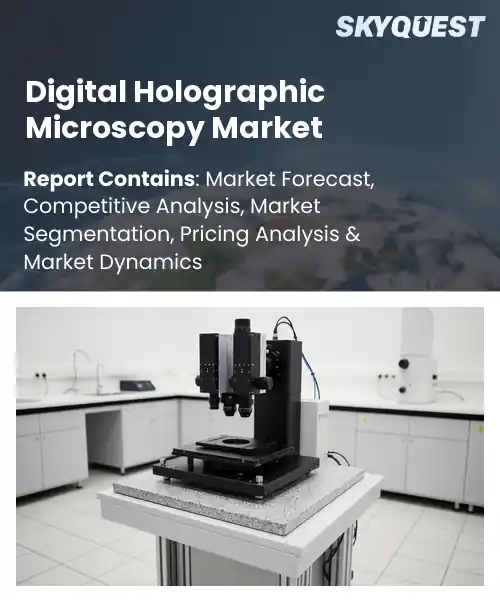
Digital Holographic Microscopy Market
Report ID: SQMIG45E2730
Report ID: SQMIG45E2730
[email protected]
USA +1 351-333-4748
Report ID:
SQMIG45E2730 |
Region:
Global |
Published Date: April, 2026
Pages:
157
|Tables:
117
|Figures:
77


Global Digital Holographic Microscopy Market size was valued at USD 785.34 Million in 2024 and is poised to grow from USD 879.74 Million in 2025 to USD 793.8 Million by 2033, growing at a CAGR of 12.02% during the forecast period (2026-2033).
Digital holographic microscopy (DHM) market centers on instruments and software that capture label-free quantitative phase images to visualize three-dimensional morphology and dynamics of cells and microstructures. The primary driver is the growing demand for non-invasive, real-time quantitative imaging across life sciences and industrial inspection, which enables higher throughput and reduces reliance on staining or destructive testing. Historically DHM evolved from niche academic prototypes in the early 2000s into commercial platforms through advances in sensor sensitivity, laser coherence, and GPU-based reconstruction algorithms, and companies began offering solutions for cell motility assays, semiconductor surface metrology, and IVF clinics, showing tangible clinical benefits.Building on commercialization and technological maturation, the dominant growth factor is the convergence of advanced computational imaging and machine learning, which transforms raw holograms into actionable quantitative metrics in seconds. Because high-throughput GPUs and AI models reduce reconstruction time and automate feature extraction, laboratories and production lines can perform label-free monitoring of cell cultures or wafer surfaces, leading to fewer batch failures and faster decision cycles. For example, pharmaceutical screening uses DHM-linked AI to quantify drug-induced morphology changes without stains, IVF clinics apply automated scoring to select embryos, and cell therapy manufacturers monitor viability in real time, creating commercial opportunities.
How is AI improving image analysis in the digital holographic microscopy market?
Artificial intelligence is transforming image analysis for digital holographic microscopy by coupling advanced computational reconstruction with learned image interpretation. Key aspects include faster phase retrieval, noise reduction, automated focus correction, and segmentation that used to require manual tuning. The current state sees AI models turning raw holograms into clearer quantitative phase maps and extracting biologically relevant features without staining. This improves reproducibility and allows continuous, real time monitoring in research and quality control settings. Market demand is growing for systems that deliver easier workflows and clinical grade consistency, so vendors and labs are integrating deep learning tools to make holographic imaging more accessible and efficient.Phase Holographic Imaging September 2025, announced a new generation HoloMonitor that adds AI powered automated segmentation and enhanced image analysis which streamlines live cell workflows and helps the market move toward clinical and pharmaceutical applications with greater efficiency.
Market snapshot - (2026-2033)
Global Market Size
USD 785.34 Million
Largest Segment
Transmission Digital Holographic Microscopes
Fastest Growth
Dual-mode/Integrated Systems
Growth Rate
12.02% CAGR
To get more insights on this market click here to Request a Free Sample Report
Global digital holographic microscopy market is segmented by configuration/type, application vertical, component layer, end-user and region. Based on configuration/type, the market is segmented into Transmission Digital Holographic Microscopes, Reflection Digital Holographic Microscopes and Dual-mode/Integrated Systems. Based on application vertical, the market is segmented into Life Sciences (Cell Analysis/Dynamic Tracking), Material Science & Metrology (Surface Roughness) and Microfluidics & Particle Tracking. Based on component layer, the market is segmented into Laser Sources & Optical Components, Digital Sensors (CMOS/CCD) and 3D Reconstruction Software & AI Algorithms. Based on end-user, the market is segmented into Academic & Research Institutes, Biotechnology & Pharma Labs and Industrial Inspection Facilities. Based on region, the market is segmented into North America, Europe, Asia Pacific, Latin America and Middle East & Africa.
[3D Reconstruction Software & AI Algorithms] segment dominates because advanced reconstruction and machine learning pipelines convert raw holograms into quantitative three dimensional images with high fidelity, enabling actionable measurements and automated interpretation. By reducing operator dependence and enabling real time phase retrieval, these tools drive adoption across research and industrial workflows. Their ability to fuse data from diverse sensors and to accelerate throughput creates strong demand and integration with instrument vendors and analytical platforms.
However, Digital Sensors (CMOS/CCD) are the fastest growing area because improvements in sensitivity, frame rate and compactness enable dynamic holography and live sample tracking with lower noise and reduced illumination. Better sensor economics and integration with on chip processing broaden applications and enable portable, high throughput instrument designs.
[Life Sciences (Cell Analysis/Dynamic Tracking)] segment leads because demand for label free, quantitative, time resolved imaging aligns directly with the core strengths of digital holographic microscopy, enabling noninvasive monitoring of cell morphology, motility and growth dynamics. Researchers and drug developers require continuous, artifact free measurements for phenotyping and screening, which spurs adoption. This application drives instrument designs, software development and validation efforts, creating a pull through that shapes market priorities and vendor roadmaps.
On the other hand, Microfluidics & Particle Tracking is emerging as the fastest growing application because compatibility with compact, label free imaging enables real time particle sizing and flow monitoring in lab on chip platforms. Integration advances and rising demand for single particle analysis are expanding industrial and diagnostic use cases, broadening the addressable market for instrument makers.
To get detailed segments analysis, Request a Free Sample Report
North America dominates due to a confluence of strong research infrastructure, concentrated centers of biomedical and material sciences excellence, and a robust commercial ecosystem of instrument manufacturers and service providers. Leading academic medical centers and biotechnology clusters drive early adoption and rigorous validation of advanced imaging approaches. A supportive funding environment and active venture capital community enable rapid product development and scale up. Close collaboration between industry, hospitals, and universities accelerates translation into clinical and industrial workflows. High availability of skilled engineers, established distribution networks, and integration with software analytics and artificial intelligence further strengthen market leadership by enabling complex system integration and tailored solutions for demanding research and inspection applications. Regulatory frameworks that support medical device innovation facilitate clinical deployment and collaboration with large end user communities provides continuous feedback for product refinement.
Digital Holographic Microscopy Market in United States benefits from dense concentration of academic medical centers, biotechnology companies, and instrument manufacturers that drive advanced application development and commercialization. Collaborative networks between universities and industry accelerate translational research and validation. Strong service provider ecosystem and access to specialized engineering talent support rapid prototyping and integration of digital imaging with analytics platforms, reinforcing market leadership and facilitating adoption across research and clinical settings.
Digital Holographic Microscopy Market in Canada is characterized by strong collaboration among research hospitals, research institutes, and emerging imaging startups emphasizing translational applications. A focus on niche instrumentation and customized solutions supports laboratory adoption. Access to multidisciplinary teams, public funding channels, and partnerships with global vendors enhances capability to address specialized imaging challenges, enabling Canadian organizations to contribute technical refinements and validated workflows that complement North America regional adoption patterns.
Europe rapid expansion is driven by strong research ecosystems, cross-border collaboration, well-established medical device regulations that support market entry, concentrated pharma and biotech sectors, manufacturing excellence in precision optics, public and private funding for translational imaging technologies, and close ties between universities and industry. Standardization efforts and multicenter validation practices accelerate clinical acceptance and harmonize workflows. Increasing industrial demand from materials inspection and semiconductor quality control complements life science applications. Presence of specialized instrument manufacturers and a network of distributors ensures local service and customization. These factors collectively support fast adoption, encourage domestic innovation, and position Europe as a competitive region in the global digital holographic microscopy landscape. Strong talent pools and targeted training programs build technical competency and user confidence, while industry consortia foster knowledge exchange and pilot deployments that refine product readiness.
Digital Holographic Microscopy Market in Germany benefits from deep engineering expertise, precision optics manufacturing, and long standing relationships between instrument makers and research institutes. Strong emphasis on industrial applications such as materials characterization and semiconductor inspection complements life science adoption. Established quality assurance practices and local service networks support customization for demanding use cases. Collaborative testbeds and public innovation programs enable translation of advanced imaging concepts into robust commercial instruments.
Digital Holographic Microscopy Market in United Kingdom is propelled by dynamic biotech clusters, translational research centers, and a growing community of imaging startups focused on clinical and industrial applications. Strong links between university spinouts and healthcare providers accelerate validation. Supportive funding ecosystems and commercialization programs foster product development. Specialized service providers and pilot programs improve accessibility and market entry for new imaging solutions and encourage collaboration with international instrument manufacturers.
Digital Holographic Microscopy Market in France is emerging through public research programs, strong university hospital networks, and growing cohort of specialized optics and imaging startups. Emphasis on translational medicine and collaborative projects with industrial partners accelerates validation in clinical workflows. Supportive instrumentation manufacturing and service capabilities enable customization for research laboratories. National innovation platforms and cross disciplinary consortia help nurture technical expertise and facilitate commercialization of advanced holographic imaging solutions.
Asia Pacific is strengthening its position through expanding R&D capacity, a strong manufacturing base for precision optics and electronics, and increasing investment in advanced imaging technologies by both private and public sectors. Strategic collaboration between regional OEMs and academic research centers supports application driven development. Focus on semiconductor inspection, industrial process monitoring, and biomedical imaging encourages adaptation of cost effective and compact holographic systems. Advanced sensor and semiconductor ecosystems in Japan and South Korea foster integration of imaging hardware with analytics and control systems. Regional supply chain resilience and emphasis on localization encourage domestic production. Growing pool of skilled engineers and targeted training programs facilitate commercialization and iterative improvement, enabling Asia Pacific to move from adoption toward innovation in digital holographic microscopy. Supportive government initiatives and collaborative testbeds enable field validation across diverse industrial and clinical environments.
Digital Holographic Microscopy Market in Japan is driven by established expertise in precision optics, sensor technology, and microelectronics that supports development of compact imaging systems. Strong partnerships between instrument manufacturers and research institutions enable iterative refinement and validation. Industrial demand for materials inspection and biomedical research fosters development. Local supply chain strength and skilled engineering talent support production quality and customization, positioning Japan as center for imaging hardware and instrumentation.
Digital Holographic Microscopy Market in South Korea benefits from strong semiconductor clusters that demand advanced inspection and metrology solutions. Local manufacturers and instrument developers focus on compact systems tailored to industrial workflows. Collaborative partnerships between universities, research institutes, and OEMs drive applied research and prototyping. Government innovation programs and specialized test facilities support validation and scaling. Skilled technical workforce and integration expertise facilitate deployment across manufacturing and biomedical research environments.
To know more about the market opportunities by region and country, click here to
Buy The Complete Report
Rising Demand In Biomedical Research
Advances In Imaging and Software
High Equipment and Maintenance Costs
Limited Skilled Technical Personnel Availability
Request Free Customization of this report to help us to meet your business objectives.
Competitive landscape in global digital holographic microscopy is consolidating as strategic M&A, partnerships, and targeted technology innovation reshape market positions. Park Systems acquisition of Lyncée Tec strengthened optical metrology scale and product breadth. Collaborations such as CrestOptics with TomoCube on correlative holotomography platforms and vendor announcements like WiMi’s DHM system illustrate direct competition through acquisitions, co development, and computational imaging advances. Note on sourcing and coverage: verified company activity shows most commercial DHM incumbents and product leaders were founded before 2019 and continue to drive the market while new ventures since 2019 more often target adjacent holographic display or visualization niches rather than core DHM instrumentation, which limited the pool of verified DHM startups founded after 2019.
Top Player’s Company Profile
Recent Developments
SkyQuest’s ABIRAW (Advanced Business Intelligence, Research & Analysis Wing) is our Business Information Services team that Collects, Collates, Correlates, and Analyses the Data collected by means of Primary Exploratory Research backed by robust Secondary Desk research. As per SkyQuest analysis, the global digital holographic microscopy market is propelled by growing demand for noninvasive, real time quantitative imaging across life sciences and industrial inspection, with North America leading adoption due to strong research infrastructure and commercial ecosystems. The 3D reconstruction software and AI algorithms segment dominates, converting raw holograms into high fidelity, actionable images. A second driver is the convergence of advanced computational imaging and machine learning, which accelerates reconstruction and automates feature extraction. However high equipment and maintenance costs remain a key restraint that can limit uptake among smaller labs. Overall vendors who bundle intuitive software with cost effective hardware stand to capture rapid market share.
| Report Metric | Details |
|---|---|
| Market size value in 2024 | USD 785.34 Million |
| Market size value in 2033 | USD 793.8 Million |
| Growth Rate | 12.02% |
| Base year | 2024 |
| Forecast period | (2026-2033) |
| Forecast Unit (Value) | USD Million |
| Segments covered |
|
| Regions covered | North America (US, Canada), Europe (Germany, France, United Kingdom, Italy, Spain, Rest of Europe), Asia Pacific (China, India, Japan, Rest of Asia-Pacific), Latin America (Brazil, Rest of Latin America), Middle East & Africa (South Africa, GCC Countries, Rest of MEA) |
| Companies covered |
|
| Customization scope | Free report customization with purchase. Customization includes:-
|
To get a free trial access to our platform which is a one stop solution for all your data requirements for quicker decision making. This platform allows you to compare markets, competitors who are prominent in the market, and mega trends that are influencing the dynamics in the market. Also, get access to detailed SkyQuest exclusive matrix.
Table Of Content
Executive Summary
Market overview
Parent Market Analysis
Market overview
Market size
KEY MARKET INSIGHTS
COVID IMPACT
MARKET DYNAMICS & OUTLOOK
Market Size by Region
KEY COMPANY PROFILES
Methodology
For the Digital Holographic Microscopy Market, our research methodology involved a mixture of primary and secondary data sources. Key steps involved in the research process are listed below:
1. Information Procurement: This stage involved the procurement of Market data or related information via primary and secondary sources. The various secondary sources used included various company websites, annual reports, trade databases, and paid databases such as Hoover's, Bloomberg Business, Factiva, and Avention. Our team did 45 primary interactions Globally which included several stakeholders such as manufacturers, customers, key opinion leaders, etc. Overall, information procurement was one of the most extensive stages in our research process.
2. Information Analysis: This step involved triangulation of data through bottom-up and top-down approaches to estimate and validate the total size and future estimate of the Digital Holographic Microscopy Market.
3. Report Formulation: The final step entailed the placement of data points in appropriate Market spaces in an attempt to deduce viable conclusions.
4. Validation & Publishing: Validation is the most important step in the process. Validation & re-validation via an intricately designed process helped us finalize data points to be used for final calculations. The final Market estimates and forecasts were then aligned and sent to our panel of industry experts for validation of data. Once the validation was done the report was sent to our Quality Assurance team to ensure adherence to style guides, consistency & design.
Analyst Support
Customization Options
With the given market data, our dedicated team of analysts can offer you the following customization options are available for the Digital Holographic Microscopy Market:
Product Analysis: Product matrix, which offers a detailed comparison of the product portfolio of companies.
Regional Analysis: Further analysis of the Digital Holographic Microscopy Market for additional countries.
Competitive Analysis: Detailed analysis and profiling of additional Market players & comparative analysis of competitive products.
Go to Market Strategy: Find the high-growth channels to invest your marketing efforts and increase your customer base.
Innovation Mapping: Identify racial solutions and innovation, connected to deep ecosystems of innovators, start-ups, academics, and strategic partners.
Category Intelligence: Customized intelligence that is relevant to their supply Markets will enable them to make smarter sourcing decisions and improve their category management.
Public Company Transcript Analysis: To improve the investment performance by generating new alpha and making better-informed decisions.
Social Media Listening: To analyze the conversations and trends happening not just around your brand, but around your industry as a whole, and use those insights to make better Marketing decisions.
REQUEST FOR SAMPLE
 REQUEST FREE CUSTOMIZATION


Want to customize this report? This report can be personalized according to your needs. Our analysts and industry experts will work directly with you to understand your requirements and provide you with customized data in a short amount of time. We offer $1000 worth of FREE customization at the time of purchase.
Feedback From Our Clients


 USA (+1) 351-333-4748

