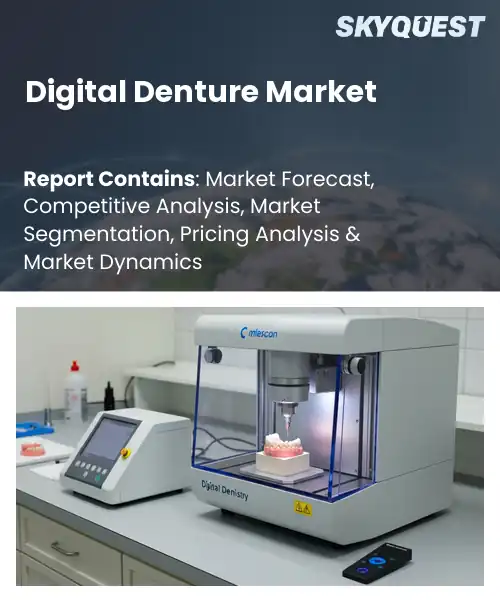
Digital Denture Market
Report ID: SQMIG35B2337
Report ID: SQMIG35B2337
[email protected]
USA +1 351-333-4748
Report ID:
SQMIG35B2337 |
Region:
Global |
Published Date: June, 2026
Pages:
157
|Tables:
169
|Figures:
79


Global Digital Denture Market size was valued at USD 1.55 Billion in 2024 and is poised to grow from USD 1.7 Billion in 2025 to USD 3.48 Billion by 2033, growing at a CAGR of 9.4% during the forecast period (2026-2033).
Digital denture market revolves around making and sending complete and partial dentures using digital workflows, with intraoral scanning, then computer-aided design, and finally additive fabrication. This matters a lot because digital methods basically swap out those labor-heavy manual steps, and the end prostheses become more consistent, so the fit tends to be better. At the same time these workflows can shorten the overall treatment timeline, help clinics handle more patients and, that improves access for older populations, too. Over time prosthodontics moved away from artisanal analog ways, toward CAD/CAM milling and 3D printing; clinics that picked up intraoral scanners like 3Shape TRIOS and desktop printers from Formlabs say they’re getting faster turnarounds, even with busy schedules.
A key growth driver is newer materials and software, because they cut down on laboratory remakes and they also push clinical throughput higher by delivering more predictable outcomes. For instance, biocompatible resins make durable denture bases that bond in a reliable manner to teeth and CAD systems can automate occlusal adjustments, which means less chair time. Because of all that, dental service organizations can pitch same-day restorations, which tends to pull in price-sensitive patients and supports better margins. Meanwhile independent laboratories can centralize production, so they serve bigger regions and wider geographies. These shifts open space for platform vendors, and also for suppliers of consumables; they raise the need for firms that provide training and integration on a global scale, and they also strengthen long-term patient results.
AI is improving precision and efficiency in the digital denture market by connecting stronger data capture, more intelligent design, and manufacturing that behaves in a steadier way. Better intraoral scanning plus AI-assisted CAD tools can turn patient anatomy into designs that require fewer manual tweaks. AI can also check fit and occlusion during the design stage and flag problems ahead of fabrication, so labs and clinics can reduce remakes and shorten treatment time. Basically, the market is moving toward tighter, integrated digital workflows where scanners, AI-enabled design modules, and 3D printing operate in tandem, leading to more uniform outcomes and smoother handoffs between clinicians and dental labs.
There’s also a practical example: 3D Systems (May 2026), ROE Dental Laboratory added NextDent 300 printers to expand digital denture capacity, and 3D Systems highlighted AI infrastructure and workflow tools that pair with its printers. This printing scale, combined with AI-supported design and built-in quality checks, can raise throughput, standardize fit, and support overall market growth and operational efficiency.
Market snapshot - (2026-2033)
Global Market Size
USD 1.55 Billion
Largest Segment
Complete Dentures
Fastest Growth
Partial Dentures
Growth Rate
9.4% CAGR
To get more insights on this market click here to Request a Free Sample Report
The global digital denture market is segmented by product type, technology, material type, workflow, application, end user and region. Based on product type, the market is segmented into Complete Dentures and Partial Dentures. Based on technology, the market is segmented into CAD/CAM Dentures, 3D Printed Dentures and Milled Dentures. Based on material type, the market is segmented into Acrylic Resin, Composite Resin, Hybrid Materials and Others. Based on workflow, the market is segmented into Chairside Production and Laboratory Production. Based on application, the market is segmented into Edentulous Patients and Partially Edentulous Patients. Based on end user, the market is segmented into Dental Clinics, Dental Laboratories and Hospitals. Based on region, the market is segmented into North America, Europe, Asia Pacific, Latin America and Middle East & Africa.
Complete Dentures segment dominates, mostly because the standardized anatomic requirements make the whole digital design and fabrication workflow feel simpler and easier to adopt, for clinics and laboratories. With predictable tooth placements scanning gets less complex and post production corrections are fewer, so clinicians get more confidence, and suppliers tend to invest sooner. That consistency pushes platform development along , supports material optimization and also improves integration with existing CAD/CAM systems, so you end up in this virtuous cycle where the ease of use plus repeatable results quietly reinforces the market tilt toward complete denture digitalization.
Partial Dentures are where growth looks fastest, though, largely due to rising demand for conservative restorations and more tailored customization. Better intraoral scanning, plus modular digital design approaches, simplify the fabrication of frameworks and attachments. At the same time, materials and workflow innovations cut turnaround times, which lets dental providers and labs expand what they can offer, and capture new revenue chances that are emerging.
The CAD/CAM Dentures segment leads, mainly because the established digital chains deliver predictable production quality and they integrate cleanly with clinical scanning, letting adoption spread across laboratories. Mature software workflows, along with proven milling and design protocols, lower technical risk for both clinicians and labs which then encourages capital spending and keeps suppliers paying attention. This stability helps standardize training, supports broad material compatibility, and even strengthens downstream service offerings, so CAD/CAM ends up acting like the foundational technology for digital denture workflows.
Meanwhile 3D Printed Dentures are emerging as the fastest growing area due to quick improvements in printable materials and faster fabrication. Lower equipment costs and even chairside capable production make clinics and labs more willing to try it. As approved materials keep expanding and digital tooth libraries get broader, clinical applications widen too, and that creates new service models , and more scalable patient specific manufacturing opportunities.
To get detailed segments analysis, Request a Free Sample Report
North America seems to lead largely because of integrated dental ecosystems, plus high take up of computer aided design, computer aided manufacturing, and three dimensional printing . There’s also a clustering of manufacturers, supportive reimbursement rules, advanced clinical routines, strong research and development depth and, well developed dental laboratories. Add to that practitioner training programs, patient awareness, regulatory clarity, investment depth, and a supply chain that’s basically grown up already. Bigger clinical networks help roll things out fast, while collaborations between universities and industry speed up innovation, and established distributor channels keep access smooth. Then continuing education becomes a thing , and the close cooperation between manufacturers and clinical opinion leaders makes clinicians ready sooner, while product refinement happens quicker. Integration with imaging and practice management also takes out some workflow friction and that boosts adoption among providers.
United States Digital Denture Market
Digital Denture Market in the United States is supported by a dense web of specialist laboratories , advanced clinical training programs and a large pool of early adopting dental practices. Strong ties between manufacturers and academic centers help push iterative improvements. Extensive aftermarket services, and a culture of investing in technology, supports faster workflow integration, while patient demand for quicker , more comfortable prostheses motivates clinician adoption and refinement of digital treatment routes.
Canada Digital Denture Market
Digital Denture Market in Canada benefits from concentrated pockets of clinical excellence, collaborative research initiatives, and growing investment in dental technology. A network of regional laboratories and service providers backs clinicians moving into digital workflows. The patient centric approach, plus cross border partnerships with manufacturers, improves system accessibility. Training initiatives, plus a preference for minimally invasive prosthetic approaches, encourages uptake and incremental improvement of digital denture protocols.
Europe is seeing rapid expansion because regulatory, clinical, and industrial forces are overlapping in a helpful way. Strong manufacturing capacity in central Europe, paired with a dense network of specialized dental laboratories, supports both scale and innovation. Meanwhile, more harmonized regulatory pathways, and increased reimbursement recognition lower barriers to actual clinical adoption. Cross border collaboration between technology vendors, academic centers, and clinical networks helps move best practices around quickly. Also growing clinician training programs, and targeted spending in three dimensional scanning plus additive manufacturing, build local capability. Patient demand for better fit and shorter treatment cycles, along with rising comfort among dentists with digital workflows, adds momentum. Strong ecosystems in leading countries then form centers of excellence that pull in more investment and talent, and that creates a reinforcing cycle of capability building.
Germany Digital Denture Market
Digital Denture Market in Germany is anchored by a strong manufacturing ecosystem , and a dense mesh of specialized dental laboratories. Close collaboration between machine makers, software providers, and clinical research centers supports integrated solutions and steady supply chains. Established vocational training and continuing education programs help clinicians adopt digital workflows . German suppliers also show up actively in regional service networks, which reinforces availability and helps keep market leadership and innovation strong across central Europe.
United Kingdom Digital Denture Market
Digital Denture Market in United Kingdom is mostly defined by expanding adoption among private practices and growing interest in public dental services . The focus on clinician training, and innovation hubs encourages experimentation with scanning and additive manufacturing. Collaboration between technology vendors and practice networks helps pilot workflows that actually work in day to day settings. Newer business models too, like centralized laboratory partnerships and managed service offerings , support broader rollouts and build practitioner confidence in digital denture solutions, and also helps scalability.
France Digital Denture Market
Digital Denture Market in France is characterized by fast adoption in regional innovation clusters, plus strong collaboration between clinical centers and technology providers, with a notable focus on design and patient comfort. Laboratory networks, along with targeted investment in additive manufacturing and scanning, speeds up availability of solutions. Training initiatives and collaboration between startups, manufacturers, and academic programs also support pilot efforts. And an emphasis on integrated digital care pathways, along with aesthetic outcomes, increases acceptance among both clinicians and patients.
Asia Pacific is strengthening its position by putting targeted money into dental infrastructure, widening vendor presence , and also raising clinician proficiency alongside digital workflows. A lot of regional manufacturers and service providers are tweaking their solutions for local treatment preferences and real cost structures, while partnerships with global technology firms help speed up technology transfer. At the same time , investment in training programs plus university clinics helps build clinical competency, and when high volume dental centers start adopting it there are real use cases that validate the workflows. Japan and South Korea keep leading on technology through domestic innovation, whereas the broader market expansion is being nudged forward by better access to scanning services and additive manufacturing options. Supportive regulatory initiatives, plus clinical collaborations, also cut down the implementation friction, and that encourages local innovation and makes service scalability easier overall.
Japan Digital Denture Market
The Japan Digital Denture Market is mostly led by precision manufacturing, advanced materials research, and close collaboration between industry and academic institutions. Local equipment makers and software developers provide interoperable solutions with high quality, and they tend to match what clinicians expect. Continuing education programs, along with specialty laboratories, back clinical adoption, and integration with dental imaging systems and practice management tools helps streamline the day to day steps. There is also a clear focus on patient comfort and aesthetic outcomes, which keeps clinician preference leaning toward digital approaches.
South Korea Digital Denture Market
In South Korea, the Digital Denture Market benefits from strong domestic electronics and manufacturing capabilities, which basically accelerates the development of scanning and printing solutions. Collaboration between startups, manufacturers and clinical centers supports rapid prototyping as well as customization that feels more practical. Training programs and specialized dental laboratories enable adoption, while vendor engagement helps form service networks. Overall, the emphasis on efficiency, tailored customization and cosmetic outcomes drives clinician interest, improves patient acceptance of digital denture workflows, and supports scalable clinical deployment.
To know more about the market opportunities by region and country, click here to
Buy The Complete Report
Advances In Intraoral Scanning
Integration With CAD CAM Workflows
High Initial Investment Requirements
Regulatory And Reimbursement Challenges
Request Free Customization of this report to help us to meet your business objectives.
The competitive landscape for global digital dentures is shaped by product and workflow overlap between older dental manufacturers CAD/CAM software vendors and clinical networks. Fast regulatory approvals for 3D-printable denture systems plus resin updates are pushing direct partnerships, and even co-developed workflows, like Dentsply Sirona’s Lucitone teaming with Carbon, and Ivoclar’s Ivotion fitting into 3Shape, while clinic-led chains quietly start pulling in capital to scale point of care services.
Top Player’s Company Profile
Recent Developments in the Digital Denture Market
SkyQuest’s ABIRAW (Advanced Business Intelligence, Research & Analysis Wing) is our Business Information Services team that Collects, Collates, Correlates, and Analyses the Data collected by means of Primary Exploratory Research backed by robust Secondary Desk research.
As per SkyQuest analysis, the global digital denture market is being pushed mostly by advances in intraoral scanning that raise accuracy, and also reduce chair side time. a second key driver is rapid progress in materials and AI-enabled software, that together boost predictability and throughput. Complete dentures still lead the market, largely because standardized design workflows make the digital transition less scary for new adopters. North America sits as the dominating region, helped by integrated clinical ecosystems and strong R&D. On the downside, adoption is slowed by the high upfront investment for scanners, software, and fabrication equipment which can really delay uptake among smaller practices even if the efficiency and patient care benefits are obvious.
| Report Metric | Details |
|---|---|
| Market size value in 2024 | USD 1.55 Billion |
| Market size value in 2033 | USD 3.48 Billion |
| Growth Rate | 9.4% |
| Base year | 2024 |
| Forecast period | (2026-2033) |
| Forecast Unit (Value) | USD Billion |
| Segments covered |
|
| Regions covered | North America (US, Canada), Europe (Germany, France, United Kingdom, Italy, Spain, Rest of Europe), Asia Pacific (China, India, Japan, Rest of Asia-Pacific), Latin America (Brazil, Rest of Latin America), Middle East & Africa (South Africa, GCC Countries, Rest of MEA) |
| Companies covered |
|
| Customization scope | Free report customization with purchase. Customization includes:-
|
To get a free trial access to our platform which is a one stop solution for all your data requirements for quicker decision making. This platform allows you to compare markets, competitors who are prominent in the market, and mega trends that are influencing the dynamics in the market. Also, get access to detailed SkyQuest exclusive matrix.
Table Of Content
Executive Summary
Market overview
Parent Market Analysis
Market overview
Market size
KEY MARKET INSIGHTS
COVID IMPACT
MARKET DYNAMICS & OUTLOOK
Market Size by Region
KEY COMPANY PROFILES
Methodology
For the Digital Denture Market, our research methodology involved a mixture of primary and secondary data sources. Key steps involved in the research process are listed below:
1. Information Procurement: This stage involved the procurement of Market data or related information via primary and secondary sources. The various secondary sources used included various company websites, annual reports, trade databases, and paid databases such as Hoover's, Bloomberg Business, Factiva, and Avention. Our team did 45 primary interactions Globally which included several stakeholders such as manufacturers, customers, key opinion leaders, etc. Overall, information procurement was one of the most extensive stages in our research process.
2. Information Analysis: This step involved triangulation of data through bottom-up and top-down approaches to estimate and validate the total size and future estimate of the Digital Denture Market.
3. Report Formulation: The final step entailed the placement of data points in appropriate Market spaces in an attempt to deduce viable conclusions.
4. Validation & Publishing: Validation is the most important step in the process. Validation & re-validation via an intricately designed process helped us finalize data points to be used for final calculations. The final Market estimates and forecasts were then aligned and sent to our panel of industry experts for validation of data. Once the validation was done the report was sent to our Quality Assurance team to ensure adherence to style guides, consistency & design.
Analyst Support
Customization Options
With the given market data, our dedicated team of analysts can offer you the following customization options are available for the Digital Denture Market:
Product Analysis: Product matrix, which offers a detailed comparison of the product portfolio of companies.
Regional Analysis: Further analysis of the Digital Denture Market for additional countries.
Competitive Analysis: Detailed analysis and profiling of additional Market players & comparative analysis of competitive products.
Go to Market Strategy: Find the high-growth channels to invest your marketing efforts and increase your customer base.
Innovation Mapping: Identify racial solutions and innovation, connected to deep ecosystems of innovators, start-ups, academics, and strategic partners.
Category Intelligence: Customized intelligence that is relevant to their supply Markets will enable them to make smarter sourcing decisions and improve their category management.
Public Company Transcript Analysis: To improve the investment performance by generating new alpha and making better-informed decisions.
Social Media Listening: To analyze the conversations and trends happening not just around your brand, but around your industry as a whole, and use those insights to make better Marketing decisions.
REQUEST FOR SAMPLE
 REQUEST FREE CUSTOMIZATION
Global Digital Denture Market size was valued at USD 1.55 Billion in 2024 and is poised to grow from USD 1.7 Billion in 2025 to USD 3.48 Billion by 2033, growing at a CAGR of 9.4% during the forecast period (2026-2033).
The competitive landscape for global digital dentures is defined by product and workflow convergence between legacy dental manufacturers, CAD/CAM software vendors, and clinical networks. Rapid regulatory clearances for 3D-printable denture systems and resin innovations are driving direct partnerships and co-developed workflows, exemplified by Dentsply Sirona’s Lucitone collaboration with Carbon and Ivoclar’s Ivotion integration into 3Shape, while clinic-led chains raise capital to scale point of care services. '3D Systems', 'Dentsply Sirona', 'Straumann Group', 'Ivoclar', 'Desktop Metal', 'Formlabs', 'Carbon', 'Mitsui Chemicals', 'GC Corporation', 'VITA Zahnfabrik', 'Amann Girrbach', 'Zirkonzahn', 'Align Technology', '3Shape', 'Asiga', 'SprintRay', 'Prodways Group', 'Dentca', 'AvaDent Digital Dentures', 'Whole You Inc.'
Intraoral scanning advances have improved the precision and consistency of digital impressions, enabling clinicians to capture accurate denture anatomy with less chairside time and reduced need for physical impressions, which supports wider clinical adoption. Improved image capture and software algorithms streamline case planning and communication with dental laboratories, enabling more predictable outcomes and fewer adjustments. Enhanced patient comfort and reduced procedural complexity make digital denture workflows more attractive to practitioners and patients, thereby encouraging investment in digital systems and expanding the market for digital denture solutions.
Workflow Integration Advancements: Clinics and laboratories are increasingly adopting seamless digital workflows that connect intraoral scanning, cloud based design platforms, and centralized manufacturing. Improved interoperability and standardized file exchanges facilitate collaborative case planning between prosthodontists and technicians, reduce manual steps, and enhance predictability of outcomes. Software ecosystems enable version control, remote consultations, and iterative design approval, supporting faster case coordination and better resource allocation. This trend promotes cross disciplinary integration, encourages investment in digital skills, and fosters partnerships across the dental value chain.
Why does North America Dominate the Global Digital Denture Market? |@12


Want to customize this report? This report can be personalized according to your needs. Our analysts and industry experts will work directly with you to understand your requirements and provide you with customized data in a short amount of time. We offer $1000 worth of FREE customization at the time of purchase.
Feedback From Our Clients


 USA (+1) 351-333-4748

