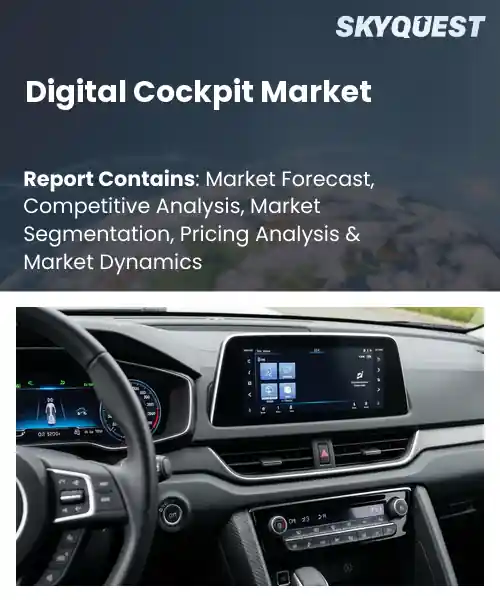
Digital Cockpit Market
Report ID: SQMIG25A2684
Report ID: SQMIG25A2684
[email protected]
USA +1 351-333-4748
Report ID:
SQMIG25A2684 |
Region:
Global |
Published Date: June, 2026
Pages:
157
|Tables:
150
|Figures:
78


Global Digital Cockpit Market size was valued at USD 31.5 Billion in 2024 and is poised to grow from USD 35.5 Billion in 2025 to USD 92.39 Billion by 2033, growing at a CAGR of 12.7% during the forecast period (2026-2033).
The digital cockpit market growth is driven by integrating in-vehicle interfaces that basically stitch together instrument clusters, infotainment, connectivity, and driver assistance into one shared presentation layer and software base. A big push here is how software defined vehicles have been growing, plus how consumers expect that smooth smartphone like feeling, so gauges don’t just sit there anymore, they become adjustable, almost like a living dashboard setting. This space matters because it affects safety, keeps people more engaged, and can extend a vehicle’s actual operational life, and also it makes over the air updates and personal services feel normal. In the last ten years, you can see it in high resolution OLED displays, domain controllers, and those partnerships between car makers and tech brands for example, collaborations between Volvo and Google show how the hardware, software, and data ecosystems keep evolving.
On top of the software-defined vehicle trend, the digital cockpit industry is increasingly driven by software and data monetization, which tends to generate steady recurring revenue and pushes companies to build richer cockpit features. When automakers roll out over the air patches and app stores inside the cabin, drivers get ongoing capability upgrades, which helps retention and opens room for subscriptions like connected guidance, advanced driver assistance tuning, or in car commerce tools. Tesla’s OTA improvements and BMW’s connected services are common examples, because they show how functionality can be sold after the purchase, which then motivates suppliers to invest in tamper resistant domain controllers and cloud connectivity. So in practice, vendors can scale these platforms across regions, cut down on repeated hardware swaps , and also unlock aftermarket offerings that reshape the whole business model.
AI is enhancing personalization and safety in digital cockpits by merging user modeling, sensor fusion, and some on device intelligence. Personalization shows up as adaptive driver and passenger profiles, conversational agents that “predict” needs, and contextual content that tunes navigation and media to what’s happening during the trip. Safety gets a boost through constant cabin observation, gaze and posture recognition, plus proactive alerts that reduce distraction and help assisted driving stay steady. The direction of travel is shifting toward software defined cockpits where suppliers, automakers, and cloud partners deploy edge to cloud patterns and keep pushing over the air updates, so features and safety upgrades can be delivered across the vehicle’s lifecycle.
Market snapshot - (2026-2033)
Global Market Size
USD 31.5 Billion
Largest Segment
Infotainment System
Fastest Growth
Driver Monitoring Systems
Growth Rate
12.7% CAGR
To get more insights on this market click here to Request a Free Sample Report
Global digital cockpit market is segmented by component, vehicle type, display type, application, level of integration and region. Based on component, the market is segmented into Digital Instrument Cluster, Infotainment System, Head-Up Display (HUD), Telematics & Connectivity Systems, Driver Monitoring Systems and Others. Based on vehicle type, the market is segmented into Passenger Vehicles, Light Commercial Vehicles (LCVs) and Heavy Commercial Vehicles (HCVs). Based on display type, the market is segmented into LCD Displays, TFT-LCD Displays, OLED Displays and Others. Based on application, the market is segmented into Navigation & Connectivity, Safety & Driver Assistance, Entertainment & Media, Vehicle Information & Diagnostics and Others. Based on level of integration, the market is segmented into Basic Digital Cockpit, Integrated Digital Cockpit and AI-Powered Smart Cockpit. Based on region, the market is segmented into North America, Europe, Asia Pacific, Latin America and Middle East & Africa.
As per the digital cockpit market analysis, the Infotainment System segment dominates, because manufacturers put a lot of weight on rich multimedia and connectivity as the first real differentiators in the digital cockpit. OEMs are basically cooking modular infotainment platforms, to blend navigation streaming, voice assistants, and smartphone ecosystems, so naturally they lean hard into software and ecosystem investments. That whole push speeds up supplier consolidation, and it also supports recurring revenue from services, while at the same time helping human machine interaction feel smooth, which makes infotainment the main “hub” for consumer engagement and for adding data driven features across different vehicle models.
But also, the Telematics & Connectivity Systems segment feels like the fastest moving part, since vehicles want constant cloud linkage and over the air ecosystems. The rising need for fleet oversight, remote diagnostics, and ongoing software updates is driving spending into embedded communications, which then accelerates partnerships between OEMs and telecom players. At the same time it opens doors for monetizable data, plus extra service opportunities.
According to the digital cockpit market forecast, The AI-Powered Smart Cockpit segment is dominant because advanced machine learning together with sensor fusion helps create adaptive, context aware interfaces that rework how drivers and passengers interact. OEMs and software partners are focusing on intelligent voice assistants, predictive personalization, and automated adjustments, to boost comfort, safety, and efficiency—so they keep investing in compute, data pipelines, and security. This concentrated attention supports stronger feature differentiation, plus longer term recurring software revenue, and it also embeds AI capabilities across many vehicle functions.
Meanwhile, the Integrated Digital Cockpit segment is showing the most growth momentum, since OEMs are consolidating displays and functions into unified architectures, to reduce complexity and cost. There’s demand for centralized computing, harmonized HMI and simpler software updates. Because of that suppliers are more willing to offer domain controllers and platform solutions, which helps with faster rollouts and then basically widens digital cockpit adoption.
To get detailed segments analysis, Request a Free Sample Report
As per the digital cockpit market regional forecast, Asia Pacific dominates the market because regional automakers and electronics suppliers push in cutting edge infotainment instrument clusters and driver assistance interfaces early, during vehicle development. There’s this robust manufacturing base too, plus close collaboration between suppliers OEMs and software developers, so iterative innovation snowballs along with custom local solutions that “fit” better. People increasingly want connected mobility, and they expect more refined in car experiences, so demand keeps rising. At the same time regulators are paying attention to safety and connectivity , which nudges feature adoption. Extra investment in semiconductor design display technologies, and human machine interface research also boosts capability. Regional engineering talent plus partnerships with technology firms supports localization of voice recognition navigation and personalization features , making it more relevant for diverse consumer expectations. Then the strong aftermarket and retrofit channels also add fuel, enabling continuous upgrades and wider market penetration.
Japan Digital Cockpit Market
Digital Cockpit sector in Japan is marked by tight integration between established automakers and advanced electronics firms, helping deliver sophisticated instrument clusters and human machine interfaces that match domestic tastes. There’s a clear focus on display quality , tactile controls and nuanced voice interaction , which supports premium cabin experiences. Strong local semiconductor and component design capability backs customization and reliability, while cooperation with mobility service providers helps connectivity feel seamless and features fit across multiple vehicle lineups.
South Korea Digital Cockpit Market
Digital Cockpit Market in South Korea shows rapid adoption of connected services and premium in car entertainment, supported by confident domestic electronics and display manufacturers. When automakers team up with technology firms, integration of advanced infotainment and connectivity features speeds up, and smart device interoperability becomes smoother. The vibe is sleek interfaces , high resolution displays, and intuitive touch controls , all combining into in car experiences that feel distinctive. Meanwhile a lively software developer community keeps driving ongoing enhancements and region tailored services.
Europe rapid digital cockpit market penetration comes from a mix of automotive heritage, consumer desire for integrated safety and connectivity, and coordinated work among OEMs tier suppliers and technology firms. Regulatory attention to vehicle safety and data protection lifts the importance of advanced human machine interfaces and driver displays. Meanwhile customers want smooth smartphone integration and more personalized cabin experiences, so innovation keeps accelerating. The presence of premium automakers and specialized electronics suppliers, creates engineering strength and supports scalable platform approaches. Cross border collaboration software development investment, and a maturing mobility services ecosystem help roll out features across different vehicle segments. So Europe is seen as a lively arena for cockpit advancement, with more differentiated user experiences.
Germany Digital Cockpit Market
Digital Cockpit Market Germany, reflects close collaboration between established automakers and a concentrated supplier base that delivers safety focused cockpit systems. Engineering rigor and comprehensive validation help keep instrument clusters and driver interfaces reliable, and these are tuned for domestic plus international models. Functional safety and modular platforms matter a lot, and supplier integration supports consistent delivery of high quality displays and connectivity. Overall, this industrial ecosystem encourages steady innovation while also enabling scalable deployment across multiple vehicle categories.
United Kingdom Digital Cockpit Market
Digital Cockpit Market United Kingdom relies on a dynamic technology ecosystem that pairs well with established automotive capabilities , speeding up software driven cockpit development. The main emphasis is user experience and connected services, which helps build partnerships between OEMs and tech firms. A strong interface design talent pool supports rapid prototyping, plus tailored solutions that can shift quickly. Also expanding mobility service experiments and engaged consumers encourage different cockpit concepts , and that tends to keep software led enhancements coming across vehicle offerings.
France Digital Cockpit Market
Digital Cockpit Market France leans into elegant user interface design and localization that fits domestic automaker styling, and consumer expectations. Collaboration among carmakers design houses and software providers results in infotainment and driver displays with strong attention to usability and aesthetics. Investment in connectivity and regional content integration supports tailored user experiences, while growing supplier capabilities and pilot projects with mobility partners suggest a maturing ecosystem. That momentum helps expand sophisticated cockpit offerings, without losing the “feel” people want.
North America is growing its role in the digital cockpit market a bit more, mostly because the traditional automakers are getting closer with a strong technology side, it brings software, cloud infrastructure, and know how about user experience right into the vehicle cabin. In parallel, innovation hubs push more advanced human machine interface design, plus voice assistants, and over the air update features, so the cockpit keeps improving even after purchase. You see partnerships between OEMs, tier suppliers, and software companies speeding up the time to market, for bundled infotainment and driver assistance screens. At the same time fleet operators , and mobility service providers they basically pull demand toward customizable interfaces and telematics integration. Then you get this startup ecosystem vibe, with investors backing it, so people can try different interaction patterns, and while doing so there is a clear focus on cybersecurity and data governance, which builds confidence in connected cockpit solutions.
United States Digital Cockpit Market
Digital Cockpit Market United States is shaped by tight collaboration between well known automakers and a technology environment that supports software delivery, cloud services, and advanced sensing. The emphasis stays on user centric design, voice enabled features, and regular software updates, all of which supports continued sharpening of the cabin experience. Venture activity, together with corporate agreements speeds up human machine interface innovation. Integration across automotive, telecom, and cloud providers helps scale deployment of cockpit ideas across different mobility applications too.
Canada Digital Cockpit Market
Digital Cockpit Market Canada leverages engineering talent that is strong already, plus a growing base of software and electronics suppliers, and collaboration between local as well as international OEMs. The focus leans toward connectivity, telematics, and localized content, which addresses multiple operating conditions and also bilingual user expectations. Partnerships with technology hubs, and research centers help advance mapping, localization, and human machine interface design. Interest from fleet operators and mobility services encourages rollout and ongoing refinement of cockpit solutions, especially for commercial use cases.
To know more about the market opportunities by region and country, click here to
Buy The Complete Report
Advanced Avionics Integration
Enhanced Passenger Experience
High System Complexity
Regulatory And Certification Challenges
Request Free Customization of this report to help us to meet your business objectives.
Competition in the global digital cockpit market gets pulled along by platform consolidation, OEM and Tier 1 alliances, plus this rapid software innovation that never stops. This can be witnessed in the concrete moves too, like TomTom rolling out the IndiGO open cockpit platform , Denso teaming up with BlackBerry for Harmony Core HMI, and eCarX working with AMD on immersive cockpit compute, which shows the partnerships, platform licensing , and targeted investments that try to compress time to production, and make it all happen sooner than later.
Top Player’s Company Profile
Recent Developments in the Digital Cockpit Market
SkyQuest’s ABIRAW (Advanced Business Intelligence, Research & Analysis Wing) is our Business Information Services team that Collects, Collates, Correlates, and Analyses the Data collected by means of Primary Exploratory Research backed by robust Secondary Desk research.
As per SkyQuest analysis, the global digital cockpit market is getting a push from the shift to software-defined vehicles and the consumer desire for smartphone-like experiences in-car, while infotainment systems stay the dominant segment and Asia Pacific leads adoption. Market growth is also reinforced by software and data monetization, which allows over-the-air updates, subscription services, and aftermarket revenue streams. Still, there’s a notable constraint: high system complexity in integrated cockpit architectures. That increases validation cycles and integration costs for OEMs and suppliers. Vendors who put money into secure domain controllers, modular platforms, and cloud integration are, overall, the best placed to capture recurring revenue and satisfy evolving expectations across both passenger and commercial vehicle segments.
| Report Metric | Details |
|---|---|
| Market size value in 2024 | USD 31.5 Billion |
| Market size value in 2033 | USD 92.39 Billion |
| Growth Rate | 12.7% |
| Base year | 2024 |
| Forecast period | (2026-2033) |
| Forecast Unit (Value) | USD Billion |
| Segments covered |
|
| Regions covered | North America (US, Canada), Europe (Germany, France, United Kingdom, Italy, Spain, Rest of Europe), Asia Pacific (China, India, Japan, Rest of Asia-Pacific), Latin America (Brazil, Rest of Latin America), Middle East & Africa (South Africa, GCC Countries, Rest of MEA) |
| Companies covered |
|
| Customization scope | Free report customization with purchase. Customization includes:-
|
To get a free trial access to our platform which is a one stop solution for all your data requirements for quicker decision making. This platform allows you to compare markets, competitors who are prominent in the market, and mega trends that are influencing the dynamics in the market. Also, get access to detailed SkyQuest exclusive matrix.
Table Of Content
Executive Summary
Market overview
Parent Market Analysis
Market overview
Market size
KEY MARKET INSIGHTS
COVID IMPACT
MARKET DYNAMICS & OUTLOOK
Market Size by Region
KEY COMPANY PROFILES
Methodology
For the Digital Cockpit Market, our research methodology involved a mixture of primary and secondary data sources. Key steps involved in the research process are listed below:
1. Information Procurement: This stage involved the procurement of Market data or related information via primary and secondary sources. The various secondary sources used included various company websites, annual reports, trade databases, and paid databases such as Hoover's, Bloomberg Business, Factiva, and Avention. Our team did 45 primary interactions Globally which included several stakeholders such as manufacturers, customers, key opinion leaders, etc. Overall, information procurement was one of the most extensive stages in our research process.
2. Information Analysis: This step involved triangulation of data through bottom-up and top-down approaches to estimate and validate the total size and future estimate of the Digital Cockpit Market.
3. Report Formulation: The final step entailed the placement of data points in appropriate Market spaces in an attempt to deduce viable conclusions.
4. Validation & Publishing: Validation is the most important step in the process. Validation & re-validation via an intricately designed process helped us finalize data points to be used for final calculations. The final Market estimates and forecasts were then aligned and sent to our panel of industry experts for validation of data. Once the validation was done the report was sent to our Quality Assurance team to ensure adherence to style guides, consistency & design.
Analyst Support
Customization Options
With the given market data, our dedicated team of analysts can offer you the following customization options are available for the Digital Cockpit Market:
Product Analysis: Product matrix, which offers a detailed comparison of the product portfolio of companies.
Regional Analysis: Further analysis of the Digital Cockpit Market for additional countries.
Competitive Analysis: Detailed analysis and profiling of additional Market players & comparative analysis of competitive products.
Go to Market Strategy: Find the high-growth channels to invest your marketing efforts and increase your customer base.
Innovation Mapping: Identify racial solutions and innovation, connected to deep ecosystems of innovators, start-ups, academics, and strategic partners.
Category Intelligence: Customized intelligence that is relevant to their supply Markets will enable them to make smarter sourcing decisions and improve their category management.
Public Company Transcript Analysis: To improve the investment performance by generating new alpha and making better-informed decisions.
Social Media Listening: To analyze the conversations and trends happening not just around your brand, but around your industry as a whole, and use those insights to make better Marketing decisions.
REQUEST FOR SAMPLE
 REQUEST FREE CUSTOMIZATION
Global Digital Cockpit Market size was valued at USD 31.5 Billion in 2024 and is poised to grow from USD 35.5 Billion in 2025 to USD 92.39 Billion by 2033, growing at a CAGR of 12.7% during the forecast period (2026-2033).
Competition in the global digital cockpit market is driven by platform consolidation, OEM and Tier 1 alliances, and rapid software innovation. Concrete strategic moves include TomTom launching the IndiGO open cockpit platform, Denso and BlackBerry co-developing the Harmony Core HMI, and eCarX collaborating with AMD on immersive cockpit compute, illustrating partnerships, platform licensing, and targeted investments that accelerate time to production. 'Visteon Corporation', 'Panasonic Holdings', 'Bosch', 'Continental', 'FORVIA', 'Denso Corporation', 'Samsung Electronics', 'Marelli', 'Aptiv', 'Hyundai Mobis', 'LG Electronics', 'Yanfeng Automotive Interiors', 'Garmin', 'Pioneer Corporation', 'Alps Alpine', 'Desay SV Automotive', 'ECARX', 'ThunderSoft', 'DXC Technology', 'TomTom'
Advanced integration of avionics components within digital cockpits simplifies system architectures and enables seamless data exchange across flight systems, which accelerates adoption by manufacturers seeking consolidated solutions. By reducing the need for disparate interfaces and enabling harmonized human-machine interaction, this factor enhances interoperability and supports modular upgrades, making platforms more attractive to airlines and OEMs. The resulting design efficiencies and improved operational coherence encourage investment in cockpit digitization and foster supplier collaboration, thereby driving sustained market growth and technology maturation.
User Interface Personalization: Automakers increasingly prioritize user interface personalization to create differentiated in-cabin experiences that adapt to driver preferences, accessibility needs and shifting use cases. Digital cockpits are evolving to support profile-based layouts, multi-modal input and context-aware content prioritization, enabling smoother human-machine interaction and stronger brand affinity. Continuous software updates permit refinement over the vehicle lifecycle, while modular design facilitates aftermarket customization and third-party app integration. This trend emphasizes occupant comfort, intuitive controls and long-term value creation through personalized, experience-driven interfaces and engagement.
Why does Asia Pacific Dominate the Global Digital Cockpit Market? |@12


Want to customize this report? This report can be personalized according to your needs. Our analysts and industry experts will work directly with you to understand your requirements and provide you with customized data in a short amount of time. We offer $1000 worth of FREE customization at the time of purchase.
Feedback From Our Clients


 USA (+1) 351-333-4748

