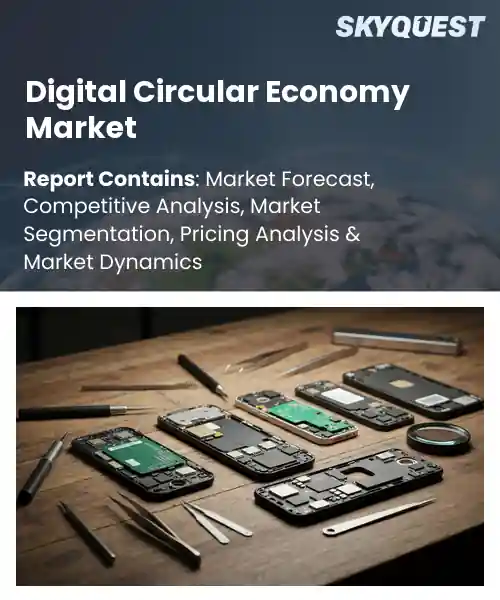
Digital Circular Economy Market
Report ID: SQMIG45E2747
Report ID: SQMIG45E2747
[email protected]
USA +1 351-333-4748
Report ID:
SQMIG45E2747 |
Region:
Global |
Published Date: April, 2026
Pages:
157
|Tables:
119
|Figures:
77


Global Digital Circular Economy Market size was valued at USD 3.84 Billion in 2024 and is poised to grow from USD 4.77 Billion in 2025 to USD 3.9 Billion by 2033, growing at a CAGR of 24.2% during the forecast period (2026-2033).
The primary driver of the digital circular economy market is the pursuit of resource efficiency enabled by digitalization. This market includes platforms, sensors, analytics and business models that keep products, materials and components in use longer while decoupling economic value from raw material consumption. It matters because resource constraints, volatile commodity prices and regulatory pressure make linear models unsustainable, prompting companies to adopt reuse, repair and remanufacturing at scale. In the past decade digital tools like IoT asset tracking, blockchain for provenance and resale marketplaces have moved from pilots into commercial operations, illustrated by technology-enabled leasing programs and remanufacturing facilities.Building on that foundation, interoperability of data and platforms is the critical factor determining scale in the digital circular economy market because seamless data flows enable visibility across reverse supply chains. When manufacturers, service providers and recyclers share standardized product histories and condition data, reverse logistics can be automated and remanufacturing prioritized, which reduces costs and shortens turnaround times. For example, fleet telematics reporting component wear causes predictive maintenance programs to extend asset life, while resale marketplaces verifying provenance increase recovery value for electronics. These cause-and-effect dynamics unlock new revenue streams, bolster regulatory compliance and attract investment in circular offerings.
How can blockchain enhance transparency in the digital circular economy market?
Blockchain can improve transparency in the digital circular economy by creating an immutable audit trail for material provenance and digital product passports. Key aspects include secure tamper resistant records interoperable product data and smart rules that track reuse repair and recycling pathways. The current market shows growing pilots and enterprise integrations that bring traceability to complex supply chains. For example providers are trialing digital product passports for advanced materials while large vendors move to embed blockchain into procurement and supply platforms to support trust and regulatory alignment. These advances help verify recycled content reduce disputes and make reverse logistics more efficient.Circularise November 2025, played a technical role in launching the Global Circularity Protocol at COP30 which highlighted digital product passports. This development demonstrates how blockchain enabled verifiable material histories and secure data sharing can accelerate adoption and improve operational efficiency across reuse and recycling networks.
Market snapshot - (2026-2033)
Global Market Size
USD 3.84 Billion
Largest Segment
Traceability & Product Passport Software (Blockchain/QR)
Fastest Growth
Predictive Maintenance & Refurbishment Tools
Growth Rate
24.2% CAGR
To get more insights on this market click here to Request a Free Sample Report
Global digital circular economy market is segmented by solution component, circular business model, end-use industry, technology focus and region. Based on solution component, the market is segmented into Traceability & Product Passport Software (Blockchain/QR), Resource Recovery & Waste Management Platforms, Sharing Economy & Asset Reuse Apps and Predictive Maintenance & Refurbishment Tools. Based on circular business model, the market is segmented into Product-as-a-Service (PaaS), Circular Supply Chain & Procurement and Recovery & Recycling Automation. Based on end-use industry, the market is segmented into Electronics & Battery Management, Textiles & Fashion Supply Chain, Construction & Built Environment and Consumer Goods & Packaging. Based on technology focus, the market is segmented into AI & Big Data Analytics, IoT & Industrial Sensor Networks and Digital Twin Modeling. Based on region, the market is segmented into North America, Europe, Asia Pacific, Latin America and Middle East & Africa.
Traceability & Product Passport Software (Blockchain/QR) segment dominates because it establishes verifiable provenance and lifecycle transparency that underpin circular flows across supply chains in the Digital Circular Economy Market market. By creating immutable records, standardized product passports and consumer access to repair and recycling histories, it reduces information asymmetry, simplifies compliance and unlocks downstream reuse and recovery pathways, driven by rising demands for accountability and interoperable data infrastructures.
However, Resource Recovery & Waste Management Platforms segment is rapidly expanding because digitization of waste streams and demand for automated sorting, tracking and monetization of recovered materials are driving platform uptake. Software enabled marketplaces and analytics integrations are unlocking new revenue from secondary materials and building infrastructure that scales circular operations and supplier networks.
Product-as-a-Service (PaaS) segment leads because it reorients revenue from one time sales to recurring access, aligning provider incentives with product durability, repairability and lifecycle optimization within the Digital Circular Economy Market market. By integrating digital monitoring, service orchestration and remote maintenance, PaaS reduces waste, extends useful life and creates predictable cash flows for businesses while encouraging design for disassembly and material recovery through service driven ownership models.
However, Recovery & Recycling Automation segment is the fastest growing area as robotics, sensor networks and automated sorting integrate with digital platforms to scale efficient material extraction. Regulatory pressure and corporate commitments to closed-loop sourcing accelerate investment, enabling improved recovery yields, reduced processing costs and new markets for reclaimed feedstock.
To get detailed segments analysis, Request a Free Sample Report
European dominance stems from a confluence of supportive public policy, deep industrial expertise, and advanced digital infrastructure that together accelerate circular transitions. Harmonized regulations and incentives create predictable market conditions that encourage companies to redesign products for longevity and reuse. Established recycling and remanufacturing systems integrate with digital tracking and connectivity solutions, enabling circular business models at scale. Strong collaboration among governments, research institutions, and private sector players fosters interoperable standards and shared platforms. A skilled workforce and concentrated innovation hubs catalyze adoption of sensor networks, digital twins, and data-driven resource optimization. Cross-border trade integration allows circular supply chains to mature, while investor and corporate focus on sustainability ensures sustained deployment of digital circular solutions across sectors. This regional ecosystem positions Europe as a center for scalable circular digital solutions.
Digital Circular Economy Market Germany benefits from a dense manufacturing base oriented toward industries with strong investment in industrial digitization. Integration of advanced automation, predictive maintenance, and material traceability supports remanufacturing and parts recovery. Regional consortia and public procurement encourage pilot deployments and scale‑up of circular platforms. Collaboration between universities and industry accelerates standards and workforce development, enabling firms to translate digital innovations into closed‑loop product strategies across automotive sectors.
Digital Circular Economy Market United Kingdom uses a strong technology sector and mature digital platforms to support circular goods and services. Product-as-a-service models, platform reuse networks, and circular procurement encourage corporate adoption. City-level initiatives and innovation centers enable pilot material tracking and resale systems. Collaboration among startups, retailers, and research institutions advances scalable solutions, while policy frameworks and investor interest promote digital integration across fashion, electronics, and construction value chains.
Digital Circular Economy Market France benefits from coordinated policy and clusters that link manufacturing, waste management, and digital innovators. Investment in logistics optimization and material recovery pairs with digital traceability to improve recycling and remanufacturing flows. Startups and partners collaborate in innovation hubs to pilot circular business models and digital services. Focus on design for reuse and producer responsibility frameworks supports adoption of data-driven platforms across consumer goods and packaging.
North American expansion is propelled by a confluence of deep technology capabilities, entrepreneurial dynamism, and strong corporate commitment to sustainability. Large cloud and software providers enable scalable circular platforms, while a dense venture and innovation ecosystem fosters rapid commercialization of digital tracking, marketplace, and analytics tools. Logistics networks and advanced sensor and IoT deployments streamline reverse flows and enable real-time resource visibility. Cross-sector collaborations between retailers, manufacturers, and waste management firms accelerate pilots into mainstream operations. Policy incentives, corporate procurement strategies, and growing consumer appetite for responsible consumption further sustain momentum, creating a fertile environment for business model innovation that merges digital services with circular materials management. Regional research institutions and standards bodies work with industry to establish interoperability and data governance approaches, reducing friction for cross-company material exchanges and enabling broader network effects.
Digital Circular Economy Market United States is driven by concentration of major technology providers, extensive e-commerce networks, and a vibrant startup landscape developing digital reuse and tracking solutions. Retailers and manufacturers pilot marketplace and takeback programs integrated with logistics and analytics platforms. Collaboration among municipal programs, waste operators, and private firms supports reverse logistics. Corporate sustainability commitments channel resources into tools that optimize material recovery and circular product strategies broadly.
Digital Circular Economy Market Canada is shaped by resource-based industries and provincial programs that promote material recovery across dispersed geographies. Clean technology and digital traceability strengthen recycling, remanufacturing, and producer responsibility approaches. Partnerships with Indigenous communities and regional waste operators support tailored reverse logistics. Startups, research institutions, and corporate partners pilot circular marketplaces and analytics platforms that adapt digital circular models to diverse local supply chain contexts and policy frameworks.
Asia Pacific is strengthening its role through a blend of manufacturing modernization, targeted government initiatives, and rapid digital adoption across industries. Large industrial clusters are integrating sensor networks, digital twins, and supply chain platforms to improve material efficiency and enable product reuse. Governments and public agencies support pilots in smart cities, electronics recycling, and battery life-cycle management, creating demand for interoperable digital solutions. A growing cohort of specialized providers and startups tailors software and services to high-volume production contexts, while academic-industry collaborations advance circular design and reverse logistics practices. Regional trade and investment links enable cross-border circular supply chains, and emphasis on standardization and workforce upskilling reduces implementation barriers, allowing Asia Pacific markets to scale digital circular models across diverse manufacturing and consumer sectors.
Digital Circular Economy Market Japan builds on manufacturing expertise, robotics, and engineering to deploy digital solutions for product lifecycle extension. Companies use digital twins, predictive maintenance, and material traceability to support repair, refurbishment, and remanufacturing. Industry consortia and research institutions collaborate on interoperability standards and circular design. Public programs encourage pilots in electronics and machinery, while supplier networks and service providers scale digital platforms that enable closed-loop material flows efficiently.
Digital Circular Economy Market South Korea benefits from a strong electronics and materials industry and adoption of smart manufacturing technologies. Firms deploy IoT monitoring and digital inventory systems to optimize reuse and facilitate component recovery. Government initiatives and industrial alliances support recycling infrastructure and circular design in high-tech sectors. A startup ecosystem and partners accelerate commercialization of digital platforms for reverse logistics, remanufacturing, and lifecycle services across electronics and batteries.
To know more about the market opportunities by region and country, click here to
Buy The Complete Report
Increasing Corporate Sustainability Commitments
Advancements In Enabling Technologies
Regulatory Uncertainty Across Jurisdictions
High Implementation And Integration Costs
Request Free Customization of this report to help us to meet your business objectives.
Competitive dynamics in the global digital circular economy are shaped by regulatory Extended Producer Responsibility mandates and corporate circularity targets that push firms to secure supply chains and service contracts, prompting consolidation through acquisitions, strategic partnerships and platform linked technology innovation. Examples include Atos partnering with Circular Computing for remanufactured laptops, retailer integrations of TerraCycle’s Loop and service line expansion through acquisitions by legacy waste and resource groups.
Top Player’s Company Profile
Recent Developments
SkyQuest’s ABIRAW (Advanced Business Intelligence, Research & Analysis Wing) is our Business Information Services team that Collects, Collates, Correlates, and Analyses the Data collected by means of Primary Exploratory Research backed by robust Secondary Desk research. As per SkyQuest analysis, a key driver is the pursuit of resource efficiency enabled by digitalization, which accelerates adoption of platforms, IoT and analytics to keep products and materials in use longer. A second driver is rising corporate sustainability commitments that push procurement and investment toward circular solutions. A restraint is regulatory uncertainty across jurisdictions that complicates interoperability and slows rollouts. The dominating region is Europe, where supportive policy, industrial expertise and interoperable standards foster scale. The dominating segment is Traceability and Product Passport Software, which provides verifiable provenance and lifecycle transparency necessary to unlock reuse, resale and remanufacturing across supply chains.
| Report Metric | Details |
|---|---|
| Market size value in 2024 | USD 3.84 Billion |
| Market size value in 2033 | USD 3.9 Billion |
| Growth Rate | 24.2% |
| Base year | 2024 |
| Forecast period | (2026-2033) |
| Forecast Unit (Value) | USD Billion |
| Segments covered |
|
| Regions covered | North America (US, Canada), Europe (Germany, France, United Kingdom, Italy, Spain, Rest of Europe), Asia Pacific (China, India, Japan, Rest of Asia-Pacific), Latin America (Brazil, Rest of Latin America), Middle East & Africa (South Africa, GCC Countries, Rest of MEA) |
| Companies covered |
|
| Customization scope | Free report customization with purchase. Customization includes:-
|
To get a free trial access to our platform which is a one stop solution for all your data requirements for quicker decision making. This platform allows you to compare markets, competitors who are prominent in the market, and mega trends that are influencing the dynamics in the market. Also, get access to detailed SkyQuest exclusive matrix.
Table Of Content
Executive Summary
Market overview
Parent Market Analysis
Market overview
Market size
KEY MARKET INSIGHTS
COVID IMPACT
MARKET DYNAMICS & OUTLOOK
Market Size by Region
KEY COMPANY PROFILES
Methodology
For the Digital Circular Economy Market, our research methodology involved a mixture of primary and secondary data sources. Key steps involved in the research process are listed below:
1. Information Procurement: This stage involved the procurement of Market data or related information via primary and secondary sources. The various secondary sources used included various company websites, annual reports, trade databases, and paid databases such as Hoover's, Bloomberg Business, Factiva, and Avention. Our team did 45 primary interactions Globally which included several stakeholders such as manufacturers, customers, key opinion leaders, etc. Overall, information procurement was one of the most extensive stages in our research process.
2. Information Analysis: This step involved triangulation of data through bottom-up and top-down approaches to estimate and validate the total size and future estimate of the Digital Circular Economy Market.
3. Report Formulation: The final step entailed the placement of data points in appropriate Market spaces in an attempt to deduce viable conclusions.
4. Validation & Publishing: Validation is the most important step in the process. Validation & re-validation via an intricately designed process helped us finalize data points to be used for final calculations. The final Market estimates and forecasts were then aligned and sent to our panel of industry experts for validation of data. Once the validation was done the report was sent to our Quality Assurance team to ensure adherence to style guides, consistency & design.
Analyst Support
Customization Options
With the given market data, our dedicated team of analysts can offer you the following customization options are available for the Digital Circular Economy Market:
Product Analysis: Product matrix, which offers a detailed comparison of the product portfolio of companies.
Regional Analysis: Further analysis of the Digital Circular Economy Market for additional countries.
Competitive Analysis: Detailed analysis and profiling of additional Market players & comparative analysis of competitive products.
Go to Market Strategy: Find the high-growth channels to invest your marketing efforts and increase your customer base.
Innovation Mapping: Identify racial solutions and innovation, connected to deep ecosystems of innovators, start-ups, academics, and strategic partners.
Category Intelligence: Customized intelligence that is relevant to their supply Markets will enable them to make smarter sourcing decisions and improve their category management.
Public Company Transcript Analysis: To improve the investment performance by generating new alpha and making better-informed decisions.
Social Media Listening: To analyze the conversations and trends happening not just around your brand, but around your industry as a whole, and use those insights to make better Marketing decisions.
REQUEST FOR SAMPLE
 REQUEST FREE CUSTOMIZATION


Want to customize this report? This report can be personalized according to your needs. Our analysts and industry experts will work directly with you to understand your requirements and provide you with customized data in a short amount of time. We offer $1000 worth of FREE customization at the time of purchase.
Feedback From Our Clients


 USA (+1) 351-333-4748

