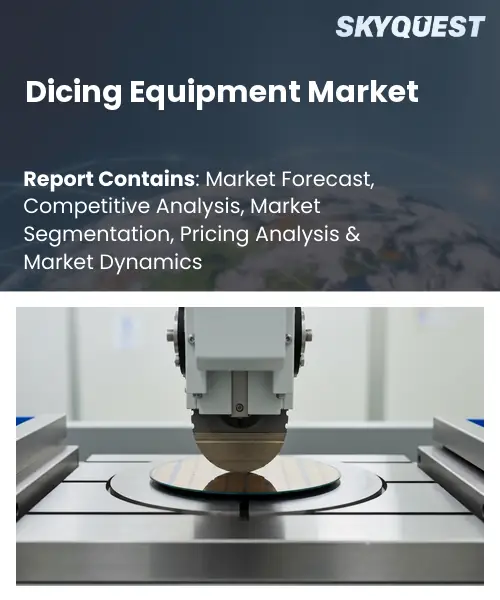
Dicing Equipment Market
Report ID: SQMIG45N2243
Report ID: SQMIG45N2243
[email protected]
USA +1 351-333-4748
Report ID:
SQMIG45N2243 |
Region:
Global |
Published Date: June, 2026
Pages:
157
|Tables:
124
|Figures:
77


Global Dicing Equipment Market size was valued at USD 1.78 Billion in 2024 and is poised to grow from USD 1.91 Billion in 2025 to USD 3.31 Billion by 2033, growing at a CAGR of 7.14% during the forecast period (2026-2033).
The global dicing equipment market supplies precision cutting tools that segment semiconductor wafers, photovoltaic cells, and microelectromechanical systems into individual dies. Its significance stems from the relentless demand for smaller, faster chips and higher‑efficiency solar modules, which require flawless separation to maintain performance yields. Historically, the market evolved from manual blade saws in the 1970s to fully automated, laser‑assisted dicers today, driven by advances in material science and the proliferation of 5G and AI applications. For instance, Taiwanese foundries upgraded to diamond‑edge blades in 2015, boosting throughput by 30 percent while reducing defect rates across the entire production line globally. The growth catalyst is the shift toward advanced packaging architectures such as fan‑out wafer‑level and heterogeneous integration, which intensify the need for fine dicing tolerances below 10 µm. As manufacturers adopt these structures, equipment vendors respond by embedding AI‑driven process monitoring and blade wear analytics, thereby lowering scrap and shortening cycle time. This loop has opened opportunities in emerging markets like electric‑vehicle battery modules, where cell segmentation improves thermal management and cost efficiency. A partnership between a German laser‑dicer supplier and a South Korean EV battery maker illustrates how tighter die geometry directly translates into pack density and faster market adoption.
How is AI-powered automation transforming the dicing equipment market?
AI powered automation is reshaping dicing equipment by embedding machine learning models directly into the cutting heads and control software. Predictive maintenance analyzes vibration and temperature data to schedule service before failures occur, while real time image analysis detects chip defects and adjusts blade pressure on the fly. Adaptive path planning optimizes wafer layout, cutting more dies per wafer with less waste. AI synchronizes dicing with upstream lithography and downstream packaging, creating a seamless loop that shortens cycle time and lifts yield. These capabilities drive stronger demand for smarter equipment as manufacturers scale advanced node production.In June 2026 an AI driven dicing platform was launched, cutting cycle time and boosting wafer yield, showing how intelligent automation creates measurable efficiency gains. The system uses real time sensor fusion and self learning algorithms to refine cutting parameters, reducing scrap and raising throughput across semiconductor applications.
Market snapshot - (2026-2033)
Global Market Size
USD 1.78 Billion
Largest Segment
Blade Dicing Equipment
Fastest Growth
Laser Dicing Equipment
Growth Rate
7.14% CAGR
To get more insights on this market click here to Request a Free Sample Report
Global dicing equipment market is segmented by dicing technology, wafer size capability, device application, end-user facility and region. Based on dicing technology, the market is segmented into Blade Dicing Equipment, Laser Dicing Equipment, Plasma Dicing Equipment and Others. Based on wafer size capability, the market is segmented into 8-12 Inch Wafers, 6-8 Inch Wafers, Up to 6 Inch Wafers and Above 12 Inch Wafers. Based on device application, the market is segmented into Logic and Memory Infrastructure, MEMS Devices, Power Devices, CMOS Image Sensors, RFID and Smart Cards, Optoelectronics and Others. Based on end-user facility, the market is segmented into Integrated Device Manufacturers, Pure-Play Semiconductor Foundries, Outsourced Assembly and Test Providers and Others. Based on region, the market is segmented into North America, Europe, Asia Pacific, Latin America and Middle East & Africa.
Blade dicing equipment segment dominates because it aligns with the high volume, cost sensitive production lines that characterize mainstream semiconductor manufacturing. Its mechanical simplicity, proven reliability, and low total cost of ownership allow fabs to sustain throughput while handling diverse wafer sizes. The entrenched supply chain, extensive tooling knowledge, and compatibility with existing process flows reinforce its leading position, making it the default choice for most logic and memory fabs in today's production.
However, laser dicing equipment segment is witnessing the strongest growth momentum because its non contact cutting minimizes particle contamination and enables finer pitch patterns required by advanced nodes. Emerging demand for heterogeneous integration and 3D stacking drives investment in laser systems, accelerating market expansion and opening new opportunities for high precision semiconductor applications.
CMOS image sensors segment dominates because the explosive growth of mobile photography, automotive cameras, and smart surveillance fuels relentless demand for high resolution, low power imaging chips. Dicing equipment tailored for these wafers delivers precise, high yield singulation that preserves sensor integrity, while economies of scale lower costs. Close alignment between sensor design cycles and dicing process optimization reinforces its market leadership, making it a cornerstone of the overall dicing ecosystem in today's competitive landscape.
Meanwhile, MEMS devices segment is emerging as the key high growth area because miniature mechanical components are increasingly embedded in consumer electronics, automotive safety, and IoT sensors. The need for precise, low stress dicing of fragile structures drives adoption of specialized equipment, propelling rapid market expansion and creating fresh avenues for equipment manufacturers.
To get detailed segments analysis, Request a Free Sample Report
The Asia Pacific region benefits from a dense concentration of semiconductor fabs and a mature ecosystem of component suppliers, creating a fertile environment for dicing equipment innovation and adoption. Strong collaboration between equipment manufacturers, material producers, and end‑user assemblers accelerates technology transfer and reduces time to market. Cost‑effective manufacturing practices, combined with high demand from consumer electronics and automotive sectors, reinforce the region’s leadership. Additionally, extensive research programmes and government incentives nurture advanced precision tooling, ensuring continuous improvement in throughput and yield. This synergy of scale, expertise, and strategic focus propels the Asia Pacific to a dominant position in the global dicing equipment landscape.
Dicing Equipment Market in Japan thrives on a long‑standing tradition of precision engineering and a robust supplier network that supports rapid technology cycles. The market is driven by the presence of leading semiconductor manufacturers demanding high‑performance solutions, fostering close partnerships with equipment providers. Continuous investment in automation and process optimization further enhances productivity, while a focus on sustainability encourages the adoption of advanced waste‑reduction techniques.
Dicing Equipment Market in South Korea is shaped by aggressive expansion in memory and display production, prompting a strong emphasis on equipment reliability and speed. Local manufacturers prioritize integration of cutting‑edge sensor technologies and real‑time monitoring to improve defect detection. Collaborative initiatives between research institutes and industry accelerate the development of novel blade materials, reinforcing the country’s reputation for high‑quality dicing solutions.
North America experiences robust growth fueled by a diversified portfolio of high‑value semiconductor applications, including communications, computing, and advanced packaging. The region’s emphasis on innovation, supported by extensive R&D investment, encourages the deployment of next‑generation dicing technologies that enhance precision and reduce cycle times. Strong demand from original equipment manufacturers seeking flexible, low‑defect processes drives equipment upgrades. Moreover, a focus on supply chain resilience and cross‑border collaborations accelerates adoption of advanced automation and smart‑factory concepts, positioning North America as a dynamic growth engine for dicing equipment.
Dicing Equipment Market in United States benefits from a vibrant ecosystem of semiconductor design houses and foundries that demand cutting‑edge dicing solutions for complex chip architectures. Emphasis on high throughput and low contamination aligns with the push for advanced packaging, prompting manufacturers to integrate sophisticated handling and inspection capabilities. Collaborative research efforts across academia and industry foster continual refinement of blade technologies, supporting the country’s drive toward higher yields and reduced processing costs.
Dicing Equipment Market in Canada is supported by a growing presence of specialized fab facilities focused on niche applications such as photonics and quantum technologies. The market emphasizes precision and adaptability, encouraging equipment providers to offer customizable solutions that address unique material handling requirements. Strong government backing for high‑tech manufacturing and a collaborative network of research institutions contribute to the development of innovative dicing processes, reinforcing Canada’s role in the broader North American landscape.
Europe advances its position through a concerted focus on high‑value, low‑volume production and stringent quality standards that drive demand for sophisticated dicing equipment. The region’s commitment to sustainability and circular economy principles encourages the adoption of energy‑efficient machines and waste‑minimizing techniques. Close integration with leading automotive and industrial sensor manufacturers stimulates the development of specialized dicing solutions tailored to rugged and miniaturized components. Collaborative industry clusters and strong intellectual property frameworks foster continuous innovation, enabling Europe to maintain a competitive edge in precision cutting technologies.
Dicing Equipment Market in Germany reflects a deep engineering heritage and a strong emphasis on precision tooling for automotive and industrial sensor production. The market prioritizes high reliability and integration of advanced monitoring systems to ensure consistent performance under demanding operational conditions. Partnerships between equipment manufacturers and leading research institutes drive the evolution of blade materials and process control algorithms, supporting Germany’s reputation for excellence in high‑quality semiconductor manufacturing.
Dicing Equipment Market in United Kingdom is shaped by a vibrant ecosystem of micro‑electronics firms targeting aerospace, defense, and telecommunications sectors. The focus on low‑defect, high‑precision dicing aligns with stringent regulatory requirements, prompting equipment providers to deliver robust, adaptable solutions. Collaborative initiatives between universities and industry accelerate the introduction of novel sensor technologies and automation techniques, strengthening the United Kingdom’s contribution to the European market.
Dicing Equipment Market in France benefits from a strategic orientation toward advanced packaging and optoelectronics, fostering demand for highly accurate and flexible dicing platforms. Emphasis on reducing material waste and enhancing process efficiency drives the adoption of innovative blade designs and smart control systems. Strong public‑private partnerships facilitate research into next‑generation dicing methodologies, reinforcing France’s role in the evolving European semiconductor landscape.
To know more about the market opportunities by region and country, click here to
Buy The Complete Report
Increasing Food Service Demand
Adoption Of Advanced Technology
High Capital Investment Costs
Stringent Safety Regulations
Request Free Customization of this report to help us to meet your business objectives.
The global dicing equipment market is characterized by intense rivalry as major manufacturers accelerate technology upgrades to meet shrinking wafer dimensions and higher throughput demands. Competitive pressure drives strategic moves such as acquisitions of niche tooling firms, joint development agreements with leading chipmakers, and rapid rollout of laser‑based dicing solutions that promise lower defect rates and faster cycle times.
Top Player’s Company Profile
Recent Developments
SkyQuest’s ABIRAW (Advanced Business Intelligence, Research & Analysis Wing) is our Business Information Services team that Collects, Collates, Correlates, and Analyses the Data collected by means of Primary Exploratory Research backed by robust Secondary Desk research. As per SkyQuest analysis the global dicing equipment market is expanding at a 7% CAGR, fueled primarily by the adoption of advanced technology where AI‑driven automation and sensor‑rich controls boost yield and cut cycle times; a second strong driver is the move toward advanced packaging architectures such as fan‑out wafer‑level and heterogeneous integration that demand finer dicing tolerances. The blade dicing equipment segment remains dominant because of its low cost and proven reliability for high‑volume logic and memory fabs. High capital investment costs pose a restraint by limiting upgrades for smaller players. Asia Pacific leads the market thanks to its dense fab concentration and robust supply chain.
| Report Metric | Details |
|---|---|
| Market size value in 2024 | USD 1.78 Billion |
| Market size value in 2033 | USD 3.31 Billion |
| Growth Rate | 7.14% |
| Base year | 2024 |
| Forecast period | (2026-2033) |
| Forecast Unit (Value) | USD Billion |
| Segments covered |
|
| Regions covered | North America (US, Canada), Europe (Germany, France, United Kingdom, Italy, Spain, Rest of Europe), Asia Pacific (China, India, Japan, Rest of Asia-Pacific), Latin America (Brazil, Rest of Latin America), Middle East & Africa (South Africa, GCC Countries, Rest of MEA) |
| Companies covered |
|
| Customization scope | Free report customization with purchase. Customization includes:-
|
To get a free trial access to our platform which is a one stop solution for all your data requirements for quicker decision making. This platform allows you to compare markets, competitors who are prominent in the market, and mega trends that are influencing the dynamics in the market. Also, get access to detailed SkyQuest exclusive matrix.
Table Of Content
Executive Summary
Market overview
Parent Market Analysis
Market overview
Market size
KEY MARKET INSIGHTS
COVID IMPACT
MARKET DYNAMICS & OUTLOOK
Market Size by Region
KEY COMPANY PROFILES
Methodology
For the Dicing Equipment Market, our research methodology involved a mixture of primary and secondary data sources. Key steps involved in the research process are listed below:
1. Information Procurement: This stage involved the procurement of Market data or related information via primary and secondary sources. The various secondary sources used included various company websites, annual reports, trade databases, and paid databases such as Hoover's, Bloomberg Business, Factiva, and Avention. Our team did 45 primary interactions Globally which included several stakeholders such as manufacturers, customers, key opinion leaders, etc. Overall, information procurement was one of the most extensive stages in our research process.
2. Information Analysis: This step involved triangulation of data through bottom-up and top-down approaches to estimate and validate the total size and future estimate of the Dicing Equipment Market.
3. Report Formulation: The final step entailed the placement of data points in appropriate Market spaces in an attempt to deduce viable conclusions.
4. Validation & Publishing: Validation is the most important step in the process. Validation & re-validation via an intricately designed process helped us finalize data points to be used for final calculations. The final Market estimates and forecasts were then aligned and sent to our panel of industry experts for validation of data. Once the validation was done the report was sent to our Quality Assurance team to ensure adherence to style guides, consistency & design.
Analyst Support
Customization Options
With the given market data, our dedicated team of analysts can offer you the following customization options are available for the Dicing Equipment Market:
Product Analysis: Product matrix, which offers a detailed comparison of the product portfolio of companies.
Regional Analysis: Further analysis of the Dicing Equipment Market for additional countries.
Competitive Analysis: Detailed analysis and profiling of additional Market players & comparative analysis of competitive products.
Go to Market Strategy: Find the high-growth channels to invest your marketing efforts and increase your customer base.
Innovation Mapping: Identify racial solutions and innovation, connected to deep ecosystems of innovators, start-ups, academics, and strategic partners.
Category Intelligence: Customized intelligence that is relevant to their supply Markets will enable them to make smarter sourcing decisions and improve their category management.
Public Company Transcript Analysis: To improve the investment performance by generating new alpha and making better-informed decisions.
Social Media Listening: To analyze the conversations and trends happening not just around your brand, but around your industry as a whole, and use those insights to make better Marketing decisions.
REQUEST FOR SAMPLE
 REQUEST FREE CUSTOMIZATION


Want to customize this report? This report can be personalized according to your needs. Our analysts and industry experts will work directly with you to understand your requirements and provide you with customized data in a short amount of time. We offer $1000 worth of FREE customization at the time of purchase.
Feedback From Our Clients


 USA (+1) 351-333-4748

