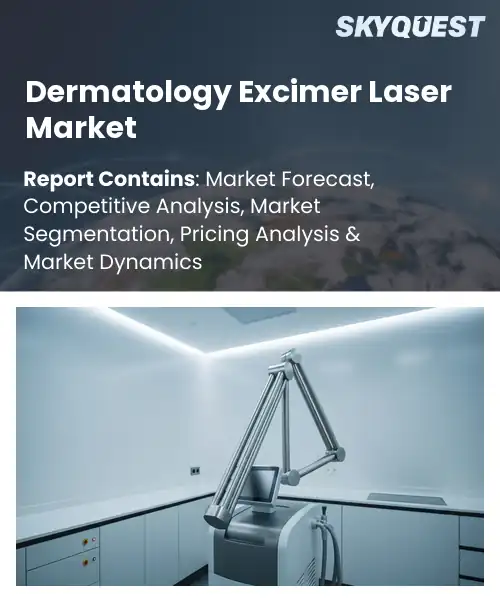
Dermatology Excimer Laser Market
Report ID: SQMIG35A3499
Report ID: SQMIG35A3499
[email protected]
USA +1 351-333-4748
Report ID:
SQMIG35A3499 |
Region:
Global |
Published Date: May, 2026
Pages:
157
|Tables:
143
|Figures:
78


Global Dermatology Excimer Laser Market size was valued at USD 182.5 Million in 2024 and is poised to grow from USD 198.23 Million in 2025 to USD 382.4 Million by 2033, growing at a CAGR of 8.62% during the forecast period (2026-2033).
At its core the dermatology excimer laser market centers on devices that emit 308 nm ultraviolet light to treat localized skin conditions, and the primary driver has been the growing clinical need for targeted, efficient therapies for chronic diseases such as psoriasis and vitiligo. This market matters because excimer technology reduces systemic side effects and shortens treatment time compared with conventional phototherapy, prompting adoption across hospital dermatology departments and clinics. Over recent decades development has progressed from bulky cabinet systems to portable handheld units and integrated imaging platforms, for example the migration from early excimer booths to modern clinic lasers.
A key factor driving globaldermatology excimer laser market growth is technological innovation which creates a cascade of commercial and clinical opportunities. As manufacturers shrink form factors and add precision targeting features the result is greater accessibility for outpatient clinics and lower per-treatment costs, so private practices and dermatology chains adopt excimer platforms more readily. Similarly stronger clinical data demonstrating rapid clearance in psoriasis and meaningful repigmentation in vitiligo leads payers to consider reimbursement, which in turn expands uptake in hospitals. In emerging markets affordability and mobile units enable outreach programs, producing new demand and sustained revenue growth.
How is AI improving treatment outcomes in the dermatology excimer laser market?
Improvement in the dermatology excimer laser market is due to improved treatment outcomes through enhanced AI diagnosis, personalizing treatment plans and monitoring patient results with increased accuracy. Examples of this include: Using AI powered imaging of the skin, AI advanced predictive models that predict the likelihood an individual will respond positively to excimer therapy, and AI provided decision support that provides the clinician with the optimal exposure setting based on patient criteria. Currently, clinicians can use their existing excimer systems paired with AI powered imaging platforms to customize sessions, minimize side effects and track results objectively, resulting in increased clinician confidence, improved patient satisfaction and substantial synergies to the development of new clinical treatments for excimer patients, beyond those that have previously used excimer systems.
In September of 2025 by STRATA Skin Sciences, it was shown that the use of their excimer device in the phase II repigmentation clinical trial resulted in significantly improved results when combined with other therapies. The combination of innovative AI powered imaging, treatment planning and accelerated personalization of dosing, decision making and efficiency of the clinics cannot be overemphasized and each of these have contributed to increased growth potential for the excimer market.
Market snapshot - (2026-2033)
Global Market Size
USD 182.5 Million
Largest Segment
308 nm Excimer Laser
Fastest Growth
Excimer Light
Growth Rate
8.62% CAGR
To get more insights on this market click here to Request a Free Sample Report
Global dermatology excimer laser market is segmented by laser type, application, end-user, distribution and region. Based on laser type, the market is segmented into 308 nm Excimer Laser and Excimer Light. Based on application, the market is segmented into Psoriasis, Vitiligo, Atopic Dermatitis and Alopecia Areata. Based on end-user, the market is segmented into Dermatology Clinics, Hospitals and Medical Spas. Based on distribution, the market is segmented into Direct Sales and Distributors. Based on region, the market is segmented into North America, Europe, Asia Pacific, Latin America and Middle East & Africa.
As per dermatology excimer laser market outlook, 308 Nm excimer laser segment dominates because its monochromatic ultraviolet output matches the therapeutic window for focal epidermal immunomodulation, delivering predictable depth and dose control that clinicians rely on for targeted dermatologic indications. Strong clinical evidence and established treatment protocols drive physician preference, while device design enables integration into routine dermatology workflows, promoting repeatable outcomes and safety. These factors collectively create sustained demand among providers focusing on precision phototherapy.
As per dermatology excimer laser market analysis, excimer light segment is emerging as the most rapidly expanding area due to compact lamp designs and simplified operation that lower barriers to adoption among more providers. Advances in device portability and cost efficiency accelerate deployment, expanding therapeutic access and enabling novel outpatient applications that create new revenue and treatment opportunities.
The vitiligo segment dominates with large dermatology excimer laser market share because targeted phototherapy has shown to be uniquely effective for repigmenting localized lesions. This effectiveness has created a high preference among clinicians and a high demand from patients for the excimer laser treatment option; hence the repigmented lesion is clearly visible, establishing clinician confidence in their treatment protocols and the outcomes observed, thus providing the basis for continued investment in excimer lasers as the treatment continues to show promise. The chronicity of vitiligo leads to concurrent cycles of treatment at an established clinic, leading to continued utilization at the clinic level and establishing vitiligo therapy as a key revenue generating option for excimer lasers.
As per dermatology excimer laser market forecast, the atopic dermatitis segment is currently realizing the largest amount of growth as additional clinical evidence continues to support the use of the excimer laser for the treatment of localized inflammatory flares and the use of the excimer laser as a steroid-sparing alternative. As more providers begin to utilize the excimer laser due to the need for a non-systemic approach, and with refinements made to improve the performance of the excimer laser on sensitive skin, more opportunities for the use of excimer lasers exist for treatment of atopic dermatitis in clinical practices.
To get detailed segments analysis, Request a Free Sample Report
As per dermatology excimer laser market regional outlook, North America is the dominant player in the market due to several variables that include clinical infrastructure, investment in dermatological innovation, and strong utilization by specialist clinics and academic medical centres. There is a well-established network of experienced dermatologists in place with reimbursement structures that support adoption and integration into treatment regimens. The presence of a competitive private sector stimulates innovation in the design of devices, methods of service delivery, and post-market support.
As per dermatology excimer laser industry analysis, there is significant clinical usage of dermatology excimer lasers within the United States across a diverse array of settings (i.e., ambulatory care, dermatology specialty practices, and academic institutions). The dominant feature sought by providers is the ability of the device to deliver predictable outcomes in a very accurate manner. A highly competitive vendor market creates many opportunities for differentiation between products, establishing integrated services agreements, and training programs that will assist in device use.
In Canada, the dermatology excimer laser market is growing rapidly through concentrated use within urban areas and dermatology specialty clinics supported by a regionalised referral system. Purchases are based on the clinician's ability to maintain the device over time and receive training to use the device appropriately. The purchasing process and structure established by payers and hospitals will have an impact on the method by which vendors provide support and education to their customers. Patient demand for accurate, effective treatment of chronic skin disorders is fuelling the investment of clinics in excimer laser technology. Local leadership and training programs are playing an essential role in the dissemination of clinical protocols among providers.
As per dermatology excimer laser market regional forecast, there is significant growth occurring within the market in all areas across Europe as clinical acceptance continues to rise due to diverse types of healthcare settings where lasers are being utilized, the establishment of coordinated purchase processes between private enterprises, and a greater emphasis on providing evidence based dermatological care. Regional centers for excellence and professional organizations have established standardized treatment protocols for clinicians to follow creating confidence in clinicians and referral patterns. The presence of favorable clinical trial and post-market study environments creates an opportunity for technology adoption and innovation to take place at the local level. Manufacturers of this equipment have tailored their reimbursement, and service models, to individual national healthcare systems allowing access to equipment for a greater number of consumers than just those who can afford the care provided at tertiary hospitals.
Germany benefits from having an established healthcare system with strong connections to specialty dermatological practices. The clinical acceptance of Excimer lasers is helped by having clearly defined treatment guidelines available, and professional organizations focused on using technology and conducting clinical research to evaluate expenses associated with providing this care. Technical performance of equipment and long-term service agreements used in the procurement process are key components of the decisions made on purchasing, along with establishing patient referral networks and using collaborative care modules that assist with sustaining the ongoing use of Excimer lasers. Lastly, through utilizing vendor partnerships and associated training programs clinicians will become more competent with using these lasers and provide additional opportunities for development within each of their own locations.
United Kingdom is marked by rapid uptake across private clinics and specialty services, driven by clinician advocacy and patient demand for targeted dermatological therapies. Flexible procurement and vendor led education accelerate adoption in community settings. Active clinical networks and multicenter studies enhance clinician confidence and broaden indications. Expansion is supported by collaborations between manufacturers and academic centers to refine device performance and treatment pathways.
France is emerging through targeted adoption at regional dermatology centers and private clinics where pilot programs demonstrate clinical value. Procurement is cautious, prioritizing long term service arrangements and clinician training. Professional societies and opinion leaders influence clinical guidelines and referrals. Rising patient awareness and interest in targeted therapies prompt vendors to provide tailored education and localized support, enabling broader but measured integration into dermatology practice.
Asia Pacific region has been developed by funding localized manufacturing ventures, targeted clinical education initiatives, and forming strategic partnerships encompassing solutions tailored to meet the unique dermatologic needs within each of the Pacific Asia countries. The investments made in clinical education and the establishment of centers of excellence will enhance both competency and confidence levels. Device manufacturers will customize their devices and associated services to reflect the different healthcare delivery models that exist across the various regions of this continent, thus making their products available to both tertiary hospitals and private practice dermatologists.
Through the integration of advanced medical technologies and strong partnerships between laser devices' manufacturers and clinical research institutes, the dermatology excimer laser market in Japan is characterized by the delivery of precision, safety, and reliable services from hospitals and specialty dermatology clinics adopting laser systems. As a result of the clarity from Health Canada regarding regulation of medical laser devices and the structured method of evaluating said devices provides much greater confidence for clinicians than they would have otherwise. Vendors providing laser equipment will continue to provide large amounts of training and service locally to maintain clinicians' high surgical quality expectations.
The dermatology excimer laser market within South Korea is very strong as a result of a sizeable manufacturing base in South Korea and the rapid acceptance of the use of these lasers within dermatology clinics. Device manufacturers have focused on creating compact and cost-effective systems with dependable post-sales service to support the clinicians using their products. Increasing aesthetic and therapeutic interest by patients to enhance skin quality has resulted in increased investment by clinics providing these services for patients; additionally, manufacturers looking to sell their products outside of their home markets have altered their offerings to accommodate demand for laser systems from all over the world.
To know more about the market opportunities by region and country, click here to
Buy The Complete Report
Increasing Demand For Targeted Therapies
Technological Advancements In Devices
High Equipment Acquisition Costs
Limited Reimbursement Coverage Globally
Request Free Customization of this report to help us to meet your business objectives.
Competitive intensity in the global dermatology excimer laser market is driven by targeted M&A, strategic partnerships and product innovation that shift care pathways. Notable moves include STRATA Skin Sciences acquiring Ra Medical Systems’ dermatology assets, Aerolase partnering with Clarteis to commercialize handheld 308 nanometer devices, and later-stage financing for connected home phototherapy entrants that pressure clinic‑based excimer adoption.
SkyQuest’s ABIRAW (Advanced Business Intelligence, Research & Analysis Wing) is our Business Information Services team that Collects, Collates, Correlates, and Analyses the Data collected by means of Primary Exploratory Research backed by robust Secondary Desk research.
As per SkyQuest analysis, the global dermatology excimer laser market trend is propelled by rising demand for targeted therapies for chronic skin conditions, with technological advancements in compact, precise systems further accelerating adoption. High equipment acquisition costs remain a key restraint, slowing penetration among smaller clinics despite clinical benefits. North America continues to dominate due to advanced clinical infrastructure and supportive reimbursement and research networks, while the 308 nm excimer laser segment leads the market given its proven efficacy and established protocols. Continued integration with AI imaging and portable device development should broaden access, improve personalization and sustain growth as clinics seek efficient, clinic-friendly phototherapy options.
| Report Metric | Details |
|---|---|
| Market size value in 2024 | USD 182.5 Million |
| Market size value in 2033 | USD 382.4 Million |
| Growth Rate | 8.62% |
| Base year | 2024 |
| Forecast period | (2026-2033) |
| Forecast Unit (Value) | USD Million |
| Segments covered |
|
| Regions covered | North America (US, Canada), Europe (Germany, France, United Kingdom, Italy, Spain, Rest of Europe), Asia Pacific (China, India, Japan, Rest of Asia-Pacific), Latin America (Brazil, Rest of Latin America), Middle East & Africa (South Africa, GCC Countries, Rest of MEA) |
| Companies covered |
|
| Customization scope | Free report customization with purchase. Customization includes:-
|
To get a free trial access to our platform which is a one stop solution for all your data requirements for quicker decision making. This platform allows you to compare markets, competitors who are prominent in the market, and mega trends that are influencing the dynamics in the market. Also, get access to detailed SkyQuest exclusive matrix.
Table Of Content
Executive Summary
Market overview
Parent Market Analysis
Market overview
Market size
KEY MARKET INSIGHTS
COVID IMPACT
MARKET DYNAMICS & OUTLOOK
Market Size by Region
KEY COMPANY PROFILES
Methodology
For the Dermatology Excimer Laser Market, our research methodology involved a mixture of primary and secondary data sources. Key steps involved in the research process are listed below:
1. Information Procurement: This stage involved the procurement of Market data or related information via primary and secondary sources. The various secondary sources used included various company websites, annual reports, trade databases, and paid databases such as Hoover's, Bloomberg Business, Factiva, and Avention. Our team did 45 primary interactions Globally which included several stakeholders such as manufacturers, customers, key opinion leaders, etc. Overall, information procurement was one of the most extensive stages in our research process.
2. Information Analysis: This step involved triangulation of data through bottom-up and top-down approaches to estimate and validate the total size and future estimate of the Dermatology Excimer Laser Market.
3. Report Formulation: The final step entailed the placement of data points in appropriate Market spaces in an attempt to deduce viable conclusions.
4. Validation & Publishing: Validation is the most important step in the process. Validation & re-validation via an intricately designed process helped us finalize data points to be used for final calculations. The final Market estimates and forecasts were then aligned and sent to our panel of industry experts for validation of data. Once the validation was done the report was sent to our Quality Assurance team to ensure adherence to style guides, consistency & design.
Analyst Support
Customization Options
With the given market data, our dedicated team of analysts can offer you the following customization options are available for the Dermatology Excimer Laser Market:
Product Analysis: Product matrix, which offers a detailed comparison of the product portfolio of companies.
Regional Analysis: Further analysis of the Dermatology Excimer Laser Market for additional countries.
Competitive Analysis: Detailed analysis and profiling of additional Market players & comparative analysis of competitive products.
Go to Market Strategy: Find the high-growth channels to invest your marketing efforts and increase your customer base.
Innovation Mapping: Identify racial solutions and innovation, connected to deep ecosystems of innovators, start-ups, academics, and strategic partners.
Category Intelligence: Customized intelligence that is relevant to their supply Markets will enable them to make smarter sourcing decisions and improve their category management.
Public Company Transcript Analysis: To improve the investment performance by generating new alpha and making better-informed decisions.
Social Media Listening: To analyze the conversations and trends happening not just around your brand, but around your industry as a whole, and use those insights to make better Marketing decisions.
REQUEST FOR SAMPLE
 REQUEST FREE CUSTOMIZATION
Global Dermatology Excimer Laser Market size was valued at USD 182.5 Million in 2024 and is poised to grow from USD 198.23 Million in 2025 to USD 382.4 Million by 2033, growing at a CAGR of 8.62% during the forecast period (2026-2033).
Competitive intensity in the global dermatology excimer laser market is driven by targeted M&A, strategic partnerships and product innovation that shift care pathways. Notable moves include STRATA Skin Sciences acquiring Ra Medical Systems’ dermatology assets, Aerolase partnering with Clarteis to commercialize handheld 308 nanometer devices, and later-stage financing for connected home phototherapy entrants that pressure clinic‑based excimer adoption. 'Photomedex (Ra Medical Systems)', 'XTRAC (Ra Medical Systems)', 'Solta Medical', 'Sciton Inc.', 'Cynosure (Hologic)', 'Alma Lasers', 'Strata Skin Sciences', 'Fotona d.o.o.', 'Quantel Medical', 'Lutronic Corporation', 'Syneron-Candela', 'Lumenis Ltd.', 'Deka (El.En. Group)', 'Aerolase Corp.', 'Quanta System SpA', 'InMode Ltd.', 'Cutera Inc.', 'EL.EN. SpA', 'Natus Medical', 'Avita Medical'
Increasing demand for targeted therapies has encouraged healthcare providers to invest in excimer laser systems because these devices offer focused treatment options for localized dermatological conditions. Clinicians favor precise energy delivery that minimizes damage to surrounding tissue and improves cosmetic outcomes, which enhances patient satisfaction and referrals. As a result, clinics expand service offerings, prioritize procurement, and support training programs, leading manufacturers to innovate and market new systems. This cycle of clinical preference, perceived effectiveness, and provider investment drives broader adoption across dermatology practices.
Integration With Digital Diagnostics: Seamless connectivity between excimer laser systems and advanced diagnostic platforms is driving more precise treatment planning and monitoring. Clinicians are adopting image-guided workflows and AI-assisted lesion mapping to tailor energy delivery and session timing, improving clinical consistency and patient experience. This convergence supports streamlined documentation, remote case review, and multidisciplinary collaboration, encouraging broader adoption across dermatology clinics and specialty centers that prioritize outcomes, predictable protocols, and efficient patient pathways. Manufacturers emphasize interoperable interfaces, streamlined software, and clinician-focused implementation support services.
Why does North America Dominate the Global Dermatology Excimer Laser Market? |@12


Want to customize this report? This report can be personalized according to your needs. Our analysts and industry experts will work directly with you to understand your requirements and provide you with customized data in a short amount of time. We offer $1000 worth of FREE customization at the time of purchase.
Feedback From Our Clients


 USA (+1) 351-333-4748

